
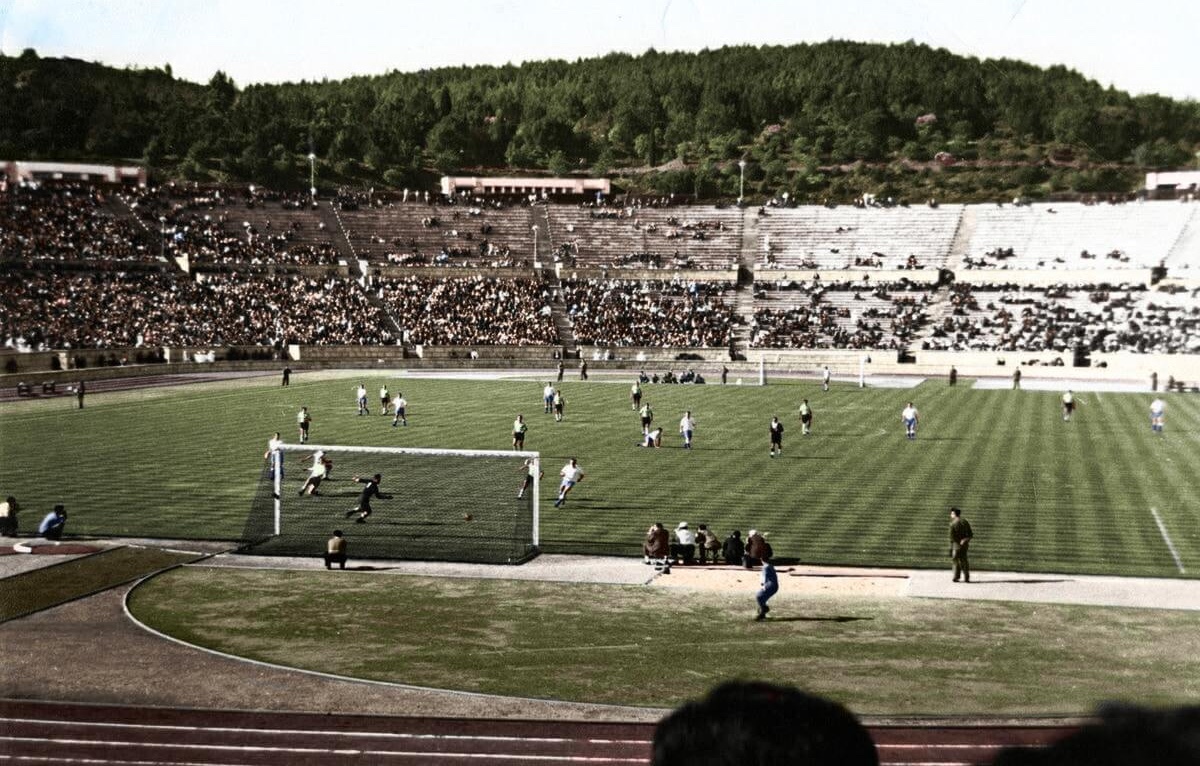
On September 4th, 1955, at the Estadio Nacional in Lisbon, the competition that would go on to become the greatest club football tournament in the world began its journey. Until that day, the clubs of the European continent played against each other either in friendly matches or in regional tournaments which, although historic — such as the Mitropa Cup — were not held under the auspices of UEFA, nor did they allow participation from teams of all European countries.
Just as had happened on the national team level, South America once again showed the way at the club level too. As early as 1948, that is, after the Second World War but before the organization of the fourth World Cup in Brazil, the Campeonato Sudamericano de Campeones had been launched — a tournament that met an unceremonious end before European inspiration gave breath to the creation of a competition that would become known as the Copa Libertadores. Still, this first attempt to establish an international club competition in South America served as the basis for French journalist Jacques Ferran’s proposal to create a similar competition in Europe.
Thus, at the UEFA Congress of 1955, it was decided to begin the new competition. However, it would start without the participation of Soviet and English clubs — two of the powerhouses of the era. A total of 16 teams from 16 different countries took part in this inaugural edition of what was then called the European Cup. Of these, only 7 had actually won their national league titles in 1955. It was also the only time that a representative from the country of Saarland — later absorbed into West Germany — would participate in an international club tournament.
In a knockout format with home-and-away legs, the 16 teams were drawn into pairs. The first match was scheduled for September 4th, 1955. In the midst of the Estado Novo dictatorship of Salazar, Lisbon’s national stadium would host the historic match. Under different conditions than those in neighboring Spain — where the dictator Franco had executed the democratic leadership of the capital’s main club and installed his own people to turn it into a regime flag-bearer — Salazar in Portugal did not associate himself with any particular club. This allowed him to more “freely” bask in the glory of all Portuguese clubs’ successes, most notably Benfica’s in the early 1960s. Sporting — the club of Lisbon’s middle and upper-middle classes — had supporters connected to the regime, but no official affiliation with it. Sporting played at Estadio Nacional until that season, before opening its own ground named after its founder, José Alvalade, in June 1956. The club participated in the first European Cup as the third-place team in the Portuguese league.
Visiting Lisbon for that historic match was Partizan, the Belgrade-based club born from the ruins of World War II and administered by the newly formed Yugoslav Army. Just shy of its 10th anniversary, Partizan had finished fifth in the previous Yugoslav league season but was chosen to represent the country in the great European competition.
That opening match certainly had its share of thrills and plenty of goals. Martins, Sporting’s center forward, scored in the 14th minute the first goal in the history of the competition. Milutinović, playing inside right for the visitors, equalized before halftime. In the 50th minute, the home side’s left full-back, José Galaz, was sent off with a red card, and Milutinović scored again for Partizan. Sporting equalized with Quim in the 65th, Partizan regained the lead with Bobek in the 73rd, and Martins rounded off the scoring in the 78th minute to make it 3–3.
The two teams met again on October 12th in Belgrade. There, Partizan won 5–2 and advanced to the next round, where they would face the eventual champions Real Madrid. They lost 4–0 in the Bernabéu, and their 3–0 win in Belgrade wasn’t enough to avoid elimination.
From the following season, 1956–57, only national champions were allowed to enter the competition — with the exception of the title holders. As a result, it would be years before Sporting and Partizan returned. Sporting won the league in 1958, while Partizan claimed the Yugoslav title in 1960.
The two clubs met again in the European Cup of 1961 — with Sporting participating as runners-up, since the league-winning Benfica were the defending European champions. Partizan once again advanced, drawing 1–1 away and winning 2–0 at home. The two sides would clash once more in the 2002 UEFA Cup. Partizan won 3–1 in Portugal, and the second leg in Belgrade ended 3–3 — meaning the black-and-white side from Belgrade held a perfect record in qualifications against their first-ever European opponent.
The European Cup was later renamed the European Champions Clubs’ Cup, the trophy evolved over the years, and the competition ultimately developed into the UEFA Champions League — the tournament that today represents the pinnacle of glory for any footballer at club level.
