
Right now, somewhere in the world, a goal is being scored! Millions of other people are engaged with football—either playing, watching a match, or doing something related, just as I am now writing these lines and you are, at another moment, reading them. Over the course of a day, that number multiplies tenfold, while on certain special days—those magical days of the World Cup final—the whole planet revolves around a ball! Billions of people, from one end of the world to the other, devote a part of their time to an activity that seems to have always existed. Yet football is a human invention and, as such, could not have always existed. On the other hand, it is difficult to pinpoint a single date of birth, because unlike other sports and activities, it was not born out of nowhere. To trace this development, in order to understand how football emerged in our societies, one must begin from the very origins of our species and reach all the way to the birth of the game we know today.
Human Prehistory
In the natural sciences, the beginning of the universe is defined by the Big Bang, the great explosion, beyond which it is nearly impossible to observe temporally. Various philosophical approaches, as well as the theoretical level of the physical sciences, attempt to answer the question: “what existed before the beginning.” Religions, on the other hand, offer some easier and more simplistic answers, since the very first thing they sought to resolve was precisely this “beginning.”
If one attempts, then, an investigation into the history of various phenomena, in many cases one might try to start from a specific date, a specific moment. This idea relates to a broader philosophical perception of the origin of things. Infinity is a rather difficult and non-intuitively graspable concept.
All of the above apply from the creation of the world to the creation of any phenomenon, natural or social. Thus, in examining football as both an athletic and social phenomenon, it is necessary to search into the depths of its historical roots—not out of general curiosity, but because understanding this evolution, in parallel with the evolution of the human species and human societies, is the solution to the riddle, the key to understanding why football has the form it does today, as well as offering reflection on how it may look in the future.
Since, therefore, there is no specific date for this beginning of football, the narrative must start from its prehistory, which has no clear boundaries. The search for historical data and their causes ends up being intertwined with the very prehistory of humankind.
In seeking the causes for the existence of sport, it is generally accepted—and perhaps self-evident—that the training of young individuals in a society helps them meet the demands of survival in a harsh world. However, while such training often occurs in a natural way—a pattern observed across almost all species in the animal kingdom—what is more difficult to understand is the emergence of organized group play.
In the earliest human groups, which could be described as anything from packs to societies, young members learned through group play to synchronize and execute more complex plans in activities related to survival. That is to say, if the ability to run fast is an individual matter—for escaping a natural enemy or catching prey—group hunting, which is much more effective because it follows a plan devised by a team, requires experience in coordinated movement. This experience is acquired by members of the community through group play, in whatever form it may take, shaped by a set of parameters related to the era in the history of the species, the climatic conditions, and many other factors.
With the entry of human societies into History—that is, the appearance of civilization—physical exercise, whether individual or in the form of group play, acquires a more organized character and begins to be integrated into traditional and—usually—religious frameworks. Religion, after all, helped establish rules that were useful without requiring each member to understand them deeply, while simultaneously ensuring adherence to them and their continuation.
Human societies, once composed of hunting groups, become communities that produce food—through agriculture—and also become users of tools that increase hunting efficiency, ensuring more food. Beyond sustenance, the tools used to work the land lead to the cultivation of larger plots than needed for each community’s subsistence. This surplus, the excess and non-consumable portion, gives birth to property. Property, in turn, gives birth to war—the mutual killing of members of our species—not for survival, as it is not a matter of cannibalism, but for the empowerment of one person or community over another. War becomes a reason for the systematic organization of physical training, because the systematic exercise of a community’s members provides a necessary advantage—along with technology and strategy—for battle. Strategy, in turn, can only be effective when physical training is accompanied by drills of coordinated action among the members who wage war.
By examining world history, one finds that various small and great—or even self-proclaimed great—rulers, tyrants, dictators, or popular leaders placed great emphasis on athletics, on the widespread physical exercise of the population in the country or region they ruled. Their aim was the readiness of the population to wage war. Although this is not the only reason sport exists today, it is alarming that this motivation has not disappeared.
In this way, the sacred duties of members in various cultures include competitions that are often religious displays. However, under sacred protection and auspices, athletic games also emerge—competitions to determine the community with the strongest athlete, who is potentially also the strongest warrior. By examining the history of sports in ancient Greece, with the Olympic Games at the center, one observes that these are primarily individual contests and revolve around purely individual martial virtues: running, wrestling, the stone throw or javelin, even horse riding.
Nonetheless, team sports or games—since they involve coordination and synchronization among teams of strong athletes or warriors—even if they hold a far lesser status within various rites, are part of their training. Among these group games are ball games, which we encounter in many cultures over the centuries, until their final codification in a much more recent era.
Ball Games in Ancient and Medieval Civilizations
Games or displays of skill—when they did not necessarily have a competitive character or established rules—can be found appearing in every corner of the planet. It is difficult to determine which was the first, as in every case there is no historical connection or continuity between them. Football was born on the European continent, but the games that pre-existed in the lands of each culture played their own role in merging local traditions with the newly introduced sport. Thus, in this exploration, it seems necessary to first present the games that existed far from the Old Continent, so that we may then present whatever historical continuity existed within Europe that eventually led to the English sport.
Far East
In contrast to what was stated in the previous paragraph, there is an “anecdote” in the modern history of football. It concerns the decision of the former—and now infamous—president of FIFA, Sepp Blatter, to designate China as the cradle of football! This, of course, was part of an effort to reach out to the vast markets of Asia. Blatter was referring to cuju, a game that flourished in China during the Han dynasty, which spans historically from around 200 BCE to 200 CE. Cuju was a game that bore several similarities to football-type games, given that it involved a ball, goals (not necessarily as constructed posts, but as designated spots on the field), and most importantly of all, from very early on—from those very first centuries of the Han dynasty—it had codified rules. This is a major milestone if one considers how significant that step was for the later diffusion of sports in the Western world.

Of course, cuju had no relation to any sport in the modern sense, and it certainly did not constitute a social phenomenon. It was more of an exercise and display for the Chinese aristocracy, as it was played only within imperial gardens, far from the public eye, and it took nearly a thousand years—until the reign of the Song dynasty—for it to reach all social classes. Cuju is also a game through which the inflatable ball was invented and developed—mainly during the Tang dynasty (which lasted from the 14th to the 17th century). This was a tremendously significant invention for the evolution of many sports, which, thanks to the Silk Road, eventually made its way to the Western world.
Other forms of ball games in the Far East include the Japanese Kemari, inspired by cuju, which, although it involves a ball, is not a competitive athletic activity. Rather, it resembles displays of foot-based ball skill—a practice that seems to align more closely with traditional Japanese temperament.
North and Mesoamerican Civilizations
North and Central America are regions of the world where ball games were closely tied to the development of local civilizations. This tradition pertains to the Mesoamerican cultures, referring to the area that today includes the countries of Mexico, Belize, Guatemala, El Salvador, as well as parts of Honduras, Nicaragua, and Costa Rica.
In this region, ball games are mentioned as far back as 3,000 years ago, beginning with the Olmec civilization, which introduced an element that also contributed to the development of modern games. In that area—and further south—rubber is produced, a material whose name comes from the South American Quechua culture. The production of rubber led to the invention of rubber balls, which are capable of bouncing and, for many years, served as the inner core of balls used in various sports. Even today, rubber is either still used in some sports or has essentially served as an ancestor in the development of materials that offer similar mechanical properties.

Balls used in various Mesoamerican games ranged in diameter from about 6 to 22 centimeters (a football, according to the rules of the game, has a diameter of 22 to 23 centimeters).
In Central America, these games were primarily carried out within the context of religious rituals, as they were linked to local cults. Perhaps the most extreme feature associated with them is that in the Mayan game known as pok-ta-pok, the losers were beheaded at the end of the match! The difference between this game and modern or medieval European football lies mainly in the fact that there were no goals, as the game resembled volleyball more than football—except that it was not played with the hands, but with the sides of the body and the parts of the legs from the waist down to the knees.
Mesoamerican ball games continue to exist to this day, either as religious practices or simply as elements of traditional festivals—though, of course, without the continuation of the beheading “custom.” Archaeological excavations have uncovered around 1,300 courts for such games in the region, which proves just how widespread they were.
Ancient Greece – Ancient Rome
The first written description of a ball game—at least in what is referred to as Western civilization—does not pertain to any specific sport, but rather to a description of great literary significance. In Book VI of the Odyssey, Odysseus is said to arrive shipwrecked and naked on a shore, where he sees some young girls, among them Nausicaa, playing with a ball. The fact that the first literary work in the history of our civilization contains the first known mention of a ball game reinforces the idea that its use as an object for play stretches deep into the origins of human societies. Among the various historical “firsts,” this is particularly significant, as it marks the first appearance of the ball in literature—and it is found in the Odyssey.
The “game of Nausicaa” bears no relation to an organized sport, yet it is not the only reference in ancient Greek antiquity to ball games, and specifically to team games, featuring two opposing sides and a ball. Unfortunately, due to the fact that the Olympic Games prioritized individual competitions of physical strength—as previously mentioned—far less is known about these types of games.
One of the very few sources providing us with some information is the Onomastikon of Julius Pollux, something like a dictionary or encyclopedia, composed of ten volumes and published in 177 CE. In the Onomastikon, four ball games are mentioned: episkyros, phaininda, aporrhaxis, and ourania. The most well-known of these games is episkyros. In this game, two teams are arranged facing each other at a certain distance. In the middle of that distance, a line is drawn with a stone, called the skyros, and the ball is placed upon it. Behind each team, two more lines are drawn. The teams in possession of the ball try to throw it behind the line of the opposing team. In this description, the written account portrays a game whose objective is to move the object—the ball—behind a goal. The fact that this goal is not a physical post but a line spanning the entire width of the described playing field resembles more the try in modern rugby or the touchdown in American football. Still, it marks a notable milestone in the history of football-type games.
Another game mentioned in the same work, phaininda, placed more emphasis on maintaining possession of the ball through skillful handling, with certain elements that may at times resemble modern handball. However, along with aporrhaxis and ourania—the latter resembling the game of Nausicaa described by Homer—these do not share the characteristic of opposing teams. Emphasizing this distinction, Julius Pollux refers to only one of the games, episkyros, as sphairomachia (ball-fighting) among all those mentioned.
The significance of phaininda, however, lies in a different particularity: due to its second or alternative name, harpaston—referring to the snatching or seizing of the ball—it appears as the inspiration for the Roman game Harpastum, for which more detailed descriptions exist. Harpastum, through its evolution and the fact that the ball was passed between players and changed hands through feints and fakes, bears notable resemblance to one of the so-called modern “football” games—rugby.
Medieval Europe
Although the existence of organized team games in the Roman Empire is well known, there is a striking absence of references during the Early and High—or Classical—Middle Ages. It seems that this historical context did not favor the recording of social and athletic activities, focusing instead almost exclusively on military and religious matters, as had also been the case earlier. As a result, the existence of such a game—though it likely persisted in various forms throughout the centuries—was not considered worthy of documentation.
Calcio
The first references to a team ball game on the Italian peninsula reappear only during the Late Middle Ages, in the 15th century. This was a period that followed the great plagues of the 13th century and marked the beginning of a long era of social progress, which led to technological advancements, the discovery of half the world by Europeans, and laid the foundations for the transition to the Renaissance. Today, the prevailing view is that the football-like game of the Italian Middle Ages—calcio storico or calcio fiorentino—is a direct evolution of the Roman harpastum.
Calcio, a form of highly violent combat with the objective of scoring goals between two opposing teams, served as a unifying element in Italian culture in the face of various northern conquerors—such as the Holy Roman Empire, a state that had taken control of the peninsula but was characterized by its Germanic or more broadly Teutonic identity. At the same time, it was also a sport seemingly supported by the Catholic Church, as within its structure it found a means to influence the local population, cultivating a distinct identity at a time when that population was seeking to reclaim dominance over Italian lands.

Developed within the urban settings of medieval Italian cities—particularly in Northern Italy, where the piazza served as the central gathering point of the population and also as the seat of political and religious authority—calcio was played on a field with defined boundaries, which usually corresponded to the specific urban features of each city.
Beyond these general characteristics, however, calcio was a game practiced by soldiers, as it helped them develop physical strength and combat skills during times of peace or military respite. As a pastime, it was primarily an activity of the aristocracy, since the lower classes of serfs would scarcely have had the time or opportunity to engage in something related to leisure and recreation.
Linguistically, the existence of this sport holds significance for modern football as well, since the drive to “Italianize” imported cultural elements in early 20th-century Italy led to the adoption of this term to replace the foreign football—the name by which the sport was originally known.
La Soule
Further north, in the French territories, another similar game was played during the same period, with equally divisive characteristics in terms of its social implications, particularly in opposition to the Holy Roman Empire. The game La Soule is believed to have originated in the northern regions of Normandy and Brittany and was typically a contest between two teams representing different parishes—a pattern we later find echoed in British mob football.
Its massive scale is striking, with reports of matches involving between 20 and 200 players, and one particular account even citing as many as 500 participants. Its violence was also a defining trait, as it was essentially a game without any rules, and its duration was indefinite—literally lasting until the participants collapsed from exhaustion.

In contrast to the Italian calcio, the French game had no defined playing field, as it was played across fields, plains, and forests, with the distances between the goals being vast, and the playing terrain including many natural features such as rivers and streams. The focal point of the activity—the ball—was an inflated pig’s bladder, and notably, this object carried symbolic meaning, as it was believed to represent the sun, something reflected in the very name of the game.
La Soule was played up until the early 20th century in these vast rural regions of the French countryside and essentially disappeared only when modern football games became dominant and widely popular—both in terms of participation and spectator appeal—as well as other modern sports that attracted public interest in France, whether as pastimes of the urban middle class or as products of technological development, such as cycling.
Football in Great Britain
The French version of football’s ancestor, however, bears a stronger resemblance to its British counterpart, from which there is a direct continuity in the development of the game that would eventually give birth to the modern sport.
Medieval football – the game of the peasants
The transmission of team games and their introduction into Britain is not known in precise detail—a fact that applies to many social practices of the Middle Ages. Since such activities were considered of lesser importance compared to political, military, or even religious history, there are significantly fewer written references about them. Thus, while there are some scattered mentions of the use of a ball for recreational purposes, there is little concrete information about how these games were structured. What is known, however, is that they were violent, as there are recorded instances of deaths occurring during their play.

The violence of the game was also one of the reasons it was banned on many occasions. It would be difficult to argue that the reason for its prohibition was the concern of kings and high-ranking nobles for the safety of their subjects and subordinates. In reality, these ruling classes were worried about the damage the game was causing to the fighting capacity of the population. The first law banning football was a decree by Edward II in 1314, prohibiting it in London, which also provided for the imprisonment of would-be football players.
Just as ball games are first mentioned in the language of Homer by Homer himself, something similar happens in the language of Shakespeare. The British playwright conveys something of the spirit of his time: in King Lear, written around 1605–1606, the word “footballer” is used as an insult.
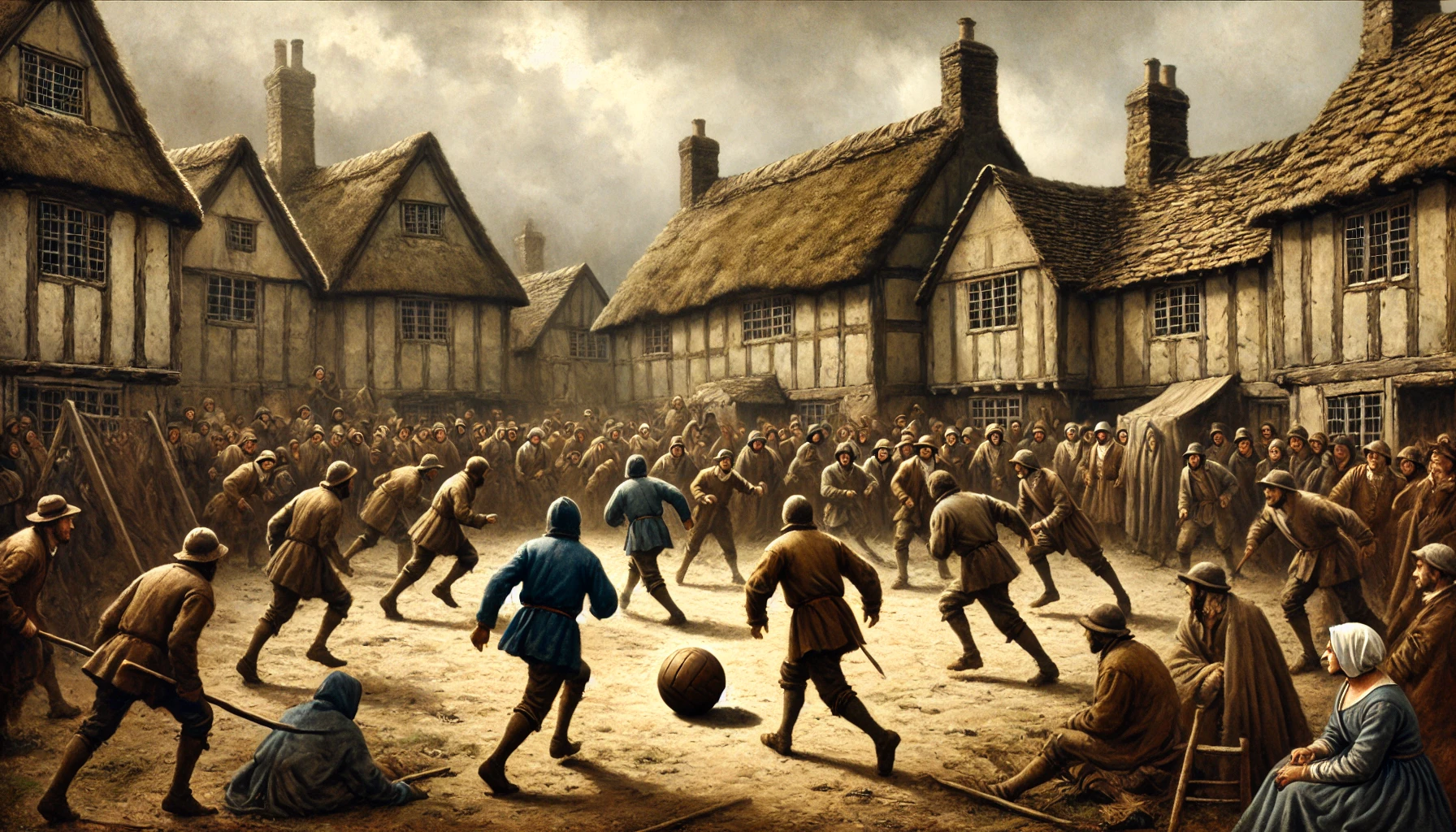
The medieval form of football—or mob football, as it came to be known—played in Britain during those centuries, shaped the sport’s evolution and essentially led to the birth of the modern game. The first recorded description of how it was played came much later than the various records of its prohibition. That reference dates to the late 15th century, when a game is said to have taken place in Cawston, Nottinghamshire. In it, participants kicked and controlled a large ball primarily with their feet rather than with their hands. In medieval England, the ball was typically an inflated pig’s bladder, which made its shape and size irregular.
From the 16th century onward, written references begin to appear that acknowledge the game—even if the bans continued periodically. Since these references were not left by the peasants, who were illiterate, it seems that there was a gradual acceptance of the game by the higher and more educated social classes, even by members of the clergy, which at the time constituted a major authority. A particularly noteworthy fact is that King Henry VIII himself is said to have owned a pair of shoes specifically for this activity.
This shift had both political and social dimensions. Each ruling power began to recognize that the physical exercise of the peasant population—particularly when it had a collective and social character, as these games involved mass participation—contributed to the fitness of the lower classes. At the same time, the game was often played during hours when it effectively replaced alcohol consumption, which in turn had negative consequences for productivity. This tension—between mass sport and football-related socialization on the one hand, and alcohol consumption on the other—is a recurring historical pattern across many different societies. Alcohol essentially acted as a sedative for the over-exploited agricultural workers, with all the obvious negative consequences of its unchecked use. Thus, it was seen as a positive development by the ruling classes to introduce an activity that had the same beneficial impact on the moral state of the working classes, without the negative effects on their productivity.
In this way, the game of football became a centuries-old social activity in Britain and came to occupy a central place in village life. Over time, historical references to the game became increasingly numerous, providing more and more information about how it was played and what its objective was. Essentially, the two goals—though not in the form of goalposts—were structures in opposing villages. These often consisted of specific buildings, such as churches (when the match was between parishes), or large mills around which each community’s production was concentrated, or even some boundary of the settlement itself.
Despite the games’ mass participation, not everyone took part in them. Usually, the more robust individuals would be on these unusual playing fields, which could extend across vast and even wild terrains. Those who did not participate as players joined as spectators. Through the game and the identity of the teams—which were associated with a parish, a village, a settlement, etc.—a corresponding supporter base emerged, made up of people connected by a shared characteristic: origin. The identity of the team and the shared identity of players and supporters is one of the elements born from that medieval game and perhaps one of the most important parameters that led to football’s modern status as a social phenomenon.
Adoption by the Colleges
In pre-industrial Britain, the games were played across vast expanses—between villages, between churches—without a defined playing field, neither in the sense we understand it today, nor even in the sense that already existed in older games mentioned since antiquity. The style of play, which resembled a kind of “peaceful war,” primarily attracted young men and teenage boys, as it was one of the few activities that allowed for such an adrenaline rush without carrying the same risk of death as war or other dangerous pursuits. For example, medieval football was certainly a much safer option than sword fighting or other forms of dueling.
Additionally, that early form of the sport already possessed a feature that later helped modern football to spread widely. It didn’t require much or complex equipment—essentially, all it needed was a ball, or an object that could serve as one. There was no need for horses, swords, javelins, sticks, or helmets… This simplicity of the sport helped endear it to young students of the public schools, also known as colleges, who would sneak away from school grounds in search of a patch of forest to play their favorite game.
However, this activity soon led to the emergence of another problem: the violence of a game without fixed rules, involving physical contact and, of course, no referee, frequently resulted in student injuries and general schoolyard chaos—something quite incompatible with the ethos of order expected among these privileged pupils.

The administrations of these schools soon realized that one way to prevent students from sneaking off to play far from school and injuring themselves during this brutal pastime was to set boundaries around the activity—both by designating a space for it within the school grounds and by incorporating it into the school curriculum. This shift in approach did not occur everywhere at once; some schools initiated it, and over the centuries this practice spread.
The college of Eton appears to have been a pioneer in this regard, with a reference dating back at least to the year 1519 mentioning the playing of football games within its walls. The term used for this sport in the 16th-century colleges is football, and while the word seems to correspond with the descriptions and the style of play involving only the feet—kicking and dribbling the ball—this form of play did not apply to all games in all colleges. It certainly did not apply to the peasants’ game, where the use of hands, along with other parts of the body, was permitted.
However, centuries passed before physical education and exercise in general came to be regarded as a necessary part of the curriculum for a complete and well-rounded education. It is telling that in many schools, engagement with football-like games was encouraged for the specific purpose of discouraging… masturbation, which at the time was considered a grave “moral transgression.”
The most important historical detail, however, is that there was not one single, unified game. Rules were invented and continuously evolved separately in each college. Every school had its own courtyard of a specific size, and from this emerged the tradition of its own game. In some schools, the use of the ball by hand and physical combat were encouraged—something that more closely resembled the medieval peasant game—while in others, physical contact and any touching of the ground by the body or clothing were considered improper. As a result, the kickers’ and dribbling game was favored, in which the ball was handled almost exclusively with the feet.
These games became part of each college’s identity, and in many cases, are preserved to this day more as a museum piece. Still, they remain a phenomenon intertwined with the structure of the school itself—alongside its crest, motto, and other symbols.
Codes of Honour and the Ethos of the Games within the Colleges
The development of football games within the colleges was not limited to physical education in the narrow sense. Although physical training had by then become a standard part of the curriculum—alongside other subjects which, of course, held much greater prestige as quintessentially intellectual pursuits—the development of team games also concerned the physical and moral formation of the students’ young personalities. At the core of these games was teamwork, the pursuit of a common goal, self-sacrifice for one’s teammate—qualities that, during a period of political realignment across Europe, offered an innovation of enormous importance for the British Empire. This is captured in the famous remark by the Duke of Wellington, who declared that “the Battle of Waterloo was won on the playing fields of Eton,” as he himself was a graduate of that prestigious college.
Proper engagement with the spirit of the game, respect for the opponent, and distinction through contribution to the team were all matters of honour for these young students—who, in many cases, were being shaped into individuals expected to later assume leadership roles they would often inherit. Among these codes of honour was also respect for the referee, who was a figure without whom no match could take place. The referee essentially guaranteed the enjoyment of the game, as the players needed to focus on their competitive duties and not on overseeing the match or disputing the enforcement of rules. Beyond its practical function, however, this approach to the referee also had a “Socratic” ideological dimension. Since these students benefitted from the rules by which the society of the time operated, they had to be taught in these schools how to uphold those very rules—rules which, in effect, were their privileges. The fact that the rules of the society within which football was played did not constitute power, but rather restraint on the part of the athletes, would later become a point of tension as more popular classes entered the sport. This is precisely why disagreement over the enforcement of the rules would become a defining feature of the game.
Within this framework, each college could present its own version of the game—with all its unique characteristics—as an integral part of its mission and its effectiveness in educating its pupils. The rules of its game became a point of pride and a reflection of each school’s status. They had to align with the social background of the students and the expectations of their families. For this reason, there was little perceived need to unify the game under a single set of rules. On the contrary—quite the opposite seemed to be true.
The Search for Common Rules
By the mid-19th century, there was a great fragmentation regarding the accepted rules of the game—or rather, the games—as the way football was played in each college drastically altered the nature of the sport. The variations in rules were not entirely random. A comprehensive examination of them can reveal characteristics that tie each version of the game to the class background of the students at each school—particularly regarding physical contact and the use of the feet or (and) the hands.
At that time, agreement on the rules for each match was reached between the two team captains and the referee. These rules, naturally, applied only to that specific encounter, and it was very likely that no future match would be played under the same set of rules. Thus, within the colleges, a practical need began to emerge: simplifying procedures and improving preparation for each game by standardizing at least part of the rules. However, for such a standardization to occur, there first had to be consensus on what was and wasn’t acceptable—something that for decades remained more a source of conflict than of convergence. The desired unification of the rules represented a qualitative leap toward the creation of a universal sport.
The first step toward the adoption of uniform rules was the codification of each college’s own rules. There was, in other words, a need—at least on an intraschool level—for those rules to be written down and developed, beyond general oral tradition, into a locally accepted document. The specific features chosen by each college depended on a variety of factors. For example, the size of the school courtyard determined the dimensions of what was now the codified playing field. The ball typically had an irregular shape, not only due to its original construction but mostly due to the wear and deformation caused by play. The number of players was determined either by a general sense of how many could fit in the field, or by grouping students based on some common trait (e.g., class year, dormitory), or even arbitrarily, based on the traditions of other sports.
Within this variety of motives for rule-making lies a popular myth regarding the eleven players that make up a football team’s starting lineup. One story claims that this number corresponds to the number of beds in the dormitories of the colleges at Cambridge. However, the more widely accepted and historically sound view is that it simply reflects the number of players per team in cricket, which had been codified earlier, and in which each fielding side consists of eleven players.
Among the myths that shaped the identity of football, however, there are others that played a crucial role in the conflict over establishing common rules. One such story comes from outside the elite aristocratic colleges, from the English provinces. Somewhere in the West Midlands, in Warwickshire—near Northampton, Coventry, and Leicester—there is a small town that today has a population of 78,000. But in 1800, it had only a few hundred residents. Even then, however, this town had a school with a particularly special history. That school was founded in 1567, thanks to the legacy of Lawrence Sheriff, a local man who rose to become the grocer of Queen Elizabeth I. Although originally a public and free school, by the 18th century its reputation had grown, attracting students from outside the area who sought ways to enroll—leading to the school’s expansion and a shift in status with the introduction of tuition fees.
In the early 19th century, this growth of the school also impacted the town itself, which by 1801 had 1,487 residents, and thirty years later had reached 2,501. This growth might have been even greater were it not for the sharp parallel rise in the cost of living. The town’s development was further aided by the construction of the railway, which significantly shortened travel times between urban centers.
The school—at the heart of the town’s life—had its own courtyard, where its own distinctive football game was codified. According to sports mythology, a student there named William Webb Ellis, during an intra-school match in 1823, identified a loophole in the rules—which largely specified what was forbidden, rather than how the game should be played—and made a move that changed football history. Picking up the ball with his hands, he began running toward the opposing goal. The opposing players tried to stop him, stunned by the unexpected action, yet unsure how they were supposed to do so within the existing framework of the rules.
That moment by William Webb Ellis led to the adoption of a new style of play, which was then incorporated into the school’s rules and took on the name of the college and town itself: it became rugby football.

The codification of the first rules at Rugby School appears to have taken place as early as 1815. However, after 1823, this process of formalization inspired a broad network of schools that wished to adopt a similar style of play. With the exception of certain very aristocratic colleges—those that insisted on banning wrestling and any contact between the students’ clothing and the grass or mud—many others came to see this way of playing as a genuine continuation of the traditions of the game known to all, but until then undefined by formal rules: football.
Rugby is today a separate sport, yet it left a legacy that has remained in many forms of football: the dimensions of the pitch, which are shared by both modern rugby and football and derive from the size of the courtyard at that very school!
The “Conflict” with the Rules of Rugby
The influence of rugby’s rules was immense. Their development was accompanied, on the one hand, by the admittedly beautiful story of Webb Ellis, which provided a founding myth for the codified version of the sport. On the other hand, the strong argument in favor of rugby was that by preserving physical combat as an element of the game, it essentially continued the tradition of medieval games—something particularly significant for British society, and especially for the nobility and the ruling class more broadly.
On the opposite side, the schools where most nobles and members of the upper class were concentrated had favored the kicker’s game. The first rules that unified this style of play were essentially those of Cambridge, in 1848. Thus, two distinct lines had emerged within the football movement, and a single, unified sport could never exist unless a way was found to decide which form of the game would be chosen for its future.
The historical evolution of this rivalry, rather than leading to a resolution and agreement, ultimately led to a schism and the creation of two separate sports. Yet the game played solely with the feet prevailed in the first confrontation—the one concerning the drafting of the sport’s official rules at the time. The solution did not come from the colleges, but from new actors who came from outside that environment! The birth of football clubs—beginning with Sheffield FC in 1857—opened up the footballing community beyond the narrow confines of the colleges and their alumni.
The Founding of the FA
By 1863, there were already several football clubs and numerous Old Boys teams and colleges playing the sport—some following the Cambridge rules more closely, others those of Rugby. But the absence of unified regulations was hindering their development, as in each match they were essentially playing a different sport. Beyond that, this lack of standardization also impeded the sport’s spread beyond major urban centers. The limited number of clubs, combined with the fact that in many cases they could not play against each other due to following different rule sets, created a barrier to football’s geographical expansion.

At the same time—during the 1860s—one of the busiest commercial areas in London, where the largest business deals and transactions were taking place, was Great Queen Street in the West End, home to the Masonic community. The Freemasons essentially operated as a vast network, in an era when professional unions and commercial associations were difficult to establish. But beyond business, the Freemasons—one of the most active segments of the city (and of many European cities at the time)—played a significant role in the founding of institutions whose existence was more a historical necessity than a matter of personal initiative.
Many of these foundational charters were drafted during meetings held at the Freemasons’ Tavern, which no longer exists today—though a plaque still marks the location. It was there that the Political Economy Club was founded, as well as the British and Foreign Anti-Slavery Society, the Geological Society of London, and many other organizations and institutions. And in 1863, it was football’s turn.
At the initiative of Ebenezer Morley, founder of Barnes Football Club in West London, representatives of ten other London clubs gathered on the morning of October 26th. Most of them—members of the hyperactive middle class during the Industrial Revolution—did not belong to the typical “Old Boys” group that had, until then, been the sport’s main custodians. Their primary goal was twofold: to establish a cooperative body that would take responsibility for the sport’s organization and development, and above all, to agree upon a fundamental set of rules to define this new game.
The invitation was declined by representatives from eight of the nine elite schools—known as the Great Nine—while the representative of Charterhouse attended under explicit instructions to act only as an observer. These schools viewed the sport as their own domain, their own property, and could not accept that others were deciding its future—thus permanently breaking the seal of exclusivity and opening the path for football to become part of broader society.
The cooperative was formed, and Morley became its first secretary. However, on the issue of rules, disagreement and deadlock quickly arose. Particularly telling were the views of Francis Campbell, representative of Blackheath FC, who argued that if wrestling were excluded from the rules and direct kicks to the shins were prohibited, the sport would lose its “manly” character—and that eventually even the French might end up playing it. No agreement was reached that day. But after many discussions, about a month later, on November 24th, 1863, the first official rules were written. Morley would go down in history as “the father of football,” and the cooperative—the Football Association—now had its game, which was named Association Football. From this, the distinctly British term soccer is derived. In those first rules, Morley wrote that players were forbidden from handling the ball with their hands.

From that day onward, the official history of football begins—and everything that followed, centered around Great Britain, is the story that shaped the identity of the “beautiful game,” which, within just a few short years, the rest of the world would come to know and love!
1863
The year 1863 marks the official signing of the birth certificate of modern football—or more precisely, association football, named after the organization that defined it. This birth was the result and reflection, above all, of the evolving social conditions that had prevailed across the European continent over the centuries—from games and occasional leisure to the organization of athletic institutions and clubs.
This birthdate did not mark the end of its evolution and history. Quite the opposite—it was merely the moment that separated its prehistory from its historical development. The game began to take shape and transform rapidly after its official codification, increasingly reflecting the accelerated changes in technological tools, modes of production, and ways of living within each society—not only among a small aristocratic caste, but more importantly among the broad popular classes, who were now becoming the lifeblood of the game and its culture.
The value of understanding the game’s prehistory lies in how it shapes our awareness of its necessity. Football is an activity practiced across the entire planet—not because it is a beautiful invention, but because it reflects the evolution of humanity itself. It is the form our species takes when it decides to live better days than those it has left behind. This is why football continues to be a vehicle of social progress, even when it becomes a target of manipulation in the hands of tyrants.
Football was not erased by royal decrees, nor lost in the historical darkness of the Middle Ages. It overcame every bleak era in human history and triumphed whenever our societies advanced. Football survives alongside humanity—and just as the future of humankind is one of inevitable progress, so too is the future of its favorite sport, the one that in 1863 entered the annals of history under the name: football.
