
On the 1st of November 1897, Belgium was under the rule of King Leopold II, one of the most brutal colonizers ever to walk the face of the Earth. A few months earlier, Leopold had dared to bring 267 Congolese people to Brussels in order to exhibit them to the city’s crowds, setting up reed houses for them, just like in their homeland, along with a large wooden bridge across the royal lakes so that visitors could get a better view of the lives of those who inhabited the conquered African territories. Such were the European morals of the time that a total of 1.3 million Belgians gathered to witness this “spectacle.” During that same period, from the 10th of May to the 8th of November, the International Exhibition was being held in the Belgian capital—a massive event with an enormous exhibition space and purpose-built structures, designed to emphasize the power of the Northern European country and its stature as a major economic force.
As for football, its first appearance in the country dates back to the 1860s, almost simultaneously with the founding of the English FA. By 1880, the first football clubs with a continuous history had been founded in the Flemish ports of the North, which had closer contact with the sport’s homeland, while in 1895 the Royal Belgian Football Association was founded. The establishment of the federation encouraged the spread of the sport beyond the privileged classes, resulting in its geographic expansion into working-class neighborhoods of Brussels and other industrial cities.
One neighborhood in Brussels with a strong working-class presence is Saint-Gilles, a municipality located in the southwestern part of the city where the Francophone population outweighs the Flemish-speaking one. It took its name after the imposition of French rule in 1795, having previously been called Obbrusselsche, which translates directly to “Upper Brussels.” Until the 1850s, Saint-Gilles was little more than a small village, but from 1860 onwards, many migrants began settling there. The intense economic activity—including professionals of all kinds, factories, mills, and other productive units—transformed this suburb into the most densely populated area of the Belgian capital’s urban agglomeration. Today, it is the neighborhood with the highest density of immigrants, still maintaining a pronounced working-class character in its population makeup.
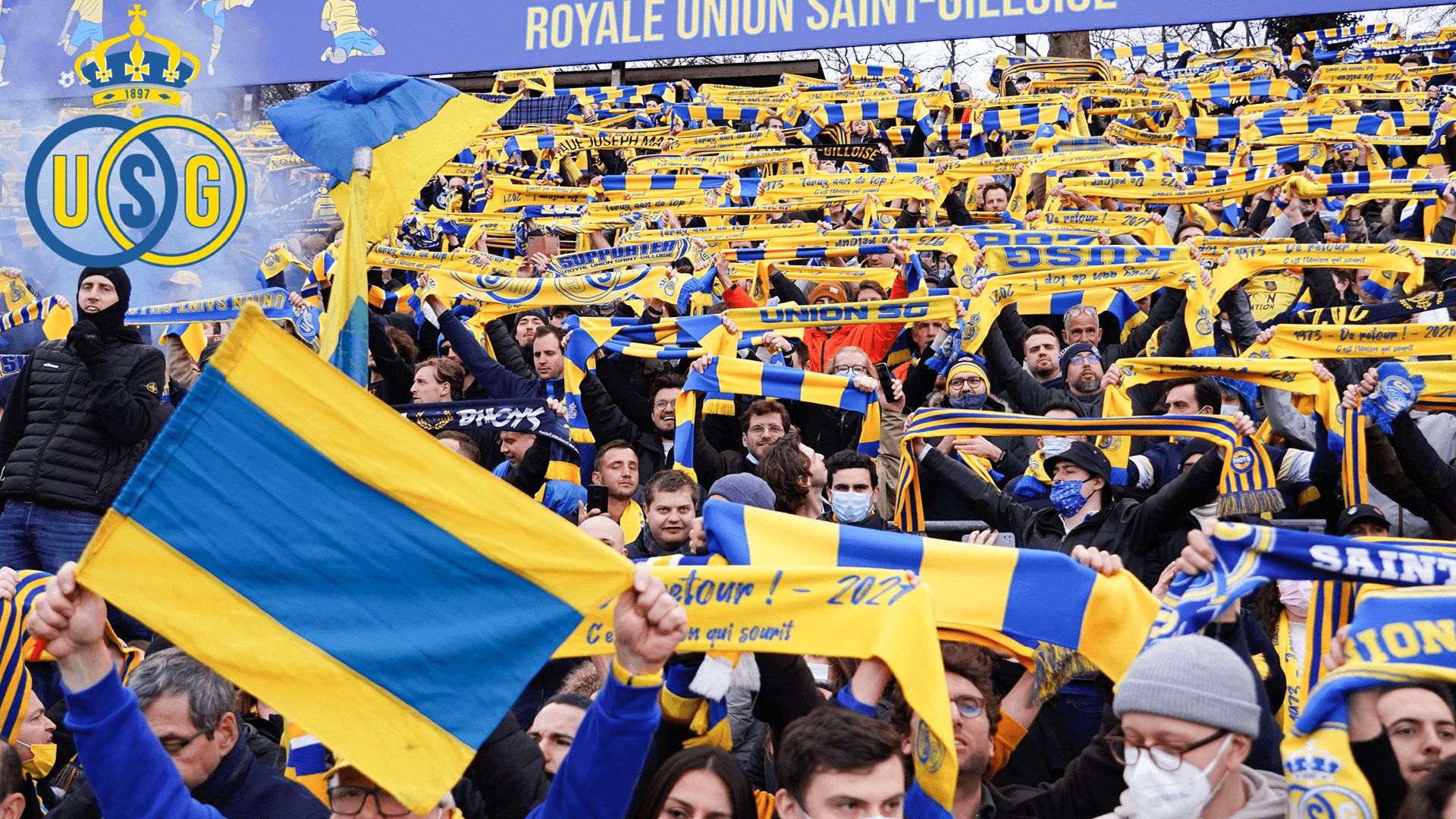
Thus, during the period of football’s rise and the founding of football clubs, a group of friends who often played together decided to found their local team on the 1st of November 1897. They chose the name Royale Union Saint-Gilloise. One year later, Union became a member of the newly established sports federation and was given the registration number 10.
Union very quickly emerged as one of the great powers of Belgian football, winning its first championship in 1904, and during that golden first decade of the 20th century, it captured a total of six titles—four of them consecutively—placing itself at the forefront of the national game. In the following decade, it won another league title and two cups, and up until the Second World War, it remained the driving force of Belgian club football, claiming a total of 11 championships. It’s telling that even today, those 11 titles place Union in third place for all-time Belgian league wins, behind Anderlecht (34) and Club Brugge (19), while the only other team that also has a star above its badge is Standard Liège (10).

After the First World War, Union—already one of the country’s footballing powerhouses—relocated to its historic home ground, Parc Duden. Though Parc Duden lies within the municipality of Forest, it is a vast green expanse located southwest of Saint-Gilles. Before settling at Parc Duden, Union had moved between a series of grounds either in Saint-Gilles or in central Brussels. However, since 1919, this has been its natural home—still preserving to this day a sense of the elegance and romanticism of that bygone era. In 1933, Parc Duden was renamed Stade Joseph Marien, in honour of the club’s long-serving president.

After the Second World War, Union lost the glory of its earlier years, failing to win any titles, with its most notable achievement being a semi-final appearance in the second edition of the Inter-Cities Fairs Cup, where it was eliminated by Birmingham City. However, from the mid-1960s onwards, a steep decline began, gradually shrinking the club’s stature and culminating in relegation to the Second Division in 1965. After a series of ups and downs, the 1973 relegation proved to be a turning point that shaped Union’s path for decades to come. Just two years later, the club dropped to the third tier, and by the end of the 1970s, it had fallen to the fourth division.
In the mid-1980s, hopes of restoring the club’s former glory were rekindled with back-to-back promotions to the Second Division—but further progress never materialised. From that point on, Union remained a club shuttling between the second and third divisions for nearly 30 years. The lowest point of this era came in the 2012–13 season when longtime president Enrico Bove, returning after a brief resignation, brought with him a supposedly promising “group of investors” to revive the club. Instead, Union had a dismal season, finishing 17th in the third tier. In the end, the club was saved only due to financial scandals involving KVK Tienen, who were relegated in Union’s place.
The revival of the club’s historic status finally came quite recently, when Tony Bloom, president of Brighton & Hove Albion, acquired a majority stake in Union, joined in the venture by the club’s current chairman, Alex Muzio. Having stabilised its place in the Second Division after a promotion in 2015, Union began its climb back to the top. In a season that resembled an Argentine-style league format (with an apertura and clausura), Union finished second in one half of the championship and third in the other, narrowly missing the chance to compete in the promotion play-offs. Instead, under Belgium’s eccentric league system, the club competed in the Europa League play-off round—but without success. Notably, Union remained unbeaten at home throughout this mini-championship campaign.
The following seasons and the pandemic slowed the club’s return to the top flight, but on 13 March 2021, with a home win against Molenbeek, Union sealed its promotion to the elite after 49 years!
Union’s return to the First Division was emphatic. By October, the club had reached the top of the league table and remained there until May. However, a poor run in the play-offs prevented a fairytale finish. Still, in its very first season back in the top flight, Union achieved something remarkable—qualifying for the Champions League. The only comparable feat in modern European football was Kaiserslautern’s surreal title-winning campaign in the 1997–98 Bundesliga season.
Though their European return didn’t end in glory, the 2022–23 season turned out to be even more chaotic for Union. In the regular season, the club finished second, level on points with leaders Genk, with a record of 23 wins, 6 draws, and 5 losses. But the most historic chapter was written during the championship play-offs—featuring the top three teams battling for the title and European spots: Union, Genk, Antwerp, and Club Brugge. After five rounds, Union and Antwerp were level on 46 points, with Antwerp behind due to their regular season ranking, Genk followed closely with 45, and Club Brugge sat at 33. In the final matchday, Union would host Club Brugge at home, while Genk would face Antwerp.

The two matches were being played simultaneously, and for most of the first half, both remained goalless. However, right before the break in Genk, the home side opened the scoring through Arokodare, momentarily taking the lead in the title race. But at the start of the second half, Adingra scored for Union, putting his team back at the top. That day, the league trophy was aboard a helicopter, en route to whichever stadium hosted the team currently leading the standings. So, for the majority of the second half, the trophy was not only metaphorically but quite literally at the Joseph Marien.
In Genk, Kerk equalised for Antwerp in the 58th minute, but in the 75th, Heynen put the home side ahead once more. Both goals had no impact on the top of the table, as Union, holding onto all three points, were still safe. But in the 89th minute, Homma equalised for Club Brugge at the Joseph Marien, knocking Union behind Genk, who were still winning. Worse still, in the 93rd minute, Noa Lang added another for the visitors, delivering what felt like the final blow to Union’s title hopes. Just one minute later, with Union effectively out of contention, Alderweireld scored for Antwerp, propelling them to the top of the table. There were still six minutes of added time in Brussels, and at that point, a single goal from Union would have crowned them champions… Instead, it was Sandra who scored again for Club Brugge, and the helicopter took off—carrying the trophy to be awarded to the new champions: Antwerp.
Beyond the heartbreak of losing the title, the result also cost Union a Champions League berth, as they ultimately finished third. Still, in the following season, their Europa League campaign placed them in a group with Liverpool, Toulouse, and LASK. Union fans completely dominated the atmosphere at Anfield, while in the return leg in Belgium, the club earned a historic 2–1 win over Liverpool.
Yet, the defining moment of the 2023–24 season came on the evening of May 9th, a Thursday, when Union contested the Belgian Cup final. Facing their tormentors from the previous season, Union secured a 1–0 win with a goal from Machida in first-half stoppage time, clinching the third cup in their history. It was their first cup in 110 years and their first title of any kind in 90 years! Union had once again added to their honours, proving that history can be written anew—right from where it had been paused in the middle of the 20th century.

The club’s journey—through the necessary transformation and modernisation it must undergo—is a challenging one, as it inevitably affects its on-pitch performance. Yet, it offers hope that the pride and soul of Brussels’ working-class neighbourhood, whose supporters are openly antifascist and gather in one of the few remaining standing terraces in Europe (which, nonetheless, are slowly making a comeback), will once again find its way toward permanent and consistent establishment in the elite of national and European football—adorning the shirt and the history of the Grande Dame of Belgian football with even more stars.
