
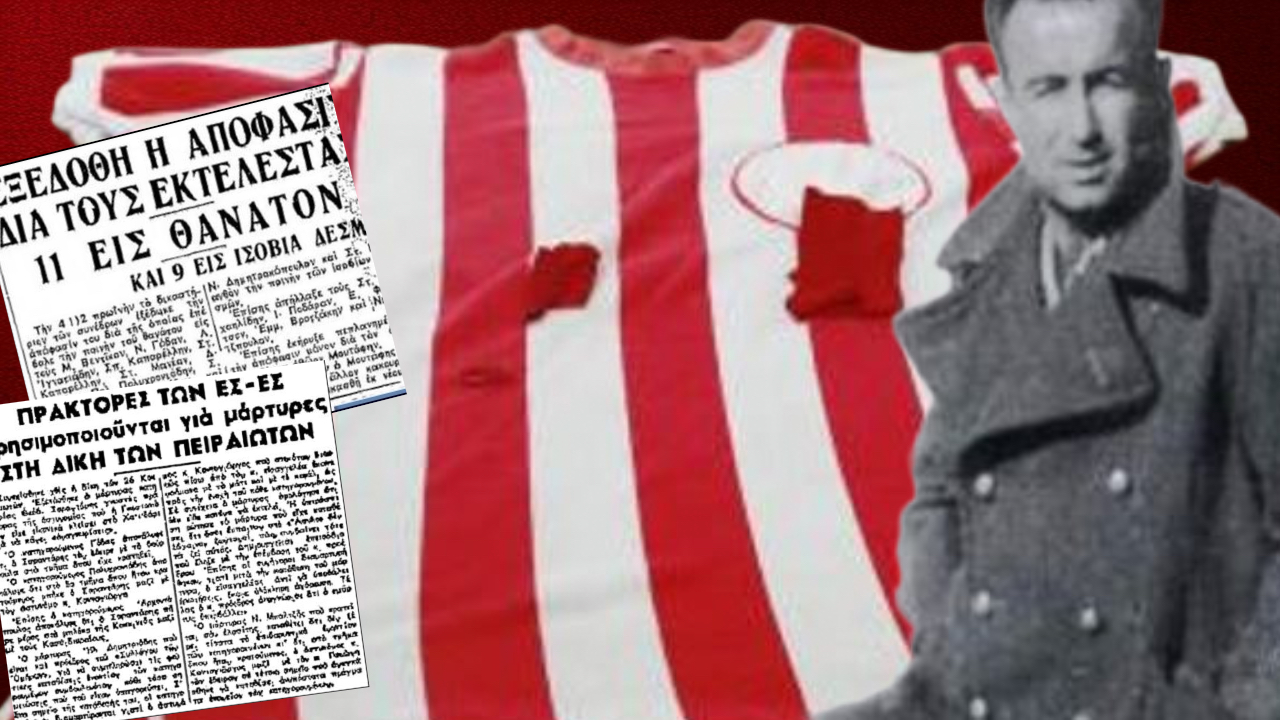
Greek football may not boast either grandiose moments that one cannot find in the footballing history of the rest of the world, nor such vast footballing sagas. The development of Greek society perhaps impeded, in many cases through repression, any kind of mass social expression—of which football is undeniably one. And although power in Greece, like elsewhere, often tried to bring the sport under its control, social developments were such that these attempts often ended up resembling a circus more than a genuine expression of popular upliftment.
One such story began under the Metaxas regime, when the dictatorship decided to ban political ferment within football in 1936, and later even went as far as to suppress the activity of football clubs in 1940, recognising that football’s very existence could give rise to the gravedigger of every tyrant.
And yet it was precisely this environment that gave birth to one of the most legendary stories connected to football in Greece—a story that is a legacy not only for the sport but, more importantly, for a society that struggles to break the chains of every form of exploitation and to claim the life it yearns to live. That life contains football—from its beginning to its end. The fight to participate in football stands alongside the struggle for every small or large issue, from daily bread to the fight for civil liberties and democracy. This is the story of Nikos Godas.
Born in Asia Minor, Nikos Godas came into the world in 1921 in Ayvalik. But his birthplace he would only know through the memories of others, for in a life that mirrored the great political developments of his homeland, at the age of one he took the path of exile and settled with his family in Kokkinia. There he grew up, there he began to work in the family tavern “Ta Arapakia,” and there he also began to play football.
Unlike his life, on the pitch Godas played “outside right,” a right winger, the old number 7 of those post-Chapman years when the classic five-man forward line was still in use. He started his career at Aris Piraeus and shortly after turning twenty, in the midst of the Occupation, he became a player for Olympiacos. But his football registration card was not the only one he acquired during that period.
Nikos Godas became a member of the Communist Party of Greece (KKE) and of the National Liberation Front (EAM), and he joined the Greek People’s Liberation Army (ELAS), taking an active part in the resistance against the occupiers. At the same time that he played for Olympiacos—being a key player from late 1942 onwards—he also fought against the Germans, organised armed and political resistance, and rose to become the Captain of the 5th Company of the Kokkinia Battalion of ELAS.
His political action did not affect his footballing achievements, for the limited statistical records of that era note goals he scored against Ethnikos and Apollon, as well as his participation in two cup finals—one under the auspices of the Municipality of Piraeus and one “Christmas Cup”—both of which Olympiacos won against their eternal rival, Panathinaikos.
His footballing activity even extended into political structures, for apart from playing for Olympiacos and the Piraeus Select XI, Godas also played with the football section of EAM’s youth organisation (EPON) in Piraeus. However, from the harsh winter of 1943 onwards, football matches became increasingly rare, as the people—starving and dying in the streets of Greek cities—no longer had much appetite for sport.
At that point, Godas ceased to be listed in matchday line-ups and instead appeared among the fighters in the Battle of Kokkinia, fought in March 1944, as well as in the Battle of the Power Plant (Ηλεκτρική), as the Nazis fled, in October 1944. But as everyone knows, liberation from the Nazis did not mean the end of the Greek people’s suffering.
The government that returned from abroad sought to crush the popular movement that had flourished and had broken the back of the Panzer war machine—liberating 9 out of 10 parts of Greek land before the final Nazi retreat. Naturally, such a government—one that hadn’t even set foot within the country during the years of struggle—couldn’t achieve this suppression on its own. Thus, the British army came to its aid.
The British bathed Athens and its suburbs in blood in December 1944. Godas was once again among those fighting. In a relatively unknown major battle—the “Battle of Athens,” which lasted for nearly a month—Godas fought with his company in the clashes around the Resurrection Cemetery in Piraeus. From that battle comes a quote of his, emblematic of a man who faced even the gravest danger with a smile. Holding positions in the cemetery and as the firefight with the British and perhaps some Security Battalionists raged, he turned to Second Lieutenant Skourtis and said:
“Comrade Second Lieutenant, we’re the most privileged of all ELAS fighters. Those of us who are killed will be lucky—because we’ll be buried in proper, and even privileged, graves.”
After the December clashes came the Varkiza Agreement, and Godas—like many of the liberators of this land—was forced to wander from hideout to hideout, relentlessly hunted for having fought for freedom. But some time later, he fell seriously ill with pneumonia and was forced to return home to Piraeus.
At that time, a “machine” had been set in motion to strike down the popular movement and eliminate its fighters in Piraeus. That was the tale of the executions at the Kokkinia Asylum. The new pimps of the people claimed they had found the bodies of children allegedly murdered by communists—“with tin cans,” no less. Of course, no serious forensic investigation was ever conducted to prove anything; in many cases, the recovered remains belonged to ELAS fighters. One woman at the trial said her husband had died of heart failure, only to be told by military judges that she was mistaken—he too had supposedly been killed “at the Asylum.” Moreover, this infamous trial obscured a femicide—that of Vasiliki, wife of Dimitris Kasidiaris—murdered by Ventikos, another Maniot from Piraeus, following a dispute with her husband. Ventikos hid in his brother’s house, while the Kasidiarises—who belonged to the Nazi Special Security Forces—participated as witnesses in the trial.
As for the trial itself, it also reveals a story about the relationship between club management and the wider society it was supposed to represent—even in those supposedly more “innocent” days of football. At the time, Olympiacos was presided over by industrialist Manouskos, who had also served as mayor of Piraeus during the Occupation. When asked to intercede for Godas, Manouskos essentially denounced him, saying: “He made his bed, now he must lie in it”—thus placing his name among the first on the dark list of football officials whose role in Greek society was disgraceful.
In the Asylum trial, Godas was sentenced to death and was first imprisoned at Averof prison and later transferred to Corfu. Even in prison, Godas did not forget football. Despite the hardships, it is said that he was always among a group of inmates who, with a transistor radio, listened to matches, cursed their outcomes, and momentarily forgot the reality of their condition—thanks to the passion that nothing could extinguish.
From Aegina he was moved to Corfu’s prison, where all death-row inmates were held. During the Civil War, a total of 112 fighters were executed there—especially in the early years, when executions were frighteningly frequent. Godas knew he would not leave alive. Even on his final night, in a conversation with one of the guards, all he asked for was access to sports newspapers—political ones were banned (a fact worth remembering for today’s sports columnists regarding the weight their platform can carry). That conversation, later relayed by his fellow inmates, revealed how the guard wouldn’t tell him outright what was coming. But Godas understood. He went, put on his red-and-white jersey and white shorts, and said goodbye to his fellow prisoners.
“Comrades, I’m glad that, as an athlete, I will tomorrow morning break the tape, giving all sports fans the greatest victory of my life. We have won. Long live the Olympians of Socialism. Farewell, my fellow athletes.”
On the morning of November 19, 1948, he took the road to the wall of the ruined church at Lazaretto, to stand before those bricks that had turned red with the blood of fighters gunned down by the bullets of national shame. He wore his coat over his jersey, collar raised. When asked if he had a final wish, he wrote a letter to his brother:
“I want you to live well. I die for my homeland and my ideals. If you have a son, give him my name.”
Facing the muzzles of the traitors—whom he had chased relentlessly, just like he did the ball down the wing in his football kit—27-year-old Nikos Godas shouted his final words:
“Long live Olympiacos, long live the Democratic Army, long live the Communist Party of Greece!”
