

Picture a scene: a crowd of people, of various ages, visibly drawn from different classes, composed of different genders, nationalities, and perhaps with differing levels of academic education. They sit in an amphitheatrical structure, facing us. On their faces we see the moment of suspense — for this instant of looking, and perhaps for the one that will follow — for the unknown but very immediate future, which has the power to unite this heterogeneous crowd in a single moment when all share the same emotion. We do not know whether calm had prevailed before, we do not know what will follow, we do not even know the reason why they are all in this similar state. At this moment adrenaline and emotional intensity seem to surge through all the tiers like an electric current. We do not even know what lies before them, for the object of their interest — the source that electrifies them — is situated on the other side of what, in theatre, is called the “fourth wall.” They are all spectators, while we are the spectators of a spectacle in which the crowd — the audience — is the protagonist. If one had to guess where this image is set, one could generally say that an athletic event, or a performing art, is unfolding beyond our field of vision. Yet if one takes a detail of the description — namely the diversity and heterogeneity that characterises the crowd — one could easily narrow down the possible scenarios to two forms: football and cinema, the most popular of sports and the most popular of the arts.
Searching, in another way, not through the history told by an image but through the history of humankind, for those forms of spectacle that gained primacy in terms of popularity during the twentieth century, one will find at the top of every list football and cinema. These two forms achieved an unprecedented global spread, becoming a beloved habit and a part of daily life for billions of people. Both are characterised by their capacity to break class boundaries, being generally — in one way or another — accessible to the broad masses. Indeed, this very feature may be seen as a point of origin and identity, since both forms exist precisely in order to be accessible to the masses. Football and cinema are the most democratic of sports and arts, not because they are so simple or superficial that anyone can grasp them in their full extent, but because everyone, regardless of the level of their engagement, can understand and feel something in any football match or while watching any film — provided, of course, they so wish.
Beginning, then, this exploration of football and cinema as pastimes but also as spectacles, it is particularly important to pose the first question: why do people gather in darkened halls and concrete stadiums to watch something together? The answer leads to the description of an experience which remains as memory and shapes the psychology of every participant in this ritual. It is a process of entertainment that contains both drama and aesthetics, but also creates an experience of belonging to a collective, a community, even reaching the formation of a distinct social “sense of belonging.” In many cases the closure of the experience becomes an individual and collective catharsis — whether through the resolution of drama in the cinematic narrative, or through the outcome of a football match. Both are events that dominate the thoughts and emotions of those in the stands for shorter or longer periods, sometimes even for the entirety of their lives.
Football and cinema, which were born almost in parallel, managed to reach unprecedented levels of universality thanks to two main factors. On the one hand, their ease of reproduction, since they require relatively simpler facilities and preparation than other sports or arts; on the other, the fact that they kept pace with social changes on the terrain of capitalist development. From the mid-nineteenth century this was bringing people en masse into the cities, into clearly defined spaces, and at the same time creating the massification of a shared geographical identity. At the same time, in an ever more noisy world, they were the forms that could most effectively produce the intensity of drama, reflecting life and thereby offering the necessary spiritual relief. With a constant flow and a set of visual and auditory stimuli, they could stand out above the din of this newly shaped reality. Simultaneously, the globalised economic base carried people and inventions far more rapidly to every corner of the world, with these simple forms of entertainment arriving sooner in every part of the planet. Their form also allowed for their immediate comprehension by people belonging to foreign cultures, for the power of the image — as well as the endless movement of a sphere across any surface — is among the most immediately graspable phenomena for any human being, of any age, regardless of life circumstances, privileges, or exclusions.
Football and cinema, from the nineteenth century and above all in the twentieth — with this dominance continuing into the twenty-first — gave birth to legends, myths, and collective memory. They embraced generations with their own collective narratives and offered entire cities, even nations, common cultural references. Both constituted forms of modernism which simplified and deconstructed complex intellectual or physical activity while at the same time ensuring that they did not strip away the intellectual and ideological foundation which was the cause of their creation. Both became means of symbolism and representation of society.
Yet within their triumphant course through time, they acquired a different status. Cinema, as an art, possesses far greater prestige. Consider the following situation: in a social encounter, when we meet someone and ask about their interests, if that person replies that they are interested in cinema, we instantly form an image of them associated with high academic education and a generally superior intellectual capacity. By contrast, if that person tells us that they are interested in football, there is a widespread reflex to categorise them among the less intellectually cultivated parts of our societies. This contrast — shaped, of course, through the different histories that accompany a form of art and a sport — shows why one should engage with them through a comparative analysis. In this way it becomes possible to grasp deeper characteristics concerning both their nature and their social reach, to identify superficial readings of their identity, and even to define how one would wish their development to be in the future.
Parallel Lives
Football and cinema were not born as individual inspirations. Their prehistory, shaped by the historical conditions of each period, prepared the ground for the form in which they would appear, while even their form at the moment of their birth reflected both the level of development of human societies (at least in what is called the Western world) and the technology of the time. Football emerged out of a centuries-long history of ball games which, though found in every corner of the world and in every culture, followed in Europe the line of succession of the great empires. Cinema is the descendant of human inventiveness combined with a range of performing arts — most prominently, of course, the theatre — but also drawing on elements from other, more popular and less respected forms of art in the eyes of each era’s intelligentsia, such as folk theatre in public squares, shadow theatre, and even the circus.
For the birth of both, however, a qualitative leap was required in the mode of production as well as in people’s way of life, particularly with regard to the broad masses. The Industrial Revolution was the lever that accelerated historical developments and radically changed, beyond habits, even the aesthetics of human life (not always improving them), creating the canvas within which new pastimes and new forms of inspiration, expression, and creation had to find their place. The organised exploitation of labour power also led to the organised struggle for better living conditions, with the establishment for the first time in history of the right to leisure time for the working class. Meanwhile, the expansion of transport — chiefly through the creation and development of the railways — allowed for the far swifter circulation of people, ideas, and cultural goods from one place to another. Urban space, which now framed all activities, required that these forms have a specific geographical location and a defined distribution of people within it, since the spontaneous and unorganised gathering reminiscent of a forgotten medieval condition had to be replaced by organised movement within large and densely populated cities.
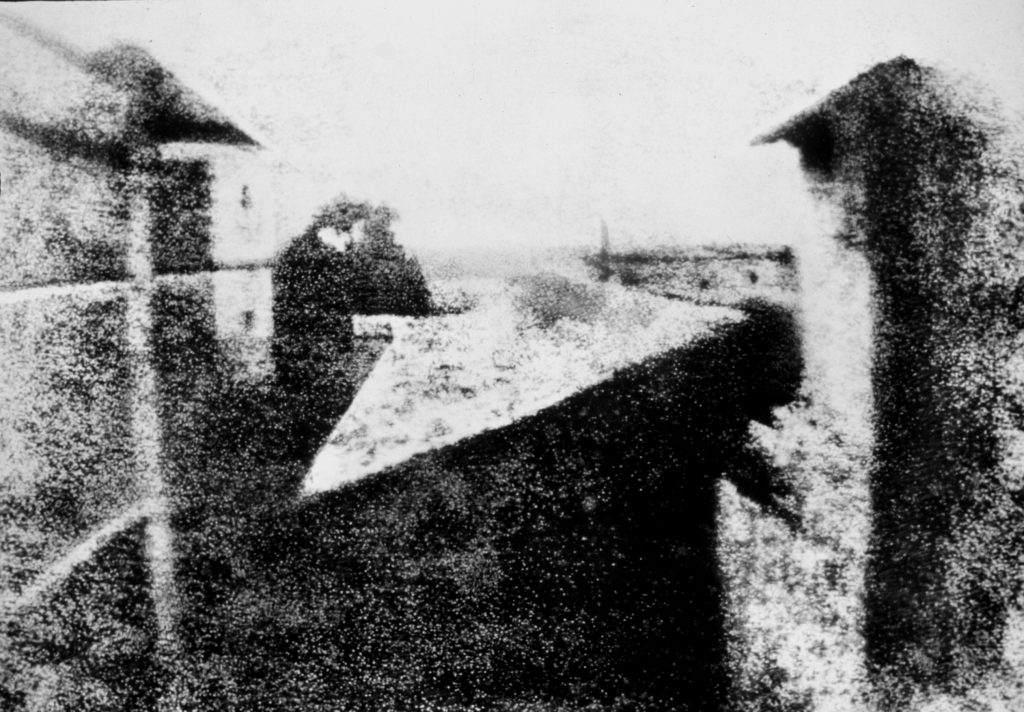
As for the prehistory of cinema — whose birth was at once a technological innovation and the emergence of a new form of fine art — one must begin from deep in history and the various experimental methods of projecting an image. The first reference to the construction of a specific device that successfully fulfilled this purpose was the so-called “magic lantern,” attributed to the genius of the Dutch astrophysicist Christiaan Huygens, who is said to have built the device and developed a method of operating it to project images to an audience around 1659. This invention, however, which coincides chronologically with the beginnings of Dutch capitalism, was nothing more than a distant ancestor of cinema — just as the ball games played by peasants in the fields of the British Empire in those same years were distant ancestors of football. To find a clear line of continuity in the evolution of the inventions that led to the emergence of cinema, one must reach the 1820s — precisely the period when, not coincidentally, football games were beginning to be codified in the British colleges. In 1825 John Ayrton Paris, a British doctor, is said to have invented the so-called thaumatrope, a device which, by projecting two alternating images, created the impression of their coexistence. Yet beyond the projection of the image, cinema also required its recording. That story seems to begin in the same period: between 1826 and 1827 a French inventor, Joseph Nicéphore Niépce, presented a “heliograph,” which constitutes the oldest surviving photographic image, recording with his device a view from the neighbourhood of Le Gras in Saint-Loup-de-Varennes in eastern France.
In the 1830s there appeared an early device for projecting moving images, through the rapid sequencing of drawn pictures and the use of a mirror: the so-called phenakistiscope. It was invented around 1832, independently, by the Belgian physicist Joseph Plateau and the Austrian professor of practical geometry Simon Stampfer. Two years later the British mathematician William George Horner presented an improved form of it, the “zoetrope,” or “daedaleum,” as he called it, which no longer required a mirror and which, several decades later, achieved great commercial success as a children’s toy in the United States. In 1839 Louis Daguerre created the first photographic apparatus capable of being marketed, which thanks to him became known as the daguerreotype. In 1841 William Henry Fox Talbot invented the negative film, allowing the production of multiple prints of the same image from the same original material. These two inventions were combined by Frederick Scott Archer in order to create, in 1851, a process of image capture requiring only a few seconds of exposure. This in effect opened the way for the taking of images set closer in time to one another, thereby making the cinematic dream more visible.
In the same period when, in the British cities, the first football clubs were being created by colleges, factory owners, and also by workers, when the Football Association was being founded and the first football institutions established with the FA Cup and the Football League championship, inventors in Europe and the United States were seeking (among other things) the dream of reproducing reality as it is, in motion, as well as projecting it in a way that could be repeated at a scale sufficient to massify the production and consumption of these images. The first reference to a specimen of such moving real image is the chronophotography of Eadweard Muybridge, who photographed a sequence of images of a horse with a rider in motion. When projected in sequence, these created the impression of witnessing actual movement.
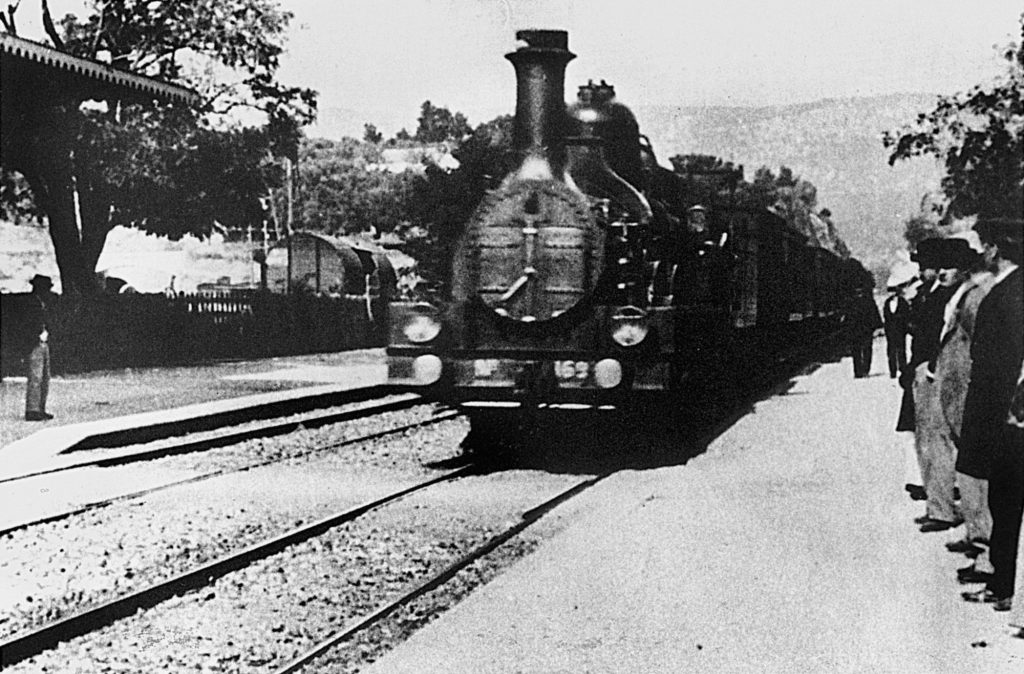
Approaching the end of the century that had given birth, among other things, to football and to cinema, the technique of film production was perfected so that it could be manufactured and used on a mass scale, with the invention of celluloid by Hannibal Goodwin, George Eastman, and Henry Reichenbach. In the final decade of the century, Thomas Edison together with William Kennedy Dickson created the kinetoscope, a device in which the user, by looking through a lens, could see the moving image produced by the passage of a 35-millimetre film. The true leap to the other side, however, for the creation of a new way in which human beings record and narrate history, came when the French brothers Auguste and Louis Lumière constructed a portable camera, with printer and projector, which could, on a mass scale, record and project images from real life before the eyes of people who might not have been present where they occurred, but could now experience them. On 28 December 1895, at the Grand Café in Paris, the first screening for which spectators paid for a ticket was recorded — thus defining the date of birth of that art form so beloved of humanity, the cinema.
In the years when the first football matches were beginning to be played in continental Europe and in Latin America — for football was already an activity that had entered the centre of working life in Britain and was being carried by workers to every country where the economic activities of the Empire expanded — the working-class combination game was gaining ground as the way the sport should be played, distinguishing it aesthetically from other attempts to codify it. The elites who embraced it in their effort to imitate British customs were also the first social groups to gain access to a new technological marvel which, for its own reasons, could generate intense emotional reactions. At the very moment when broad masses were being initiated into the emotional response of a goal being scored, in darkened halls the Lumière brothers were “frightening” their audience by projecting the image of a train that people felt was about to crash into them.
The reception, however, of football and cinema, from the moment of their birth, by academic and educational elites, is a point that deserves particular attention. Only very recently — essentially within the twenty-first century, and in a very localised way, especially in Great Britain where football is considered a central cultural element of the native culture and now even forms part of the United Kingdom’s cultural diplomacy — has the most popular of sports begun to be studied with academic seriousness, whether within educational and research institutions or by journalistic and publishing organisations. In this development, an important role was perhaps played by the internet and the possibility of publishing historical knowledge about football independently at first, in ways that proved to have both commercial success and intellectual depth, attracting the interest of conventional media and even universities. In that initial period of the sport’s development and expansion, in the second half of the nineteenth century, there were many brilliant pioneers who saw in the game beloved of the masses a tool of communication between nations — but whose work and outlook came to be analysed with seriousness and systematically only more than a century later. Attempts by intellectuals to highlight the cultural depth of football were very sporadic, with the few such works of the twentieth century now considered classics. A characteristic example is Eduardo Galeano’s Football in Sun and Shadow, regarded as one of the classic works of literature dealing with popular culture in Latin America.
Cinema, on the other hand, enjoyed better fortune. The rapid development of technological means led to a correspondingly rapid evolution of its narrative technique, so as to attract members of the intelligentsia not only as analysts of the medium but above all as its creators. As early as 1911 the art theorist Ricciotto Canudo, with the publication of his manifesto The Birth of the Sixth Art, produced the first reference that placed cinema among the fine arts, revising his classification ten years later to call it the “seventh art,” while at the same time founding in Paris the Club des amis du septième art, the first “Society of Friends of the Seventh Art.” The engagement of Canudo and other such figures with cinema, in only the second decade of its existence, shows that the bearers of new ideas in the arts — then expressed through various modernist currents — recognised cinema as an avant-garde, elevated form of artistic expression.
There is, however, another difference concerning the part of the educated elite that became involved either with football or with cinema. While the devotees of cinema were figures seeking innovation in forms of expression and in art, football officials usually perceived human societies in a more static manner, often imbued with spurious “pure” athletic ideals or even with militaristic notions, which they believed could be reconciled with team sport. Yet regardless of the analysts and the officials of football or cinema, the most important element was the emphatic growth of the love of the masses for both, which created a social relationship and a social identity for each activity. On the one hand, cinema became beloved because through it people could see the representation of their lives, with the necessary filtering out of noise so as to focus on artistic narration — but through a medium that was not only far more readily grasped than literature, where the image is absent, or than music, where the word is absent, but which increasingly incorporated all the other arts as constituent parts. If cinema was the representation of life, football was its symbolic reflection. And if what every supporter sought in the stands seemed to be something simple — such as a goal — in reality the bond with the sport, forged above all through the bond with a club, constituted a social relationship laden with symbolism.
Because academic research often focuses on individual excellence rather than on the social breadth of phenomena — itself evolving upon a specific economic, capitalist basis — it is almost inevitable that the perception of football as debased is perpetuated: a sport that seems not to evolve technically when compared with an art form in which the very development of the means of production constitutes both the foundation and the inspiration for the search for new expressive forms. For this reason, today if someone in a conversation mentions that they are engaged with cinema, they are usually met with admiration by the gathering: they are considered a person of particular education and of refined interests. Whereas if they say that they are engaged with football, the image that forms is of a poorly educated individual with limited intellectual horizons. Both these perceptions are, of course, aspects of the same mistaken and distorted view of the value of the products of human culture.
The placing of these two forms, football and cinema, side by side within the historical framework of their emergence and development, and also through the common or simultaneous needs for entertainment that they met and continue to meet over time, dismantles any spurious distortion of their supposed value. It highlights that they are forms which, in essence, express the way of life of human beings in an era unlike the whole of previous human history. Their popularity lay neither in the ingenuity of the Victorian aristocrats who codified the football games nor in the (truly admirable) ingenuity of the inventors who created the techniques of photography and image projection. Their popularity was the result of the fact that they responded to the real needs of human beings at the moment of their creation — needs that could not be fulfilled by the forms of sport and art that had existed until then. From this perspective, both these forms deserve the attention and respect of all those genuinely concerned with the evolution of the cultural needs of human societies, rather than with their own vain personal promotion as supposed members of a supposed intellectual elite.
Power and Instrumentalisation
If theorists and intellectual elites systematically and consistently distinguished between the value of cinema and of football, political power never made the same mistake. Perceiving the importance of both in attracting the interest of the masses, it instrumentalised them alike, seeking — and to a large extent succeeding — to integrate them permanently into its ideological arsenal for the achievement of political objectives and the maintenance of its power. It is very important to emphasise that it was the popularity — not the nature — of football and cinema that caused every ruling power to take such particular care of both. In everyday conversations, it is not uncommon to hear the view — chiefly concerning football — that it is a sport created by the bourgeoisie in order to control the working masses. Even if this is partly true, if one considers the reasons why British industrialists founded football clubs — in order to curb uncontrolled violence or the consumption of alcohol during non-working hours, or earlier still the attitude of nobles and feudal lords who, for similar reasons, thought it better to let peasants play football rather than drink and fight — such a reading of the sport’s history in no way corresponds to the essence of its social reach. Even if today organised armies, under the banner of supporters’ clubs, in many cases align themselves with and protect the interests of businessmen, this is a collateral phenomenon of football. It is neither its raison d’être nor the reason why billions of people adore it.
This interpretation of football is as superficial as the parallel interpretation — less common, though not rare — which claims that cinema is a tool of imperialism or of any system of power and exploitation for the shaping of consciousness, for ideological propaganda, or even for the laundering of crimes against humanity. If one considers the content of lavishly funded Hollywood productions, which dominate our Western societies, with a series of mythical stories that have themselves become legendary parts of cinema history — the entire James Bond franchise being a typical example — one can arrive at such a superficial conclusion. Yet cinema existed before this instrumentalisation and became beloved of people before it became a key medium of ideological propaganda. It was this popularity that transformed it into a vehicle of propaganda, not the other way around.
Thus, through a comparative approach to the instrumentalisation of the two forms, perhaps an answer may be given to the various opponents of football’s very existence, those who go so far as to argue that football would be better off not existing, so that the reactionary and dangerous phenomena of organised violence and the support of human exploitation that develop around it might not be maintained. It is as if someone were to argue that cinema, or Hollywood itself, ought not to exist so that American imperialist propaganda could not be carried out.
If this last view seems extreme, it becomes rather interesting when one searches through historical examples, which show that arguments of this kind have already been expressed — not by the opponents of imperialists, but by the imperialists themselves. Perhaps the most telling part of the relationship between the popularity of football and cinema, the support both received from power, and their potential to be used against the very power that supported them, lies in Italy — beginning from the country’s darkest period, the years of fascist rule.
In the 1930s, Mussolini — by then firmly established — was constructing his own imagined version of the most perfect civilisation in human history, spending countless resources from the state budget to achieve this domestically, with pharaonic public works that included football stadiums. He had also set his sights on distinction for the Italian national football team at international level, aiming for conquest of the world summit of the sport. By providing every material condition, by clothing in fascist and racist trappings legislation that allowed the best Latin American footballers to become Italians, by hosting the 1934 World Cup in Italian stadiums, and by personally attending at least one match on each matchday in different cities of the country, he instrumentalised football in order to imprint, through victories on the pitch, a symbolism of victories for his regime, above all on the cultural level. The pretence of this cultural superiority was, after all, a necessary complement to his ideological arsenal, something that aided the development of nationalist ideas which were indispensable within the country if the regime was to enable the Italian bourgeoisie to claim a larger share of the spoils through the wars that were to follow. Mussolini celebrated the victories of Pozzo’s team and of the oriundi: the World Cups of 1934 and 1938, and the gold medal at Hitler’s 1936 Olympiad.
Beyond football, Mussolini also took care to support Italian cinema with equal zeal. In the early twentieth century it had already replaced the popular commedia dell’arte, transferring the theatre of the piazzas into halls where the silent image was at first accompanied by local pianists, until technical means allowed the narration of stories from the glorious past — even from mythology — as well as from the humble present, simultaneously stimulating the imagination while meeting the need for a reflection of the life of the masses. Cinema’s popularity, which by the 1930s had surpassed other art forms, could be said to have “compelled” Mussolini to spend an enormous sum from the state budget to establish Cinecittà in 1937 — which remains to this day the largest film studio in Europe. So then, are football and cinema, supported by the fascist regime, inherently tools of authoritarianism?

The answer to this question was given by History itself. Italian football, so often entangled with mafiosi of all kinds, nevertheless produced some of the greatest popular heroes of the sport — whose personalities bore no resemblance to those who paid their wages. Even more important, however, is the fact that beyond the creation of fascist nuclei in clubs that were effectively supported by that regime, or were geographically located in areas it had special reason to protect (with Lazio and Hellas Verona being the most characteristic examples), at the very same time there were clubs that became symbols of opposition to fascist power — still more, of the struggle for a world free of exploitation. The most characteristic example was Livorno, the team of the city where the Communist Party of Italy had been founded in 1921. As for cinema, Cinecittà became the material condition for the flowering of Italian neorealism, enabling sacred figures such as Rossellini, Visconti, Fellini, and others to create their films — culminating in Pasolini, whose considered extreme critique of the fascist regime was the essential reason for the fascists’ hatred towards him, leading to his murder in 1975, a few days after the first screening of Salò in Paris, amid the leaden Italian years.
So then, did Cinecittà, which breathed life into Italian film production, serve only to foster the development of fascist ideology? This, more or less, was what the Americans and the British — who had taken on the “reconstruction” of Italy after the Second World War and the liberation from fascism — sought to argue. Essentially, perceiving that cinema, beyond being a tool in the hands of power, could also become a tool in the hands of the forces of social progress, they tried — as the new power — to sever creators from the technical means that had served an ideology targeting their own imperialism. A further reason for their obsession with shutting Cinecittà down was the fact that, in the decades following the Second World War, Hollywood never managed to surpass Italian productions at the box office, having markedly limited penetration into the Italian public, while Italian cinema succeeded in winning significant audiences in many other countries — even in the United States. Fortunately Cinecittà never closed. Yet is there a parallel example in football?
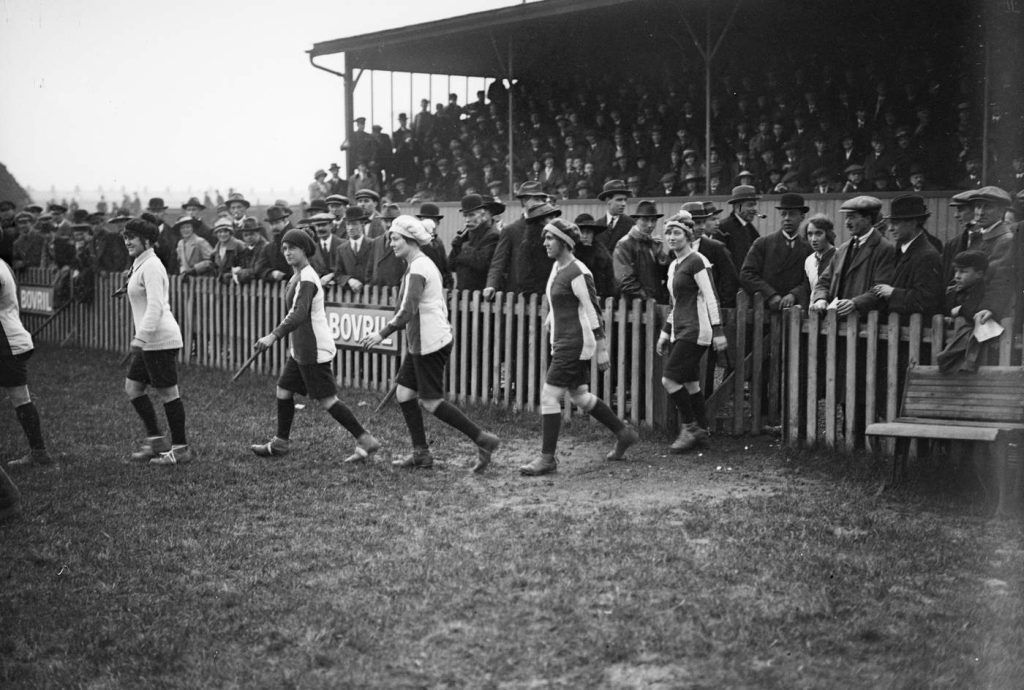
There may be many such parallel examples, but perhaps the most telling comes from the little-known history of women’s football, and more specifically from the first period of its triumphant and unexpected development. Women’s football, which during the First World War found the material conditions to break patriarchal barriers in practice — when Britain’s factories were filled with women workers who had replaced the men serving in the trenches — faced the wrath of the football institutions. That wrath grew exponentially, just as the acceptance of the women’s game grew exponentially, culminating in the 50,000 spectators at Goodison Park on 27 December 1920. The bourgeois — and therefore dominant in our own day — reading of the history of women’s sport claims that the motive for its prohibition by the Football Association was the fact that men’s football, already commercialised, had suddenly acquired a competitor beyond the reach of the established institutions’ control. Yet this problem could have been resolved with a more conciliatory approach by the football and political authorities of the time. What could not, however, be tolerated was that, in the hard years of post-war reconstruction in Britain, with deprivation ravaging the working class, women’s football became a tool for supporting workers’ struggles: with matches held to aid strikers and their unions, and with the game in practice yielding not only financial but also ideological gains, through the exercise of the broadly recognised organisational capacity of the working class, for the benefit of the exploited masses. That was the essential reason why, although political power in Britain had no problem permitting the development of a popular sport under bourgeois control, it gave football’s institutions the right to exclude women from the game for nearly fifty years.
Thus, one observes that, despite the fact that popular forms of sport and art become tools that power seeks to exploit, their necessity does not lie in serving purposes of domination but in the given social and technological development. Out of the very material support provided to them spring extensions that express social progress and resistance to whichever exploiting class prevails.
In football especially, where phenomena often express themselves in a more symbolic way, there are examples in which these two characteristics — instrumentalisation by authoritarian powers and the expression of social progress — coexist. A telling case is the Argentine national team in the 1978 World Cup, a tournament that FIFA gifted to the dictator Videla in order to advertise his criminal regime. At the very moment when the junta was using footballing success to conceal the thousands of disappeared militants, in the realm of ideological struggle over the use of football, the philosophy of César Menotti was prevailing: a philosophy that treated football as a form of sport in which aesthetics must take precedence over mere results, reflecting a conception of life in which, beyond the satisfaction of basic needs through productivity, there must also be substantive content and beauty for everyone.
Football and cinema, precisely because they are popular forms beyond the given social and economic conditions, also became tools in the hands of revolutionary forces. A characteristic example is the support given to cinema in the first decade of the Soviet Union’s existence, after the October Revolution, as well as the great ideological debate that took place within its political organs concerning the future of football. The voices, mainly within the Komsomol, advocating the promotion of an athletic ideal without competition, with a supposedly pure conception of physical education, failed to prevail. Thus a series of clubs was born, organically linked with the institutions of the new revolutionary power — the most prominent examples being the great clubs that still exist today, CSKA and Dynamo, in whichever city those names are found.
It was, moreover, from the Soviet Union that one of the most brilliant examples of resistance through football emerged, born of its attempted instrumentalisation by the Nazi occupiers. In Kiev in 1942, against the German effort to demonstrate their superiority within a football pitch, with the aim of humiliating the spirit of the enslaved inhabitants of the Ukrainian capital, an eleven that appeared under the name FC Start defied all risks and threats in order to offer, at the symbolic level of football, a victory that was in essence an act of defiance and of hope — at a moment when the armed resistance still required time before it could signal the Soviet counter-offensive, which began a few months later with the victory at the siege of Stalingrad.
Football and cinema were created by elites — whether this meant the codification of the former or the development of the inventions necessary for the latter’s existence. The motive of each elite in creating them may well have been their use for its own purposes; yet their success, defined and measured by their mass adoption, rendered them independent as social phenomena from the ruling class, transforming them into forms through which the masses could find outlet and expression. Completely? No. On the basis of the given relations of production — that is, on the basis of capitalism — the economic profits from both forms are reaped exclusively by the ruling class. Nevertheless, the fact that commercial exploitation concerns only one side of their existence reveals that both these forms, like other sports and other arts, constitute a part inseparably linked with the evolution of societies across a span of time far greater than that of any one, momentary socio-economic formation — with its corresponding power.
Football in Cinema
If the discussion of the instrumentalisation of sport and the arts — with emphasis on their most popular forms, football and cinema — and of their existence as acts of resistance within exploitative societies seems like a theoretical conversation, with conclusions that may vary amidst the complexity of the phenomena, often making arguments appear unverifiable, the essence of these forms can be analysed upon a much more material, even empirical, basis if one considers their convergence, their encounter. Since football expresses society symbolically, while cinema, beyond symbolism, has the capacity for representation, the meeting of the two occurs much more in cinema than in football grounds. The technical development of cinematography itself played a decisive role in the growth of football.
In analysing the spread of football as a social pastime — and not only as a sport — in Victorian Britain, we noted that the change in the level of education of the working class, through the establishment of compulsory schooling, was decisive in disseminating footballing life to a wider section of the population and over a greater geographical area, via the press. This meant that by the late nineteenth century there were, through printed media, the material conditions for multiplying the number of football supporters. But from the early twentieth century cinema — or, more precisely, the possibility of cinematography — became a crucial ally in transmitting the footballing experience to a far larger number of people than could ever fit inside a stadium. Major football matches, particularly FA Cup finals as well as international fixtures, were filmed in the form of newsreels. In the production of these, the Franco-British agency Pathé, founded in 1896, was a pioneer. Today the British Pathé archive holds some of the most valuable cinematographic documents of that distant, and perhaps formative, footballing age, including the earliest women’s football matches, standing as historical records both of its success and even of its form, transmitting it to the present day and preserving it within the conditions of the embargo imposed by football’s institutions.
It is worth noting that the reproduction of cinematic reels of football matches predates by a long way radio broadcasts, and of course television coverage — both of which were decisive in the sport’s mass adoption and its genuine entry into the lives of millions at first, and now billions, of people. The fact that the image of a stadium packed with tens of thousands, sometimes more than a hundred thousand, people reached the eyes of many more than those present at the event was the best advertisement for this sporting innovation, contributing decisively to its further popularisation. Perhaps a train from the British North, full of supporters, might never have departed had the residents of the destination city not known that, in London, their team would play before a true pandemonium — in which it must have corresponding support, with equal fervour and mass presence.
The evolution of this initial, experimental cinematography of football was naturally its transmission on television — something that has since become part of the sport’s very identity. Broadcasting rights and the management of football as a television product now stand at the summit of its commercial activities, placing it at the top not only of the list of sports but also of spectacles that are sold and consumed (if one may use the term) worldwide. Thus football is a sport that has become bound far more to the small than to the big screen, and its direction has developed primarily technical characteristics: its purpose, beyond the overall aesthetic outcome, being the transfer of reality to a spectator not physically present at the events. The aim is for the viewer, through the screen, to grasp the space of the pitch, the speed of the players and of the ball, even the countless marketable items borne by the players as sporting equipment, down to the sponsors around the perimeter of the field. To the aesthetic outcome contributes the skilful depiction of the stadium’s architecture, of the choreography and acoustic presence of the supporters, and of the emotional responses — whether inside or outside the pitch — of all the subjects within the stadium walls during the match.
Yet football also exists on the big screen, in the darkened halls of cinematic ritual. Usually, in such cases, within the vast body of articles — even books — one finds lists of films about football, or films containing football. The aim of our undertaking, however, is not to enumerate these films and discuss either their artistic value or their plots and narratives. What is interesting in this exploration of the social dimension of the phenomena is to discover in what particular way football is presented in a popular performing art, and which of its characteristics are those that usually draw the attention of creators. In this search, of course, examples must be used — and thus references to films. Yet this does not mean that these are objectively, or even subjectively, the best of their kind. This is no competition, but rather the necessity of using examples.
In cinema, football cannot be captured in the same way as on television, and for that reason the development of the match itself is rarely the focus of artistic creation. Even the technical skill of play has little meaning to reproduce, for it is never as impressive when the viewer knows it is staged and not the product of a spontaneous moment of inspiration. Thus cinema, instead of concentrating on the unpredictable aspect of the sport that generates the great sporting emotions, usually takes its inspiration from all the other phenomena that unfold during a football match — inside and outside the stadium, and in society at large, among those who live and breathe the popular sport. This is a distinctive difference between football and the cinematic depiction of other sports. Boxing films, for example, often focus on the protagonist, highlighting through direction the human transcendence in the very moment of physical combat, expanding in time those singular moments of a bout so that the viewer may analyse them mentally. In baseball, the drama concentrates on the decisive pitch that will settle a balanced game — again centring the image on the ball and on the opposing protagonists, pitcher and batter, each living the moment purely through their emotions, and not through the endless physical movement that characterises football. A combination of the two occurs above all in American football, where the violence of physical contact — impossible to appreciate from a distance — and the breakdown of the component movements in an attacking play of only a few seconds’ real time, are otherwise imperceptible to spectators, yet become the elements that heighten the drama of the cinematic narrative. Similar emphasis on the ferocity of physical contact is found in rugby, with the cinematic gaze entering those particular parts of the match the spectator cannot reach from the stands: beneath a scrum, within a ruck, in the vertical contest of a line-out. Finally, in basketball, the choreography in three dimensions — with athletes’ bodies moving in length and breadth but also in the far more spectacular height of the court — provides material that can create the necessary choreography to portray cinematically the experience of each protagonist.
In football, by contrast, the cinematic transference of moments on the pitch is rarely a central element in the building of drama, or has historically been attempted in ways that have never quite left behind iconic scenes to be recalled over time. In my humble opinion, the most beautiful cinematic scene to convey the entirety of the footballing rite — all that occurs within and beyond the pitch — is the reconstruction of the match between Huracán and Racing, at Huracán’s ground, for the Argentine championship, in Juan José Campanella’s El secreto de sus ojos. The shot begins from the sky, the camera borne on some fantastical flying device — perhaps a helicopter — approaching the stadium from its southern side, showcasing the Torre del Palacio, the tower that has adorned Huracán’s stadium since 1944 and stands as a symbol of stadium architecture along the Río de la Plata. The game is played under floodlights, the stadium standing out for the intense contrast of its bright light against the dark shroud of the surrounding streets. The soundtrack combines dramatic music with the radio or loudspeaker commentary of the match, making explicit reference to the time of its occurrence. As the camera nears the stadium, the voices of supporters become ever louder in the audio background reaching the viewer. The camera enters the ground and, filming the pitch from a bird’s-eye view, sweeps over the fans in the southern stand to descend onto the playing field, following the development of a Racing attack. The ball, reaching the left wing of Racing’s attack, ends with a shot from the left winger against the crossbar, flying high out of the frame. Yet the camera continues its journey towards the stadium’s eastern side, towards the stand of the visiting supporters, gradually shifting its angle from vertical to horizontal, until it reaches the portrait of Inspector Esposito, who among Racing’s fans is trying to identify the fugitive he is investigating — whom he must recognise through the psychological analysis of his supporter’s passion.

This scene is adored by football lovers because it combines so many of the elements that place football in its special position as a sport within society. It begins with the architecture of a stadium symbolising an entire — and legendary — football culture, that of South America. It proceeds with the expression of football passion, through the visual and acoustic references of the time. It highlights the mass choreography of the crowd in the stands and the aesthetic grace of a flowing attack across the pitch, without needing even to end within it — the ball never reaches the net to form a temporary climax to sporting drama. Finally, the focus on the supporters’ faces translates this general image into human dimensions, into something that is the experience of each one of us who has stood on a terrace supporting a team somewhere on our planet.
Beyond its value for football lovers, this scene also has enormous significance for the way cinema approaches football, useful for analysing the meeting of the two forms. Football continuously produces social relations, emotional responses, even ways of life, standing at the centre of existence for millions. The lives of these people, their relationship with their club, and at the same time with those around them, their each and every perception of their social position through the simultaneous and identity-defining role of supporter — this is what usually inspires filmmakers who choose to place football within their work.
Football appears in cinema as it appears in life: more than the match itself being reflected in the sport, what matters are the aesthetics and the ensemble of processes that occur around it and thanks to it. This has a particular importance for football itself, in conditions of extreme commodification. In the present commercial framework, the score seems to be “sold” far more than the unique elements and their corresponding aesthetic qualities that make the sport special. Match highlights are the main content with which sports websites and media bombard their audiences across platforms to secure the largest possible number of followers, while the tracking of scores — with the sole aim of petty financial profit through betting — now happens incessantly. At its most absurd, scores are even followed inside a cinema hall, or from the terraces of a football ground. In essence, the need to commodify every footballing moment destroys the essence of the football experience and diminishes the sport’s social reach. Cinema, however, does exactly the opposite!
In cinema — which as an art form does not seek to generate only a plot but, upon a plot, to communicate an aesthetic approach to political, social, and all manner of phenomena — football is celebrated as a phenomenon that exists in life itself. There is no need for a scoreline or for reference to a particular match for football’s presence to enter a film; its relationship with characters, and with class, religious, ideological and all forms of identity markers, is enough to bring it into focus. Football functions in cinema essentially as it does in society: through the symbolism it bears, it enables the necessary abstraction for artistic narrative, offering the viewer much more information than words and scenes alone, allowing the creator to use cinematic time to concentrate on the story to be told.
Perhaps the most striking examples of such films are Paolo Sorrentino’s two works about the city where he grew up, Naples — a place where football dictates the days of collective joy and grief, imposes optimism or plunges into terror, in a way that to an uninitiated external observer may seem metaphysical, but to someone who has either lived it as an experience or sought to analyse it with the necessary respect, it is a complex and omnipresent dominant social phenomenon. In È stata la mano di Dio — whose very title refers to Maradona’s legendary Hand of God goal against England — Maradona appears only as a background presence, not in the foreground, yet presides throughout the film as the central figure of attention for the inhabitants of the southern Italian city. In the more recent Parthenope, on the other hand, while football seems absent throughout the film and the lives of protagonists sharing experiences within spaces of the elite — economic or academic — the director’s statement that resolves the drama comes at the close of the film: with the convoy of Napoli supporters passing before the heroine, making clear the reason why the creator made his artistic work. Oggi come allora, difendo la città, cry the supporters — and Sorrentino himself exalts his birthplace, a place of ceaseless and profound social beauty, in permanent contrast with the fleeting external aesthetic of places and people. The fact that the director found the words to tell his story — the very story that had been the unknown quest of the protagonist of his previous film — through a supporters’ chant, is the exaltation of the authenticity and realism contained in the spontaneous and collective popular expression of the fans on the terrace of every ground.

In recent decades, football has appeared more and more frequently in cinema, as through a broader process of apparent “cleansing” or “gentrification” it ceases to seem base and therefore forbidden for the higher — educational and economic — strata of society. Yet in many cases, for many decades now, we also find it in the seventh art not as caricature — as still often happens today — but with the necessary respect and an attempt to analyse particular social characteristics of it. Among the earliest serious attempts to convey elements of football culture on screen is Ken Loach’s Kes, which the English director filmed at the beginning of his career, in 1969. The depiction of power relations as they appear within a football match — with the symbolism of each position, of the artificial satisfaction of the ego for the centre forward and of the outsider for the goalkeeper — is the way Loach communicates with his domestic audience, deeply steeped in the elements of football culture which, by definition, mirror British society from their very birth. Ken Loach would return to football more explicitly in later films — with My Name Is Joe (1998), and by using the figure of a footballer, this time not only in the background but through the participation of Eric Cantona himself, to tell his story in Looking for Eric (2009).

The presence of football in films dating back many decades is evidence that helps newer generations to understand the sport’s enduring imprint on people’s lives. In Greek cinema — the so-called “classic” era, defined by a period of unprecedented and never-repeated productivity in film production — there are numerous films in which football even takes centre stage, usually as caricature. Yet there is one scene that beautifully places it in its true dimension: in Alekos Alexandrakis’ Synoikia to Oneiro (A Neighborhood Named ‘The Dream’), filmed in 1961 and butchered by the censorship of the time, which wished only to present a sunny, touristic Greece. In the preserved version, the protagonist Rikos first encounters the children of the poor neighbourhood of Tilegraphos, in a setting entirely disconnected from the triumphs of stadiums. Alexandrakis has him speak to a young boy, calling him “Panathinaikara”, while children run and play where the football adventures of all past generations’ heroes also began — in narrow streets, on bare ground. In another scene of the film, declarations of football passion are painted on the walls of the ramshackle houses. This is the canvas upon which football is painted, and since it is this canvas — of human societies — that cinema too uses to tell its stories, when it is truthful it cannot ignore it.
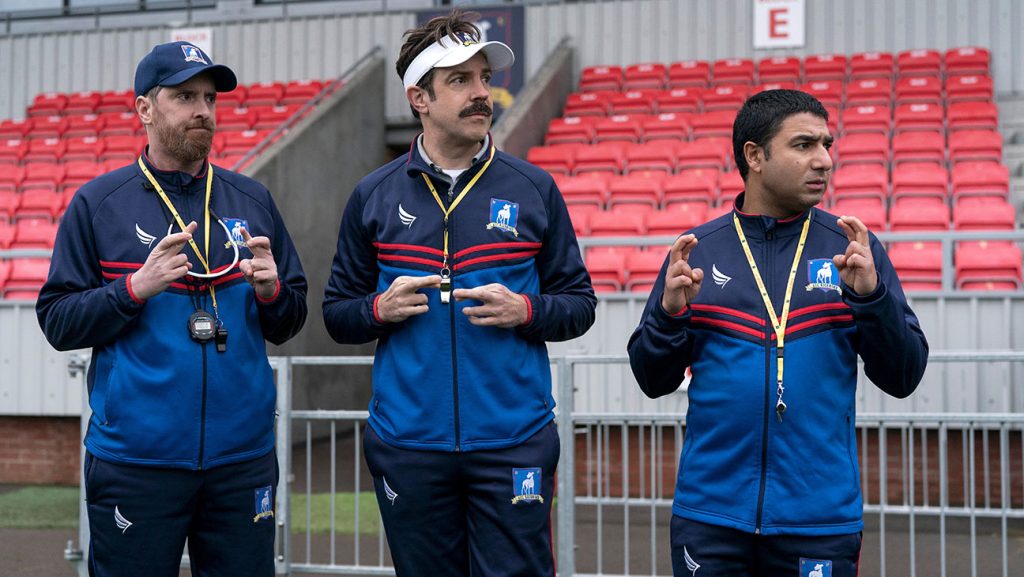
As in all cases, the successful cinematic depiction or even simple inclusion of football — successful because of its authenticity — also provides motivation for its use with the aim of commercial success. The confirmation that football is a useful tool for telling the stories of a society, or indeed of all human societies, is the fact that in the streaming era the largest corporations incorporate lavishly funded projects into their catalogues: series that deal directly with football, essentially revealing that, on the basis of the game, one can approach every facet of social life. For the American-based giants, this also carries an element of exoticism. In this framework, Disney+ decided to produce a multi-season documentary following the financial adventure of two Hollywood stars who chose to purchase and revive Wrexham. Meanwhile, Apple TV, with Ted Lasso — a series that, it must be said, adopts a much more analytical approach clearly informed by the depth of football literature — uses the affairs surrounding a fictional football club to speak about society at large. These ventures may seem to “discover America”, yet they are of interest if viewed from the perspective of the mass acceptance of a phenomenon that is ultimately used not only for artistic narrative but essentially to guarantee the commercial success of the artistic undertaking.
Finally, a perhaps lesser phenomenon is the passage of protagonists from the pitch to the cinema screen. The fame of footballers — who usually came from the popular classes — was, from the early twentieth century, comparable to that of film stars. And in many cases, even if the directors and producers came from higher strata, they too were children of the working class. The first footballer perhaps to have capitalised on his sporting fame by moving into cinema was the Austrian Matthias Sindelar, who in 1938, a few months before his death and having left the game after Austria’s annexation by the Reich, appeared in the film Roxy und das Wunderteam — a work dedicated to the golden Austrian team that was dissolved that same year. Later, monumental is the participation of Pelé in Escape to Victory (1981), which also includes elements from the “Death Match” in Nazi-occupied Kiev in 1942. Eric Cantona, meanwhile, appears in person in Ken Loach’s Looking for Eric(2009). The singular footballing personality of Vinnie Jones — the “hard man” of the pitch — was also cashed in cinematically, as he appeared in a series of films and television shows after his playing career. Yet speaking of the children of the working class — the footballers who became actors in cinema — mention must also be made of the representatives of the wealthy: the football executives who are also film producers, revealing that the field of entrepreneurial activity in the world of mass spectacles can encompass both forms. In this category, the most characteristic case is perhaps that of Aurelio De Laurentiis, film producer who inherited from his uncle Dino — a towering figure behind the production of some of Cinecittà’s and Hollywood’s most legendary films — a place in the world of cinema. Aurelio, beyond being a producer, is today the majority shareholder of Napoli, the executive who revived the club on the pitch and helped the sun shine once again over Vesuvius twice in the last three years.
Football is, for cinema, a bridge that unites the erudite approach of the creator with the popular elements of society; it functions as a common language through which complex meanings can be conveyed to a broad audience without demanding that it follow intricate intellectual reasonings, but only the familiar symbols and experiences it already shares. For this reason, the intelligentsia increasingly recognises that it cannot ignore the depth of football’s social substance, because to do so would be to turn its back on the very subject of study and the canvas of its creation: one cannot speak of society without respecting it, and a part of societies, whether it accords with one’s personal tastes or not, is football.
Dialectical Antithesis
Through the parallel exploration of the birth and evolution of football and cinema, even in brief references to their similarities and differences, the elements that make these two forms stand out — and grant them a unique ability to penetrate the hearts, minds, and even the temporal existence of the masses in recent centuries — are revealed. Yet the whole of this analysis, if one strips it back to its fundamentals, is permeated by a basic antithesis. Football and cinema may share similarities, but they are certainly not the same. They have a general characteristic, however, shaped over time, that makes them resemble two opposing vectors. While the level of their mass appeal corresponds to the magnitude of these vectors, their class direction points the other way. Football, even if codified by the elite, is produced by the working class: from where the footballers themselves come, from where the supporters who fill the grounds originate. Without the working class, there is no footballing experience. If the sport had not become essentially the property of that class, football might socially resemble fencing. This phenomenon has inevitably drawn the attention of intellectuals, who bend over it in different ways: participating in the collective experience, whether on the pitch or in the stands of great stadiums, or in the case of cinema, through study and the artistic appropriation of its elements. In effect, football, functioning metaphorically as the “art of the masses”, becomes the medium through which they communicate with intellectuals. Cinema, on the other hand, is produced from the thought and inspiration of intellectuals, based not on spontaneous momentary creativity but on the need to express an original and potentially new meaning, following deep and almost academic study of artistic production. Yet the result of this mentally demanding and intricate process is accessible to the masses, essentially serving as a bridge that creators use to communicate with a wide and heterogeneous audience, one that does not share their concerns beforehand and has not been engaged — still less academically — in the same searches.
The existence of this dialectic, in an idealist, Hegelian reading, could easily be interpreted as synthesis: the existence of Spirit in two opposing states, creating a unified whole of intellectual communication — encompassing representation, so that the complex becomes empirically comprehensible, and symbolism, so that experience is elevated into a set of phenomena for analysis. In a static world, where cinema would always be produced by the upper social strata with access to academic education, and football by the working class recognising brilliance in the portrayal of transcendence — whether expressed in a dribble or in a victory — this generally romantic notion of synthesis would suffice.
But the world, fortunately, is not static — for if it were, there would be neither cinema nor football! In a world “condemned” to resolve contradictions through revolutionary leaps, the class-based — and, indeed, dialectical — antithesis expressed between cinema and football is not eternal. In front of it lies the resolution of the historically material drama. The abolition of the dividing lines that separate today’s social classes is, in essence, what will render both football and cinema forms through which people will express themselves — whether they wish to employ symbolism or representation. On one side, football in a society without class barriers will no longer be treated as a base pastime that reproduces hatred and violence for the ends of whatever authority; naturally, it will be able to be regarded as the physical activity that, on the foundation of individual spontaneous inspiration and organised collective preparation, symbolically expresses the true path of progress for each society. On the other side, the democratisation of film production and the access of the working masses to academic education will provide the necessary intellectual tools to liberate the potential for creating original and new meanings, inspiring society itself to evolve — offering it new aesthetic forms, generating new content for life itself, and helping art to contribute decisively to philosophical debate, opening new horizons for the purposes of the existence of the human species as a whole.

Today, those of us who engage with football in an analytical manner do so either to serve the first conception of synthesis — as part of an intellectual current bending over a popular sport in order to analyse society — or to become partakers in change, seeking to produce means of communication that perhaps resemble a little more those of a society without class barriers. This particular endeavour, Balanzone, belongs to the latter category. We love football because we are part of it; we live it from within, and it is our way of expressing ourselves, of feeling, and of living together with it and through it. With cinema, we are still spectators, moved by the possibility this art form offers us to receive the avant-garde intellectual thought of our era, together with others, in a darkened hall or in an open-air summer garden at night. Both give us experiences that create the inspiration to speak in our own way — about football, about cinema, and ultimately about our whole life.
