

On the northern bank of the Meuse, a schoolboy carries, in a builder’s wheelbarrow, some of the materials he needs in order to build a piece of his life: some nets, a few pairs of boots, two leather balls, and a bundle of deep-red shirts. In front of him stands the multitude of chimneys, the signature of the Industrial Revolution, which by 1909 has completely altered the landscape of the city where he was born and raised. It is the present and the future—his, and that of the generations to come. His back is turned toward a city of narrow cobbled alleys, squares, cathedrals, religious buildings of power, statues, and monuments to conflicts from an age he himself never lived. Along with everything else, he has his back turned as well on his school, the Collège of St Servais, which, keeping alive a tradition from the Middle Ages, educated him too as a scion of a bourgeois class that found its identity in the middle of the fourteenth century, only to seek a new stride in the twentieth.
The balls, the boots, the red shirts, are the materials with which the schoolboy, together with his comrades, will build a new, immaterial identity, springing from the city’s bourgeois class, from the milieu of cathedrals and schools, for the damned of the Earth—for those who give life to the factories. Their route, despite the fact that its direction runs opposite to the flow of the Meuse, is fully aligned with historical evolution—just as is the club created eleven years earlier by some other pupils of their school: Standard FC Liégeois, which in our days is known as Royal Standard de Liège.
The contrary current of History
In the sixth century, the bishop of Maastricht, Monulphe, was making his way in the opposite direction to those schoolboys, “going down” the Meuse from Dinant in order to reach the seat of his bishopric. Passing the point where there was a small stream by the name of Legia—possibly a naming legacy of some Roman legion—he beheld, among rivers and rivulets that formed countless little islets, among the mountains that sink to let the great river pass, a few huts. It did not take much for him to grasp the strategic importance such a place held for any power, and he undertook to deliver an oracle so that it might become part of religious authority. In his oracle he said: “Here is the place God has chosen for the salvation of a multitude of people; here a mighty city is destined to rise later on—we ourselves shall build here a small oratory in honour of Saints Cosmas and Damian.”
The metaphysical prophecy was anything but purely spiritual, since the location gathered all the material prerequisites for every kind of activity to develop there, communicating—through the natural routes of the time, the rivers—with a large part of the most developed region of Western Europe. Responsible for this is the river Meuse, which, though its name does not dominate among those of the Old Continent’s most sung rivers, has—through its importance and through the activities that take place along the roughly 1,000 kilometres of its length—played a decisive role in its physiognomy.
With its source at an altitude of just 409 metres, in the area of Le Châtelet-sur-Meuse in the French Ardennes, it is one of the continent’s most easily navigable rivers, with the result that several significant economic centres lie along its banks, while its mouth, in the Rhine Delta, meets Europe’s largest port, in Rotterdam. Its innumerable meanders allow major infrastructures to stand on its shores—and if there is any place where these meanders granted this possibility in abundance, it was certainly the spot Monulphe chose for his “prophecy.” The Catholic Church essentially turned the oracle into a strategy, expressed in the frequent presence of Bishop Lambert, who was murdered there in 705, and with his successor, Humbert, transferring the seat of the Bishopric to the city. Religious authority in the city would not be long in becoming political as well, since from 985 begins a centuries-long history of the existence of the Prince-Bishopric of Liège, which ended during the period of the great Revolution of the French, in 1795.

The Prince-Bishopric of Liège, which in the Middle Ages constituted a “corridor of neutrality” within the lands of the Holy Roman Empire, naturally had a religious leader, while its territories were not contiguous; on the map it looked more like scattered blotches. Owing to the absence of political frictions and to religious authority, it was transformed during the period of the High Middle Ages (11th–14th century) into an intellectual centre. In the ecclesiastical schools, where renowned masters of theology, canon law, and secular law taught, students flocked from all the surrounding regions, but also from Germany, Italy, and the Slavic lands, in order to study at the ecclesiastical educational institutions, which had an organisation corresponding to the early form of the oldest university in the world, that of Bologna. This intellectual identity of the city gave it the nickname “Athens of the North,” and its character remained unchanged for as long as Europe’s history evolved without great qualitative leaps.
Despite the fact that the Catholic Church controlled the Prince-Bishopric, the city of Liège was never a quiet place with disciplined and obedient subjects. Every political development, every decision, had to have popular consent in order to be implemented and survive. The peasants of Liège often and forcefully expressed their own will—something that would mark the city through time, later giving it the far better-known metaphorical nickname Cité Ardente, that is, the Fiery City. With the production of legal knowledge being located within the walls, a historical example is the wresting of two constitutional charters during the fourteenth century: first the Peace of Fexhe, in 1316, and then the Tribunal du XXII, in 1343. These two laws dictated the way in which the people had a say in political decisions.
The history of the Prince-Bishopric would come to an end with the end of the old Europe, when in 1795 the city was annexed to the French Republic, becoming for the first time essentially part of a secular state, while in 1815, after Napoleon’s defeat at Waterloo, it would pass into Dutch hands, to be liberated together with the rest of Belgium in 1830.
The upheaval from the foundations of an entire world in Europe was expressed as an excessive contrast in Liège, whose history followed a diametrically opposite course. Napoleon’s defeat and the victory of Nelson’s army at Waterloo opened the road for English industry, which was developing rapidly in the Old Albion, into the territories of the Low Countries. Liège, apart from being a city that lies in the bed of the Meuse, also lies atop another very important, economically speaking, geological formation: the great Northwest European Carboniferous coal basin—namely, a formation that begins in Wales and reaches as far as Poland, and literally constituted the subsoil upon which the Industrial Revolution took place. The road of coal and of British armies brought to Liège, in 1817, an English industrialist, the Lancashire-born John Cockerill. His company, the Société Anonyme John Cockerill, dominated an area of 570 stremmata on the southern outskirts of the city, in the region of Seraing, where hundreds of coal miners, gold miners, and factory workers had been working since the beginning of the nineteenth century. This was only the beginning of an activity that would dominate the city’s economy, and on it the life of the greater part of the population would depend right up to our own days.
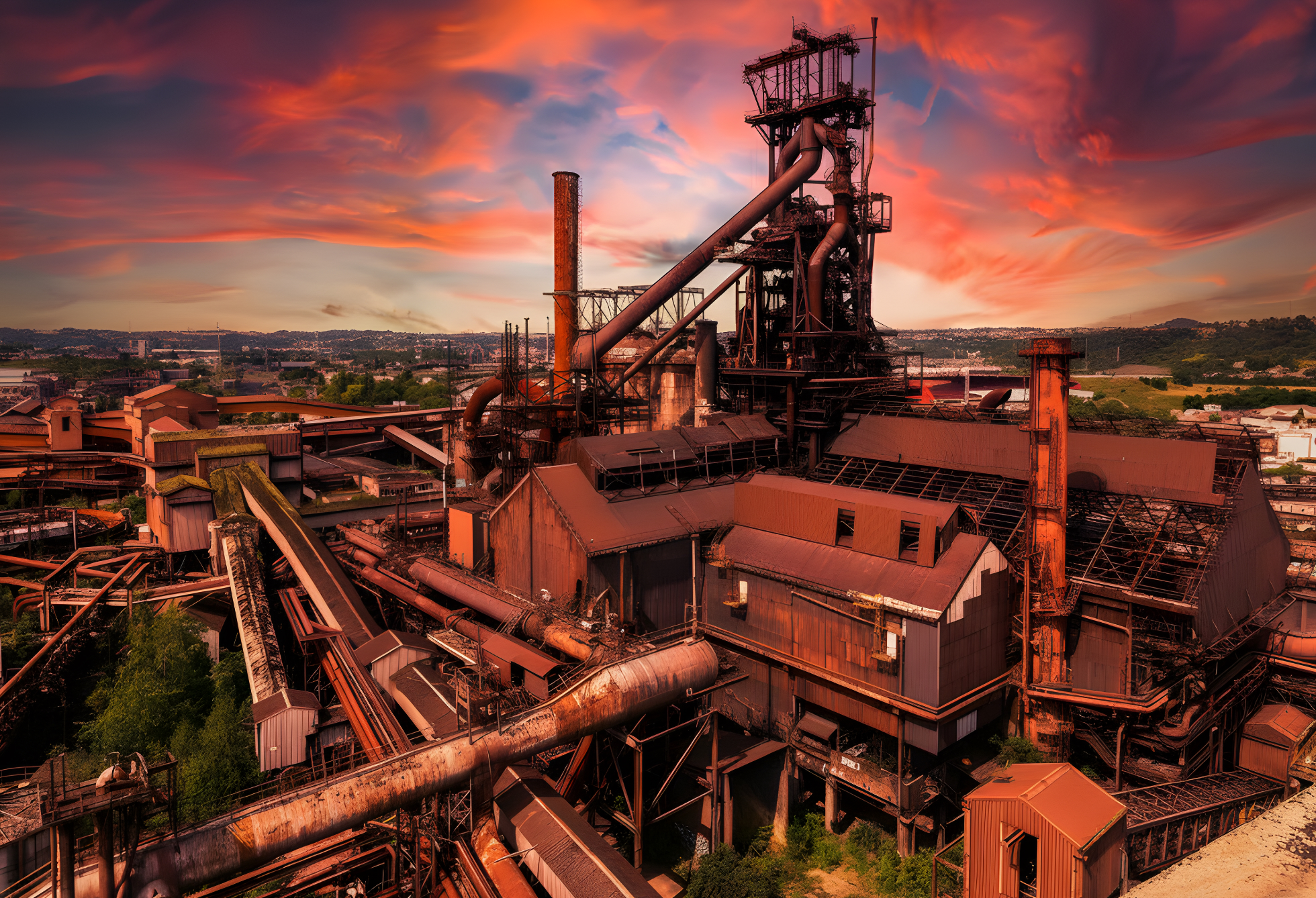
Beyond coal, however, industrial activity expanded into steel production as well, with output reaching, at the dawn of the twentieth century, 500,000 tonnes annually; and upon these basic industrial materials extracted from Walloon soil, further sectors of industrial production were erected too, allowing the development of the relevant know-how. Characteristic is the export of this know-how, reflected in the numbers of Belgians from Liège who settled in the regions of the Donbas and the Urals, with 20,000 people working in Tsarist Russia in steelworks, tram factories, and glassworks.
The crystal industry, with the company Cristalleries du Val Saint-Lambert at its forefront—founded in 1826—became an almost-monopoly in global exports from 1880 until the outbreak of the First World War, exporting mainly to Tsarist Russia, a country with which the city of Liège forged particular ties.
A business of enormous importance was also the Fabrique Nationale d’Armes de Guerre, known as FN, which had its headquarters on the northern side of the city, in Herstal, and was founded on 3 July 1889. With its presence, Liège was not only a city producing wealth, but also producing the means by which peoples would kill one another in the contest for its ownership.
Beyond the character of the city of Liège, however, in the nineteenth century the very map of it was changing too. The small islets, a result of the Meuse’s meanders, were not compatible with the need for rapid transport of industrial raw materials and their products. Thus, in 1850 a project was completed that drastically altered the morphological relief, with the cutting of the Liège–Maastricht canal, which to a great extent also created the present-day formation of the islet of Outremeuse.
The spiritual city of ecclesiastical schools and peasants had now given its place to the immensely wealthy industrialists and to a great working class—the industrial proletariat which was charging, with momentum, onto the historical stage, quite literally through the hell that was being constructed for its survival. Just as was happening in Britain, the living conditions of Liège’s proletarians were miserable: the absence of domestic hygiene, overcrowding in working-class neighbourhoods, and of course the workers’ exposure to every kind of disease, with whatever measures existed concerning only the isolation of these conditions in places outside the vital space of the bourgeois class, which remained the city centre. Employers, wanting to control the lives of their workers completely, took back their meagre income by controlling the whole of nightlife, and through entertainment ensured the workers’ productivity as well as the material return of the day-wages.
The proletariat of the Cité Ardente, however—genuine heir to the city’s traditions—did not remain idle in the face of destitution and of conditions that weighed most heavily in periods of crisis. One such year was 1886. A few months before the outbreak of the historic May Day strike in Chicago, the workers of Liège, celebrating the fifteenth anniversary of the Paris Commune on 18 March, organised an uprising that remained in History under the name Jacquerie Industrielle, which led to the bloodshed of the Fusillade de Roux; and despite the fact that it did not yield immediate fruit, it created something far greater for Belgian workers: the creation of the Commission du Travail and the rise of the newly founded Belgian Workers’ Party (Parti ouvrier belge – Belgische Werkliedenpartij).
The very dialectical nature of the city, beyond the historical split, was expressed, however, in the evolution of intellectual activity as well, following “to the letter” the needs of the era. In an intensely industrialised city there was a need for highly specialised personnel—engineers who would be placed on the front line of designing frenzied industrial growth. Within the framework of the University of Liège, founded in 1817 by the Dutch administration, on the initiative of Georges Montefiore-Levi—a politician and engineer born in the United Kingdom—the Institut Électrotechnique Montefiore was founded, which today is part of the Polytechnic School (Science Appliquées) of the University. Montefiore, returning from the International Exposition of Electricity held in Paris in 1881, proposed the need to found and operate a school with the exclusive subject of the applications of electromechanics in industrial Liège, laying the foundations for many generations of local, highly educated engineers, initially drawn exclusively from the bourgeois class. As for the entertainment of the ruling class, in the city centre, in the same period, the Théâtre Royal was founded and the Salle Philharmonique was inaugurated. Finally, the school education of the bourgeois class took place at the re-founded Collège Saint-Servais, in 1828, which revived the long tradition of the Jesuit college in the city dating back to 1582. In this college, beyond the seeds of the educational process, the seed was also planted that would yield the greatest footballing fruits in the city’s History.
The coming of the ball
In contrast to Britain—where, during the peak of the Industrial Revolution, in the second half of the twentieth century, the organisation of the working class, beyond trade unions, found expression also in football clubs—in Belgium football was not born as an institution “from below.” One possible explanation for this difference is that whereas in Britain football was the evolution of an occupation of the population across the centuries, which was codified and institutionalised in industrial cities, in Belgium there was no corresponding activity. The coming of football to Liège has more in common with the way it reached the Austro-Hungarian Empire at the end of the nineteenth century.
The bearer of football’s birth in Belgium was the bourgeois class, which, animated by admiration for the British way of life, tried to incorporate British sporting activities into the programme of its pursuits. Football and cricket appeared in every city, either as a pastime of Britons who were outside their homeland working for the “informal Empire”—that is, the countless enterprises of British interests on foreign soil—or as an activity of local elites. The first football club founded in Belgium was the Antwerp Football and Cricket Club, in 1880, that is, fifteen years before the Belgian Football Association was founded. Because of its antiquity, when in 1926 the list with the serial number of each club was published—something that accompanies the identity of every club in Belgium—Antwerp received the number 1. However, the Football and Cricket Club of Antwerp was not founded by locals, but by British employees in the rapidly developing port of Flanders.
In Liège, the first football club to be founded was, in 1892, FC Liège, which today is better known by the initials of its full name, RFCL. The founders of FCL were members of the cycling club, which was flourishing in a location where to this day the oldest institution of road cycling takes place, “Liège–Bastogne–Liège.” The members of FCL became carriers of the “football microbe” through contact with Britons who played the “strange game” in the central Parc de la Boverie, part of the islet of Outremeuse, as it had been shaped after the cutting of the Liège–Maastricht canal. The founding date of FCL made it a founding member of the Belgian Football Association, while later it received the serial number (matricule) 4. In the same period, in the province of Liège, Britons founded the Club Sportif Verviétois in 1896, a few kilometres to the south-east. But this was not the only footballing activity in the city.
From the middle of the 1890s, the pupils of the Jesuit Collège of St Servais founded their own team, which is known to have had red shirts and, as its emblem, the city’s monument, the so-called Perron. The Perron—which today has the form of a column placed atop a hexagonal construction with a fountain—is more than a monument of the city; it could even be characterised as an institution. It symbolises the protection of freedoms in the city of Liège, during the centuries of the Prince-Bishopric, but also in the years of secular authority. It is the symbol of its pride. Indeed, in 1467, Charles the Bold, Duke of Burgundy, after his victory over the Liégeois at the battle of Brustem, seized the monument and placed it in Bruges, in order to humiliate the proud and unsubdued inhabitants of the Fiery City.
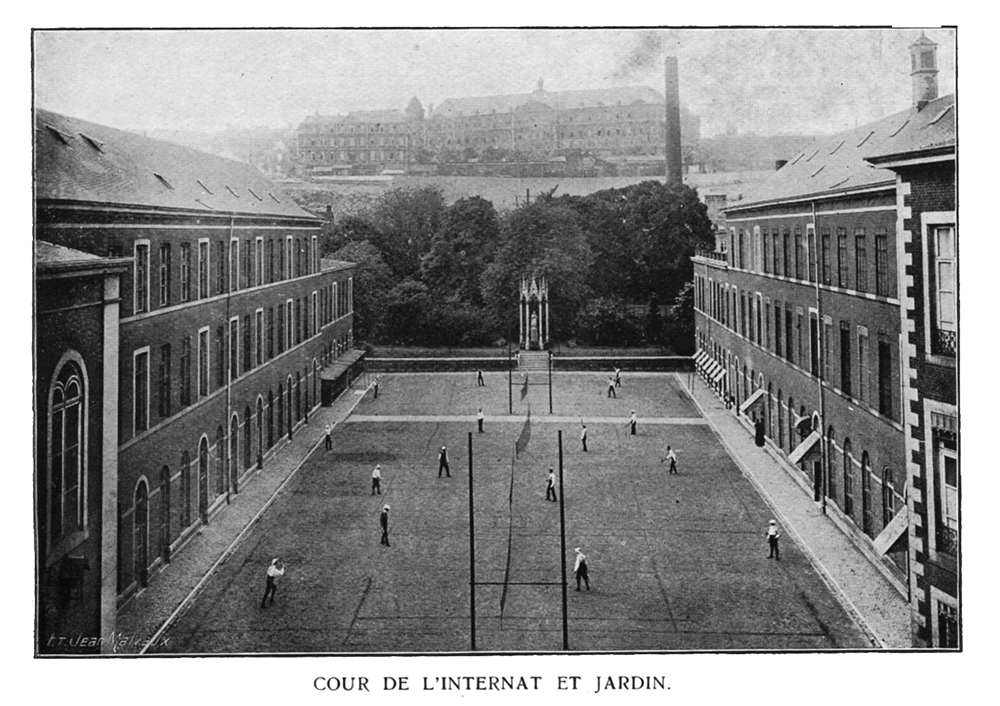
This symbol of Liège’s eternal pride and freedom was also adopted as an emblem by FCL, which shortly after its founding chose as its colours deep blue and red—“Sang et Marine”—as a reference to Dulwich, the area of origin of several of its British athletes. Yet these colours symbolised something more than a random choice among sporting companions: they were the reflection of an identity that would lead to a historic schism. As is easy to understand, FCL was the epitome of the Anglophilia of the bourgeois class of the era, with characteristics that were exceptionally outward-looking and almost one-directional toward Great Britain. Within its ranks, however, FCL also hosted for a short period the team of the pupils of the Collège St Servais, who were animated by the ideas of Muscular Christianity (Christianisme musculaire) and the local Catholic tradition. This clash of identities would soon lead to a historic schism, destined to play a decisive role in what followed.
In the summer of 1898, a group of pupils, led by the sixteen-year-old Joseph Debatty, decided on the secession of their club from FCL and the creation of a new club. It is extraordinarily interesting that pupils of that age had the ability—not only to become carriers and begetters of an ideological football identity—but also to create a new club, with all that this implies in terms of the practical and, above all, administrative demands of such a move. As it is historically recorded, on the first day of the school year—which must have been Thursday, 1 September 1898—the pupils decided on the creation of their own club. After a democratic process, the name Standard prevailed by one vote over the name Skill. These two names reveal a paradox: despite the fact that the pupils wished to disentangle themselves from the Anglophile club of FCL, they could not conceive of football without references to British culture. The name Standard, in fact—the one that prevailed—was inspired by Standard Athletic Club de Paris, an elite sports club with enormous British influence, which is also the first champion in the history of football in France, having won the 1893–94 competition. The Standard Football Club, with its fully British name, began its own course in a city in order to become the symbol of a population that, at its founding, had no absolutely no relationship with it.
The newly founded Standard, despite the fact that it was able to acquire legal standing, had an enormous problem in basic practical matters, one of them concerning kit. The pupils did not have the resources and the necessary network to equip their club properly. Thus there emerged yet another paradox: the shirts of the new club were lent by FCL—the club from which it had seceded. In that framework, of course, FCL viewed the pupils’ move more with sympathy, without feeling the fear of competition—History would, naturally, refute this perception. Yet History has recorded that the first deep-red shirts of Standard, without the Perron—since that was FCL’s emblem—were provided by the “old” club of the city. Standard would permanently be the younger team, characterised by matricule 16, and it took roughly half a century for it to manage to overturn the negative historical balance.
Against the Meuse
The schoolboy Standard, with the borrowed red shirts, began to play football in the open spaces of the city: on the hill of Cointe, which lies very close to the Collège St Servais, and on the opposite bank of the Meuse, in Grivegnée, which, although today it is a densely populated area, was then a large expanse of agricultural fields. Cointe, however, is yet another coincidence in the history of Standard and RFCL, since the older club of Liège also began its sporting activity there before descending toward the city centre. This cradle of the footballing culture of the Fiery City is synonymous with the privileges of the elite, since it was traditionally a leisure space of the ruling class, and had even been a private park. And if FCL came down from Cointe to meet the evolution of the “Athens of the North,” guided by the flow of the Meuse, the historical course of Standard went against the flow of the great river.
Joseph Debatty remained in the club’s presidency until 1902, before leaving in order to become a priest; and after quite a few administrative changes, in 1909, a certain industrialist, Maurice Dufrasne, came into the administration of the club—the man who would define the club’s historical identity, remaining in that position until 1931.
At the beginning of the twentieth century, Liège continued to experience the development that had begun in the nineteenth. A landmark year was 1905, when on 660 stremmata in the area of Vennes and Boverie the International Exhibition was organised. That year the bridge of Fragnée—of exceptional aesthetic quality, resembling the Alexandre III Bridge of Paris—was completed, as was the bridge of Fétinne, the Palais des Beaux-Arts, while the residential area of Vennes was created. This urban and construction development led to a great flourishing of Maurice Dufrasne’s personal finances as well; as a civil engineer and industrialist, from a family with a great tradition in the construction sector in Wallonia, he did “golden business.” But Dufrasne, beyond entrepreneurial flair, proved to be an outstanding football administrator too, in an era when that particular role differed little from a common hobby.

With the assumption of the club’s administration, Dufrasne decided that the nomadic club should acquire its own place—not in the “Athens of the North,” not in the city centre with its intellectual tradition, nor in Cointe, historically bound to the elite. Looking toward the southern side, where the chimneys of the ironworking and mineral-processing factories rose, where the workers lived, he saw humble, industrial, proletarian Sclessin as the natural space in which Standard would become the symbol of an identity that, until then, had had no symbols.
Literally turning its back on the historic centre, Standard began its course toward the southwest, “going up” the Meuse, in a mobilisation which, in the absence of means of transport, was carried out with builder’s wheelbarrows, inside which the members of the club transported everything needed for football to be played—from the goalposts, to Standard’s red kits, which matched perfectly the “unknown” working class it was going to meet. In 1909 came the first encounter of Liège’s proletariat with Standard, and since then their love has remained unextinguished and their passion, quite literally, fiery.
Standard’s fairy-tale began with great expectations; yet in order to move forward, the club—like the city, like the whole world—had to manage to survive the first great blow of the twentieth century. The outbreak of the First World War in 1914 made industrial Liège a target of German attacks, and its industrial infrastructure was almost completely destroyed by bombardments. In 1918, out of the ruins, the “miracle” that had taken a century to build had to be built again. And that is exactly what happened: a miracle, because within six years—by 1924—Liège’s industry had returned to its pre-war productivity. At the same time, Standard, which had played in the First Division for the first time in the years 1909–1914, returned to the top tier in 1921, in order to remain there to this day, recording 105 consecutive seasons in Belgium’s football elite—a number that constitutes a record.
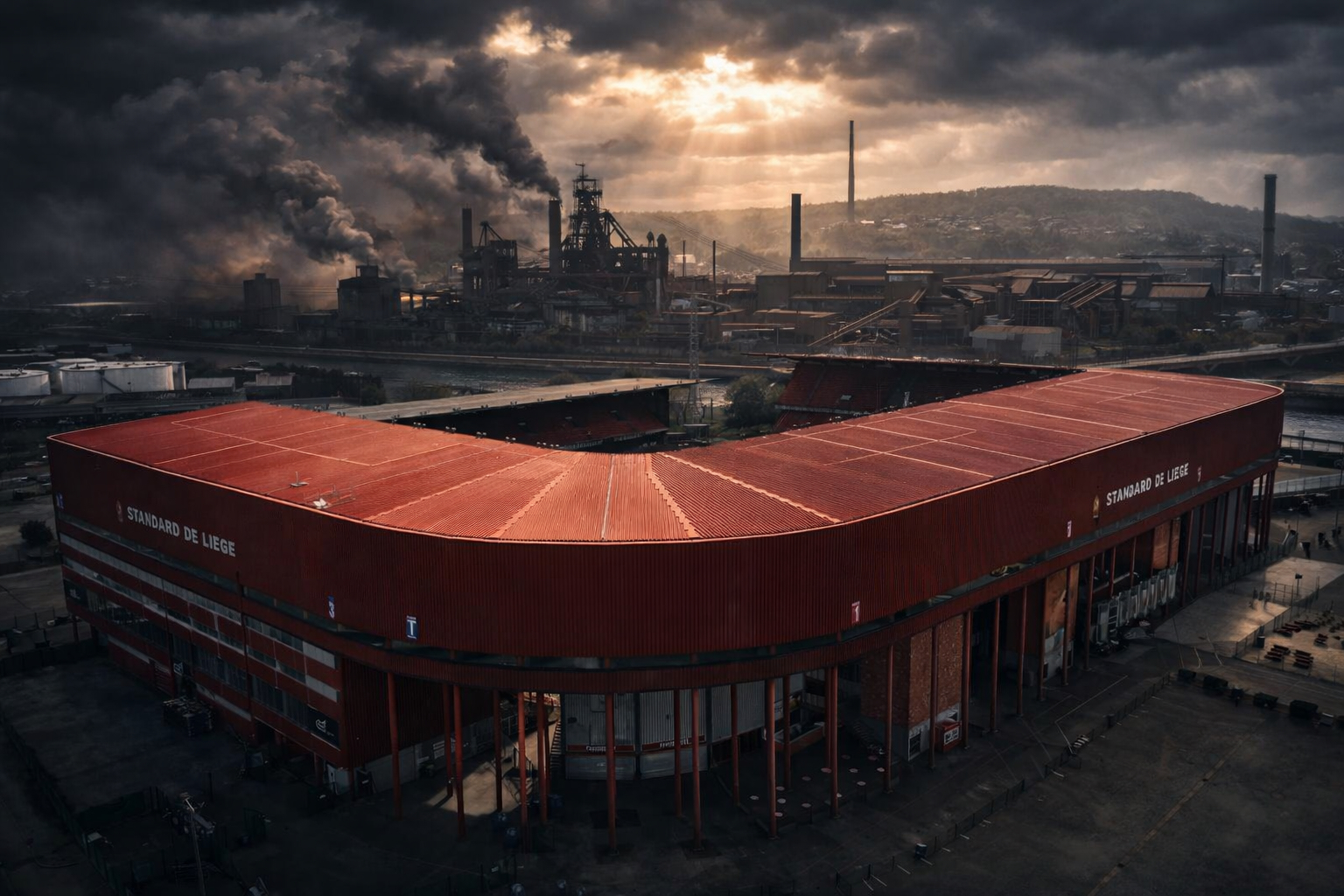
In the same period, Dufrasne proceeded to buy plots around Standard’s ground, moving on to the construction of a new structure, with concrete stands and a capacity of 24,000 spectators, in 1923. This stadium—the “hell” of Standard—built directly opposite the emblematic Cockerill factory, which today stands dominant as a monument to an irreversible era of coal and steel, has taken the name of its inspirer and is known to friends of football culture as the Stade Maurice Dufrasne.
And while the world was sinking to its knees once more under the effects of the so-called “crash” of 1929, in Liège the grandiose plans had no end. In 1930, the Exposition internationale de la grande industrie, science et applications, art wallon ancien was organised—more than an exhibition: the seal of industrial Wallonia’s participation in the Belgian national economy, set against the development of Antwerp, the great port, whose international radiance was also expressed through the hosting of the 1920 Olympic Games. On the occasion of the exhibition, new works were carried out in the city: the straightening of the Meuse, the construction of the barrage-bridge of Monsin and the bridge of Cornemeuse. Attendance, however, is disappointing: instead of the 12 million visitors that were expected, only 6 million arrive in Liège, a reflection of global economic conditions and of an era that smells of gunpowder.
The consequences of the global crisis hit Liège in 1932, with unemployment in Belgium reaching 20% and a huge General Strike breaking out across the country, which, despite the fact that it did not lead to material gains, contributed once again—after the uprising of 1886—to the radicalisation of Wallonia’s proletariat. The extraction of material victories did come, however, for the Belgian working class, four years later, when, with the General Strike of 1936—which began in the docks of Antwerp and had massive participation in Liège—paid holidays were instituted, the 40-hour working week, the recognition of trade unions, as well as wage increases of 7%.
As for the city’s development, shortly before the outbreak of the Second World War, in 1939, a project of exceptional importance for the Belgian economy was completed, as the Albert Canal connected the industrial centre of Liège with the port of Antwerp, making the port of Flanders the second largest in Europe.
The Second World War finds the proletariat of Liège once again defending its historical identity. The Nazi occupiers, unlike the destructive German machine of the First World War, chose not to dismantle the infrastructure but to operate it for their own benefit. Thus, labour exploitation—wage slavery—became subjugation to the foreign occupier-boss as well. In 1941, however, under conditions of destitution, the workers of Liège, with the Communist Party as the driving force of the movement, proceed on 10 May to the largest strike under occupation in History, the so-called “Strike of the 100,000,” because of the number of participants in it, which forced the occupation forces into concessions toward the local population, mainly concerning conditions of food supply.
Bandiera Rossa
The end of the Second World War would bring earth-shaking changes across the planet, but it would also mark the beginning of an entirely new chapter for the social history of Liège. If the Industrial Revolution created, in the spiritual city of the former Prince-Bishopric, an enormous and extremely radicalised proletariat, 1946 is the year in which the very composition of this proletariat would begin to acquire different and broadened cultural characteristics.
With the end of the War, together with the Nazi occupiers, some 65,000 German workers employed in Liège’s industry also departed. This departure created an immediate need for labour hands, which were found thanks to a bilateral agreement between Belgium and Italy, from which 50,000 workers arrived, unable to find work in their own country which had been brought to its knees by the fascist onslaught. In exchange, Belgium would export to Italy daily 200 kilograms of coal. The Italian workers arriving in Liège lived in huts (Nissen Huts) called cantines, under miserable conditions, essentially reliving the emergence of the industrial proletariat of the nineteenth century. The miserable living conditions were made even worse by social racism and ghettoisation, as well as savage exploitation in the workplaces, the escalation of which was the tragedy of Bois du Cazier, near Charleroi, in August 1956, which led to the death of 262 people and the termination of the bilateral agreement. But the proletariat of Italian origin became from then on an inseparable part of Liège’s working class, and its culture is encountered beyond the city and in the stands of the Maurice Dufrasne, where in many cases banners are hung with slogans written in the “language of Dante.”

A new—and indeed golden—era was opening for Standard as well, into whose administrative inner circle entered Roger Petit, an official whose historical contribution can be compared worthily with Dufrasne’s imprint. Petit, who had played as a forward at first and as a defender later, from 1931 to 1943, registering 207 appearances and scoring 8 goals, took on the duties of General Secretary in 1945 and remained in that position until 1984! Petit turned the club’s activities into an industry, adopting corresponding practices for everything around the club beyond the first team, which had to remain non-profit. In essence, he transformed Standard into an organisation upon which the very livelihood of a large part of the city’s population depended, with an emphasis on working-class Sclessin. Moreover, he worked intensively to win the football backstage, creating a rivalry of epic proportions with his alter ego at Anderlecht, Constant Vanden Stock—a rivalry that gradually, and through the clash of ideological identities as well, expressed itself in the development of the greatest inter-club antagonism historically in Belgium.
And if Standard was still not winning titles, even if RFCL was, in theory, the only big team of the city—winning its last championships in the 1952 and 1953 seasons—the proletariat of Liège was “conquering” Brussels too. In 1950, when the so-called Question Royale was in full swing—that is, whether the King of Belgium, Leopold III, would return to the throne—58% of Wallonia voted against the Monarchy. However, with 72% of the Flemish vote and a marginal result in the Brussels area, the Monarchy was restored and Leopold returned to his throne. The workers of Liège, who had suffered under the Nazi yoke, rose up against a king who had collaborated with the occupiers. The march of Walloon workers toward Brussels, on 30 June 1950, led to the bloodshed of the Fusillade de Grâce-Berleur, with four demonstrators dead. As a result, Leopold’s son, Baudouin, took the throne; yet the events left another legacy of democratic convictions for the city of Liège.
1954 was the year in which Standard would win the first trophy in its History. It was the play of fate, perhaps: one year after RFCL’s last championship, the epic began that would define the change of historical balances in the city. In March 1954, Standard bent Sint-Truiden’s resistance for the Round of 32, and in April it eliminated Club Brugge with an imposing 5–1, and Daring in the quarter-finals with 1–2. At the end of May, it prevailed over RFC Sérésien 2–5, in order to play in the great final of 6 June, at the Stade du Centenaire (also known as Jubilé or Heysel, and today the Stade Roi Baudouin). Against RC Mechelen, Standard opened the score in the very first minute, with Sébastien Jacquemyns as scorer, and before the tenth minute was completed Joseph Givard—playing at inside-right (8) in the era’s 2–3–5 system—doubled the Liégeois’ tally. In the 30th minute Mannaerts pulled one back for Mechelen, but in the 86th minute the captain and centre-forward of Standard, Fernand Blaise, locked the win and the title for his team, writing the final 3–1. This was Standard’s official entry into the club of the great sides of Belgian football.
This was also the excellent first season of a major personality who reshaped Standard on the pitch. In the summer of 1953, the French coach André Riou arrived in Liège—a former footballer from Moulins in northern Auvergne, who had previously linked his name with the club of Toulouse. Riou had played in the 1930s for Racing in Paris (after Hogan’s spell) and then for Toulouse, and from there began his coaching career. He had won the French Second Division in 1950 with the team of Stade Français – Red Star, before becoming Standard’s first professional coach, remaining in history as “the man with the beret.”
In his first year, Riou brought Standard its first cup, and in his last season he left an indelible seal on the club’s History, being the architect of a run that led to the first championship, in the 1957–58 season. In a race that lasted from the first to the last matchday, with title-holders Antwerp as rival, Standard managed to secure the title on level points thanks to a single goal, since in their head-to-head matches it had been defeated 1–0 in Antwerp, but had won 2–0 in Sclessin. The first champions in Standard’s colours were Toussaint Nicolay (goalkeeper), Jean Mathonet (captain), Maurice Bolsée, Gilbert Marnette, Henri Thellin, Joseph Happart, Karel Mallants, Jean Jadot, Joseph Givard, Jean Van Herck, André Piters—also known as Popeye—Denis Houf, and Marcel Paeschen.

Winning the championship also meant Standard’s first entry into European competition the following season. With a new coach, the Hungarian–Czechoslovak Géza Kalocsay—a footballer for Sparta Prague who had won the Mitropa Cup in 1935—the European run of the newly crowned Standard in the relatively young institution of the European Cup was more than satisfactory. In the first round, it overcame the obstacle of Scotland’s Hearts, winning 5–1 in Sclessin and losing 2–1 away, while in the Round of 16 it faced the great Sporting of Lisbon, whom it beat away 2–3 and dismantled 3–0 in Liège. In the quarter-finals the opponent was Reims of Just Fontaine, who in the summer of 1958 had emerged as top scorer of the World Cup in Sweden with 13 goals (a record that to this day has not been surpassed). Reims, which had played a few years earlier in the competition’s inaugural final, found things tough in Liège, with Standard winning 2–0 thanks to goals by Jadot and Givard; but in the return leg, a goal by Piantoni and two by the supreme scorer Fontaine deprived Standard of a great qualification.
Standard would find itself on top of Belgian football again in a year that was also “coloured” by the action of its proletarian element. On 30 June 1960, the historic gold mine (or diamond mine) of Belgium—a country that became a symbol of harsh colonial exploitation—Belgian Congo, became an independent country: the Republic of the Congo, with Patrice Émery Lumumba as its first prime minister, who was assassinated in September of the same year. The economic consequences for Belgium were immense, which led Prime Minister Gaston Eyskens to propose the imposition of a programme of strict austerity, the so-called Loi Unique, in order to absorb the debt crisis that arose from the loss of the African reservoir of blood-stained wealth. The response of Walloon workers was the terrible strike of that winter, led by André Renard from the FGTB union, which escalated on 6 January 1961. Although the law ultimately passed on 14 February, the events of that year highlighted a political schism between Belgium’s linguistic regions, with Walloon workers acquiring a distinct “national” ideological identity, which evolved in various ways and ideological offshoots across the different political shades of “Walloonism.”
At the very moment when the red flags of the FGTB were forming new complex political identities, however, the red shirts of Standard, in Kalocsay’s last season, once again found the road to triumph—in a championship historic for the city of Liège, since Standard took the title, leaving RFCL second, with that victory showing something more than the balance of the moment: a historical trajectory. This would also be the first championship of a decade in which only Standard and Anderlecht would alternate at the top, creating the great bipolarity of Belgian football. The hero of that team, and the top footballer of the season, was Jean Nicolay, a goalkeeper born in 1937 in the district of Bressoux, who also played 39 times for Belgium’s national team.
Les Rouches
During the 1960s, Standard would consolidate its status as one of the giants of Belgian football and become a reference point for Walloon football as well, with the club’s reputation spreading far beyond the national borders, as its successful European campaigns made it, in effect, an ambassador of the city of Liège across the entire Old Continent. With the modernisation of football following through television, the image from Sclessin could reach far beyond the city’s limits, and through the commentaries—above all those of Luc Varenne, who worked at the French-language public broadcaster RTBF—the club’s most popular nickname became known: “Les Rouches,” which is nothing more than the utterance of the word “les rouges” (“the reds”) with the particular accent of Liège.
The same modernisation was reflected in the image of the city of Liège too, which for yet another era was being transformed—not necessarily as dreamily as it had been designed. A major plan to create an underground bus station at Place St Lambert remained stalled for many years, leaving for decades a hole in the city centre. In 1967 the Cité Administrative building was constructed, one of the city’s first skyscrapers, designed by the architects Jean Poskin and Henri Bonhomme. In the same period, in Droixhe, an area was planned that aspired to become the paradise of the modern way of urban living. A series of prominent artists—such as Jo Delahaut, Pol Bury, Georges Collignon, Jean Rets, and others—adorned with their works the entrances of the new residential tower-block complexes. All of this was part of an urban-development plan that included everything needed for a comfortable life: shops, open play areas, sports facilities, schools, libraries, a medical centre, and a large cinema.

Standard, representing a city in full industrial ascent, triumphed in Europe, as its return to the European Cup was marked by yet another astonishing run. In the 1961–62 edition it managed to beat, in succession, Fredrikstad and Haka from the Scandinavian countries, in order to face, in the quarter-finals of the competition, the very powerful Rangers of Glasgow. In the first match, at Sclessin, Claessen opened the scoring for the Rouches in the 7th minute, before Wilson equalised in the 18th. But with two goals by Crossan, in the 40th and 51st, and one more by Vliers in the 56th, Standard took an excellent advantage, in order to find itself one step further from where it had reached in 1959. In the return leg at Ibrox, Rangers went ahead through Brand in the 28th minute, but they could not score more in order to cover the negative margin of three goals. In the end they managed only to reduce it, with a penalty taken by Caldow in the 89th minute, and thus Standard took the great qualification for the semi-finals, where it would face the five-time champions of Europe, Real Madrid, which the previous season had lost its crown to Benfica. The semi-finals, played on 22 March and 12 April, were a much more difficult affair, and Standard, with two defeats, did not manage to reach the final in Amsterdam.
In the 1962–63 season, in a championship contested with serious claims by at least six teams, Standard overtook Anderlecht at the top of the table on the 20th matchday, with ten still remaining to the end of the season. Five matchdays later Standard had achieved four more victories, and Anderlecht only a single draw, with Antwerp and RFCL sitting six and seven points off the top respectively. This great gap (with the 2–1–0 points system of the time) seemed in danger only after Anderlecht’s visit to Sclessin and Standard’s 0–1 defeat, on the 26th matchday (which was the postponed 23rd). With four wins in the last four matches, however, the Standardmen celebrated yet another national title, reaching three championships, and having in their ranks the most valuable player of the league: the goalkeeper Jean Nicolay, who was evolving into a legend of Sclessin.
In the next three years Standard was not in a position to compete in the league with its sworn enemy Anderlecht, but on 8 June 1966 the opportunity was given for the great clash of the two giants, in the Cup final played at Heysel. Standard, whose technical leadership was held by the Yugoslav Michel (Milorad) Pavić, prevailed thanks to the goal scored in the 32nd minute by the Limburg defender Nico Dewalque, achieving a victory laden with symbolism: beyond the fact that it bent the resistance of its great rival, it now had in its trophy cabinet three championships and two cups, drawing level with the five trophies (championships) of its fellow city club RFCL.
This Cup triumph, however, was also the ticket for yet another triumphant European run, in the 1966–67 Cup Winners’ Cup. In the second-tier European competition, Standard eliminated Valur of Iceland, with the match at Dufrasne ending in an emphatic 8–1, while in the following rounds it passed its examinations successfully against Apollon Limassol and Chemie Leipzig. In the quarter-finals the obstacle of Vasas proved more difficult, as on 1 March 1967 the Hungarians won 2–1 in Györ, with Semmeling nevertheless scoring a “golden” (as it proved) goal in the 85th minute. In the return leg, Claessen and Jurkiewicz wrote the 2–0 for Standard, which, within a decade, found itself for the second time in the semi-finals of a European competition, surpassing RFCL even in this informal comparison, as RFCL had earlier reached the semi-finals of the Fairs Cup, the ancestor of the UEFA Cup. In the semi-finals, although it did not suffer a rout as had happened against Real in 1962, it was defeated 2–0 away and 1–3 at home by Bayern Munich, losing the chance to contest the European trophy in the final in Nuremberg.
With the end of the decade, what remained was the dethroning of Anderlecht from the summit of the Belgian league, which in those years dominated without great pressure. This happened in the 1968–69 season, when under the guidance of René Hauss, who had come from RC Strasbourg, the Rouches rediscovered the promised land. The protagonist of that season was Wilfried Van Moer, the midfielder born in 1945 in Beveren, who was named the league’s most valuable player for the second time, after having done so in 1966 as a player of Antwerp. The spearhead of the Liégeois attack, however, was the Hungarian Antal Nagy, who in 28 league appearances sent the ball into the opponents’ net 20 times.
The following season Nagy departed via transfer to Antwerp, but Hauss’s Rouches—with Van Moer as leader and protagonist, winning again the title of the league’s most valuable player—made an astonishing run with 22 wins, 5 draws, and 3 defeats, in order to win the championship for a second consecutive year, for the first time in their history. This meant that Standard now had as many championships as RFCL, had a stable presence in European competitions, and had emerged as the de facto representative of Walloon football through a dispute with Anderlecht that left a legendary historical legacy. Hauss’s golden three-year spell was completed the following season, in which Standard, with the German Erwin Kostedde as a super-weapon in attack—scoring 26 goals in 27 matches—managed to finish the league race one point ahead of Brugge, despite being handed a forfeit in the away match against Antwerp (which Standard had won 0–2) for using more than the permitted number of foreign players on the pitch.
The death of coal and the swan song
This golden three-year spell, and the absolute dominance of Standard and Anderlecht in the Belgian league, would end at the beginning of the 1970s—a decade in which the European dream of prosperity also came to an end. In many countries of Western Europe, the existence of the “glorious thirty” (trente glorieuses) years has passed into collective memory: the three decades from the end of the Second World War up to the mid-1970s. The breakneck development of European, and more broadly Western, capitalism—which, under the weight of ideological competition with the socialist camp and the existence of strong workers’ movements in every country, was able to concede rights and better living and working conditions to the working class of these countries—was reaching its end. The so-called “oil crisis,” which manifested as a crisis of overaccumulation of capital in 1973, coincided with the entry into the global energy market of countries outside the traditional European and North American space of energy production. Japan and Brazil entered as strong players in the energy market, at the very moment when coal was no longer the necessary primary energy material industry required, as it had in previous decades, and steel was being produced more cheaply elsewhere. Thus, the great wealth-producing zone of the Carboniferous basin began to live through a great historical downturn.
In Liège, this reality is reflected in the numbers of those employed at the emblematic Cockerill factory. In 1957, 45,000 people worked at that specific plant, while just before the blow of the great crisis, in 1974, that number had reached 65,000. A decade later, in 1984, only 18,700 workers constituted the workforce of the historic factory, with the number falling to 12,100 workers in 1988.
The economic downturn in the city of Liège was reflected in Standard’s course as well, which, despite the fact that it stood at the centre of the skirmishes of football’s backstage thanks to Roger Petit, could not match the teams of Flanders worthily, with Brugge emerging as a new great power of Belgian football, winning in 1973 its first championship (and second overall) after 53 years. By the end of the decade, however, Brugge had reached a total of six championships, drawing level with Standard in the relevant historical table, while in 1978 it played in the final of the European Cup, losing at Wembley to the great Liverpool of Bob Paisley with a goal by Dalglish in the 64th minute.
It took almost a “dry” decade for the moment of the last triumphs to arrive—triumphs that were, in essence, the swan song of that golden era for Standard. It was the era marked by the presence of some of the greatest legends of Belgian football at Sclessin. Outstanding among them was Eric Gerets, right-back, born in Rekem in 1954, who remained in History with the nickname “the lion of Rekem.” In eleven seasons wearing Standard’s shirt, Gerets wrote 413 appearances, scoring 30 goals, before transferring to Milan. Another great figure was the legendary Belgian goalkeeper Michel Preud’homme, born in 1959 in Ougrée, on the southern outskirts of Liège. On Standard’s bench sat a towering figure of European football, the reformer of Brugge, a coach who linked his name with the course of Central European football after the epic of the Danubian School: Ernst Happel.

This legendary Standard side found its first title on 7 June 1981, when it faced Lokeren at Brussels’ Heysel for the Cup final. The victory of the Rouches was more than comfortable: with goals by Edström, Daerden, Tahamata and Önal—that is, four players of four different nationalities, before the post-Bosman era—it won 4–0 to add the 4th cup to its trophy cabinet. But in 1981 one more significant event happened for Standard, even if it was not under its control. At the end of the season, Beerschot, a team from the southern outskirts of Antwerp, was relegated, despite having finished 15th in an 18-team championship, because of the exposure of a scandal by the club of Beringen. The case led to its relegation and thus ended a streak of 65 consecutive presences in the elite. From the 1981–82 season, Standard would be the club with the longest uninterrupted presence in the first division of Belgian football.
The 1981 cup was only the beginning for that team, which in the 1981–82 season excelled, recording perhaps the best season in the club’s history. On the bench, Ernst Happel was replaced by Raymond Goethals, the coach who would later win the Champions League with Marseille, thus setting a milestone in French football. Standard of Gerets and Preud’homme was strengthened by the arrival of Arie Haan, midfielder of the legendary Ajax of the early 1970s, who came down to Liège after a six-year stint at Anderlecht.
In the league, Standard, with a steady but not supersonic run, managed to prevail, finishing the season ahead of Anderlecht and adding the 7th championship to its trophy cabinet. But the season was marked by the monumental European run in the Cup Winners’ Cup. In the first round, Malta’s Floriana proved an opponent far beneath expectations, with the score at Sclessin stopping at 9–0. In the second round, an old acquaintance, Hungary’s Vasas, this time did not make things difficult for Standard, which, with wins of 0–2 away and 2–1 at home, moved on to the next round. In the quarter-finals, however, the opponent was the rising Porto, which did not yet dominate Portuguese football, but was beginning a path that a few years later would reach the European summit. Standard managed, with a goal by Engelbert and an own goal by Gabriel, to win 2–0, so that when Jean-Michel Lecloux scored at the Estádio das Antas it had essentially locked the qualification, in the return leg which ultimately ended in a 2–2 draw. The great challenge was, of course, the semi-finals, where Standard had to go further than the previous two times. The away match laid the foundations, since thanks to Daerden’s goal the Rouches left Lenin Stadium in Tbilisi as winners, against the local Dinamo; and in the return leg, once again Daerden made the same scoreline to send the Standardmen to the final in Barcelona.
When the final of a European competition takes place at Camp Nou, under the gaze of 100,000 spectators, the last opponent one would want to face is surely Barcelona. The Catalan legendary side was, however, Standard’s opponent on the night of 12 May 1982, and despite that the match began very well for the Walloon team, as Guy Vandermissen opened the scoring for the nominal—and above all, the substantive—visitors in the 8th minute. On the stroke of half-time, however, Barcelona equalised through Simonsen, and in the end Quini, with a goal in the 63rd minute, deprived the history of Standard of a European title.
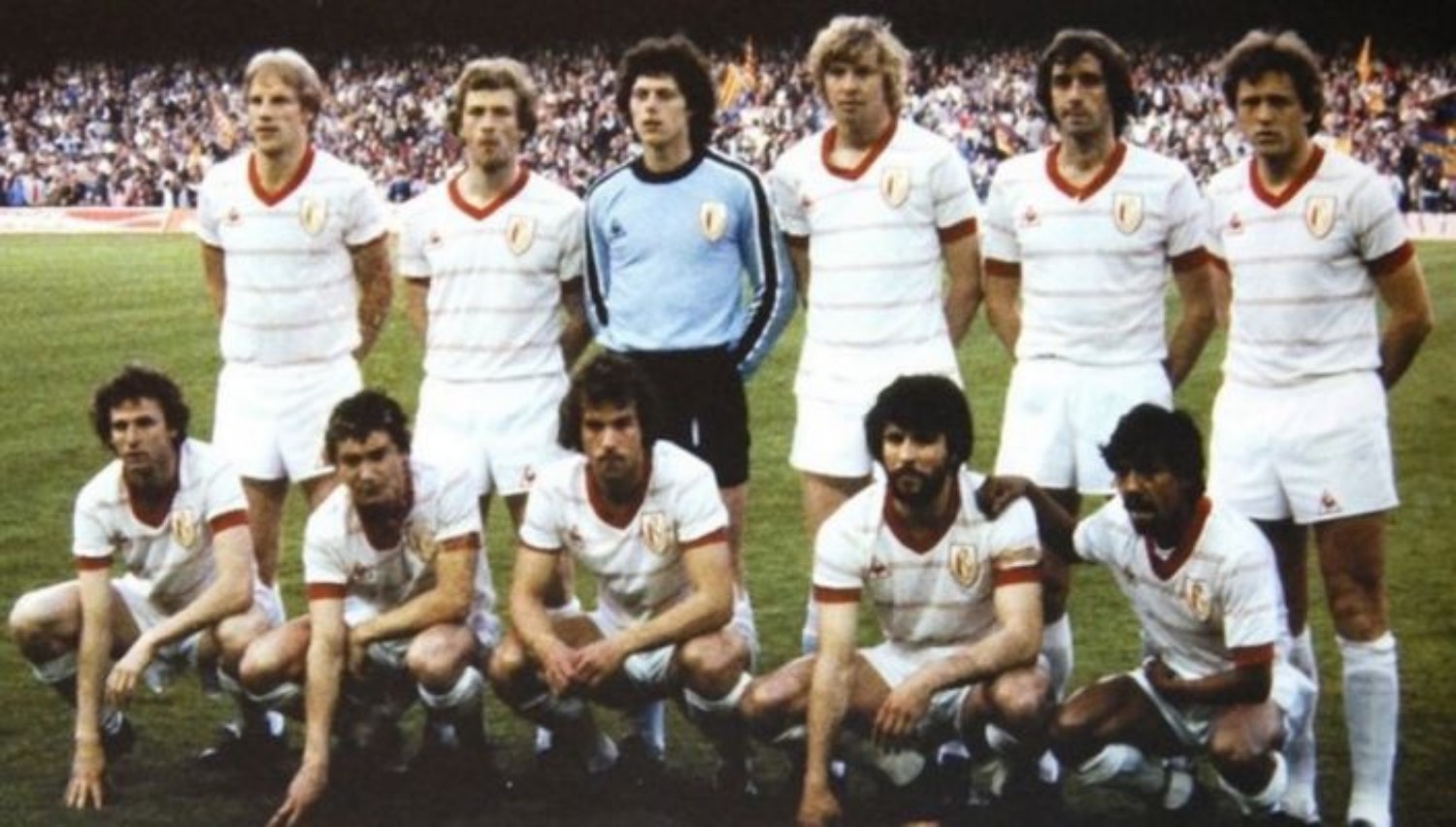
The 1982 season, however, beyond the European final, was also marked by the Standard–Waterschei scandal. The two teams were playing each other at Sclessin for the final matchday of the league, on 8 May, while on the 12th of the same month Standard would play a European final in Barcelona. Standard’s away defeat to Waregem on matchday 31, on 18 April, had brought the situation to a razor’s edge, with the Rouches only one point ahead of Anderlecht. After that, Anderlecht drew on matchday 33, with Standard now two points clear and needing only a draw in the last match to win the championship. In order to secure the league title, but also to protect players from injury for the European final, Roger Petit moved in the shadows to agree a favourable result for his team. In the end, Standard won that match 3–1—even though the draw that seems to have been agreed would have sufficed—but the scandal would have historic consequences.
Goethals’ Standard became the second team in the club’s history to win two consecutive championships, in 1983, while at the same time rising to 3rd place in the UEFA club ranking that year, level with the legendary Liverpool, behind Barcelona and Real Madrid. However, the investigation and clarification of the Standard–Waterschei scandal brought Petit’s responsibilities to light, ultimately leading to his removal from the club he had served for almost 40 years. This was a shock for Standard, which at its peak was losing its most important—and certainly its most emblematic—administrative figure. In a climate of decline, with Liège turning into the ghost of a dream of the past, the effective ghettoisation of Droixhe’s “paradise” and the city’s stagnation, the epic of Goethals’ team was the swan song not only for a club, but also for the symbolism of prosperity and development in a city that had embodied the industrial locomotive of Western Europe for roughly a century.
The hard years
On the one hand, Petit’s removal, and on the other, the economic conditions worsening in the city of Liège, composed a setting in which it was far more difficult for the previous growth to continue. In 1977, the architect of post-war Standard, Paul Henrard, had already stepped down from the club’s presidency, while Charles Huriaux, who held the administrative reins of the club during the period of its last triumphant run, handed over the baton in 1986 to Camille Heusghem. In the leagues that followed, Standard was unable to reach the level of Anderlecht and Brugge, who formed a new bipolarity—one that lasts to this day—which does not have the same ideological depth as Standard’s rivalry with Anderlecht, but sits at the centre when it comes to contesting titles. Indeed, in the 1987–1988 season Standard finished the league in 10th place, even losing primacy within the city of Liège itself after many years, as RFCL finished 5th, having amassed 14 more points.
The same picture, with the RFCL reborn at the end of the 1980s, was repeated the following season, and Standard—which in 1988–89 was equalling Beerschot’s record of consecutive presence in the First Division—saw its historic rival within the walls in a position that could turn upside down a reversal that had taken place in previous decades. In 1988, however, the club’s fortunes were taken up by Jean Wauters, a businessman born in industrial Herstal, in the north of the city, who undertook to reinvigorate the team of Sclessin. In 1989–90, Standard became the team with the most consecutive presences in the history of the First Division, but RFCL, which finished 12th in the league, achieved an unexpected triumph. On 19 May, the sworn enemy, guided by Robert Waseige—a coach who linked his name with the history of Standard, but also more broadly with Walloon and, overall, Belgian football—defeated Germinal Ekeren 2–1 at Heysel, to bring a title back to the other side of Liège, increasing the pieces in its trophy cabinet after 37 years, and in the same season reaching the quarter-finals of the UEFA Cup, where it was eliminated by Werder Bremen.
The beginning of the 1990s, however, showed that this course of overturning balances would not continue. In 1992, Standard found its way back into Europe, taking 3rd place in the league, at a moment when RFCL was once again at the bottom of the table; and in 1993, Standard of Arie Haan—who had now returned as coach—faced Waseige’s Charleroi in the Cup final and, inside the Vanden Stock Stadium of the hated Anderlecht, which bears the name of Petit’s eternal personal rival, won with goals by Henk Vos and Philippe Léonard yet another title.
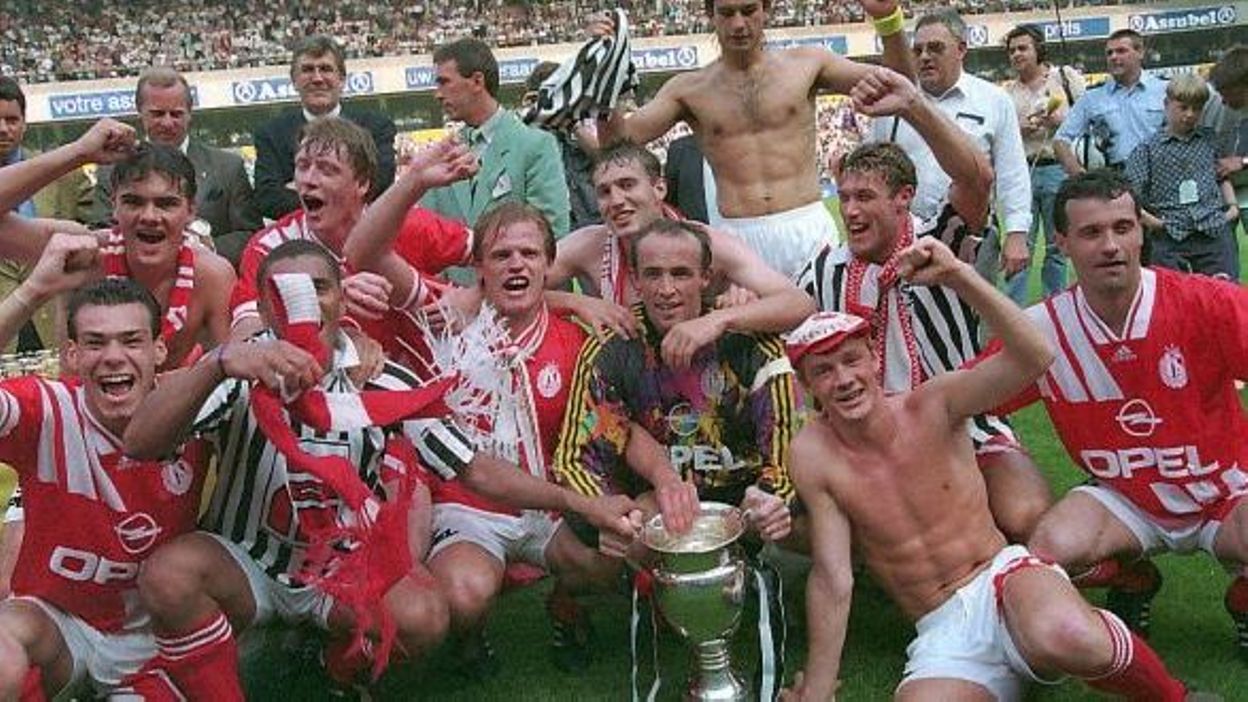
In the far more commodified era of football that began in the early 1990s, the clubs of deindustrialised Liège were struggling to find their stride. Standard managed to contest the 1994–95 championship until the very end, which it lost by a single point to Anderlecht; yet that season was a coup de grâce for RFCL, which, under the weight of financial problems, collapsed, finishing in last place and bidding farewell to the top flight after 50 consecutive seasons. In addition, Liège found itself at the centre of global football interest, as the case of an RFCL player demanding the right to be able to play in any country of the European Union on the basis of Community law changed forever the terms of the business game in football. Jean-Marc Bosman—who had played for Standard for five seasons between 1983 and 1988, registering 86 appearances and 3 goals—moved to RFCL, for whom he played only three times. Demanding the application of the Treaty of Rome to football as well, he delivered a crushing blow to the old methods of club governance in Europe; and he himself became a victim of the situation, unable to find a club to play for again, and later watching his life fall apart. But RFCL too was a victim of this situation: it found itself on the brink of destruction, was forced to merge with FC Tilleur in order to survive and to keep the historic matricule 4, and over the past 30 years has found itself in the first division for only one season.
Mediocrity, however, also characterised Standard’s course, which, even though it had “cleared” the landscape in the city—evolving into the only club representing it in the elite of national football—could not rediscover the glories of previous decades, limiting itself to positions that led only to a handful of Intertoto appearances, far from the protagonists of the era. This second descent reached its nadir in 1998, when Standard finished the league in 9th place, having collected across the season almost half the points of champions Brugge (43 against 84). In this gloomy moment appeared Robert Louis-Dreyfus, a French businessman who at the time was also CEO of Adidas and at the same time owner of Marseille. Dreyfus reorganised the club, placing particular emphasis on the academies, from which in the following years emerged some of the most emblematic players of Belgian football, such as Steven Defour, Axel Witsel, and Marouane Fellaini. Dreyfus was essentially the first owner of Standard who kept pace with the demands of the new football industry, and Standard was able—at least at first—to avoid a fate comparable to that of RFCL.
The post-industrial era
Entering the twenty-first century, Liège looked like a remnant of the past: with an industry that elsewhere had vanished and elsewhere was dying slowly, and with the necessity of finding a new plan for the city’s survival and development. Its strategic position—the one Bishop Monulphe understood fifteen centuries earlier—became the basis for the development of a new design. The greatest infrastructure the city inherited from the Industrial Revolution was its river port, the third largest in Europe, which is connected to the continent’s two largest ports, Rotterdam and Antwerp. Liège is also a crossroads between many important cities, such as Brussels, Antwerp, Luxembourg, Maastricht, Rotterdam, Aachen, Cologne, Strasbourg—even Paris, which by road is four hours away, only two with the TGV. Thus, the choice was almost obvious: to begin transforming into a transshipment hub, with the creation of a huge cargo airport and the development of high-speed rail lines that complement the existence of its port.

At the same time, the age-old polarity between industry and intellectual centre found, this time, a synthetic outlet by placing weight on the latter. The strengthening of innovation, in the Sart-Tilman area, around the University, became a priority, with the attraction of companies active in the fields of biotechnology and space. But this solution, even if it could offer an outlet for the capital that was in—or passing through—the city, could not solve the problem of survival and work for the enormous industrial proletariat that was also the legacy of a centuries-old course of hyper-exploitation of the city’s productive capacities. At the same time, this proletariat, which had first been grafted with Italian workers, then with Greek and Spanish political exiles, and later with workers from Morocco and Turkey who also came through bilateral agreements, began to include refugees from places of war and total destitution, who arrived in caravans from countries of Africa and Asia, creating a multicultural mosaic of poverty and deprivation across a large part of the city, and a few islets of high specialisation and intense capital investment. These two worlds seem not to meet: the city’s geography is such that it allows them to coexist, yet never to touch one another.
But Standard is the team of industrial, proletarian Sclessin, opposite the Cockerill factory which in 1998 was privatised and passed into the hands of France’s Usinor, in order to decay under its new owners and finally to close in 2014. It is the team of workers who face, steadily, double-digit unemployment rates in the twenty-first century, and the presence of Louis-Dreyfus at the beginning of the millennium could only be described as the presence of a Messiah, as far as the club’s football results were concerned.
Standard, which in the 2000s had almost nailed down the unofficial 3rd place in the hierarchy of Belgian football’s strength, behind Anderlecht and Brugge, saw a great footballer wear its shirt again in 2004. Sergio Conceição, after an unsuccessful second spell at Lazio and a brief passage through Porto, arrived on Walloon soil. His first year at Standard was astonishing: in 34 appearances he scored 11 goals, bearing great responsibility for the creation of the team’s play under Dominique D’Onofrio, who had succeeded Waseige after his last spell at Sclessin. Conceição was named the league’s most valuable player in 2005, with Standard finishing 3rd, and there being, in the commodified era of the sport, a reason for a player’s shirts to be sold throughout the city and even beyond.
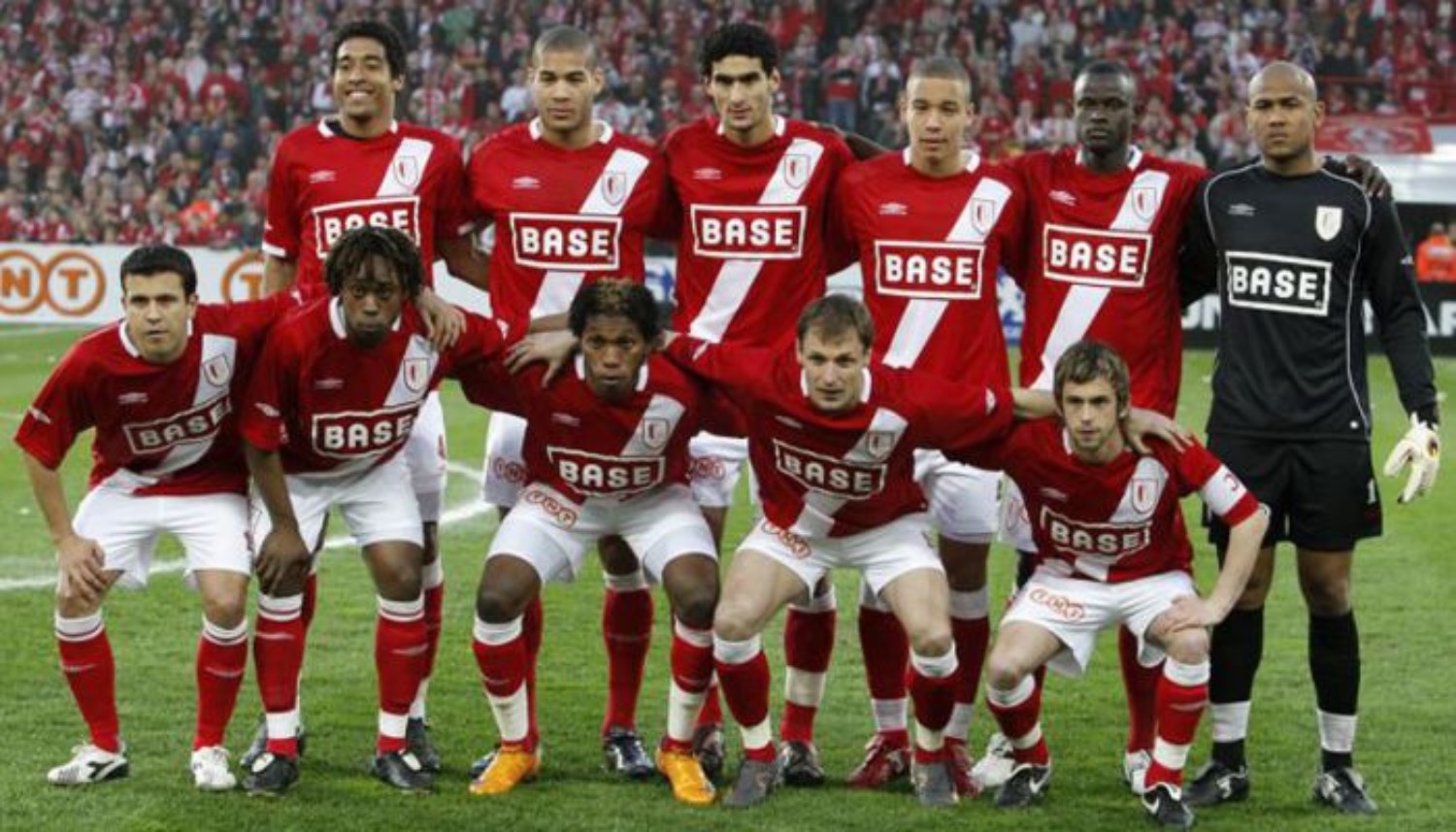
The era of triumph returned in the 2007–08 season, with Standard by then having been steadily in the league’s top three. On the bench stood the emblematic goalkeeper of Standard and the Belgian national team, Michel Preud’homme, and on the pitch the 20-year-old Axel Witsel was leading the Rouches, who on the 4th matchday found themselves at the top of the table for the first time, overtaking Ghent. Following Brugge for a long stretch through the winter, Standard found itself back on top on the 24th matchday, in order to win a championship by the greatest margin in its history, finishing the season with 22 wins, 11 draws, and just one defeat—away to Charleroi.
The feat of the teams of the early ’70s and ’80s was repeated in 2009, with Standard winning again a second consecutive title, this time under the leadership of the Romanian coach László Bölöni, already known for his spell at Sporting Lisbon, which went hand in hand with the development and utilisation of the academies’ talent—something that was a primary objective of Louis-Dreyfus’s plan for Standard.
But on 4 July 2009, Louis-Dreyfus died, after a long battle with leukaemia, and the Swiss Reto Stiffler, who had been acting as chairman during his ownership, sought to find hands to which to transfer the club’s fate. Initially, Roland Duchâtelet, a businessman from Liège who would later enter politics, took over the club until 2015, before the shares passed into the hands of Bruno Venanzi, a businessman descended from the Italians who had arrived in the city. In the 2010s, Standard managed to win three cups (2011, 2016 and 2018), but Venanzi’s stewardship was disastrous: the debts ballooned and, with the outbreak of the pandemic, the situation became unbearable and the club was even at risk of bankruptcy. What Venanzi did not manage to do through bad management, however, the 777 Partners group almost managed to do: by buying a series of clubs and creating a football network, it drove the club to the absolute financial nadir—one step before the seizure of its assets!
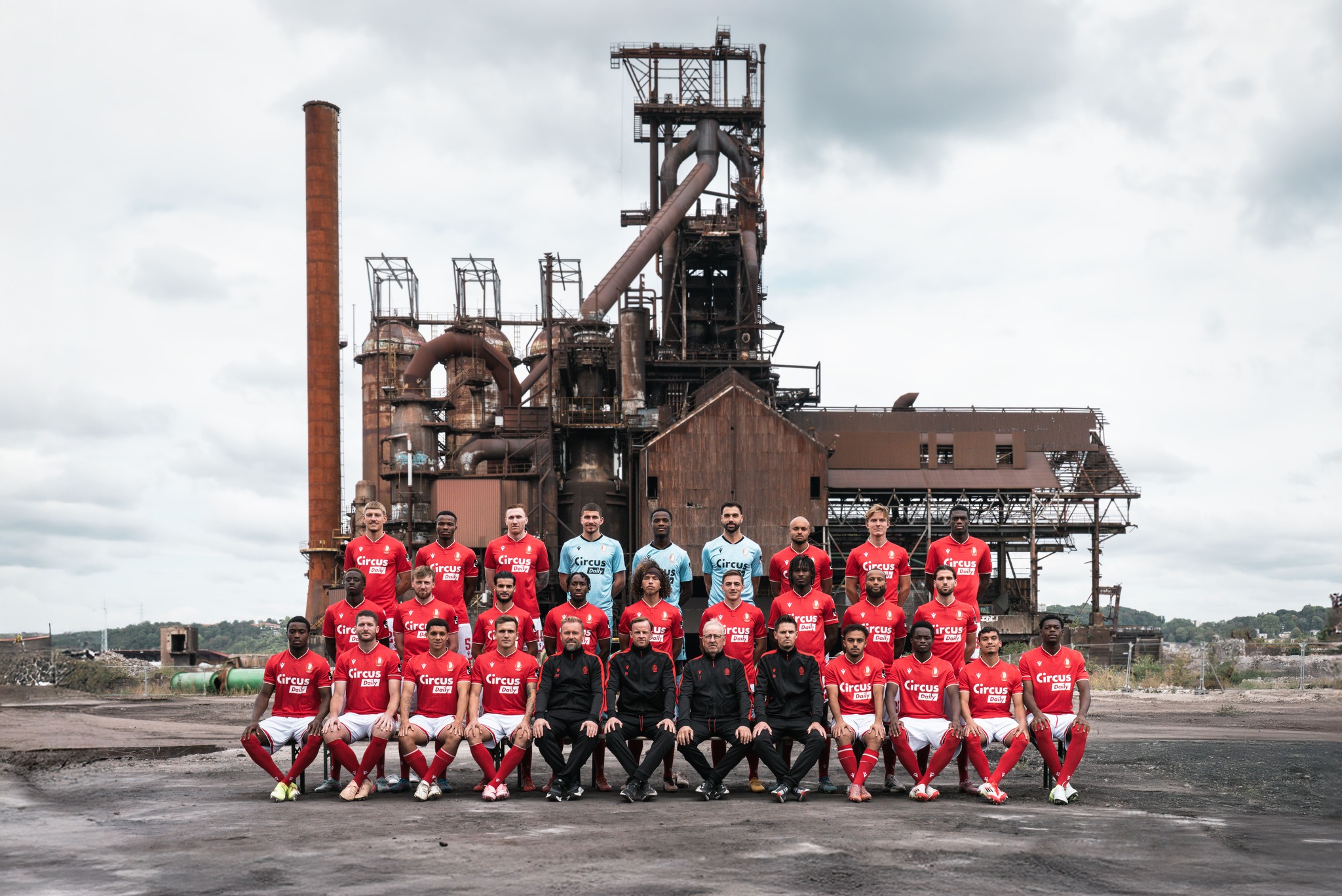
In recent years, with the introduction of championship play-offs in Belgium as well, Standard has not managed to break into the top four—or top six—that lead to the title, usually fighting instead for some place in the Conference League, and failing at that too. Its worst points haul came in the 2021–22 league season, when it finished 14th—the worst since 1921, when it has been competing in the first division—with just 36 points from 34 matches. In the summer of 2025, Giacomo Angelini—another local, a descendant of Italian migrants—took it upon himself to save the club from bankruptcy and to secure, first, its survival and then its development; yet what Standard seems to be today is exactly what its city, Liège, is: a ghost of the past.
Is there a future on the banks of the Meuse?
From the day of Maurice Dufrasne’s historic decision to bind Standard to the city of Liège’s industrial proletariat, the club’s History and fate became inseparably tied to the city’s economic development. What happened on the pitch was almost a direct reflection of what was happening in the factories of Sclessin and Seraing: the tons of coal and steel, and the number of workers who were fed by the processing of the metals of the Fiery City. Today, however, as the millennium reaches its silver jubilee, the city’s regeneration—aimed at a different kind of development—moves in very slow steps, often with destructive delays, like the construction of the tram, completed in 2025 instead of 2017 as originally scheduled. This initial transformation of the city through the necessary modern infrastructure has dismantled its commercial fabric, leaving the centre essentially without life. At the same time, the inability to integrate into the new innovation model the great proletariat that has no access to the necessary high specialisation keeps unemployment at outrageously high levels. So, under these conditions—where would Dufrasne’s convoy of students be heading?
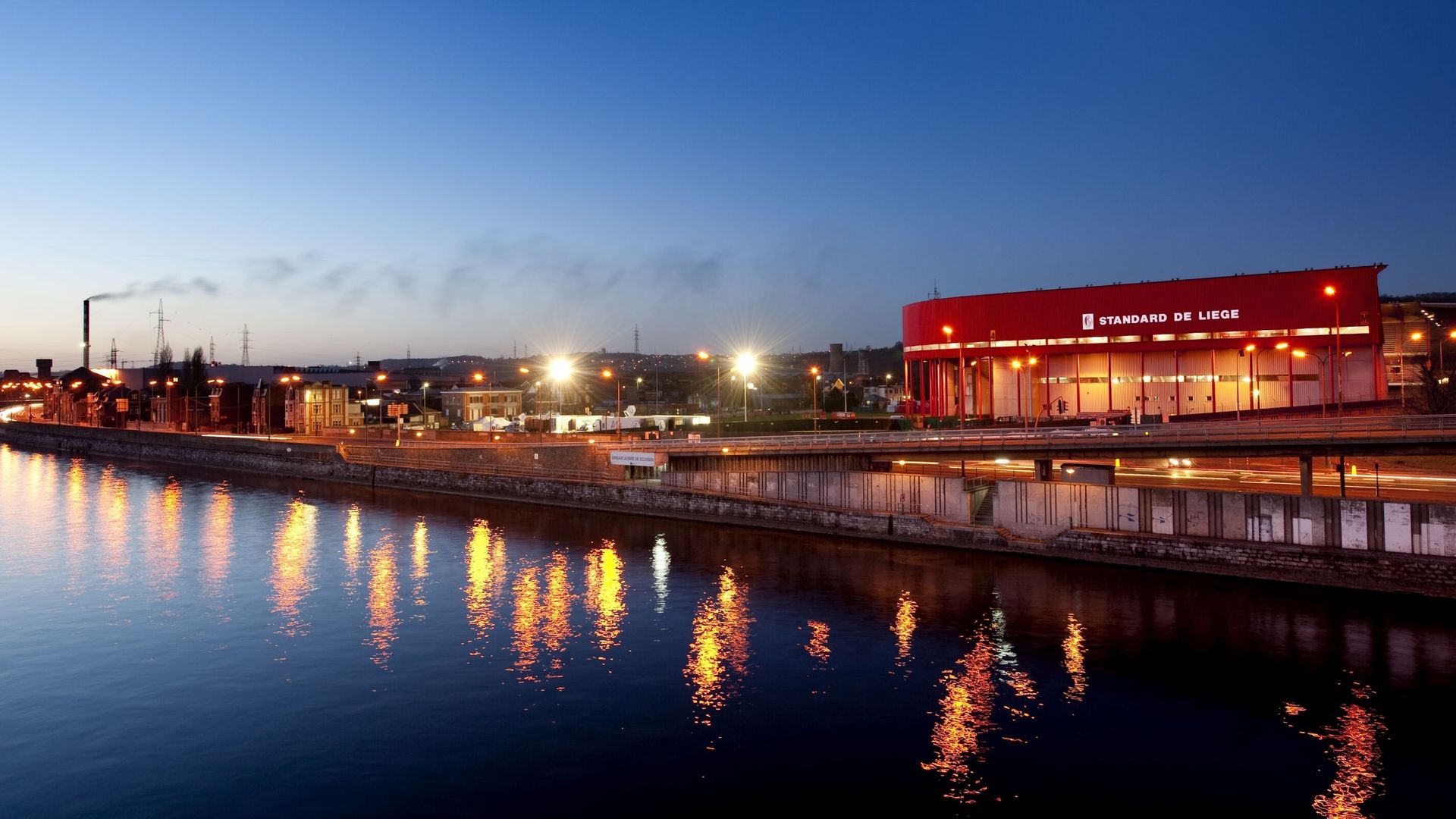
For Standard to be able to survive, like any football club, it needs a solid fan base that can also materially support the club’s longevity and successes. However much football is run and owned by millionaires and billionaires, at the end of the equation the supporters’ capacity to back the club is the most important factor that decides the outcome. Under conditions of steady economic decline, Standard’s intensely radicalised crowd—thanks to the ideological legacy left to it by the previous generations of Rouches supporters and by the workers of the Fiery City—can keep its distinctive identity held high, and with pride, on the concrete terraces of Sclessin. But for that pride to be combined with a new sporting resurgence, the people who set out to go to the stadium need to have solved other problems in their lives as well, as back then, in the glorious thirty, which in Liège now seem like an image from a fairy tale of the past.
Yet the future always hides its optimism, and in whatever way the working class of Liège manages to find the road to prosperity again, along that same road Standard will be able to rise as well—a club which, unlike other clubs of the Belgian capital, cannot rely on “yesterday’s” supporters who, either fighting their boredom or searching for any kind of social content, discover new football loves. Standard has only one love: the proletariat of Liège—and for the workers of Liège, the same holds true.
