
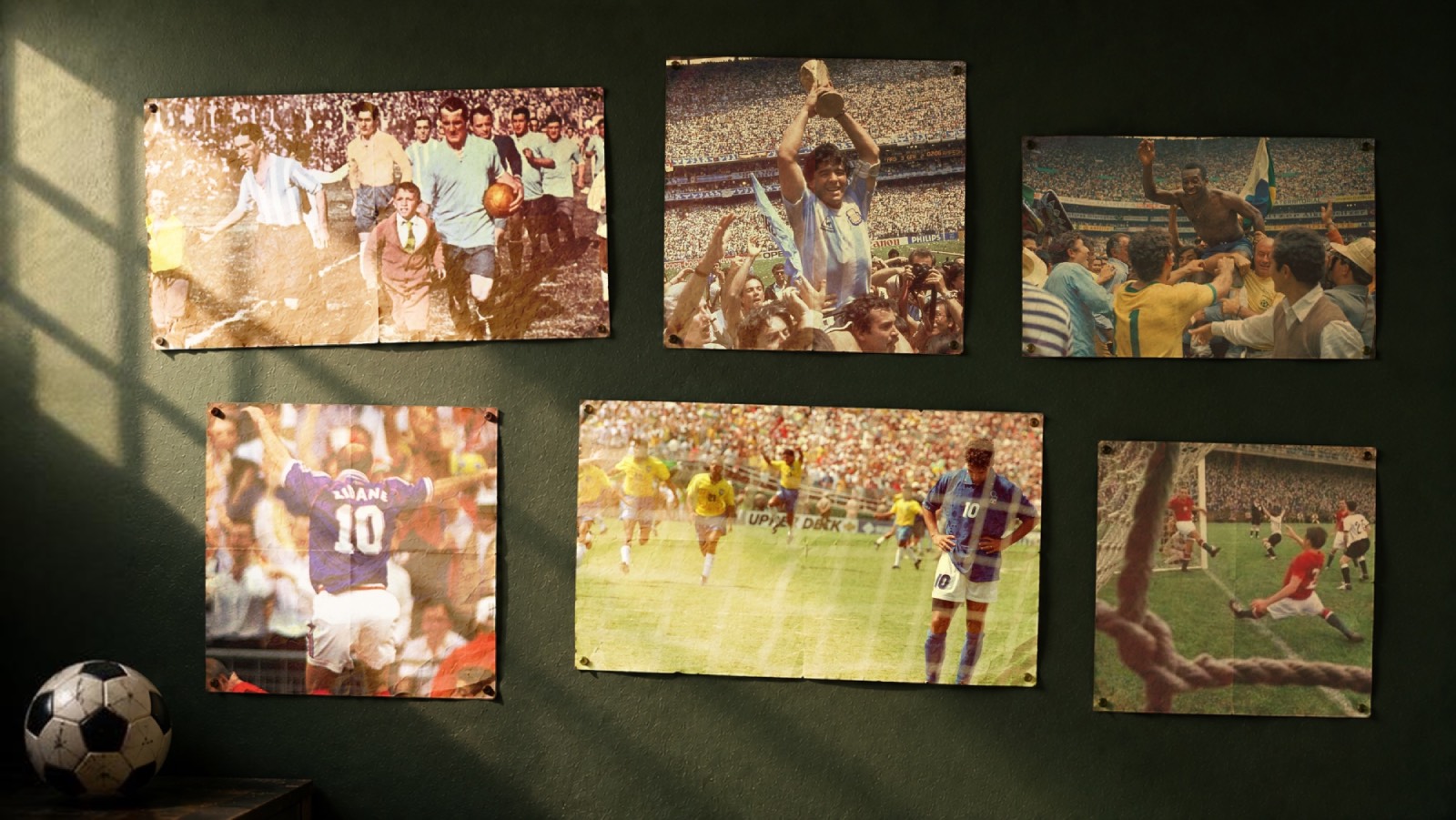
If one tries to find the human activities that simultaneously attract people’s interest on a global scale, it is difficult to identify any that has a greater impact than the FIFA World Cup. Over the years, the World Cup has claimed an ever more central place in the life of societies, in every country, during the period in which it is held. Perhaps the fact that it takes place every four years helps in this, since it makes the period of its staging less ordinary. Beyond the countless social activities related to it, the personal and collective memories that are created, society as a whole, in every part of the world, seems to be transformed during this period. Naturally, economic activities, within a network of interconnected opportunities, revolve around this central tournament. The streets, catering businesses, clothing shops, fill with the colours of the flags of the whole world, ultimately changing even the appearance of cities, of the places where people live. No other tournament today manages to change the appearance of cities to such a degree – the Olympic Games usually transform only the city or the country that hosts them, but never does an event taking place in America change the appearance of the streets of an Asian or European city. In this sense, the World Cup cannot be discussed only in footballing terms, although of course football is its central subject and – fortunately – it is football, as a sport, that evolves through it.
Beyond the economic activities, which in essence aesthetically affect social life, there is also political power, which takes a particularly zealous interest in this tournament. A country’s participation in the football World Cup is elevated into the mirror of its social development, a kind of secondary national value, not measurable in economic and social indicators, especially in periods when those indicators are not moving in a positive direction. It is characteristic that the presentation of Spain’s and Norway’s squads for the forthcoming 2026 World Cup was made by the kings of the two countries, in corresponding videos. Why would a monarch sit down to present 26 footballers who will travel to a country to play football? This is a question whose answer is simple to the initiates of this global mystagogy, yet it seems a paradoxical phenomenon to those who consciously or unconsciously abstain from understanding it and from participating in it – in whatever role. And of course it is not only monarchs: one of the latest activities of the national team of the most republican country in the world, France, was the photo session with President Macron, before the journey to the other side of the Atlantic. One might say that politicians want to participate in the glory of champions, to present their successes as successes of their own governance, yet here we are not dealing with photographs after victory, but with the operation of rallying a people, a nation as their bourgeois political conception understands it, around a group of people who, without having been elected, but instead having been selected on the basis of criteria of footballing excellence, represent everyone at the most important level. No corresponding video has ever been made for the appointment of a country’s Ambassador to the UN, while no major campaign has ever moved the masses in support of a fellow national candidate for a Nobel Prize. Yet it seems entirely natural that such a thing happens for football.
Thus, naturally, the question arises: why does all this happen for football? The answer is everything that takes place in the undertaking of futbol: that is, the analysis of the reasons why a sport, by virtue of specific characteristics, is, according to Pasolini, “the last sacred ritual of our time”. It is the way it appeared, the way it covers specific human needs, the particular way it is able to cover those needs within the specific social and political framework of human exploitation, the way it developed socially, in other words a set of small and great emotions that football has the power to create in people. In order to understand, then, why the World Cup is so important, one must begin from the reasons it exists – both as a tournament itself and football as a sport. Although the overall History of football, its relationship with societies, nations, cultures, the way it was shaped by all these and shaped them in turn, is a larger discussion and a broader field of enquiry, the way football became World is, more or less, the history of the World Cup – because a sport could be played in every corner of the Earth, yet it would never have the same value if it were not played, by everyone, in such a central global arena.
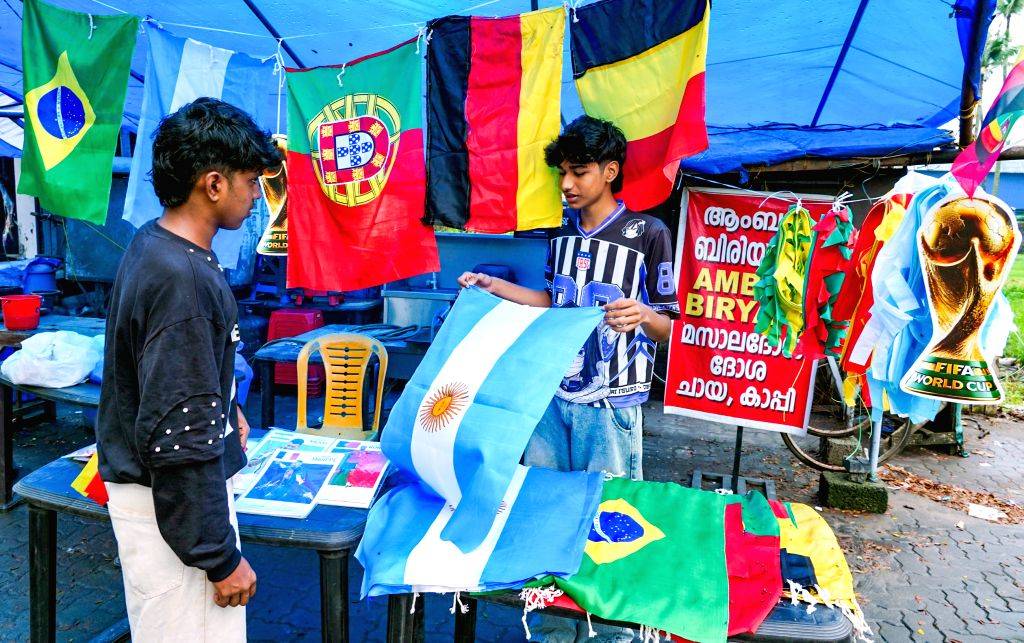
In the articles on the Prehistory of Football and the Birth of Football in Britain, the historical mechanisms through which a game that, in various forms, was played by many civilisations, as a continuation of the game of the British peasants, was codified, became the property of the ruling class, but immediately, almost simultaneously, became the beloved pastime of the working masses in an era when anything British was conquering the whole world, were analysed in detail. The path of football towards the whole world was explained, along with the expansion of the British Empire, but chiefly the transmission of those British social habits, such as British sports, wherever British economic activity expanded, with characteristic examples being Central Europe and South America, which were presented in detail in the corresponding articles. It would therefore be repetition to expend ourselves, in this enquiry whose focus is the World Cup, on that part of History. Instead, taking as given the fact that already from the end of the 19th and the beginning of the 20th century the masses were embracing the sport, indeed transforming it into a creator and bearer of collective identities, what is useful and critical for understanding this global institution is to examine the material basis and the causes of its creation, indeed outside the traditionally British framework that gave birth to the sport. At the same time, we shall also take as given the fact that an activity with such social resonance attracts the interest of political power; the reasons do not need to be explained here, only the way in which this was expressed.
Unlike a multitude of other sports, which were being codified and, with the existence of the Olympic Games, were acquiring global participation and interest within the framework of a sporting ideal, football constituted a social mass sport which for only a very brief period – that of British amateurism – seemed to lay claim to such an identity. From the beginning of the existence of professionalism, which began in Britain at the end of the 19th century and meant a number of things, such as that footballers represented a collective which participated materially (by paying a ticket) in the existence and operation of the football club, that clubs constituted institutions with ties to local society, on a territorial or factory level, football had no relation to “the road and the wrestling and the stone”, that is, the – even if only imaginary – ennobled form of sports aiming at a generally defined fair competition. On the basis of these characteristics, it never attracted interest within the framework of the Olympic Games, a tournament which in its early years had strict terms for the exclusive participation of amateurs, placing particular emphasis on the achievements of physical strength, on the triptych “faster, higher, stronger”, rather than on the success of collective victory against an opponent.
Thus, one might wonder whether football is indeed part of a broader sporting framework. The answer could perhaps be twofold: as regards the methodology for achieving athletic performance, that is, training, physical exercise, the development of the body’s ability to execute complex, almost acrobatic, movements that help achieve the aim, namely victory in a game, then football certainly resembles all other sports. As regards, however, the reasons why someone wants to win a football match, these seem from the very beginning to stand very far away from generally defined sporting fair play. Here many become confused, accusing football of being “dirty” because it is not “pure” as a sport, with its only characteristic being the guileless will for the best athletic performance. Yet this is perhaps a crooked way of reading society itself, since the need for victory of a collective identity is probably something more complex, greater in impact and certainly more mass-based and collective than the individual victory of the body. In this sense football democratises athletic success, allowing the existence of many roles that contribute to this success, which materially comes from the actions of 11 people.
In this sense, football, which is always among the interests of “dirty” social activities, will not cease to exist when this dirt surrounding it is eliminated; instead, it will mirror whatever society is created through the overthrow of today’s relations of power, expressing collectivity once again in a different way. It is probably the bourgeois Olympic Ideal that will not be able, in such a condition, to express a new collective conception of victory – though certainly the other sports too will evolve in a way that allows them to fit within this society, liberated as it remains potential up to today.
And here lies a central question with which one must engage when examining the History of the World Cup: does the fact that the World Cup has throughout time been an object of interest and exploitation by ruthless dictators, authoritarian regimes, powers that have used it even as a mechanism of repression, mean that by nature it is something that expresses global reaction? An analysis of the evolution of phenomena only “from above” could arrive at such a conclusion. Yet such an analysis is superficial – because in the World Cup the way football is played evolved, indeed on the basis of ideological convictions that in no way aligned with those of its organisers and abusers, while it also created popular expression, popular memory and collective experiences, beyond the framework of national antagonism and exclusions, which throughout time the powers in exploitative systems represent. If the position that football is only a tool of power were true, many of these phenomena would never have existed – and so instead of making yet another analysis of the relationship between exploitative power and football, it is far more useful to examine everything that truly happens in the History of people, which is not a fairy tale only for princes and princesses, but for peasants.
The global foundation of football
At the turn of the century, developed British football, with its professional championships, clubs counting thousands of supporters, the evolution of football tactics, ideologisation and international (within a British framework) tournaments, was no longer alone in the world. Beyond the four “domestic” associations, that is those of England, Scotland, Wales and British-ruled Ireland, national associations were also being created in continental Europe, from North to South, with Denmark, the Netherlands, Belgium, Switzerland, Italy and Germany having founded their own institutions at the end of the 19th century, while Argentina, Chile and Uruguay had corresponding associations of their own. To all these countries, for reasons of completeness, one must also add the football association of Gibraltar, as well as that of Singapore, states which of course formed part of the Empire.
All these Associations had one thing in common: they consisted to a large extent of English migrants or expatriates, with their officials naturally being members of the British bourgeoisie operating internationally, indeed having ties of dependence with the mother of the sport, the Football Association. Thus, although football was a sport that had already begun to be played internationally, there was no particular reason for there to exist a corresponding international or global confederation, since the FA had the dominant role in everything concerning its administration.
Football remained a British sport in an era when sport as a whole was changing – but not because of the English. The initiative for an international and potentially global governance of sport began from Britain’s rival power. Perhaps the most important institution, which led to the construction of the first global sporting edifice, was the Union des sociétés françaises de sports athlétiques, known by its initials as USFSA. Founded as a union of two athletic associations, which came from the clubs of the Parisian bourgeoisie Racing Club de France and Stade Français, as well as other French nobles initiated into British sporting organisation, from 1890 the USFSA undertook to play a pioneering role in organising the international framework of sport, in a field that had been left free by the British. The truth is that the English bourgeois and aristocratic class did not care very much about the ways in which it would share its pastimes, neither with other civilisations nor with other classes. After all, it also intended football itself for itself, only to be confronted with accomplished historical facts when the masses did not stop playing the sport that constituted an evolution of their own game.
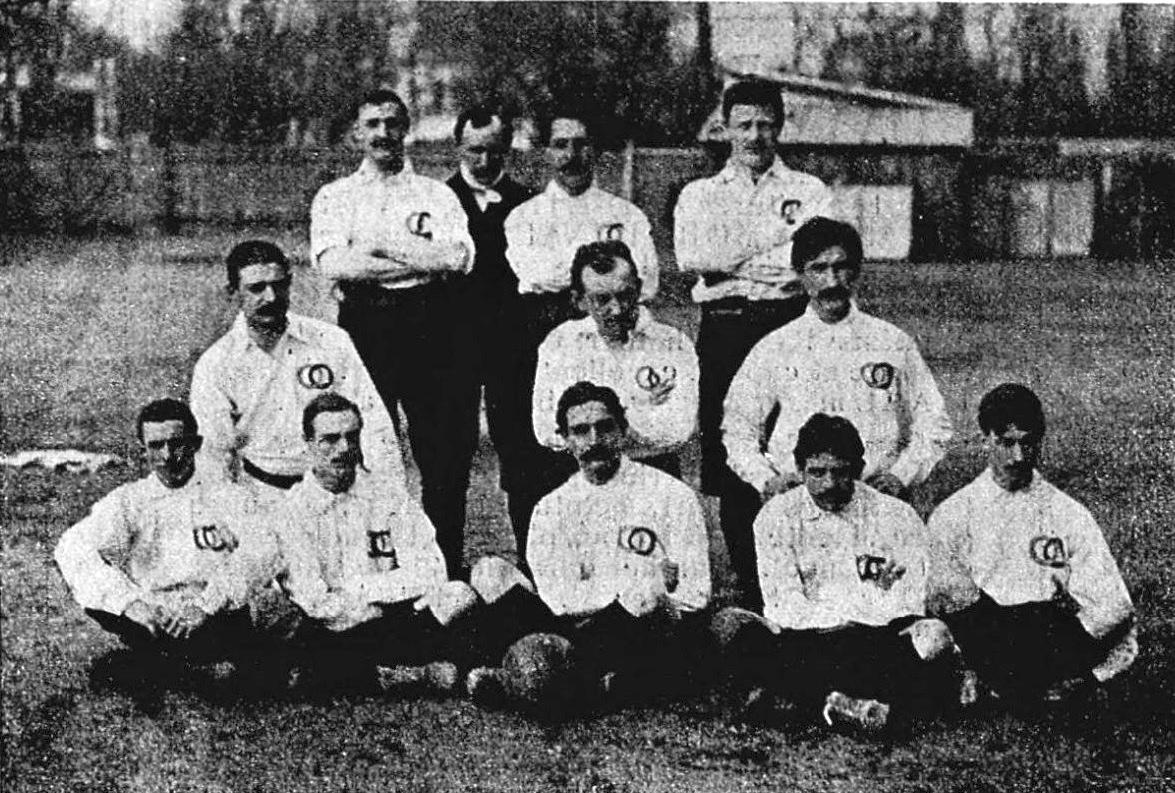
The USFSA, with a symbol of two rings, which symbolised the union of those two athletic unions of Paris, also constituted the organisational structure for the creation of the modern Olympic Movement, which with a corresponding symbolism of five joined circles, corresponding to the continents, began in 1896 the first great multi-sport tournament, that of the Olympic Games. The fully aristocratic origins of the Olympic movement, as well as the expansion of the USFSA’s activities into the organisation of the rugby championship, a sport of the middle and upper strata, in France, left football at the turn of the century on the margins, although it was part of the Olympic programme, but in an amateur form that had no relation to the mass British sport. It is characteristic that the first gold medal was won by the crew of a Danish ship that had run aground in Piraeus, facing the Athens Cycling Club in a match that was more of a parody, as it ended either 9-0 or 15-0 for the Danes, under the direction of Prince George, who took on the duties of referee in the encounter.
At the time, then, when sport was being constituted internationally only within an aristocratic framework, mass football remained outside this process and under British control. After the organisation of two Olympic Games, which for obvious reasons took place in Athens and Paris, the Dutch football association called on the Football Association to take an initiative for the independent international organisation of football. But the British had no reason to create an international institution where they could have absolute control through their own national association. For this reason, they replied negatively, while they showed similar indifference to a possible establishment of an international institution when the President of the USFSA, the journalist Robert Guérin, made the same proposal.
Guérin, of course, did not have only pure intentions. In an era when the whole sporting edifice was essentially under construction, he wanted to ensure that the USFSA would have the authority to administer the most mass-based sport that was slowly developing also in France. The best way to achieve this was the participation of the USFSA – instead of other French associations with the same expectations – in an international confederation. This practice of attachment to international confederations in order to secure domestic power over a sport would become a permanent scene in every developing sport, in every country. The truth is, however, that the Football Association would very difficultly accept becoming an equal interlocutor with Guérin, since the French aristocrat represented a sect of sporting officials in France who wanted to administer football as well at national level, without any previous work in its development, at a time when the FA had for decades been organising a professional championship and cup, with a huge attendance of supporters, and participated in international tournaments with the states of the United Kingdom, which had a much greater footballing tradition than France.
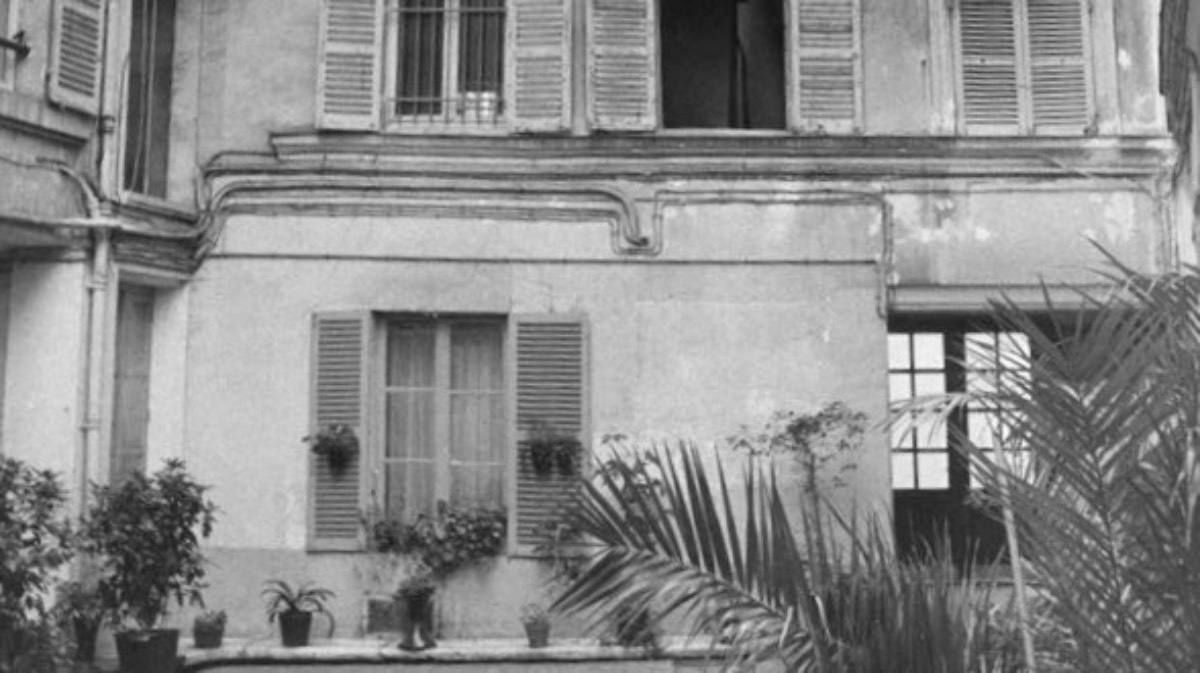
Yet, however logical the stance of the Football Association appeared within the specific framework, it was equally short-sighted, since it did not calculate that the French aristocracy could find allies from continental Europe in order to achieve its aim. Thus Guérin, disregarding any tradition and seeing the great opportunity opening before him, in the absence of any international institution, invited the already founded associations of Belgium, Denmark, the Netherlands, Sweden and Switzerland, as well as the club Madrid FC, in order to found in Paris the international football institution. On 21 May 1904, at number 229 of rue St Honoré, in the 1st arrondissement of Paris, the founding declaration of the Fédération Internationale de Football Association was signed, which, because of its French inspiration and place of birth, took its name in the French language, creating the famous acronym FIFA.
The 28-year-old Guérin thus achieved his basic aim, making the USFSA, as a founding member of FIFA, responsible for the development of football in France, while by assuming the presidency of the new football organisation he could bring France into a central position as regards the global development of the sport, exploiting the gap left by an England indifferent to this role. Yet History quickly showed that the English were not so short-sighted to such a degree. The powerful FIFA of today could not play its international role if it did not manage to include England in its ranks. Given that the motivation of Guérin, as well as of other officials from the national confederations (including Madrid FC, later renamed Réal, coming from a country without a football association), was to acquire international recognition and not to compete with the mother of the sport, all of FIFA’s moves concerned the terms under which the English would become part of it.
This finally happened in 1905, when England became a member of the international organisation through a process that was completed in 1906, when at the Congress of Bern Daniel Woolfall, an official from working-class Blackburn, assumed the duties of FIFA president, remaining in this position until the beginning of the First World War. Woolfall’s leadership was decisive so that England would keep a central position in footballing development, as football was gradually leaving the hands of the English in the national associations, which were passing under the control of the locals. But Woolfall has other reasons to be remembered too, chiefly the organisation of the first truly international football tournament. His placement at the head of the World Confederation may indeed have been motivated by this historical conjuncture.
London was the host city of the 4th Olympic Games, which were held in 1908, and Great Britain wanted more than anything to advertise its national sport, the one which, unlike other Olympic sports, had been codified within the centres of its own education system, reflected its own society and was spreading along with its own cultural influence. Thus, 12 years after the parody match of the Athens Olympics, in London there took place a tournament with the participation of eight teams initially, although in the end, because of internal issues that prevented the teams of Austria-Hungary, Bohemia and Hungary from taking part, the participating teams were six. Denmark beat the two French teams successively 9-0 and 17-1, while Great Britain defeated Sweden 12-1 and the Netherlands 4-0. In the final the hosts and organisers prevailed 2-0 over the Danes to win this first truly international football medal.
The position of football, however, was by no means guaranteed in the programme of the Olympic Games and despite its subsequent success, the football tournament in Stockholm was by no means certain to be organised in 1912. There, the final once again had the same opponents, in the last international football meeting before the outbreak of the First World War. The real development of World Football would come immediately afterwards…
The War of the Trenches destroyed the infrastructures and almost wiped out a generation of the countries of Europe, dealing a decisive blow also to football and its institutions. After its end, under the new international political balances, FIFA found itself on the threshold between life and death. The Olympic Games continued to be held, beginning with the Antwerp Games in 1920, yet the football institutions, perhaps also paying the price of the greater contribution of the working class to the war, took slower steps towards reconstruction as regards Europe, because in South America football was going through its first golden age.
The first post-war FIFA congress was held in Geneva in 1923. There, a Frenchman was elected president of the Confederation for the second time: a lawyer, the son of a greengrocer from eastern France, deeply Catholic, the most emblematic president in its History, Jules Rimet. Rimet was perhaps the most suitable person to lead football into this new era and towards its true globalisation. His religious convictions aligned with the papal encyclical Rerum novarum, of Pope Leo XIII, according to which particular weight had to be given by the church to the living conditions of the working class. Of course, the papal church as an institution did not feel any great pain for the wretched of the Earth, but rather saw the danger that they might express their anger at their destitution in revolutionary ways, imbued with the great ideas that developed during the 19th century and led even to the workers’ seizure of power in the Paris of the Commune in 1871. Under these conditions, the church had an interest in functioning as the body that would be able to manage this popular anger in a way less painful for the ruling class: initiatives for the improvement of the terms of life and the content of the lives of workers helped in that direction. Given, then, the ideological pressure, this stance of the Catholic church can be read as a conquest of the working class, even in conditions where it did not organisedly demand the overthrow of the power hostile to it. After all, we do not know how easy it is to claim that a powerful institution, such as the Pope, decided without deeper reasons to proclaim such an apparently radical political line.
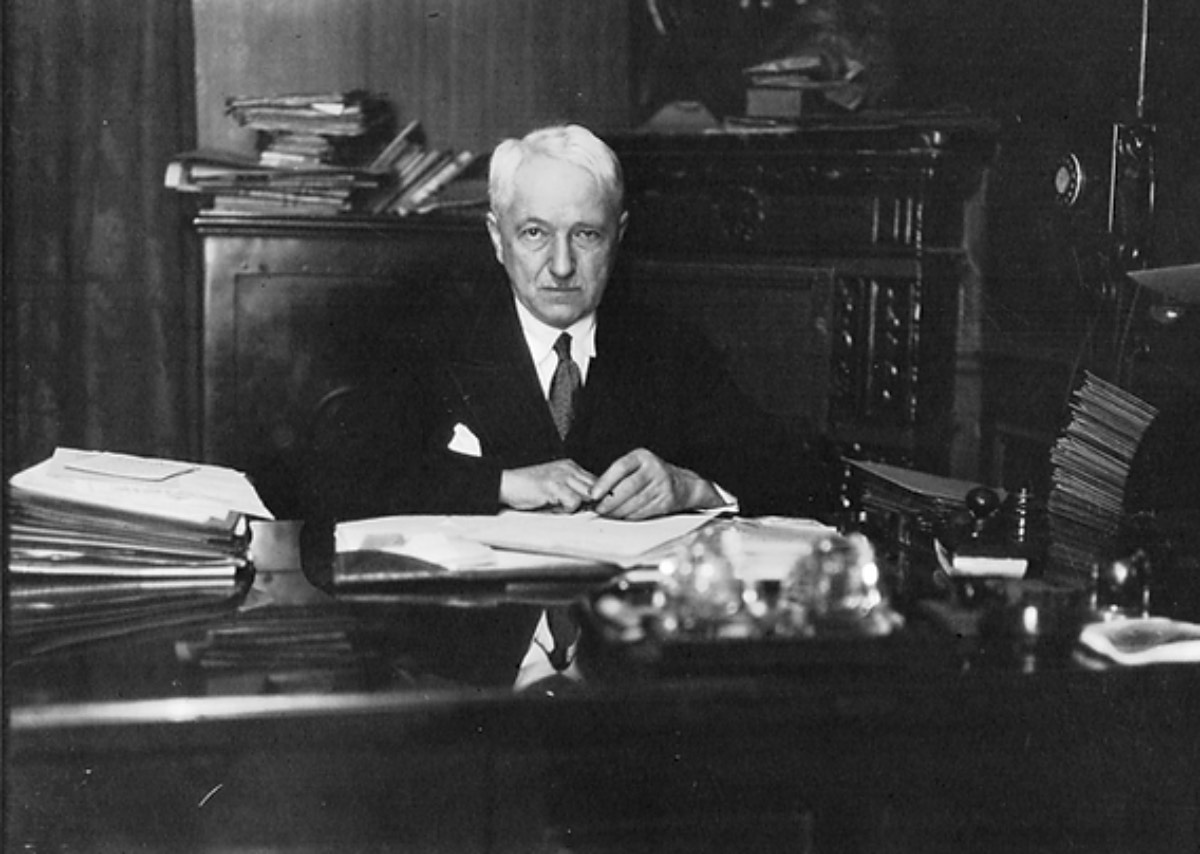
Imbued with these ideas, Rimet had founded in 1897, that is six years after the proclamation of Rerum novarum, the working-class club Red Star in Paris, which to this day constitutes a symbol of pride for the poorer strata living on the margins of the dazzling French capital. The historical record has classified Rimet as an inspired man who believed in understanding and peaceful coexistence between nations, something that was naturally necessary for post-war (or inter-war) reconstruction. As is natural, the reading of this characteristic cannot be naive: Rimet either consciously believed in this path, in harmony with the deeper ideological stance of the church, knowing the consequences of the war in Tsarist Russia that led to the Bolshevik Revolution, or, as an idealist, believed that international understanding was the best path of progress within a political system that he considered either natural or the only possible way. In any case, while the Catholic church had officially renounced, as was natural, socialist revolutions, we do not know anything specific about Rimet’s stance, despite the fact that the newly established Soviet Union was not accepted into FIFA throughout the inter-war period.
The examination of Jules Rimet’s political ideology could constitute a dissertation topic in itself, since the whole modern edifice of world football rests upon it, yet in the historical enquiry into the existence and evolution of the World Cup, what perhaps matters to use as a given is his pure internationalist conception, in contrast to the conservatism of the bourgeois and aristocratic classes which, in other countries, mainly those under British influence, kept football trapped on a much smaller scale than that of its real potential. Whatever the reason Rimet believed what he believed, it is a recorded fact that his conception was needed in order to release the forces that would make football the social phenomenon we know today.
One further element that cannot be bypassed when examining Rimet’s contribution is the fact that he thought outside the frameworks that had until then been given, thus also drawing a strategic line that would characterise FIFA’s course throughout time. When football appeared in the eyes of Europeans to be an English product concerning a series of countries in Western Europe, Rimet very quickly saw that his greatest ally – and above all the ally of his vision – was on the other side of the ocean. The football of the Río de la Plata, without having been crushed by the war, having disengaged from English influence, acquiring its own distinct aesthetic and social temperament, and indeed acquiring a very high level as regards athletic performance itself, could become the bearer on which the new form of the global football network would rest.
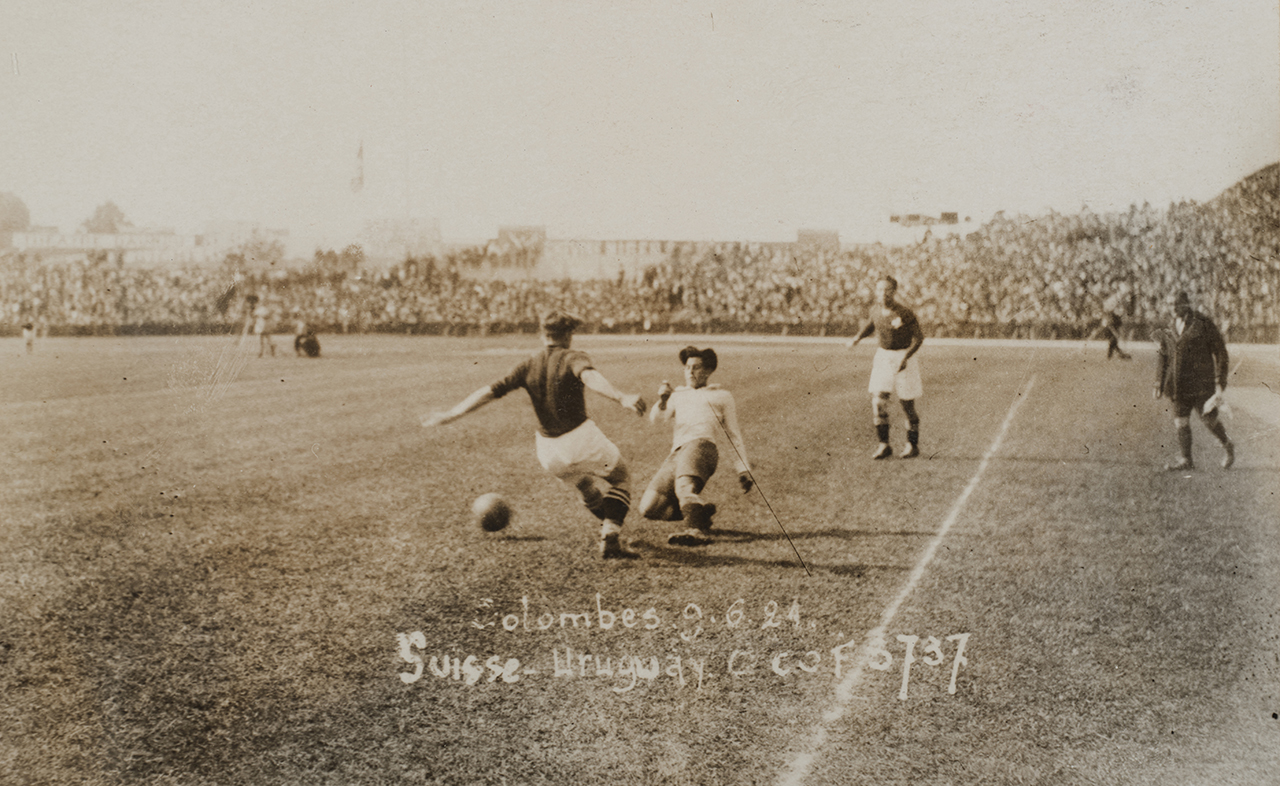
One year after his election to the Presidency of FIFA, Rimet saw the great opportunity in the Olympic Games being organised in the city where he lived, Paris. There he invited the national teams of Uruguay and Argentina, which were already competing in their own South American institutions, creating a legendary tradition and very rapidly massifying the sport. Of the two teams, Uruguay was the one that accepted the invitation, in order to write golden pages on and off the pitch in Paris in 1924, transforming the football tournament from a peripheral event into the central subject of the Games, with the demand for tickets exceeding the capacity of the Olympic Stadium of Colombes and football showing that it could not be compared, as regards mass appeal, with any other sport human beings have invented.
The success of the football tournament in Paris in 1924 was not accidental – the football officials managed in essence to violate a basic rule of the Olympic Ideal as it had until then been defined, despite the objections of the various Federations. The great difference in Uruguay’s quality was not only the result of the absence of the War from South America; it was also a consequence of the professionalism that had already begun to exist on the other side of the Atlantic. At the same time, the path of professionalism was also opening in Central Europe, which had its own distinct institutions, such as the Mitropa Cup and the Central European International Cup. It was clear in practice, then, that the professionalism which had made football gigantic in Britain from 1885 onwards, opening the doors to the mass arrival of the working masses, had the same results in other regions of the world. The model of professional football, fed by the working class and in this way becoming an element that could constitute a symbol and an identity for the masses, was now being repeated and stood in opposition to the framework of the Olympic Games. This showed that the time had come for the schism.
Already from 1926 the General Secretary of FIFA, Henry Delaunay, was arguing strongly both in favour of professionalism and in favour of the existence of football networks at a larger, European level, not only a regional one, such as that of Central Europe, but also of the need for a global institution. Naturally, Rimet was moving along the same line, presenting Uruguay as a model of a country whose national existence and recognition changes in quality through football, and seeing in the small South American country the appropriate ground on which to realise his vision. At the FIFA congress held in Amsterdam in 1928 this line was essentially confirmed: the autonomous course, that is, of the global football edifice, outside the framework of the Olympic Games, through the creation of the FIFA World Cup. There was no country more suitable to take on this tournament than Uruguay, which, beyond the fact that it had won the Olympic gold medal in Paris in 1924 and in Amsterdam in 1928, prevailing indeed in an epic series of matches against Argentina in the final, was a country in full economic development, following the tendencies of modernism, a current which characterised the very birth of the World Cup and is reflected to this day in every side of its aesthetic identity.
Although the final decision on the place of staging was written at the FIFA congress one year later, in 1929 in Barcelona, Uruguay’s will to take on this tournament was evident from the moment the necessary agreement for its launch was secured. The only thing that was added – and contributes to different historical narratives – was the addition of the argument that Uruguay was in 1929 a two-time Olympic champion, unlike at the 1928 congress which took place before the beginning of the Olympic Tournament. Many historiographers mention that the fact that Uruguay beat Argentina in the final of Amsterdam was the reason the first World Cup took place on its soil, yet a series of elements, many of which have already been mentioned, show that even if the result had been different, the reasons for it to be held in Uruguay were already many; perhaps that footballing result simply removed arguments from a potential Argentine claim to the tournament.
This evolution of football, on an administrative and political level, after the end of the First World War created a new cultural identity in the game itself. France, as well as other countries of Western Europe, came to the fore, replacing British primacy with an international system of administration and organisation. The British, who intended to maintain their undisputed position as guardians of the sport, did not place weight on their involvement in an international institution that would naturally force them to become involved in conflicts, but rather on the confirmation of their superiority on the field of play. The England national team became the tool of this policy – instead, of course, of participating in tournaments of international institutions foreign to Britain, it played friendly matches against whichever team seemed to be the best of all the others. Every victory secured the perpetuation of this myth. The first defeat by a non-British team, however, came in 1929, in Madrid, against Spain, which prevailed at the Metropolitano 4-3. Nevertheless, the result was marginal, away from home, and was followed by two emphatic victories, 1-4 in Paris and 1-5 in Brussels – thus the era in which this British dominance would be questioned still seemed slow to arrive.
Beyond the national team, however, the Football Association also showed its strength on another level, which certainly constitutes a criterion for who truly had the fate of the sport in their hands in those years. Today it is almost impossible to imagine a change to the laws of the game without such a thing being a FIFA decision. The truth, of course, which fewer people know, is that the laws of football are not defined by FIFA – at least not directly. The competent body for the laws of football is the International Football Association Board, in which today FIFA participates with a 50% right of participation in any decision and practically exercises its control over it. But this was not the case in that inter-war and pre-World Cup period. The IFAB, which was founded by the Home Countries, that is the Associations of England, Scotland, Wales and Ireland (today’s Association of Northern Ireland) in 1886, had in those years very different balances of power. In 1912 FIFA requested to become an equal member of the law-making board and a year later managed to be represented with two seats, while the other four belonged to the Associations of the United Kingdom. Thus, decisions on the laws were a British affair.
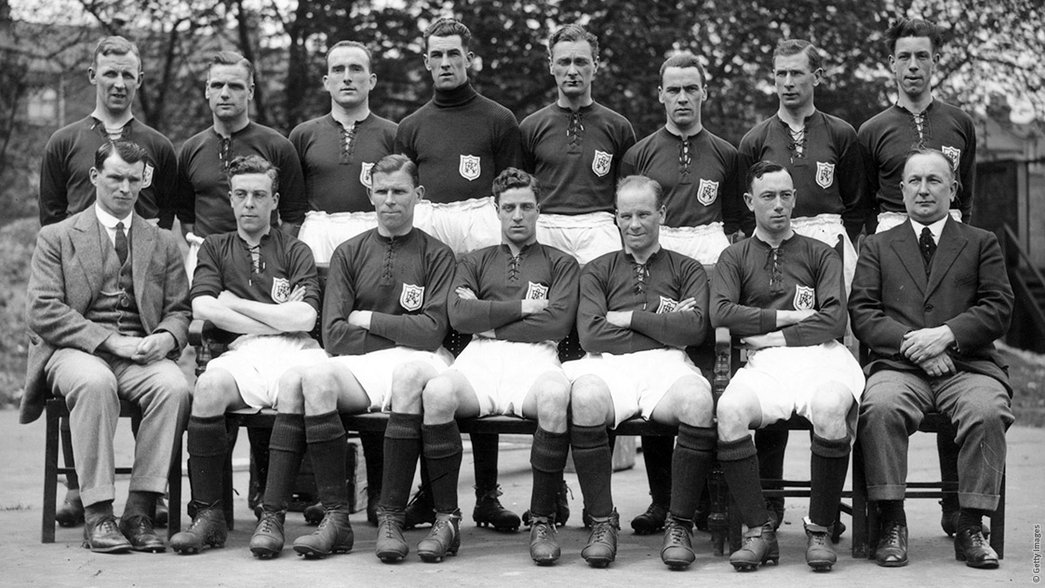
Perhaps the most important decision for the transition of football from its proto-history to the modern era was the change to the offside law in 1925. Until then, a player needed to be covered by three opponents when he received the ball moving forward, in order not to be offside. The fact that, through the development of tactics, this left fewer margins for scoring led the IFAB to adopt the change of these players from three to two. This change in turn had as a consequence a reshuffling of the deck as regards the positioning of players and opened the path for the development of tactics, with the first innovation being the adoption of the WM system by Herbert Chapman at Arsenal. The passage from 2-3-5 to a system with a central defender and the fullbacks (who are still called thus today) moving to the sides was proof that England still controlled the essential evolution of the game and that whoever wanted to be at the cutting edge of footballing development had to follow the tendency of the English game. This was a reality FIFA had to face – if not on the grass, then at the administrative level.
The first era
Jules Rimet was not a footballer, nor a football technician; he was a lawyer and an official, an ideological Catholic and certainly a chauvinist Frenchman who aligned himself with the interests and the line of international cooperation of his republican country. The difference between this conception and the British one was that it could give much more space to every distinct identity that could emerge from the game. Football was not French anyway, and Rimet had no reason to want to impose French dominance on its culture; what chiefly mattered to him was that France should be at the centre of decisions. For this reason South America was also the best laboratory for carrying out his experiment.
In England the change in tactical approach concerned mechanical manoeuvres that led to successful results, while this footballing rationalism also dominated in other countries, where Anglophile officials and technicians tried to set up each national football school on British models. The only place where exactly the opposite was happening was the two countries of the Río de la Plata. Argentina and Uruguay, on the one hand, had no reason to seek this Britishness, given that their problem was precisely the opposite, the excessive contribution of the British to the foundation of their national football and therefore to their national footballing conception; on the other hand, they had every reason to ideologise their game deeply, in order to find this different path of truly autonomous and independent footballing development from Britain.
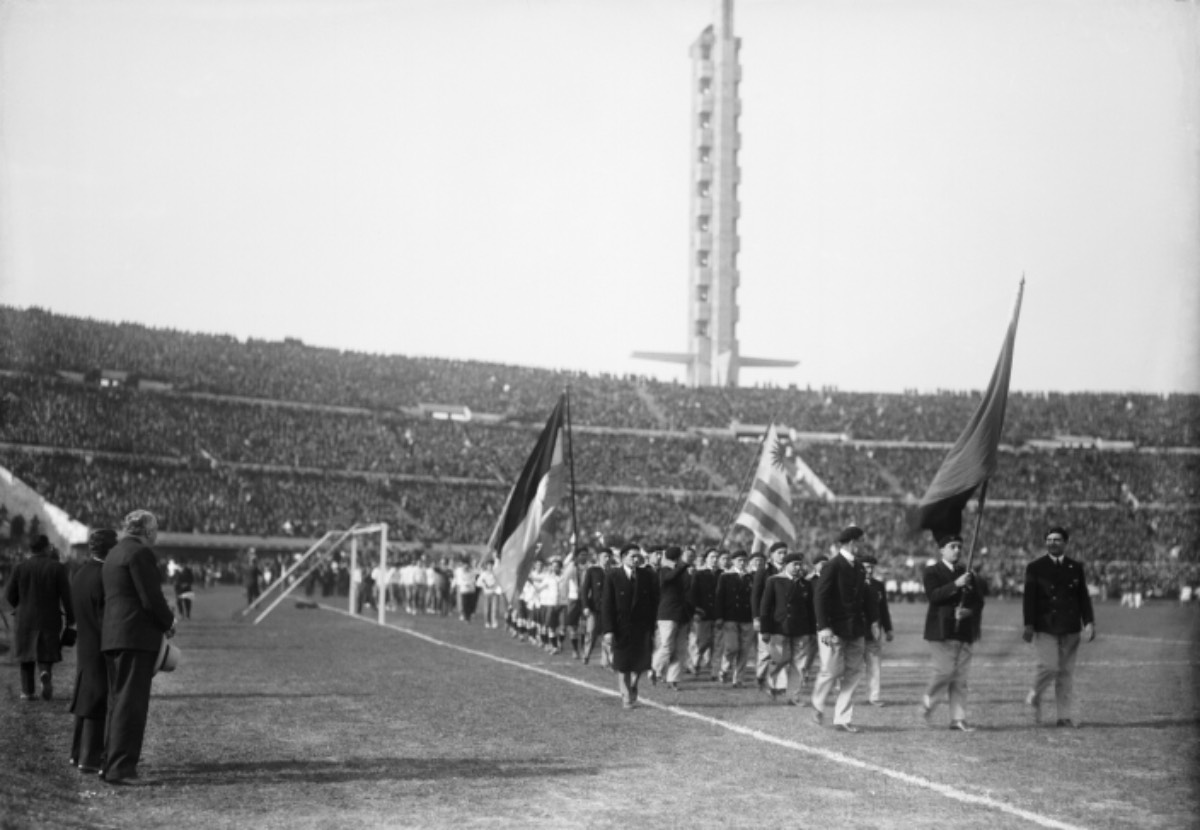
If one looks at the composition of the countries that took part in the first World Cup held in Uruguay, one can easily understand that it was ideal for the apparent success of this path. Beyond the seven South American countries, that is Uruguay, Argentina, Brazil, Chile, Paraguay, Bolivia and Peru, two from North America participated, Mexico and the United States, while from Europe Belgium, France, Romania and Yugoslavia travelled. The interest lies in this European participation. The only country with clear ties to Britain is Belgium, where football had been transferred by Englishmen to the ports of Flanders and where indeed the famous superstar referee of the era, Jean Langenus, came from a deeply Anglophile family of Antwerp, his first name in reality being John and not Jean, as he is presented in the various archives because of his nationality. France was at every step the counterweight to the British approach to the sport, even if the first inspirers of its national sporting conception had studied the corresponding English one in order to apply their ideas in their homeland. Romania and Yugoslavia were two countries very far from the sphere of influence of British interests, outside the formal and informal Empire, with Romania in particular maintaining very close cultural ties with France throughout time, because of its Latin background.
The countries to which the leading English footballing thought had been transferred, that is the countries of Central Europe – Austria, Czechoslovakia, Hungary and Italy – and even others that lagged behind, such as Germany, the Netherlands and the Scandinavian countries, did not participate in this tournament. Thus, in Uruguay the WM would not face the 2-3-5, nor would the teams that had professional championships on their territories play against each other, leaving the field free for national conceptions of aesthetic performance to be glorified, such as the Argentine Nuestra and the more combative Uruguayan garra charrúa. The emphasis is not placed on the tactical evolution of the game, but on the way of playing, on individual technique, on the game of short passes and on the ability to improvise.
The history of football results has written that the centre of footballing excellence at that time was in the Río de la Plata. Yet a search for the comparative elements that could support such a thing is subject to criticism. For example, the great teams of Uruguay never faced England, any other British national team with professional footballers, or any national team of Europe made up of professionals. The same applies to the national team of Argentina. The Argentines and the Uruguayans managed to defeat the British who were on their soil, wresting football away in order to turn it into national capital. Therefore, the conclusion that can be drawn from these historical data is that, on a purely athletic level, it is difficult to define the position of rioplatense football in the global framework of that era; the undisputed contribution of the Argentine and Uruguayan school, however, was that a distinct national football school with enormous ideological depth could be created, far from the metropolis of the sport. This was something that Rimet and the FIFA organisation as a whole needed much more in those years than technical evolution.
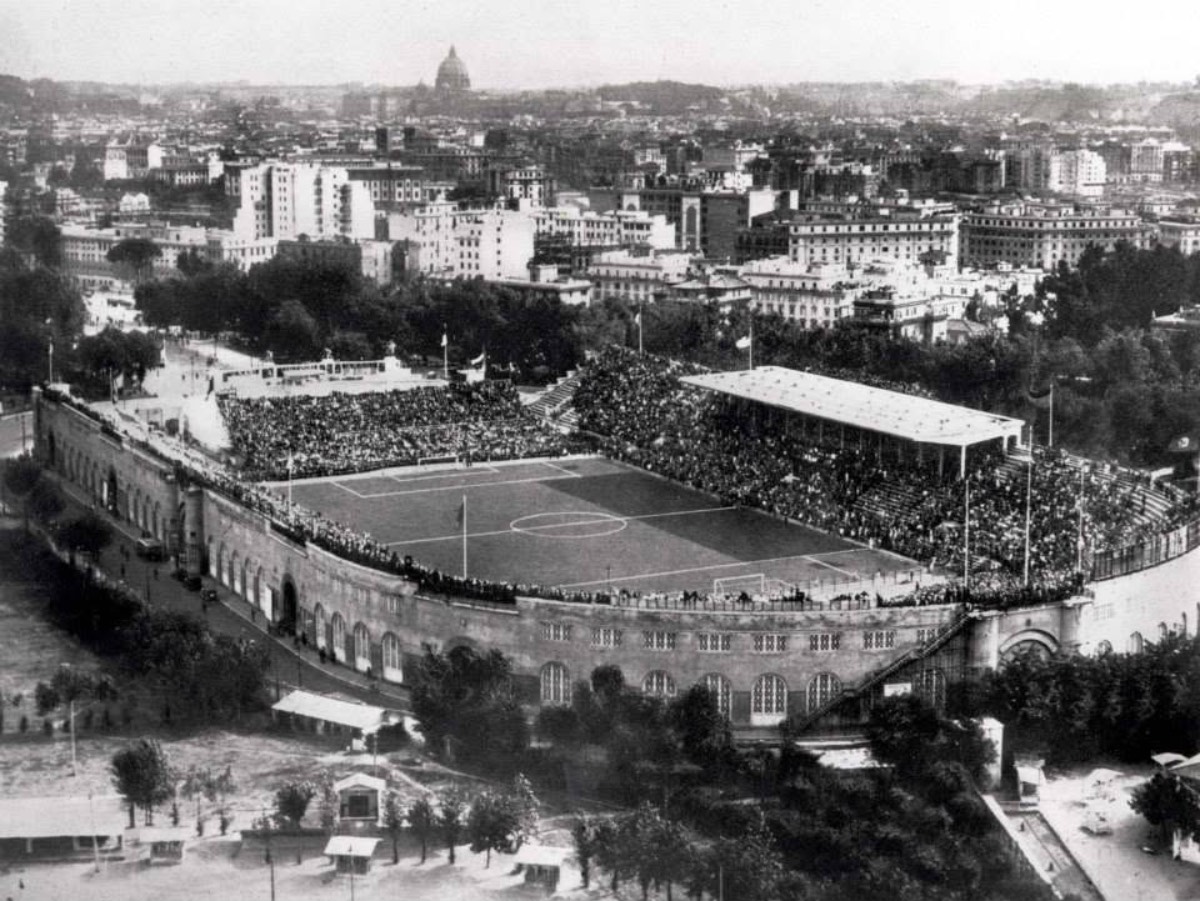
Perhaps the first World Cup in which the modern footballing thought of the era was expressed was that of 1934. This comment may seem prejudiced against the football of South America, yet the objective enquiry into the footballing level of the two continents and the comparative view strengthen this conviction. In 1934, twelve European teams took part in the World Cup in Italy, among them all the countries of Central Europe, together with Germany, the Netherlands, Spain and Sweden, while Belgium and France returned to the institution. A look at the beginnings of football in these countries, with emphasis on the footballing development of the so-called Danubian School, is enough to highlight the difference in approach that existed in relation to South America. In Austria Jimmy Hogan became the messenger of football, Hugo Meisl was a British-nurtured official who developed his own thoughts on the football of his homeland, another empire, within the same ideological framework in which the British sport was developing, while the “patriarch” of Italian football was one of the most fanatically Anglophile and English-nurtured Italians to have existed in History, Vittorio Pozzo.
From South America, Brazil and Argentina participated in the tournament. Both were eliminated in the first round by Spain and Sweden respectively, that is by countries that were not even among the protagonists of European football of the era. The creation of two different football networks, one in Europe and one in South America, was perhaps necessary for football to be able to acquire deep roots in two geographical regions which are considered to this day its traditional pillars. Perhaps if all these countries had played under the same terms, in the same tournaments from the beginning, the global football map of our days would have been different. The different conceptions, together with the British one that remained detached, perhaps had to develop separately up to a point, so that they could, without backsliding, create the deep social extensions that were necessary in order to take root in the very psyche of the peoples of these countries.
If one considers that the countries of Europe that did not find themselves among those first protagonists of the footballing firmament never managed to create a distinct footballing tradition and a separate recognisable football school, the way History evolved was perhaps the only one that could lead to what we understand today as the global football edifice. At the same time, the absence of a distinct football network in Africa did not help the countries of the continent develop the corresponding depth in their footballing culture. Egypt may have participated in the 1934 World Cup (after the ship it missed because of a storm in the Mediterranean in 1930), yet despite also its presence in the Olympic Games, it remained a small peripheral force within the great and rapid footballing evolution, part of a European course of the sport which needed many decades to find its rhythm in Africa, for many reasons that are historically explained later.
The development of the two football networks, that of Central Europe and that of the Río de la Plata, however, does not have as its only contrast the relationship with English football and the different emphasis on football tactics or aesthetics. Their ideological basis is proof that everything that happens in football is a reflection of human History, of a truly material basis and not of a random idealistic inspiration. The apparently “romantic” South American football, with its rich bibliography, vocabulary, identities and insistence on its aesthetic superiority, was the result of societies that saw the world with an objective progressive optimism, coming from great empires with the aim of existing as independent states from a conglomerate of arrivals who were searching to find a common national consciousness. On the other hand, football in Central Europe, despite the fact that it moved geographically and intellectually alongside the most pioneering spiritual enquiries of the era, was the expression of Empires whose national identity rested upon a world that belonged to the past.
The political aim of the organisers of those two first World Cups, who in the end were also the teams that won them, shows this contrast. On the one hand, Uruguay was creating a new modern capital, based on the principles of architectural modernism, with Le Corbusier recognising it as a brilliant field of application for the cutting edge of intellectual approaches to urban planning, while the central newly built stadium, which celebrated the 100 years of independence, was a direct depiction of this conception. In Italy, the 1934 World Cup was the first (and it did not take long) that was so closely tied to the conceptions of an authoritarian power whose aim was not the radiance of a small country creating culture on virgin ground, but that of one burdened with carrying the weight of millennia of human civilisation that had existed on its soil. The stadium of the final, which bore the name of the fascist party and had been built on the site where the Stadio Flaminio later stood, had the shape of a D in order to symbolise the title of the leader of the fascist formation, and all the newly built stadiums were intended to symbolise a futurist conception of ancient Roman grandeur. It is no coincidence that in the historical narrative, also through historical distance, the contribution of the South American experiment seems far more important for what football symbolises for billions of people today, even if it did not have the most evolved tactical approach.
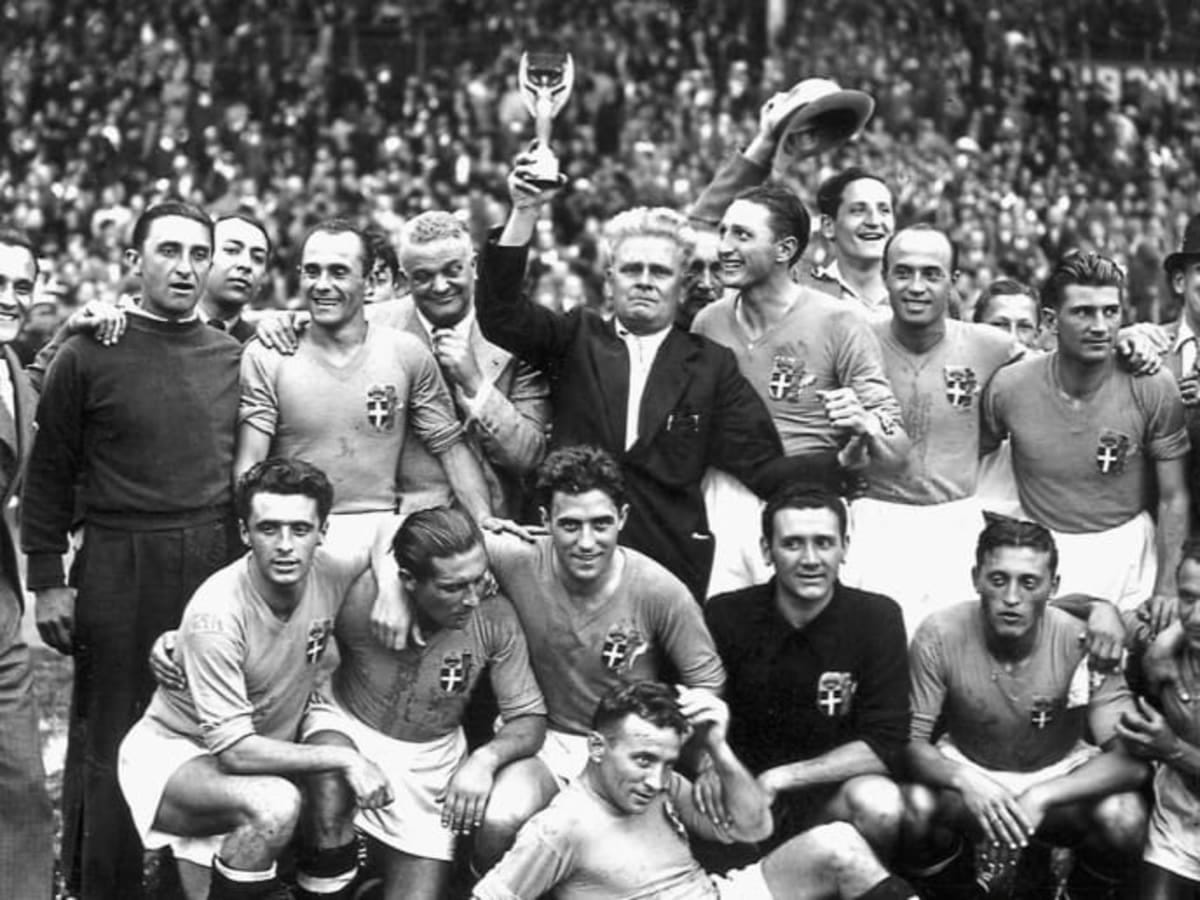
This was certainly expressed at that time by Vittorio Pozzo’s Italian metodo, which was not very far from Herbert Chapman’s WM. Their difference was that while the WM placed a trio in defence, the Italian version of tactical evolution kept the fullbacks as a defensive pair, with the central centre-half beginning his efforts from greater depth, creating a 2-3-2-3 formation, with the two inside forwards also dropping back, leaving space for the centre-forward and the wingers at the top of the attacking line. The militarist Pozzo had been inspired to create this system by military mechanisms that keep depth through the axis and allow the flanks to charge in order to create breaches in the opponent. If one pays attention to the essential function of the quartet created by the two fullbacks and the wide half-backs, then one can identify the first elements of the deep function of catenaccio, which essentially needed the binding role of the withdrawn centre-half in order to acquire the form it took a few decades later.
As regards the competitive programme, the 1934 World Cup was also much more interesting than that of 1930. In the first tournament, in Uruguay, we had to reach the final in order for the first truly great match of the tournament to take place, since the big favourites, Argentina and the host Uruguay, did not face any particularly difficult opponent on their way there. It is characteristic that both won their semi-finals by a score of 6-1. But in 1934 Italy needed a replay in order to beat Spain after their first draw in the quarter-finals, in a match in which the legendary goalkeeper Zamora did not play, stating that he was ill, although he was seen in the stands of the Tuscan stadium watching the match a few metres away from the place where Mussolini himself was seated. In the same round Austria beat Hungary 2-1, while Czechoslovakia defeated Switzerland 3-2, in two matches that gathered together all the Central European teams. Of these, Italy’s opponent in the semi-final in Milan was the Austrian Wunderteam, a team of unfathomable talent, perhaps the alter ego of the Argentine school in Europe, which had to find before it a heavy pitch, almost destroyed by a storm, in order not to be able to produce the wondrous football it played and to be eliminated by Italy 1-0. In the final, Italy prevailed in Rome in extra time over Czechoslovakia 2-1, thus sealing the superiority of the teams of the Central European football network in the tournament.
Italy’s superiority, however, was not only footballing. A specific transfusion was needed in order to ensure that the metodo would be sealed with the global success necessary for Mussolini. Understanding the importance, on an ideological and political level, of the instrumentalisation of football, the Italian dictator defined Italianness in a new way, so that all those who had an Italian in their family up to seven generations earlier would be defined as repatriated Italians. In practice, this meant that the majority of the inhabitants of the Río de la Plata countries had the right to Italian citizenship and, naturally, the same was true for the footballers who played for the national teams. In the final, three Argentines played in the colours of the squadra azzurra: Enrique Guaita from Bahía Blanca, Raimundo Orsi from Avellaneda, as well as the captain of the Argentina national team in the 1930 final, Luis Monti, from Buenos Aires. All three had previously played in the colours of the albiceleste, but were now considered ripatriati, oriundi, who gave the necessary strength in human resources to the Italian footballing vision.
However hard one may try to detach Italy’s footballing victory from the fascist regime, this is something very difficult to do. The eleven that represented the country was the result of the moves and policy of that regime; the way the victories against Spain and Austria came about had to do with the fact that Italy was playing at home and, above all, Vittorio Pozzo, that militarist, English-bred football man, who may have loved England a little more than Italy, was not ideologically distant, in his footballing approach, from the ideology of the regime, whether as regards the inspiration of the tactics or as regards the psychological part of preparation, in which he included military marches and visits to the cemeteries of battles of the First World War. It is not compulsory for the team of a winning regime to represent that regime in depth, but that Italy is difficult to disconnect from the aims of the fascist formation.
Care is therefore needed when one examines the victory of a team that came in a dark environment, with the support of the corresponding regime. The analysis of such cases in world, international and club football can be the subject of another dissertation, and the conclusions for each separate example are not the same. That Italy of Pozzo, however, was a team that probably also objectively represented – for a series of reasons already mentioned – the best football of the era. If this cannot be said without asterisks about the 1934 World Cup, then the 1938 World Cup certainly gives a clear answer.
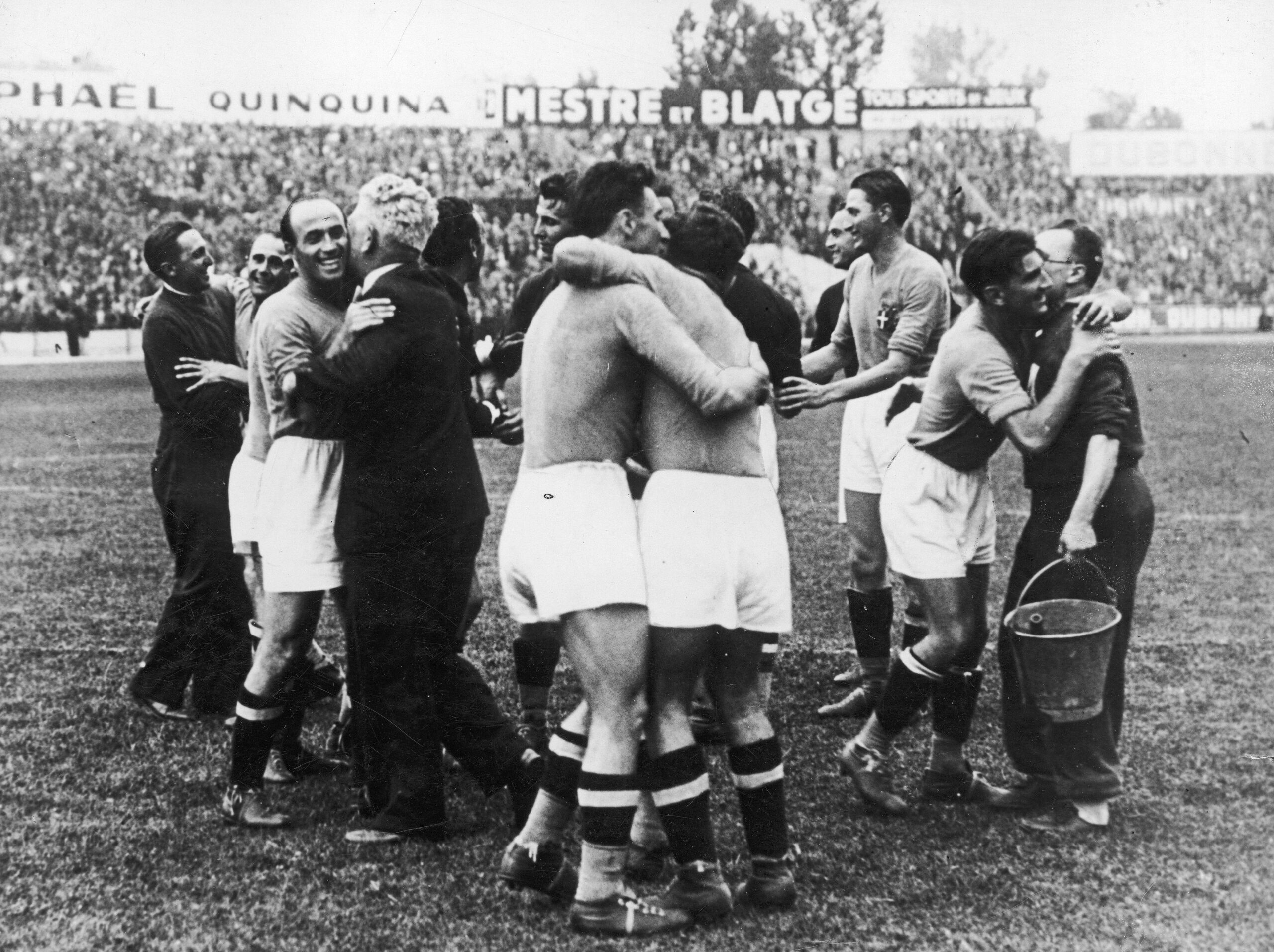
The third World Cup was organised in a republican country, in the homeland of Jules Rimet, which was certainly hostile to Italy’s political aims at that time, and no one in France wanted to see another triumph of the Squadra Azzurra. The great help this team needed was eventually given by a third country, Nazi Germany, since with the Anschluss it dissolved the footballing superpower Austria, which no longer had its own national team to participate in the World Cup, while disorganisation had also begun in the other countries of the Central European football network, where many prominent footballing figures were under persecution. Italy beat the host France 3-1 in the quarter-finals, dressed in all-black kits, in full reference to the fascist regime, while in the semi-final it found itself facing the Brazil of Leônidas, who despite the Italian triumph was the great star of the tournament. In the final, once again two teams of Central Europe claimed the trophy, with Italy winning this time much more clearly, 4-2 against Hungary.
Pozzo himself said that the Italian team of 1938 was much better than that of 1934 – and this was probably true, with several objective causes helping this footballing evolution and improvement. On the other hand, it is also true that it did not have the same strong opponents as in 1934, and its victory seemed much more emphatic and clear. This, after all, would also be the last one before Europe changed dramatically through yet another destructive World War.
Examining the World Cups of the 1930s, it is worth pausing over Rimet’s ideological approach, how this was expressed in 1928 in order for the institution to begin, and what had happened by 1938, that is ten years later. The criticism made earlier of Rimet’s view and its Christian Catholic basis seems to find very solid ground in what unfolded in 1934. If Rimet and FIFA so guilelessly believed in peace and understanding between peoples, then how did they give the tournament to the country that had been for about a decade under a harsh dictatorship, which introduced authoritarian practices the world had not known until then? If the basis of the papal encyclical aimed at improving the living conditions of the working class within a free environment and was not simply direct anti-socialism and anti-communism from the conservative parts of the Old Continent, then how did the same papal church align itself with the development of the fascist formation in Italy? These two courses, of FIFA and of the papal church, alongside fascism, have a common basis and course – and football was being instrumentalised from that first era of the World Cup, even if some today want to present it (for reasons of their own) as an “age of innocence”.
This first era would essentially close after the Second World War, with the 1950 World Cup, which thus completed a quartet of tournaments characterised by recurring motifs. The World Cups of South America were organised in countries that needed, through football, to create and showcase a new national identity; those held in Europe had the participation of all the footballingly developed countries of the Old Continent. The South American tournaments took place with participation problems, since from sixteen teams, for various reasons, there were finally thirteen when the tournament began, while the structure with a group stage (and ultimately without a final as regards 1950) had very few clashes of footballing giants. In the European World Cups of 1934 and 1938, the simple knock-out phase created a great many important matches, encounters between great football schools, in every round.
All four of these tournaments took place in countries that had their own reason to invest in football and support FIFA’s undertaking. If this is clear for Uruguay, Italy and Brazil, the organisation by France was yet another event in a series of moves whose aim was that the cultural background of world football not be British. This is a goal that Rimet certainly achieved: world football would forever be Latin and thus it remains to this day. Even if the schools of Anglo-Saxon and Protestant conception, which gave birth to the game, have made a great contribution to its course and have had several successes, to this day they have never had the upper hand as regards its projection and its social impact. When one speaks of the World Cup, one usually does not think of rainy afternoons and the racial characteristics of those who gave birth to the sport, but of a very different, multiracial content of Latin temperament.
The 1950 World Cup was the one that essentially closed an era of Latin American football that rested on fairy tales. This era may not have contained political innocence, since political forces saw in the sport an excellent tool for connection with the masses, as well as the possibility of creating identities and therefore consciousnesses, but it contained a considerable dose of footballing innocence, which led to dramatic defeats, the failure of Argentina and La Nuestra in 1930 and, of course, the tragic Maracanaço in 1950. The closing of this era would also mark the beginning of a new rational effort of reconstruction of South American football, which would eventually bring it into a truly equal position – and many times into a position of superiority – against European football.
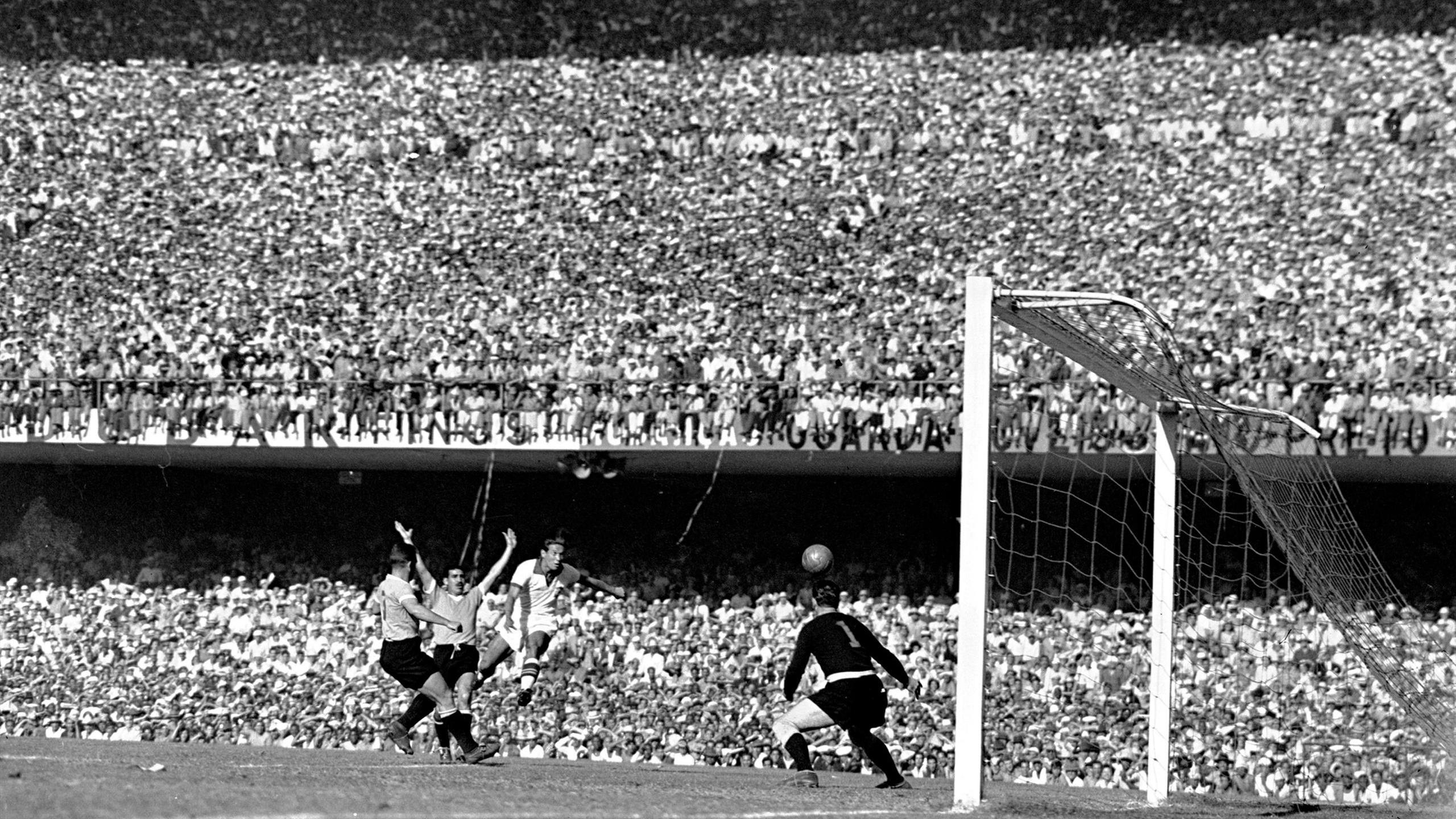
The 1950 World Cup would also close the intense period of footballing symbolisms through football architecture. The construction of the Maracanã had many elements in common with that of the Centenario and of the ancestor of the Flaminio, which also had to visually reflect the ideology of a regime and be able to carry the weight of its ideological intervention. The fact that footballing fate fell to the Maracanã to become more the tomb of such a regime fairy tale perhaps helped prevent the recurrence of the corresponding metaphysical approach and the elevation of the construction of a stadium into a national objective and cause of national pride. As regards the protagonists of that era, Uruguay and Italy paid heavily the price of their premature success, with the former considered from those years a “sleeping giant” and the latter needing to go through a great adventure before finding again its international rhythm. The great winner of this whole process was certainly FIFA, which had taken into its hands the reins of world football, was universally recognised as the institution defining the fate of the sport internationally, while with the change of its headquarters to Zurich, in 1932, it was transformed from an organisation linked to the political aims of a state into an organisation with the characteristics of an international diplomatic body. The great loser was certainly England, which lost its most precious cultural export product – football no longer needed English ships and trains to be transferred to new territories, while the national team left humiliated from the fields of Brazil, having lost to Spain but also to its footballingly indifferent colony, the United States of America.
The era of the football explosion
The first World Cup that symbolised the new post-war era was the one organised in Switzerland in 1954. At the World Cup in Brazil, many European countries were still picking up their pieces, amid the ruins of the war, and a football tournament had far less importance for peoples trying to stand on their feet again and to rediscover old habits or discover new ones in a very different world, which despite its fragile balances concealed an optimism of long-lasting peace. The socialist camp that was created after the end of the Second World War and the victory of the Soviets over the Nazis led to a new international understanding also at the footballing level, with the Football Federation of the Soviet Union becoming a member of FIFA from 1946. This was not a small or peripheral event for the course of post-war football. An entire football school was integrated into the same global network, while countries that now belonged to the socialist camp brought a different conception of tactical development.
Things were, however, considerably more complicated at the political level and specifically as regards the future of the great defeated party of the Second World War, Nazi Germany. The German state was partitioned so that it would not be able to develop again the same ambitions it had created during the inter-war period, after its previous military defeat. The Allied powers, that is the United States, Great Britain, France and the Soviet Union, each took control of a part of the German territories, while the old capital, Berlin, was also divided separately into four sectors, although it lay entirely within the territories under Soviet control. The Cold War rivalries, however, and the new hegemonic position of the United States in the capitalist camp led to a rupture also regarding the observance of what had been agreed at Yalta and Potsdam, with the result that the three capitalist powers founded, on 23 May 1949, the Federal Republic of Germany, through the unification of all the territories under their control, while in response the Soviets proceeded to found the German Democratic Republic, a few months later, on 7 October of the same year. The capital of so-called West Germany was moved to Bonn, a small city that essentially constitutes a suburb of Cologne, while the eastern sector of Berlin remained the capital of the East German socialist state.
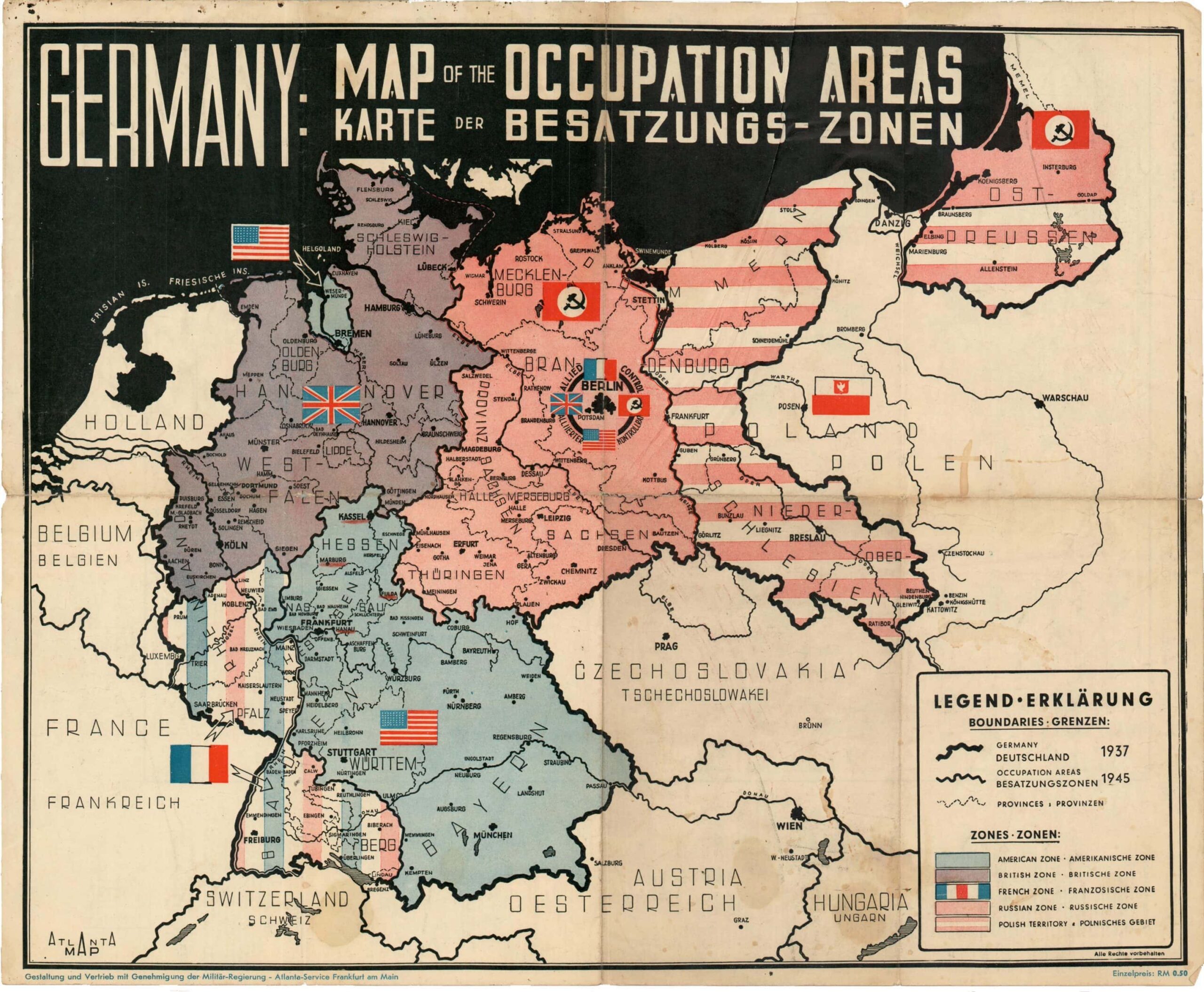
In the qualifiers for the 1954 World Cup, which began in June 1953, only West Germany participated from the two new German states, competing against the national team of Saar, a small statelet that in 1956 was absorbed by Federal Germany, and Norway. With three wins and one draw, the West Germans qualified for the World Cup in order to represent their new homeland for the first time, naturally carrying the great historical burden of continuity with a criminal state – as it had been characterised by the UN as well as by the Allied powers – and the need to show that their national identity could be transformed after the savagery of the great war of the previous decade.
In another corner of the world, on the Korean peninsula, less than a year before the start of the World Cup in Switzerland, the war ended between two regions that were under American and Soviet influence. In that case the countries created were the Democratic People’s Republic of Korea and the Republic of Korea, which are known to this day by the names North and South Korea. South Korea, competing in a qualifying group that took place entirely in Tokyo, a few months before the start of the World Cup, became the second Asian team that would play in a World Cup, after the Dutch East Indies, that is Indonesia, which had played in the 1934 tournament.
Of the old European powers, three teams now represented a new political camp in the global political arena. Czechoslovakia, Yugoslavia, as well as Hungary, were now part of another and opposing political ideology and part of a distinct football network which, together with the Soviet Union, was autonomously developing football tactics. The result of the pre-existing experience at the highest footballing level, as part of the Central European network, and of the new socialist tactical conception was expressed mainly in the evolution of the Hungarian team. The pioneers of the footballing transformation of the old great Hungarian school were communist football people, who saw a very rapid evolution in the tactics and analysis methods of Soviet football, which the rest of the world perhaps ignored or simply underestimated. The first of them was the coach Márton Búkovi, who experimented with the centre-forward Palotás at MTK, creating a false-nine position that filled the space in front of the midfield and left greater freedom for the movements of the other forwards, acquiring a more creative and not only finishing role. But as regards the national team, the great figure who wrote the history of the football tactics of socialist Hungary was a former trade unionist in the French automobile industry, Gusztáv Sebes, who had been inspired by the book “Tactics in Football”, written in 1946 by the Soviet Boris Arkadiev, coach of Dinamo Moscow, a team that managed to leave undefeated, taking a 3-3 draw from Chelsea at Stamford Bridge in 1949.
Arkadiev, in this book, which essentially constituted the bible of football tactics for the countries of Eastern Europe in the first post-war years, studied the evolution of the 2-3-5 into the W-M that had taken place during the inter-war period in England, attempting to find the points where the new general standard of football tactics was vulnerable and rigid, in order to propose an even more evolved system that could overcome and defeat it. Arkadiev’s ideas concerned mutual covering and the changing of positions of the players on the pitch, ideas that clearly also had an ideological basis, as they came from a conception of the non-restricted role in the productive process, but of its more total understanding by each of its members, whether this concerned the production of material goods or the production of …goals, as happened in the object of his interest. These were, then, ideas whose development led to the change in the physiognomy of football a few decades later.
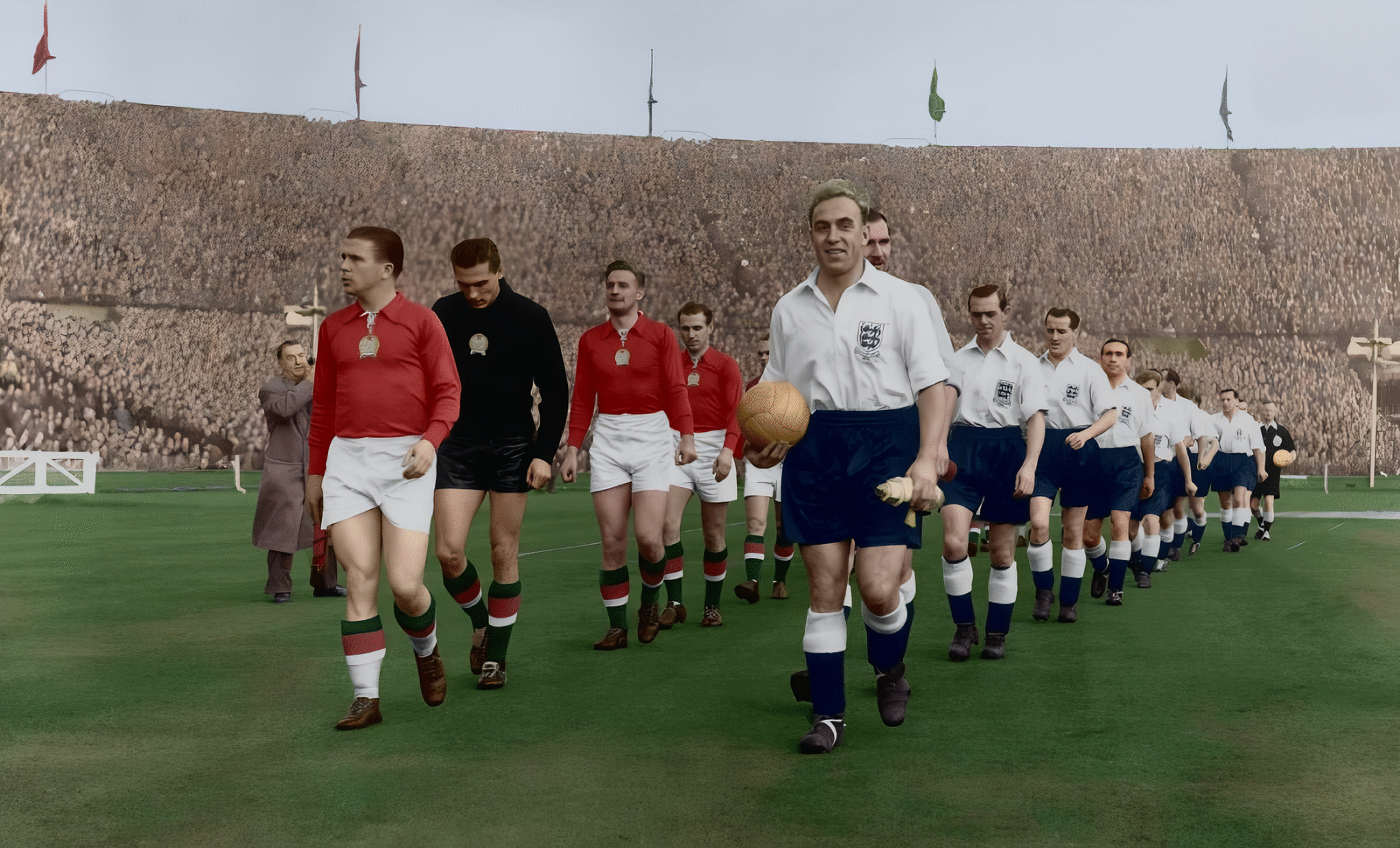
If Soviet football, inexperienced in international encounters, could so quickly have admirable results, such as that tour of Dinamo Moscow in England, Sebes understood that the prospects of adopting these ideas in a football school with much greater international experience could create footballing miracles. No one can say that he did not achieve it, writing indeed in golden letters the history of footballing Hungary, when on 25 November 1953, about half a year before the World Cup in Switzerland, the Magyars brought the England national team to its knees with a score of 6-3 before more than 100 thousand spectators who had come to Wembley to watch what was called “The Match of the Century”. Sebes’s notes clearly show the mutual covering and the changes of position of the Hungarian eleven that completely blocked the English, who had remained in a mechanistic conception of football tactics that already counted many decades of sterile reproduction. Hungary, indeed, repeated its triumph against the English, this time at home, on 23 May 1954, in the last match before the World Cup, winning 7-1 and destroying once and for all any illusion that existed about English superiority in a sport that was now global.
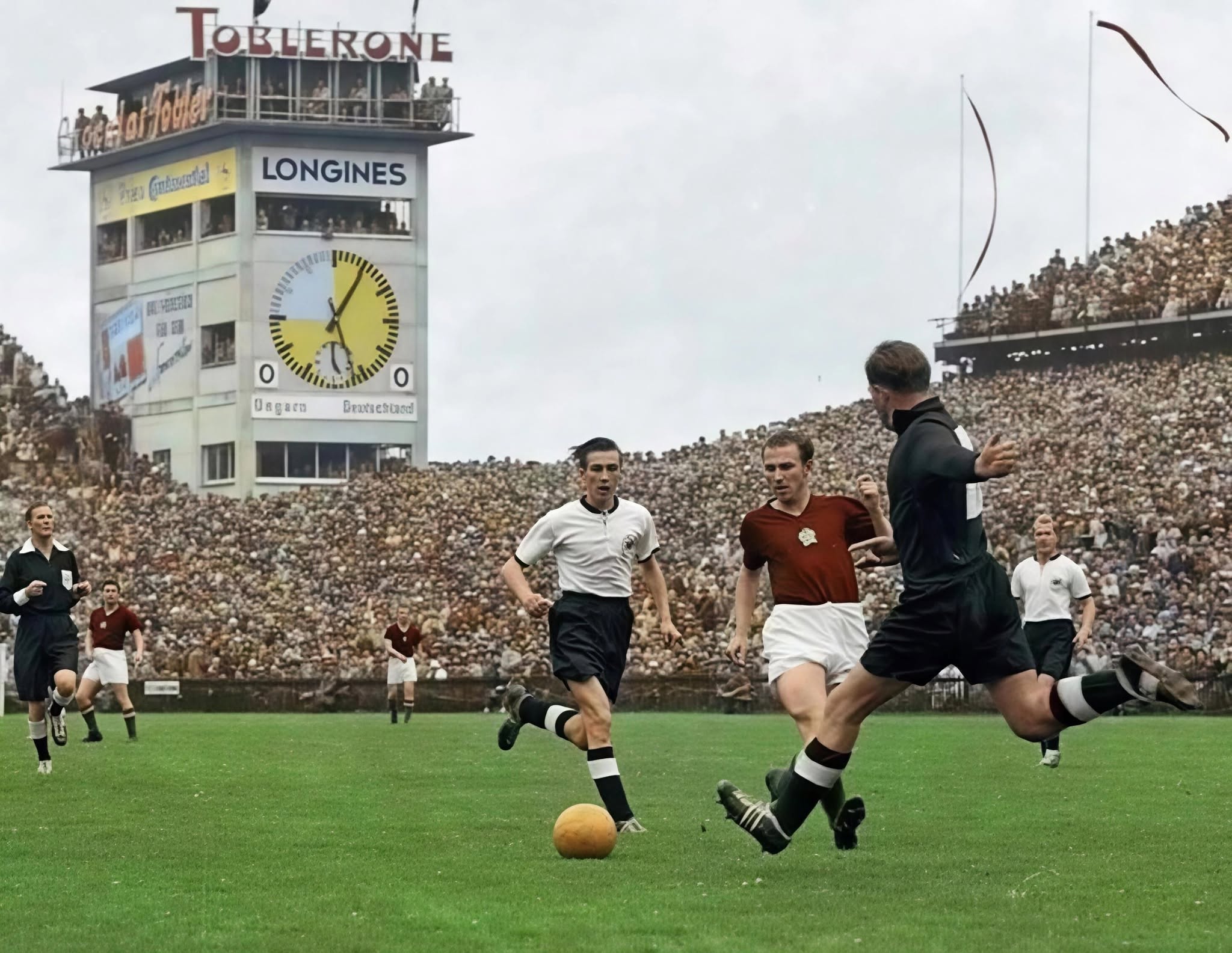
Hungary was drawn in Switzerland to play in the 2nd group, with the strange system of the tournament bringing it up against West Germany and South Korea in matches. There could not have been a draw more fitting to the political climate of the era, since socialist Hungary, of the communist Sebes, playing a football inspired by the Soviet school, faced the two countries that the capitalist camp had created through its conflicts with the socialist one. The results were more than resounding: 9-0 against South Korea and 8-3 against Germany. The Golden Magyars, the Olympic champions of 1952, were advancing through the greatest footballing arena, in a World Cup that FIFA, in the climate of the era, had brought to its new home.
The team that made things most difficult for Hungary was the one that proceeded to a tactical readjustment, with an enormous impact on world football. The system Hungary played, although theoretically a 3-2-5 or even a 2-3-5, could be described completely differently through the way the players moved. The wide defenders, the old full backs, who had left their place to the withdrawn centre-halves, although they advanced down the sides, clearly had defensive duties, while with the retreat of the centre-forward the other half could also go even deeper, playing in front of the defensive line. Thus, Hungary’s system looked more like a 4-2-4, with the two midfield players functioning as the connecting link between attack and defence. The same system, but with a clear back four, Brazil had also begun to play after the Maracanaço – and had it not found before it the formidable team of the descendants of Kürschner and Guttmann, who influenced its own footballing history, perhaps its path on the pitches of Switzerland would have been more successful. But on 27 June 1954, in Bern, the Hungarians had scored two goals within the first ten minutes, in order to win the quarter-final by a score of 4-2, in a game played under torrential rain and which, because of its violence, leading to three sendings-off, remained in history as “The Battle of Bern”. In the semi-final, the superhuman effort and intensity of this match led to an even more difficult victory over the World Champions Uruguay, but the Hungarians managed to win in extra time by a score of 4-2, in order to return to Bern for a Final that would constitute the crowning achievement of a triumphant course of years, of one of the best teams that have existed in the history of world football.
The final, which has remained in History as “the miracle of Bern”, is one of the most discussed games in football History. On a heavy pitch, the Hungarians could not produce the same exceptional football they had played at Wembley or in the group stage, while the tactical readjustment of the German coach Herberger, who put Horst Eckel to become the shadow of the most neuralgic Hungarian player, Nándor Hidegkuti, brought things into an extremely unexpected balance, a Gordian knot that was cut in the 84th minute with the goal by Helmut Rahn that gave West Germany its first world title. The golden generation of Hungary essentially dissolved after this match, with the departure of its great stars to the countries of the West that offered large professional contracts, foremost among them the so-called “galloping major”, Ferenc Puskás, who became a legend of the golden era of Réal Madrid.
The World Cup, however, did not cease to be absolutely tied to the narrative of the political History of the world. First there was the emergence of the new world and the existence of the South American Promised Land, then Italian fascism, then the lost dream of the reformulation of Brazil’s multiracial history and finally, in 1954, the triumph of the country born from the remnants of Nazism in order to be considered from then on an equal member of a peaceful and developing international community. The lawyer from Paris, the supporter of Rerum novarum, the Catholic visionary Jules Rimet had achieved all his aims: football was truly global, political powers understood its international arena as the best field for the reflection of their prestige, the English had been marginalised and defeated footballingly, and a sport that had become a vehicle for the creation of collective identities now functioned also at national level, worldwide, as a central stage for the reading of social History. On 21 June 1954, at the Congress of Bern, Jules Rimet left the presidency of FIFA, with the Belgian Rodolphe Seeldrayers elected to its leadership.
Four years later, at the World Cup in Sweden, football could finally be played, far from the close binding of the tournament to the aims of each political power. The period between the leadership of Jules Rimet and the rise of another official who completely changed how we understand football within the level of the economy constituted a frenzied development of footballing thought that in essence gave birth also to what we understand today as modern football. The timing was not accidental. From the middle of the 1950s onwards, the rapid economic development throughout the world, on its capitalist and socialist side, led to a rapid development of every field that required intellectual creation – the paradox would have been for football to remain outside this broader evolution that influenced the sciences, the arts, letters and political thought and expression. The old inter-war world had departed from football together with Jules Rimet, and what was now left to remember him was the trophy that bore his name, the same winners’ trophy that had been presented in Montevideo, Rome, Paris, Rio de Janeiro and Bern.
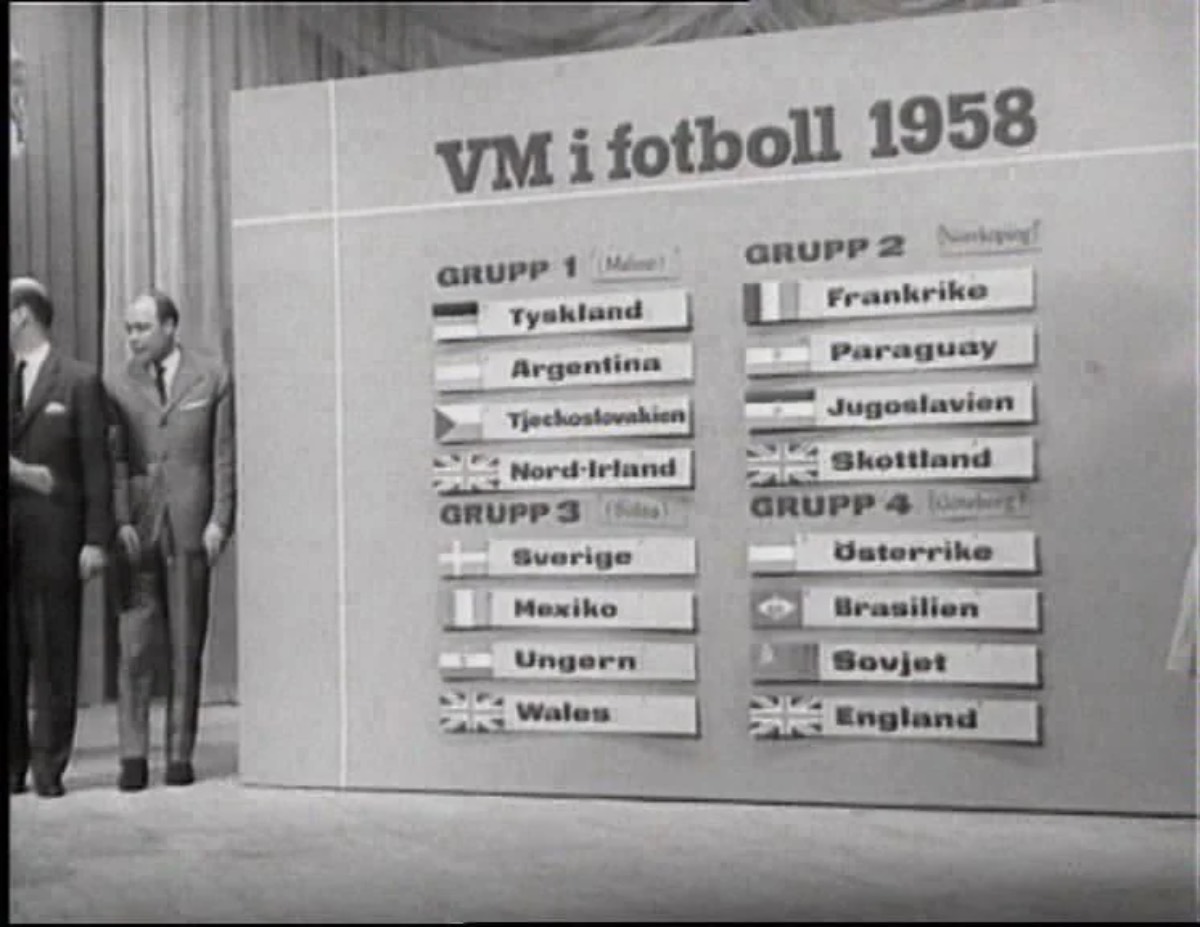
Among the 16 teams that would take part in the World Cup in Sweden were many that would play for the first time in the top footballing tournament. Northern Ireland, despite its long course in international encounters, as part of the British network, made its appearance on the world stage; exactly the same applied to Wales, while, as host, one of the first countries that had participated in football tournaments, Sweden, competed. Together with them, the Olympic champion of the Melbourne Games, the national team of the Soviet Union, also made its first appearance in the World Cup, which among other things had in its composition a goalkeeper dressed in black who would change the entire conception of the function of the most particular footballing position, Lev Yashin.
Knowing, of course, today the result of this tournament, interest should turn to the participation of the two South American teams in it, as well as to the course they followed before it took place. As regards Argentina, the analysis of political developments during the Peronist period is an undertaking that cannot in any case be presented to a satisfactory degree within the framework of the examination of another phenomenon, such as the World Cup, but requires the examination of all the particular and unique parameters that defined the country’s History. Perhaps, however, the most important element is the attachment of Argentine football to the innocence of La Nuestra, of the arrogant aesthetic approach, of the old school of virtuosity, of the elements that made national football divorce its British past. This approach, which had been strengthened through the course of the great Argentine clubs, such as River Plate’s La Máquina in the 1940s, continued to produce results, with Argentina winning the Campeonato Sudamericano in 1955 and 1957, in its new form consisting of double matches between all the competitors. However, Argentina had for many years been measuring itself only against the football of the other South American countries, none of which, except Brazil, had a stable presence in global tournaments. On the other hand, the encounters against Brazil were never only a matter of pure footballing superiority, since many factors, even emotional and extra-competitive ones, decided the results of their matches. Thus, Argentina, with this approach, travelled to Sweden to measure again the stature of its football 24 years after its previous participation.
With a diametrically opposite approach, Brazil travelled to Sweden with a great deal of raw and indeed still unknown talent, but with an extremely technocratic organisation, whose roots lay in a reorganisation of its football from the foundations after the Maracanaço. The representative team was administered by a technical committee that had responsibilities for every matter concerning the life and function of the team, had specialists for the psychological preparation of the players and the analysis of their mental health, organised travel instructions that contributed to securing maximum athletic performance, strict discipline and a meticulousness at every level of organisation that in many matters seemed excessive. This rationalism and technocratic organisation did not at all resemble what has remained as the myth about the South American teams and especially that Brazil, about which everyone today knows the talent of Pelé and Garrincha, perhaps considering that its expression in the World Cup was simply the result of fate, of the metaphysical force that gave this divine gift to the Brazilian footballers.
Argentina’s course in the 1958 World Cup showed that the old footballing myths had ended together with the era of Rimet’s ideologisation, and that in a world creating modern science, modern art, innovation in every activity, mythical stories were not enough to win on the pitch. The first match against Germany and the 1-3 defeat was a loud but not catastrophic slap, which was perhaps balanced by the victory by the same score against a team with great footballing history but little participation in World Cups, Northern Ireland. The crucial game that dissolved all the myths was the match that decided qualification for the knock-outs, against Czechoslovakia. The 6-1 of Helsingborg is for Argentina perhaps the equivalent of the Maracanaço and the moment when Argentine football began a long effort to rediscover its identity – a process that, fortunately for all of us who love everything that happens around the sport, had conflicts, internal and external, and naturally an enormous ideological depth!
The most interesting group of the tournament, the one that would metaphorically be called – as usually happens – the “group of death”, was the 4th, in which Brazil, the Soviet Union, England and Austria participated: three traditional powers, representatives of the three basic footballing networks that created international football, and a fourth team, of a new footballing world that was meeting the old one. If one looks with some distance at the general history of football up to its full homogenisation, one can say with some boldness that this group had the teams that created the four basic ingredients of its now global and homogenised philosophy, even if the Austria of 1958 was no longer the Wunderteam that wrote its own golden History in the 1930s.
On the first matchday Brazil defeated Austria 3-0, while the Soviet Union gave a demonstration of the tactical evolution that characterised its football, almost unknown to Westerners, drawing with England, having led in the game 2-0 until the 56th minute. The game between Brazil and England also ended level, in a goalless draw, while the Soviet Union beat Austria 2-0 on the second matchday. This meant that Brazil’s game against the Soviet Union was extremely critical, since it could put out of the competition whoever left it defeated. At the Ullevi stadium in Göteborg it was time for one of the boldest decisions in the History of football, a decision for which the whole planet can nevertheless be grateful. Two players who had never before appeared in a World Cup, the 25-year-old Manuel Francisco dos Santos and the 18-year-old Edson Arantes do Nascimento, appeared with the numbers 11 and 10 on their yellow shirts. The technical committee, within all its rationalism, had judged that the two players were not ready to take on the burden of national representation in the international arena and would not be able to adapt so well to the novelty of the pure 4-2-4 played by Feola’s team. But fortunately rationalism, when based on limited parameters, can be a completely mistaken assessment, with the result that those known in the footballing world as Garrincha and Pelé began a legendary course on the central footballing stage of the planet. With two goals by Vavà, Brazil beat the Soviets and, given England’s draw with Austria, the Soviet Union needed to beat the English with a goal by Anatoli Ilyin in order to pass to the next phase.
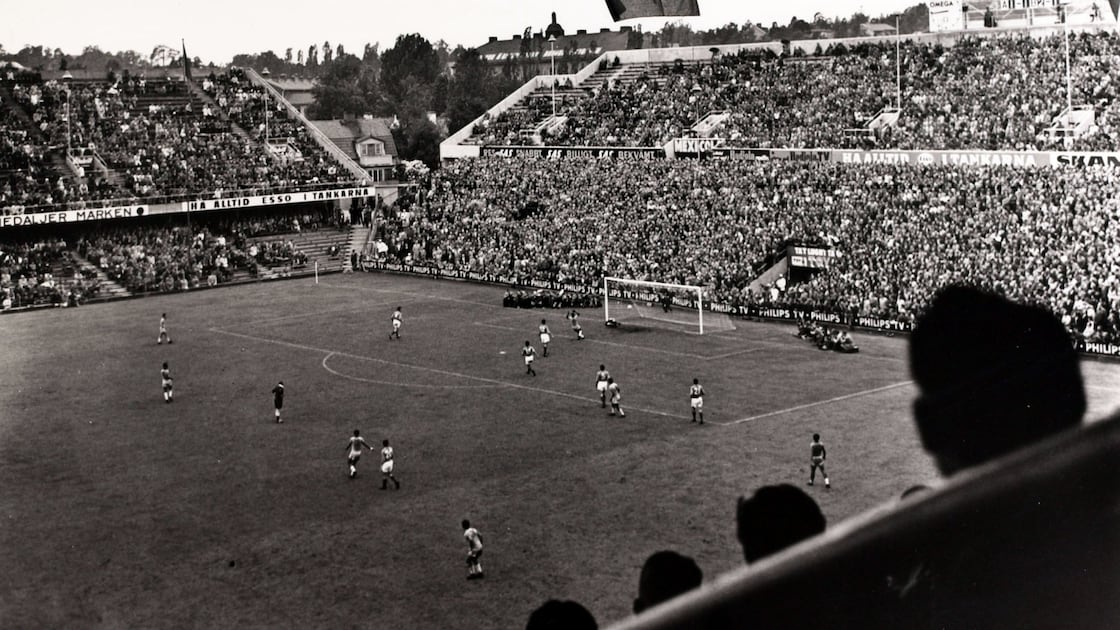
In the knock-outs Brazil beat Wales 1-0 with Pelé’s first World Cup goal, while in the semi-final against France the 18-year-old superstar scored his first hat-trick in a World Cup, gathering the eyes of the whole world, even if this came against a team of 10 players, since the French captain Robert Jonquet left injured in the 9th minute, shortly after the goal by the tournament’s top scorer, Just Fontaine, who to this day holds the record for top scorer in a single tournament with the 13 goals he scored on the Swedish pitches. Pelé again left history in the final at Råsunda Park in Stockholm, against the hosts, and with 5-2 Brazil had exorcised, through the organisation and rationalism of its football, the tragedy of the metaphysical Maracanaço. It took only eight years to pass from hell to paradise, and the proper utilisation of the innate talent of a country which, although it lacks basic infrastructure compared with the European national teams, never stops creating footballers who offer beauty to football through dedication to its organisation. The theories of mestiçagem of 1950, which had nothing to do with football, had within less than a decade given their place to the most beautiful and material footballing myth: the jogo bonito, which would make people dream with their eyes open until football found an entirely new identity in an ever-changing world.
In the same period, humanity was discovering that what is constantly changing is not only the social edifice, but also the very material basis of the existence of our species, the planet that hosts us. In the late 1950s and early 1960s, technological development helped the collection of bathymetric data as well as the installation of seismographic networks, which confirmed the validity of Alfred Wegener’s theory about the existence of lithospheric plates and the mechanism of their movement. The inhabitants of Chile would experience the application of this physical theory with deadly consequences on 22 May 1960, when the largest earthquake recorded in history, with a magnitude of 9.5, would occur with its epicentre near the city of Valdivia. The country that would host the 1962 World Cup, before being shaken by the pulse of a World Cup, was shaken for several minutes, only to find itself counting incalculable material destruction before the organisation of the 7th edition of the great footballing institution.
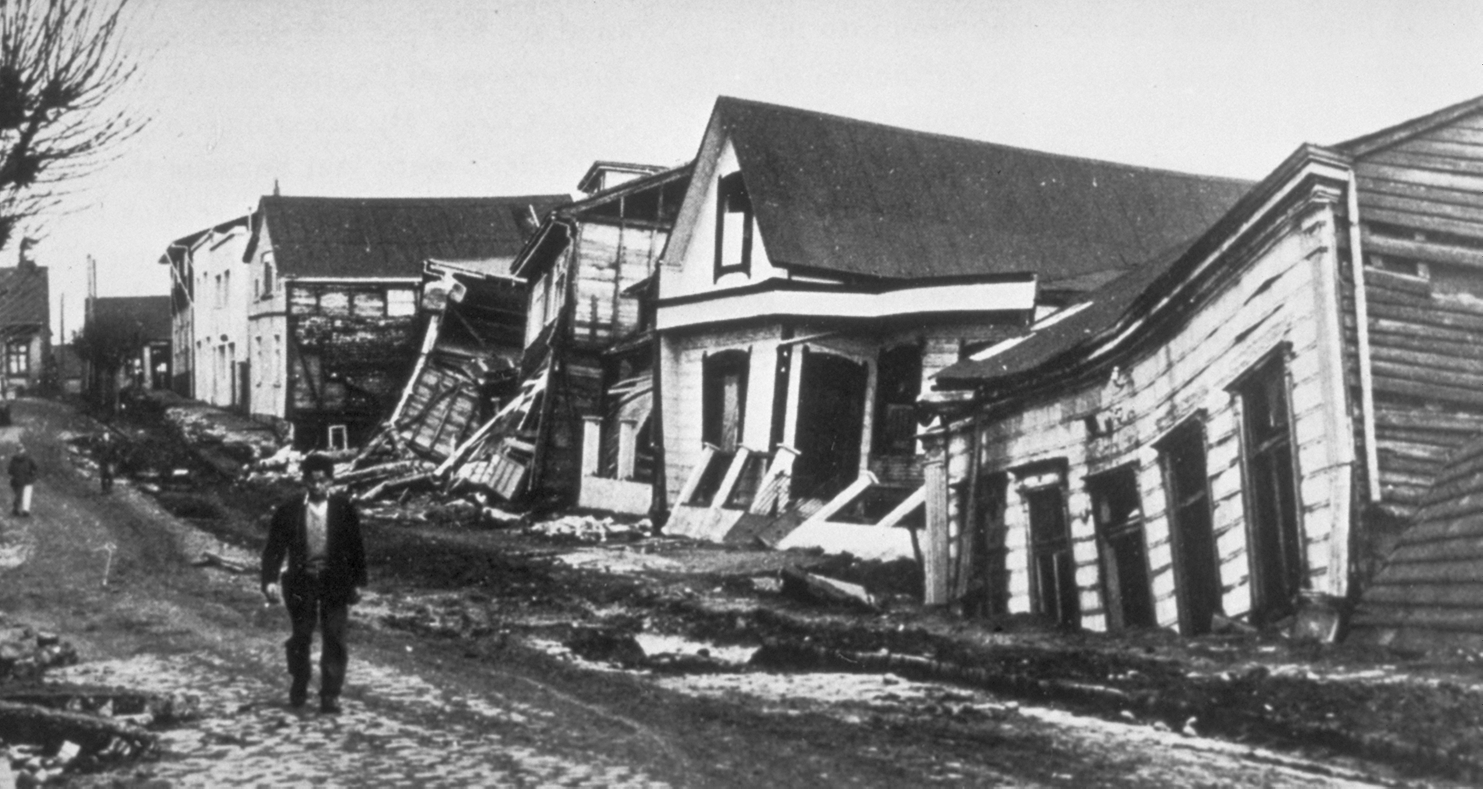
Chile had claimed the organisation of the World Cup against Argentina, which considered that it was finally entitled to organise an institution on its soil. In an extremely opportunistic campaign, the president of the organising committee, Carlos Dittborn, managed to convince the members of FIFA of the importance of the article that provided for the priority that countries with underdeveloped football had in staging the World Cup. Dittborn, of course, had not foreseen – as no one ever foresaw – the deadly earthquake that destroyed the cities of Valdivia, Concepción, Talca and Talcahuano, which although they were to host matches, ultimately remained outside the tournament’s planning. After the earthquake, Dittborn proposed to the country’s president, Jorge Alessandri, release from the obligation of organising it, so that the resources intended for the World Cup could be used for the reconstruction of the affected areas; however Alessandri, like so many other political actors in History, saw in the organisation of the World Cup a much greater political opportunity than the legacy of a rational handling of the destructive consequences of a natural phenomenon.
Carlos Dittborn died of cardiac arrest in April 1962, a few months before the start of the tournament, while on 25 March 1961 the English President of FIFA, Arthur Drewry, also died, with the result that at the London Congress, in September of the same year, his successor was elected: the last official of World Football before its transformation into one of the most important business fields. Stanley Rous, a former referee, made from the base of the footballing organisation, led the World Confederation in an era when football found its new identity, since he was the first who managed to last long in the position of head of FIFA after its historic President, Jules Rimet.
The world perhaps expected a tournament that would constitute the continuation of the footballing prosperity presented four years earlier on the pitches of Sweden. But the information coming from Chile did not show that such a thing was possible. Sometimes, indeed, this information may have exceeded the limits of criticism, with the reports of the Italian journalists Antonio Ghirelli and Corrado Pizzinelli being contemptuous texts about the country, describing beyond the absence of infrastructure Santiago as “the sad symbol of an underdeveloped country”, directly attacking FIFA’s decision to give the responsibility of the tournament to the South American country, “13,000 kilometres away”, expressing a Eurocentric and therefore racist conception of the world. These reports did not help the Italian national team, since when on 2 June the Squadra Azzurra faced the host Chile at the Estadio Nacional in Santiago, the atmosphere was particularly hostile, with the hosts treating the “battle of Santiago” as a matter of national honour and finally winning 2-0, essentially eliminating the Italians from the continuation.
The World Cup in Chile, however, was not characterised only by the heavy climate and the hardness of this game. The violence of football made a triumphant entrance, knocking out Brazil’s great star, Pelé, in the second group match, the goalless draw with Czechoslovakia. Pelé could not continue in the tournament, leaving the role of protagonist to Garrincha, while the Soviet footballer Eduard Dubinski suffered a terrible injury in the first match, from an action by the Yugoslav Muhamed Mujić that was not even given as a foul, but led to serious health problems and ultimately to the premature death of the Soviet defender seven years later. Amid all the heavy climate of destroyed infrastructure, violent football, injured players, one more tragic event came to make the tournament seem cursed. The eight-year-old Chilean Manuel Molina González, who followed the Uruguay national team supporting it passionately, died of cardiac arrest after La Celeste’s defeat to Yugoslavia in the third group match, which meant its elimination from the continuation.
England managed for the first time to pass from the group stage, where it faced Brazil, losing 3-1 in Viña del Mar, while Chile managed to beat the Soviet Union in Arica. Czechoslovakia and Yugoslavia completed the quartet of semi-finalists, which meant that this was the first tournament since 1930 in which no Western European country managed to reach the last four. Brazil found Czechoslovakia again in the final, in a game with much more spectacle than the one in the group and under the direction of the Soviet referee Nikolay Latyshev, who thus completed the Western European absence from the culmination of the tournament; with goals by Amarildo, Zito and Vavá, it won the second consecutive World Cup, repeating after 24 years the achievement of Vittorio Pozzo’s Italy. The great difference was that this Brazilian team still had much future ahead of it for more successes, and the whole world was not on the threshold of a destructive war, but in an era of rapid social progress and development.
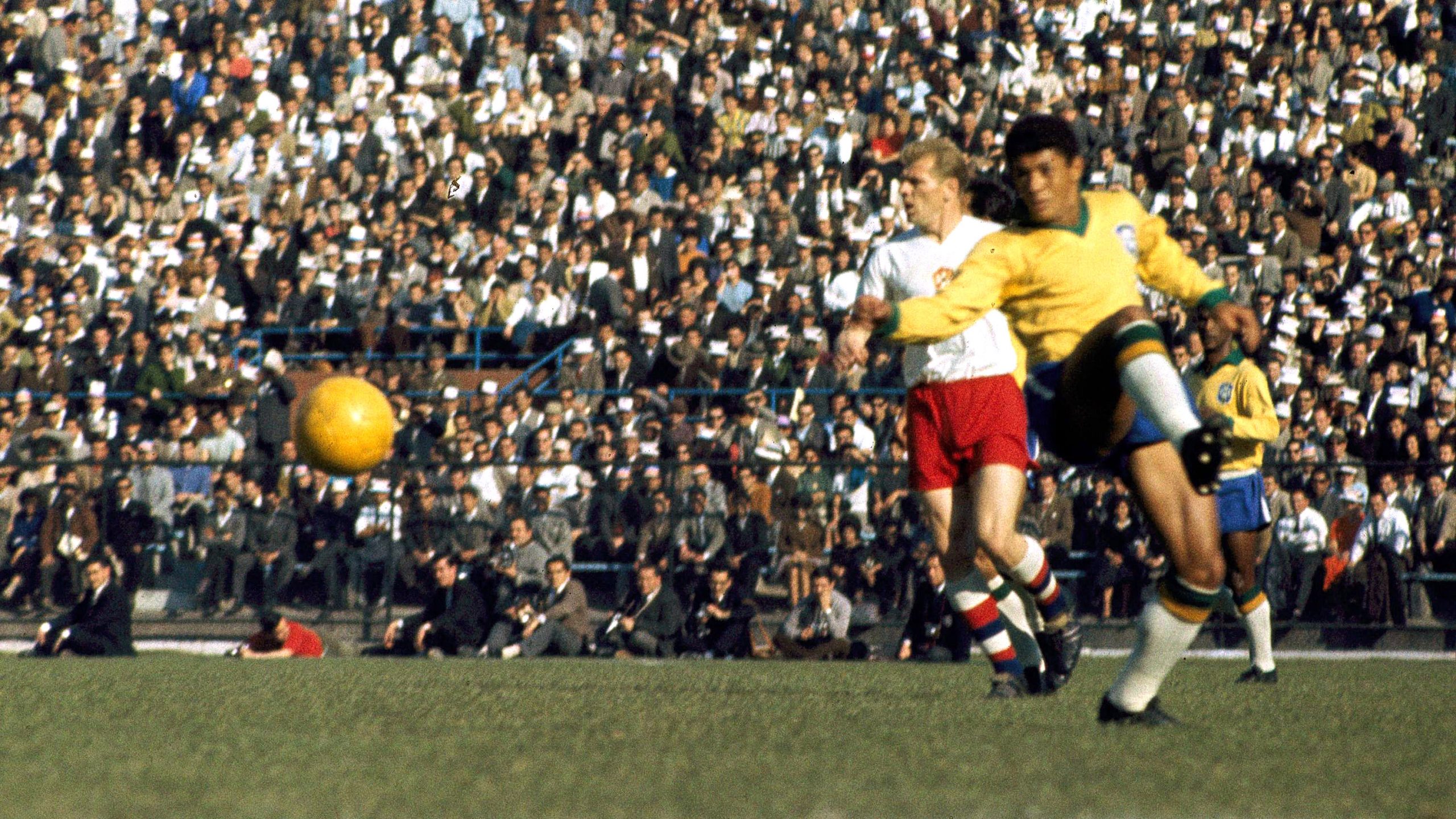
The World Cup in Chile took place at a crossroads of football history where different directions would dawn for the evolution of the football of many countries. The Western European countries may have been outside the last four, but they had already properly begun the functioning of their own footballing network, since in 1954 UEFA was founded, in the 1955-56 season the so-called European Cup began, the one known as the European Champion Clubs’ Cup and which evolved into the Champions League, while in 1960 the first final phase of the UEFA Nations’ Cup was also held in France. The absence of a wider footballing network in Europe had earlier allowed only national teams from specific regions to distinguish themselves in the World Cup, while the advantage of the South American teams, which had their corresponding own tournament from 1916, was great. Gradually Europe would regain dominance in the evolution of the sport and the teams of South America would have to reformulate the bases of their footballing conception, as Brazil had done from those years, because of the Maracanaço. This evolution would be more visible in Argentina’s course.
The 1966 World Cup was held in the homeland of FIFA President Stanley Rous and in the homeland of football itself. As happens with all football tournaments that have taken place in England, the slogan was that “football was coming home”. The United Kingdom, however, no longer had any relation to the great Empire that spread the sport across the entire planet. In a decade dominated by the independence of many states that had belonged to the old Empire, something that in the footballing firmament would be seen later, England, as the central state of Great Britain, also changes the profile through which the rest of the world sees it. It modernises above all culturally: London, from the seat of an aristocratic and colonialist class that dominates the whole planet, becomes the laboratory of a new cultural explosion, with the rock of the Beatles, the Rolling Stones, David Bowie, the cinematic productions of James Bond, the new tendencies of British fashion, within a framework that escapes aristocratic protocols and touches the thought of the protagonists of the industrial revolution, of the popular and middle strata, who, among other things, were also the protagonists of British football.
Perhaps there could not have been a more suitable moment for the World Cup to be organised in England – this cultural basis was much closer to football than the outdated conception of imperial Britain trying to impose itself, with an excessive superiority complex, on the rest of the planet. What England also did not lack was footballing culture, stadiums, huge crowds that lived for football. In contrast with the examples of Uruguay and Brazil, for example, in England there was no need to build a new stadium to host the final, nor to construct others to host the matches of the great tournament – the grounds where the English clubs played were already among the most legendary footballing temples in the world. What could seem like decline for an Empire was the modernisation of a country that now had nothing else with which to create its national identity than the production of cultural and intellectual innovation. Its football, correspondingly, had to be innovative as well, so that this tournament would help the organising country place its own stamp, as a culture, on its position in the world.
England, with Alf Ramsey at the head of its technical staff, born of a family of the non-privileged classes of the English countryside and a veteran of the Second World War, was footballingly harmonised with the development of its popular culture. Football was no longer an ideological framework for the development of physical strength, but nor was it a cultural product for the display of superiority, since the resounding defeat by Hungary at Wembley in 1953 and the failures in the World Cups that followed had created the necessary humility and the need for the organisation of national football in such a way that it could again find itself in the position of protagonist, if not of inspirer then at least of dominant force in the global footballing firmament. Thus, the mechanistic evolution of tactics, which had earlier created a stagnation, now meant that the footballing ideas born in other countries and by representatives of other schools were not rejected, but examined, utilised for the formation of the physiognomy of English football. In a few words, since world football could no longer be English, perhaps it would be a good solution for English football to become global. Having as a basis for these experiments a perennially very strong championship, with clubs that had a huge, stable and faithful supporter base, with many divisions of competitive teams, England could present to the rest of the world a new way of organising and developing football, claiming the lion’s share in its modern reformulation.
At the World Cup, of course, the aim was victory and the conquest of the institution, and thus the first game against Uruguay, in the opening match of 11 July, which ended in a goalless draw, was not considered an ideal start. Against Mexico and France, however, the English managed to achieve two victories with the same score (2-0) and to take relatively easily the qualification for the knock-out phase. There they would meet Argentina, which seemed to be recovering from the shock of Helsingborg, beating Spain and Switzerland in its own group and drawing goalless with West Germany, to advance as the second team of the 2nd group. But Argentina was not the one that had appeared in the inter-war years. A great change had taken place after the World Cup in Sweden.
The coaching triumvirate that took over the national team immediately after the Swedish shock consisted of Victorio Spinetto, José Barreiro and José Della Torre. Of these, certainly the most influential personality in the evolution of Argentine football was Spinetto, a footballer essentially raised within the Vélez club, which, as an outsider in the football of Argentina and Buenos Aires, had to find alternative ways in order to manage a distinction. Spinetto, who had taken over Vélez as coach from 1942 to 1956, managed to bring the club back to the first division and win the 1953 championship. Later he passed through Atlanta, before taking over the national team in two different terms, from 1959 to 1961. Spinetto was essentially an enemy of the ideological aestheticism of Argentine football, of La Nuestra. In contrast with his predecessor, Guillermo Stabile, the great protagonist of the 1930 World Cup, he believed that this naive approach belonged entirely to the past, trying to transform the football of spectacle into football of purpose. Certainly, the conquest of the Campeonato Sudamericano in 1959 was a result that convinced many of his approach – people sought results more than performance. Spinetto, however, among other things, was also the mentor of Osvaldo Zubeldía, who played for Vélez from 1949 to 1955 and found Spinetto again as coach at Atlanta in the 1958-1959 season. In 1965 Zubeldía took over the national team as coach, continuing the work of his mentor.
What, however, was the football that Spinetto envisioned and that Zubeldía developed to a notorious degree? The football of purpose was that which gave no importance to characteristics such as the aesthetics of the game, the beauty of cooperation, the conception of the development of any playing plan; it was instead the conception that football is the sport where, within the four lines of the pitch, for 90 minutes one must do whatever is possible to win. Instead of tactical boards, referees were hired by his teams to explain the loopholes in the regulations; instead of scouting the way opposing players played, a hunt for information about their personal lives was conducted, in order to find the ways and means that would crush their psychology during the game. It was what was called in Argentina anti-fútbol, and representatives of this school defend its principles to this day, with Cholo Simeone, the coach of Atlético Madrid, as its main representative.
The turn of Argentina from La Nuestra, aesthetic naivety, to anti-fútbol, the extreme expression of football for the result, is however only the reading of events. The basic ideological question around this evolution is how such a conception was able to develop so quickly in Argentine football. If one carefully studies the History of Argentine football and keeps as the most important element of La Nuestra its ideological basis of the secession of national football from its English characteristics, then the transition to anti-fútbol can be read as a return to the roots, that is, to the game based on physical strength, the one that the British bourgeoisie brought with it to every corner of the world, the one that it first developed also in its own home, until the combination game of the English workers, the clubs of the North and the Scotland national team prevailed.
The quarter-final that took place on 23 June 1966 at Wembley, between England and Argentina, did not only bring face to face two teams that shared common roots in their footballing History; it was held at a moment when Argentina was approaching the British roots of its game, in order with that to beat the English. The Argentines, however, were already notorious for this approach, and the West German referee Rudolf Kreitlein was ready not to let the game become an arena. Thus he began to whistle every suspicion of an Argentine foul, before the eyes of 90,584 spectators at Wembley, among whom naturally was also the president of FIFA, who had every interest in seeing the team of his country leave victorious from the encounter. Knowing also Zubeldía’s “tricks” in the way players gathered around the referee in order to complain about every tiny decision, thus exerting their own pressure on the ruler of the match, he did not hesitate in the 35th minute to send off the captain of the albiceleste, Antonio Rattín, giving a very significant advantage to the hosts. Rattín, of course, did not leave the pitch, since there was no red card and there was also a problem of communication with the West German referee, in the absence of an interpreter. This led to chaos, with tens of thousands of English people watching from the stands and seeing the Argentine captain as a red rag. Finally, when he left, the touching of the British flag that was at the corner did not need much in order to be explained in various ways and to give deeper explanations too to a conflict that on that day began as purely footballing. It is characteristic that there are stories from that era saying that English mothers told their children that if they did not eat their food, Rattín would come. Within 90 minutes, Argentina and England became perhaps the two most hated opponents in the history of the World Cups, and the cherry on the cake was placed by Alf Ramsey himself who, in the tension of the whole encounter, which was decided by a goal by Hurst in the 78th minute, stated that his team’s opponents behaved like animals, in a statement that is timelessly considered by Argentines to be a direct racist attack.
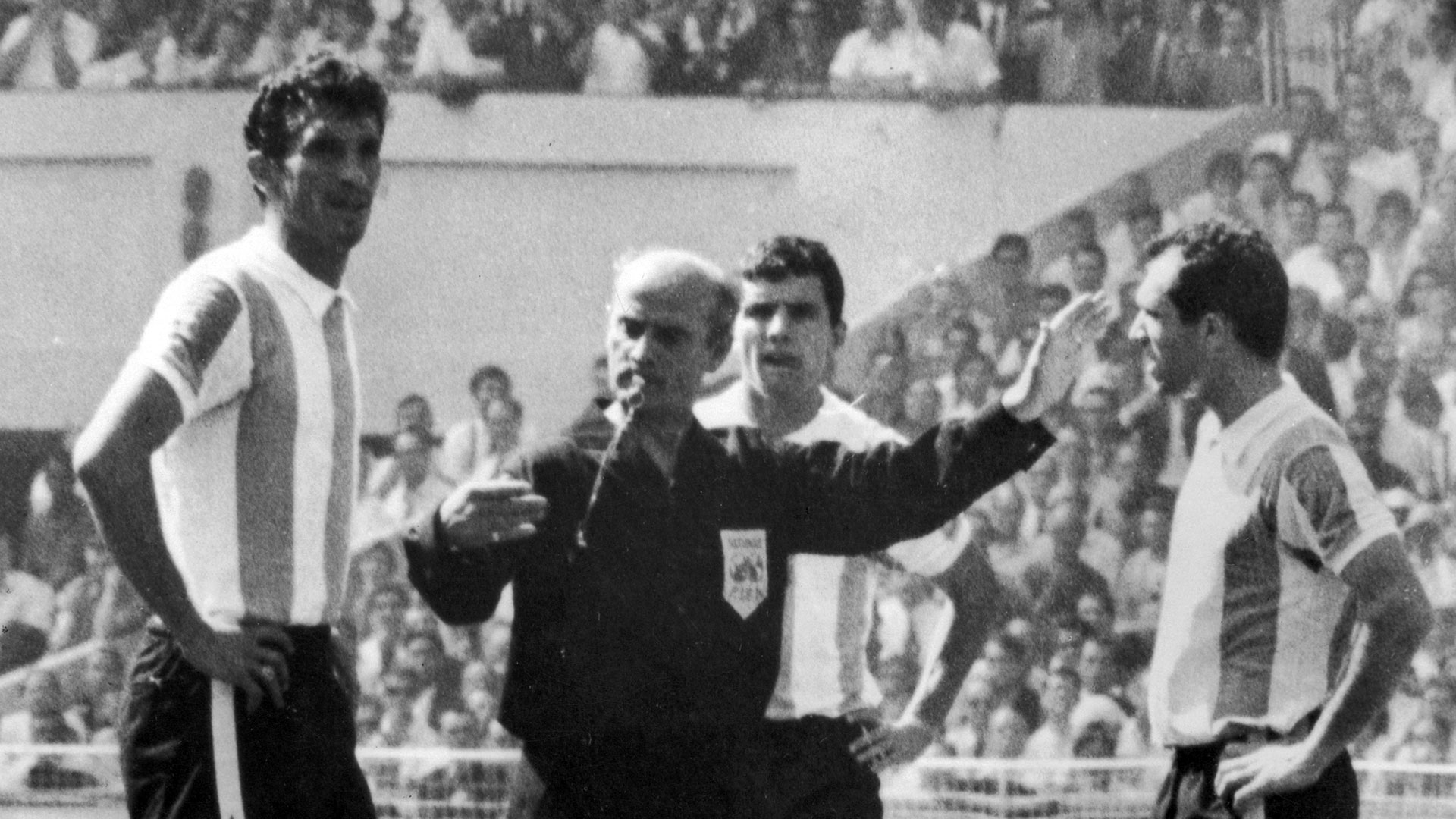
With Uruguay also eliminated in the quarter-finals by West Germany and World Champions Brazil seeing Pelé injured in the first game against Bulgaria, without managing to qualify from the 3rd group against Portugal and Hungary, South American football had failed completely in England in 1966 and the Western European teams that had been absent from the quartet of semi-finalists four years earlier occupied the first three places, with the last ticket from the quarter-finals won by the Soviet Union against Hungary. The final between England and West Germany was decided by a Hurst goal which even to this day the Germans maintain never existed (and they are probably right) and another in the dying moments, at the moment of its achievement, amid a general pandemonium, when supporters had already entered the pitch.
The English had found themselves at the top of the world, Bobby Moore wiped the mud from his hands on the velvet covering that surrounded the official stand in order to receive the trophy from the Queen, while at the head of the World Confederation stood an Englishman. But these conditions, which perhaps half a century earlier could have meant the complete dominance of the English, as inspirers of the game, in what concerned its global evolution, now meant exactly the opposite: the great success of the England national team in winning in the tournament of the others. The reformulated aim had been achieved: instead of the global game becoming English, the English game managed to become global.
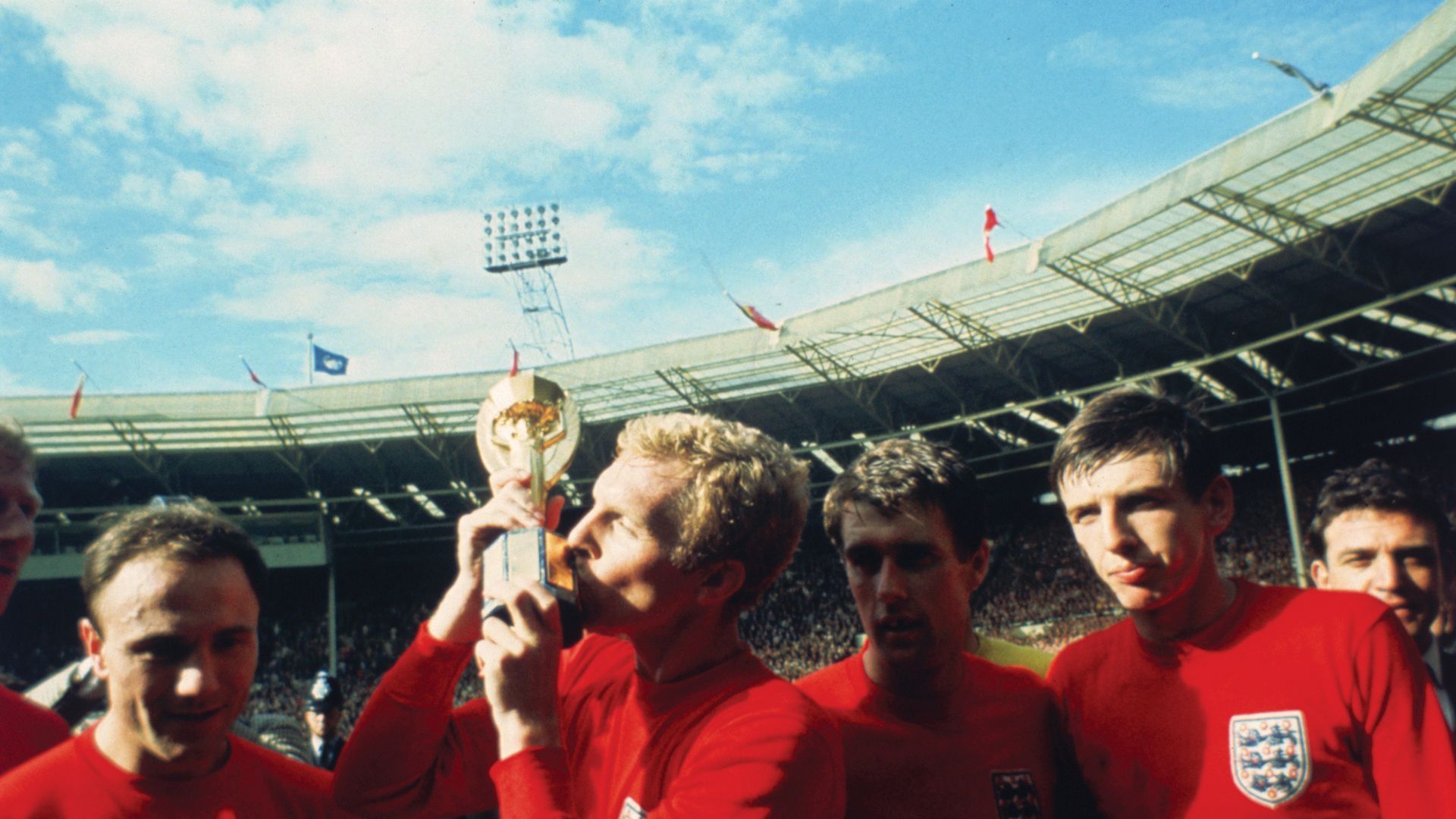
The world of the 1960s, however, was under the influence of other powers, far from Great Britain, and the conquest of new seas and oceans that had built the Empire of the past centuries had now given way to the conquest of interplanetary space, of near space, in a mad race between the United States and the Soviet Union. On 10 July 1962 the satellite Telstar 1 was launched from Cape Canaveral, an experimental prototype device that found itself travelling in geostationary orbit for 63 years, 10 months and 27 days. It was the American answer to Sputnik, the great success of the beginning of the United States satellite programme for the establishment of space telecommunications technology. Those first Telstar satellites were spherical, mainly white in colour, while the collectors of solar radiation placed on them seemed to create dark-coloured panels. Perhaps there was no other scientific development in History that influenced football more, on both a symbolic and material level.
The existence of telecommunications satellites meant that an image from any point on the planet could be transmitted very quickly to any other. This technique was what essentially transformed football from a mass phenomenon into a global phenomenon. If the evolution of industrial typography, the existence of newspapers and the evolution of the British educational system created the first great football clubs, whose reach extended as far as the news of their competitive activity travelled, printed on paper, the football of every country in the world could enter every home, with sound and image, through a television receiver. The first World Cup that sealed this revolution was the one held in Mexico in 1970.
Perhaps the greatest symbol from that era is what has remained as the model of the football. When someone asks us to imagine a football, the first image formed in our mind is the familiar ball with the 32 stitched pieces, the white hexagons surrounding the black pentagons. This ball is placed everywhere, in every symbol, as the emblem of the football game. For younger generations it is very difficult to imagine that it did not exist before 1970. This black-and-white ball was created for the needs of television broadcasting, since it had to stand out on the green grass on receivers that obviously did not have the clarity of today’s televisions. What would its name be? In one of the most inspired namings in the History of world commerce, this ball took the name of the telecommunications satellite that opened new paths for information, propaganda, global planning, as well as football: this ball was the Telstar. Initially manufactured by a Danish goalkeeper, Eigil Nielsen, for the Select company, it was adopted as a design by the company of a German manufacturer of sports shoes, with a shadowy past during the period of Nazism, Adolf “Adi” Dassler, from whose full name Adidas took its name. The ball first used in the 1968 Nations’ Cup became the official ball of the 1970 World Cup and from that year began one of FIFA’s most historic collaborations with a sporting goods company, opening paths for the extensive commodification of every side of the sport and its tournaments.
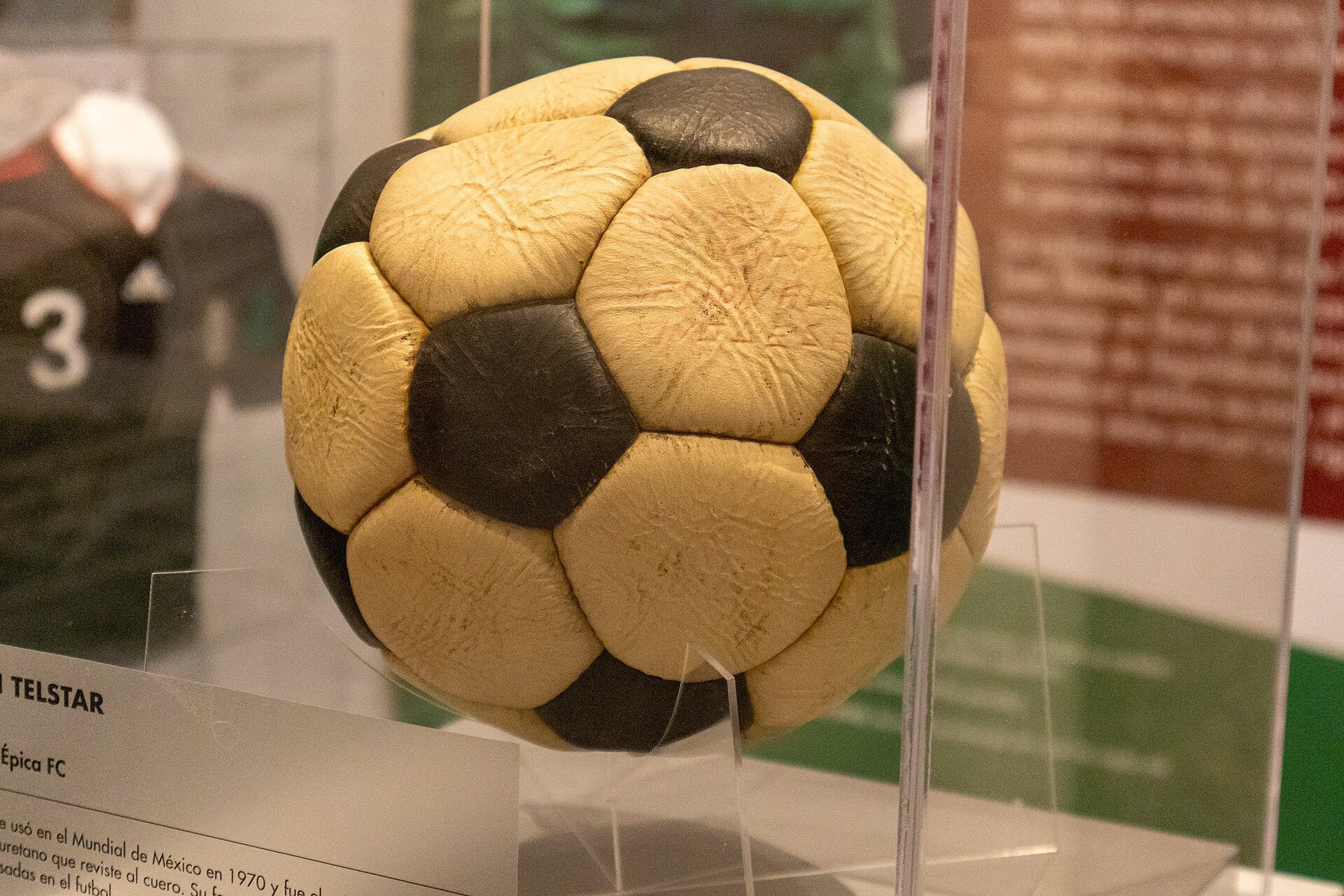
Although most television receivers, in many countries, may still have been black and white, the image from the World Cup stadiums was recorded and processed so as to be disseminated in colour and likewise archived in colour in the audiovisual material of football History. Technological evolution was not enough; football itself also had to be beautiful, so that a symbol of this transition would remain in perpetuity, from the football of highlights, of printed matter, of stories, to the football of the image, of moving memories. Perhaps no other colour could fit more than that of the Brazilian shirt, which from white became yellow after the Maracanaço, contrasting with the colour of the grass, the deep blue shorts and the white socks, which all together created an archetypal footballing colour palette.
Brazil, after the first appearance of jogo bonito in Sweden, which broke the historical curse, the violence in Chile and in England, was ready in Mexico to produce a monumental footballing spectacle. The situation on its bench, however, during the 1960s seemed more chaotic than ever; coaches changed constantly and until April 1969, a year and a little before the start of the World Cup, no stable plan for the development of the national team’s game existed. Then the fortunes of the Seleção were taken over by João Saldanha, a communist, naturally an enemy of the regime, who saw the change coming in European football, with the handing over of the sceptres of romantic football to a tactic that was adapted to the elimination of mistakes, sacrificing creation along with them. Saldanha managed, in the 17 games in which he guided the Seleção, to win all 17, but he exaggerated in his plans, causing cracks in the cohesion of the team, reaching the point of expressing views even about the exclusion of Pelé from the squad for the coming World Cup. These internal conflicts cost him his position and he was succeeded by one of the most emblematic coaches in the History of the national team, Mário Zagallo, world champion in Sweden in 1958 and in Chile in 1962, that is, a teammate of the great stars, closely connected with Pelé. Zagallo was able to balance this team, to impose the necessary discipline in the preparation for a World Cup that would be held at high altitude, but also to choose an innovative system that did not remain attached to the formation, but allowed creation, relying on the characteristics of the composition he had at his disposal.
Because there is no great victory without a great opponent, a team that seemed to come from the past, a great footballing school, made its reappearance on the global foreground. Italy’s return was not accidental – the founding of UEFA and the holding of the European Champion Clubs’ Cup allowed a country that has an extremely analytical approach to football to create new ideas, upon those that had remained incomplete from the old Danubian School. Some of the words that were then added to the vocabulary of football, such as libero, catenaccio, trequartista, reflect a way of playing with dedication to defensive function, the zeroing of mistakes and the opportunistic use of counterattacks in order to achieve each goal and victory. The teams of Milan, Inter and Milan, developed their own approach to a style of play that gave increased responsibilities to the libero and the regista, who created the game on the axis from the depth of the pitch, leaving freedom of choices to the quick forwards. Players such as Cesare Maldini and Gianni Rivera embodied these roles at Milan, while Sandro Mazzola emerged from the Inter of the inspirer of catenaccio, Helenio Herrera. With this approach the teams of Milan won a total of three European Champion Clubs’ Cups during the 1960s.
The national coach, Ferruccio Valcareggi, could not diverge much from the spirit of Italian football of the era, at a moment when he also had a series of players, such as Pierluigi Cera and the great scorer Gigi Riva from Cagliari, who could be integrated into the same logic. Italy got the results it needed in each phase, passing first from the group with only one win and two draws, against Sweden, Uruguay and Israel respectively, while in the quarter-finals it triumphed 4-1 against Mexico, which was playing at home. On 17 June at the Estadio Azteca of Mexico City, Italy nevertheless needed an unreal performance, in a game that is considered to this day the best in the history of the World Cups, in order to beat West Germany by a score of 4-3, in extra time, in an encounter with successive reversals and a constantly increasing rhythm and intensity, which, had there not been a final whistle, seemed ready to lead to an explosion.
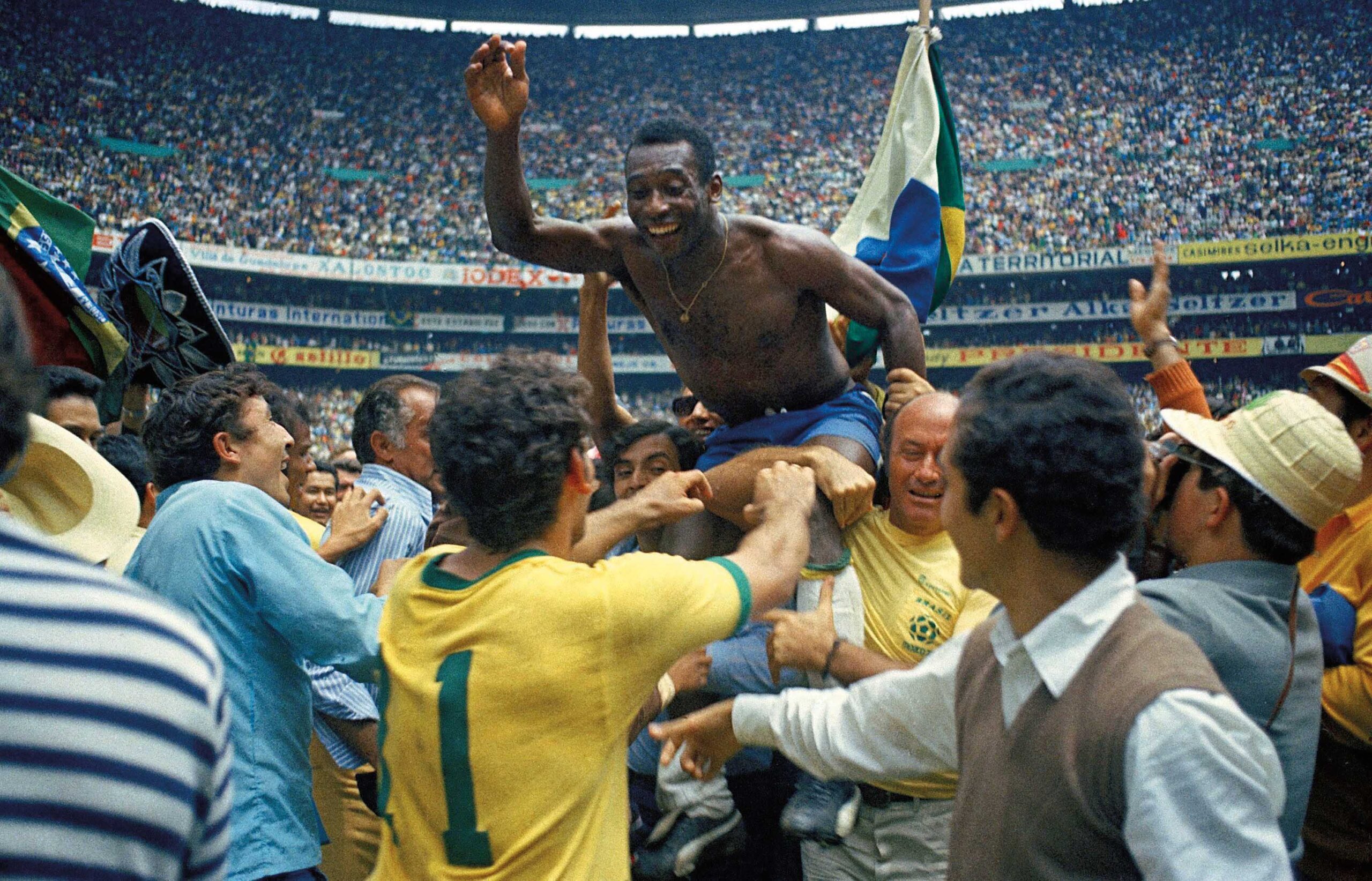
In a World Cup whose physiognomy had begun to reflect the new post-colonial world, since Morocco participated representing Africa for the first time after 46 years and the newly founded Israel from the Asian Confederation, colour abounded in every expression. It was this colour that the team of Brazilian artists, Pelé, Tostão, Rivelino, Gérson, Jairzinho, bound together on a footballing canvas, taking as much freedom as they needed from Zagallo’s instructions in order to create moving images of works of art. That Brazil was unstoppable: 4-1 in the opening match against Czechoslovakia, 1-0 against World Champions England and 3-2 against Romania in the 3rd group, 4-2 against Peru and 3-1 against Uruguay in the knock-outs, in order to find facing it in the Final that dangerous Italy, a team which, like the Brazilians, had won the World Cup twice. Catenaccio was capable of giving titles on European pitches, but at the altitude of Mexico, where time is counted differently and creation finds the necessary space to unfold in a less suffocating framework, contrary to the absence of oxygen, it could have no answer to the Brazilian superiority in arms. Although the score of the first half was 1-1 with goals by Pelé and Boninsegna, in the second half Gérson, Jairzinho and Carlos Alberto, coming from a position outside the television screen, wrote the final 4-1 that created dreams of a football combining beauty and result! This conclusion would fade quickly, but the Brazilian dream game had been recorded forever in the consciousnesses of humanity and in the films with technicolor processing, so as to constitute for decades the definition of ideal football and to place Brazil in an informal position linked to the stereotypically given global footballing summit. From 1970 onwards Brazil, whether it lost or won, was and remains the greatest footballing power on the planet.
Thus began the History of modern football, from the apotheosis of its old era…
Modern football
At the FIFA congress held in London in 1966, under the leadership of Stanley Rous, the countries that would organise the World Cups of 1974, 1978 and 1982 were elected and announced, thus creating the conditions for the long-term planning of the tournament and of the course of the sport worldwide. But before the 1974 World Cup was organised on the pitches of West Germany, football would change radically, in a way that seems permanent up to our days. As usually happens, a few days before the start of the great tournament, the FIFA Congress was organised, which that year took place in Frankfurt and, like every Congress in a World Cup year, had on the agenda the election of the president of the World Confederation. Never again, however, had the campaign of a candidate been a political campaign of global dimensions, as it was that year.
A former swimming athlete from Brazil, who had participated in the 1936 Olympic Games and had been president of the Brazilian Sports Confederation from 1958 to 1973, was setting course for perhaps the most powerful position of sports official in the world. João Havelange, the son of a Belgian migrant from Liège, born in Rio de Janeiro in 1916, was destined to change world football administratively, commercially, politically and finally in the consciousnesses of all peoples in a way even more influential than the great inspirer of the global dimension of the sport, Jules Rimet.
In order to achieve the aim of overthrowing Stanley Rous, Havelange used countless resources from FIFA to make his intercontinental journeys, to win the favour of the national federations that voted at the Congress, literally spending every last dollar he could for this purpose. Stanley Rous, not accustomed to this technocratic globalised world, despite his connections, did not manage to remain in the leadership of FIFA and thus Havelange began his first term, part of a long course, on his birthday, 8 May 1974. His first move for the financing of his programme, given that nothing had remained in the coffers after his global political campaign, was the signing of cooperation contracts with the companies Adidas and Coca-Cola, which from then became permanent sponsors of the World Cup.
Beyond the aesthetics of the sponsors that imprinted the political hue of the World Cup held in West Germany, a further series of aesthetic elements signalled the new era. The old-style trophy, the Jules Rimet Cup, was replaced by the FIFA Cup, a statuette 36.5 centimetres high, weighing 5 kilos and made of 18-carat gold, designed by Silvio Gazzaniga, depicting two athletes who hold on their backs and raised hands the entire globe, and it would become the new “holy grail” of the footballing planet. As regards the stadiums that hosted the tournament, their modernist architecture, with the foremost example being Munich’s Olympiastadion, which two years earlier had hosted the Olympic Games, symbolised the reconstruction of a country built on the ruins of a nightmarish war defeat and on the past of a criminal state. Everything symbolic that had happened in the 1954 World Cup with West Germany’s victory, 20 years later appeared on the television receivers of the whole planet as material proof. A dissonance, voluntary or involuntary, was the inclusion of the Olympiastadion of West Berlin, the stadium that had hosted the Hitleriad of 1936, among the grounds that would host the matches of the tournament, among them the opening match of the hosts against Chile, a country where another stadium was writing corresponding black pages in the History of the state of the South Pacific.
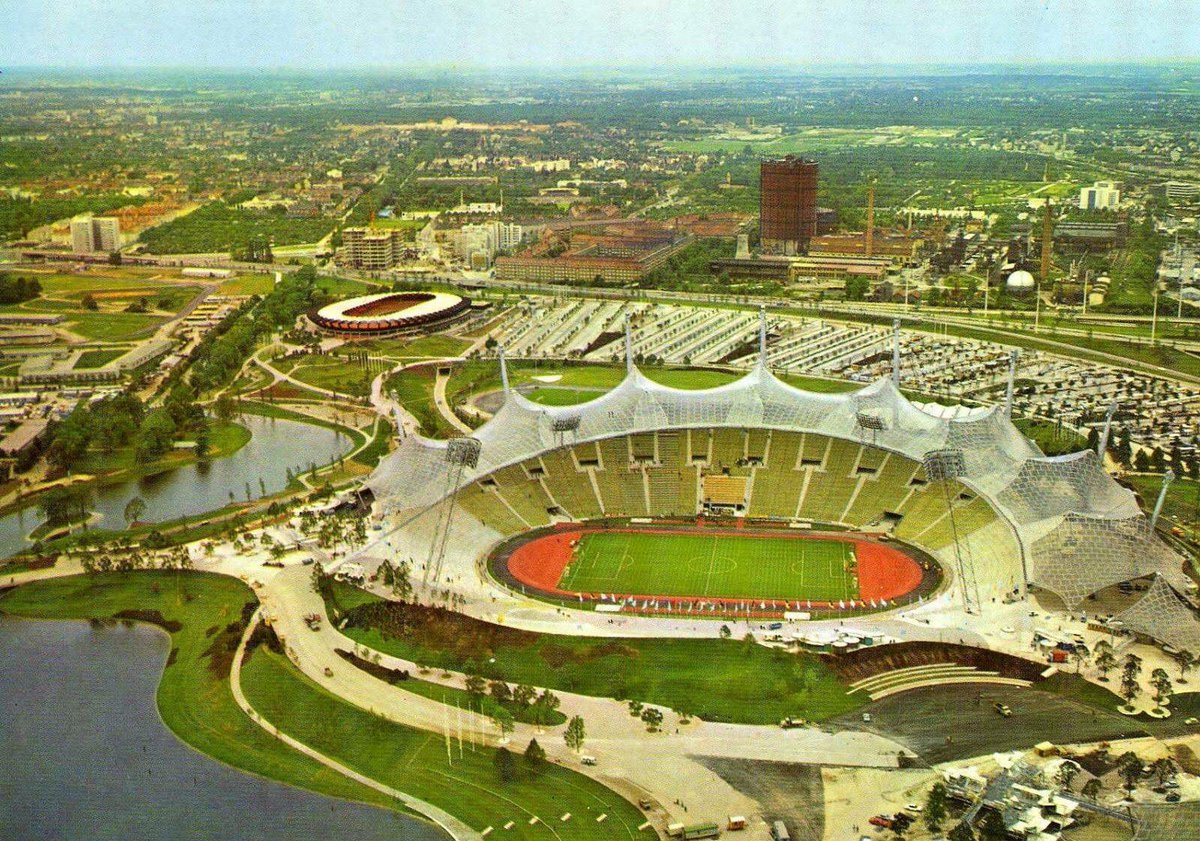
The draw brought things so that in the group stage West Germany had the opportunity to achieve yet another great symbolic victory, facing East Germany in the last match of the first phase. In the game in Hamburg, however, which did not claim laurels of footballing quality, the team of the People’s Republic left victorious thanks to the goal scored by Jürgen Sparwasser, footballer of Magdenburg, in the 77th minute.
The second group stage directly determined the pair of the final. In this phase the world truly saw one of the most formidable national teams that have ever existed. On the north-western borders of West Germany, a country that had always been at the cutting edge of intellectual innovation followed, during the post-war period, the same modernist steps, inspired by the Die Stijl of Piet Mondrian and those around him, reshaping its cities, creating a new ground for the life of its working class. This innovation broke the limits of Protestantism and of absolute, moralising discipline, which hindered the development of a sport in which creation is a basic ingredient. From within the concrete buildings sprang a new consciousness of youthful insolence, which became the raw material with which an entire footballing philosophy was built. The generation of the post-war boom could not fit within the moral limits of the war generation, and the same was true of the footballers, poor devils, who appeared from the modern working-class neighbourhoods around De Meer, the historic home of Ajax in the southern suburbs of Amsterdam. This talent was initially taken in hand and put in order by Vic Buckingham and then by Rinus Michels, who, in order to achieve it, broke all the rules known until then in football – or almost all.
The last great school that had won the admiration of Europe was the formidable team of the Hungarians. The approaches of the teams winning the European Champion Clubs’ Cup in the 1960s were excessively realistic and conservative – and although they secured the desired result, they could not cope successfully with the difficult tasks posed by the creativity of South American and, at that time more specifically, Brazilian football. In two points of Europe, however, pioneers of football tactics worked with the aim of evolving, instead of a system, a set of ideas that would create a new game, with greater flexibility and fluidity, that could cope with any situation. These principles came from different schools, such as, for example, pressing when the ball is lost, from Soviet football; the artificial offside (offside trap) from the 4-2-4 of eastern Europe; the changes of position and the covering of space by teammates from Hungarian football of the 1950s; the quick circulation from the combination game; the compression of the opponent when he has possession and the opening of spaces when you have the ball. It is not at all accidental that these ideas appeared, through different roads, simultaneously in two footballing schools, from two different coaches: Valeriy Lobanovskiy in the Soviet Union and Dinamo Kyiv and Rinus Michels in the Netherlands and Ajax.
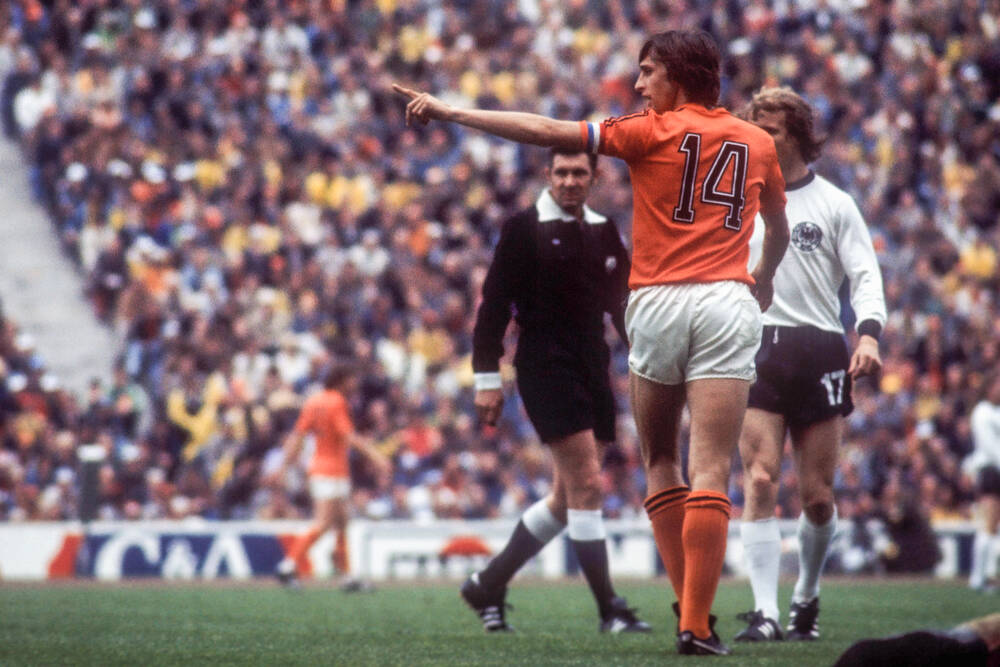
The entry of television into football, which allowed the more immediate exchange of experiences and footballing thought, the greater number of games at global and regional level, the international club competitions that had begun both in Europe and in South America, as well as the establishment of a fully professional framework for the sport, were the factors that created the foundations for a new universal footballing approach. For this reason it did not appear only in one place. And if the Soviet Union did not participate in the 1974 World Cup, refusing to play a qualifier with Chile in the Estadio Nacional that was a place of martyrdom for the political prisoners of the Pinochet regime, the Netherlands was the team that brought this innovation to the pitches of West Germany. Before the World Cup, of course, the world had admired the same elements in Rinus Michels’ Ajax, which won three consecutive European Champion Clubs’ Cups, the last two under the guidance of the Romanian Ştefan Kovács, from 1971 to 1973.
Apart from the goalless draw with Sweden in the first group stage, Michels’ Netherlands, with superstar Johan Cruyff, who was the epitome of the embodiment of insolent and innovative totaalvoetbal, Neeskens, who constituted Cruyff’s alter ego in the triumvirate of total football, as well as a series of hyper-talented players who emerged within this new way of suffocating expression of footballing creation, seemed unstoppable. 2-0 against Uruguay, 4-1 against Bulgaria, 4-0 against Argentina, which was still searching for its ideological footing, balancing between aesthetic naivety and anti-footballing discipline, 2-0 against East Germany and 2-0 against World Champions Brazil, in order to find itself in the Final of Munich, on 7 July.
There things seemed almost predetermined, with the Dutch making 14 passes from the kick-off of the match until they won the penalty that Neeskens converted into a goal to give his team the lead in the 2nd minute. But if there was one thing one should have learned from the finals of Montevideo, the Maracanã and Bern, it is that no such great match permits complacency, devotion to aesthetics and not to the result. The West Germans, who came from a very difficult tournament, with internal disputes that intensified after the defeat by East Germany, found the way to spoil the Dutch footballing party and finally, as they had done 20 years earlier, to leave with the trophy from a match in which opposite them they had the greatest footballing school of their era. From this paradoxical victory, which now seemed repeated, also came the phrase that football is a game in which 22 players play for 90 minutes and in the end the Germans win.
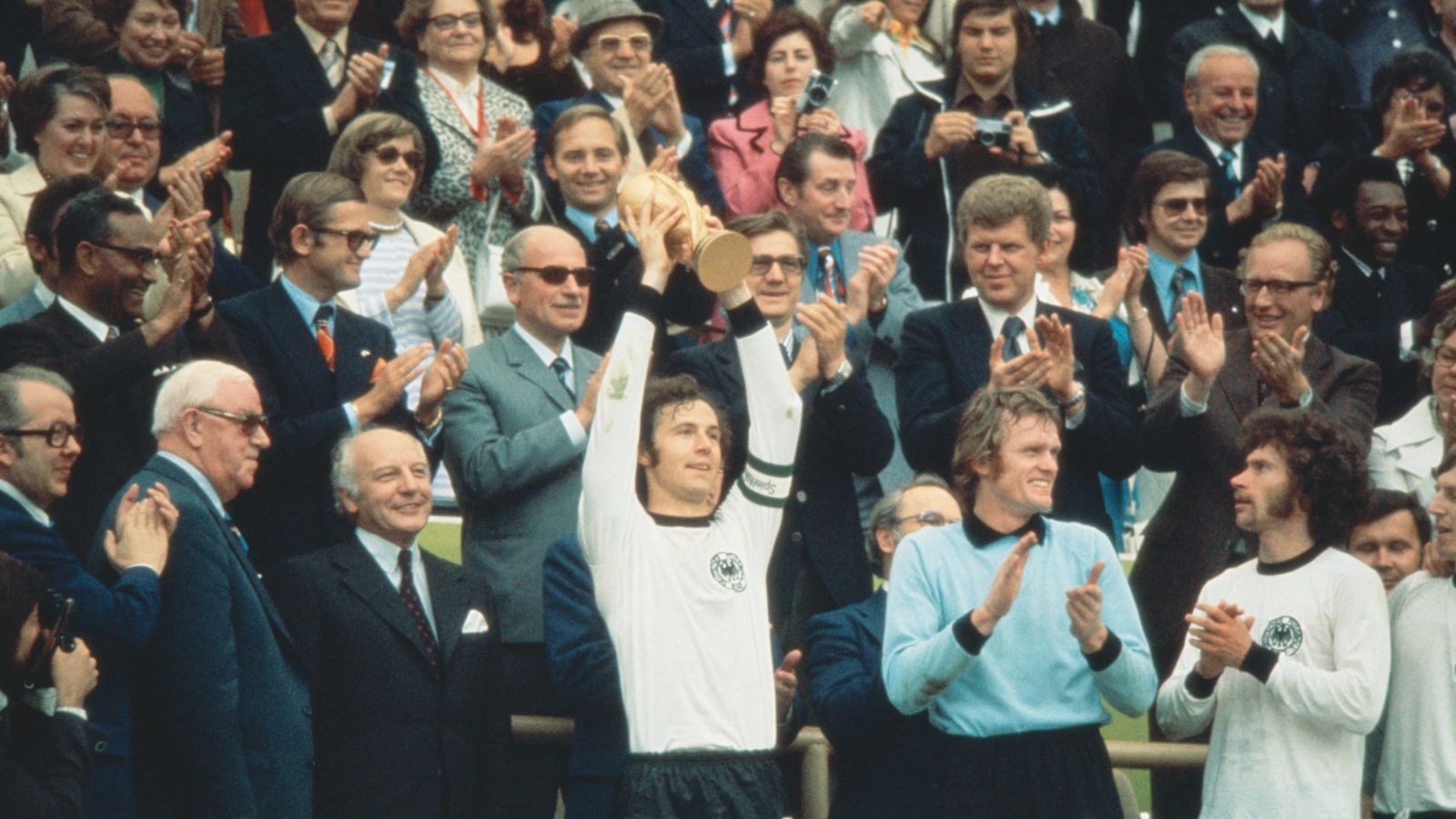
West Germany was winning another Cup that symbolised its post-war History, the course after the Nazi atrocity, the victory of the camp of the capitalists who founded the state of the Federal Republic, and it thus seemed almost condemned, every time it won, to have this identity stuck to its victory. Would it ever win leaving the world to speak only about the football it played? Given the teams it had faced until then in finals, this became even more difficult.
More difficult, however, for the whole planet, was the future created by the end of the period of post-war growth that had seemed eternal for about 30 years. New rivalries, wars, authoritarian regimes, would spring up at every edge of the Earth, most often with the support of the great imperialist power, the United States, which, especially as concerned the western hemisphere, considered every interventionist move part of the Monroe Doctrine, the foundation that theoretically secures the existence of the federal state. Not at all difficult, on the other hand, was it for Havelange to assist in the organisation of a World Cup which, as History brought things, would be the first to contribute directly to the washing and to the radiance of an authoritarian regime, 44 years after the World Cup of Italy.
Argentina had managed in 1966, at the London Congress, finally to take on the organisation of a World Cup, that of 1978, but political developments would give it an entirely different historical hue. They would, however, in parallel, also create a huge and deep discussion about the role of football within conditions of state violence and repression, reopening a subject that had been put in the drawers after that tournament of 1934. Can a footballing victory of a national team not express the dictator who governs it?
In 1974 the Argentine leader and for many years President of the country, Juan Perón, died. Within a climate of permanent conflicts between his supporters, leftist armed groups that defended bourgeois democracy, and the army that wanted to rid itself of populist Peronist power, his widow Isabel took over the leadership of the country for two years during which far-right para-state organisations began to run wild, until the coup of 1976 brought power into the hands of the military junta and was marked by 5,000 killed and disappeared communists, 5,000 killed and detained fighters of the People’s Democratic Army, 22 to 30 thousand disappeared and 12 thousand detainees in 340 concentration camps. The regime, supported ideologically and materially, with 50 million dollars of military aid, by the United States, could use the World Cup for its positive international projection. FIFA once again was an assistant in this criminal work, refusing even to receive Amnesty International’s report on the regime’s crimes.
And if within the years of propaganda many Argentines did not know what was truth and what was lie, so much so that they often needed migrant relatives to convey to them the news about the truth of the homeland in which they lived, this ignorance was not something that characterised the national coach, a coach who had served at Huracán, presenting beautiful football during the years of anti-fútbol, believing that the principles of the Argentine game should not be abandoned for the sake of the result, but should evolve. Luis César Menotti, who with these ideas won the Metropolitano championship of 1973, said: “There is the football of the right and the football of the left. The football of the right proposes that life is a battle. It asks for sacrifices. We must become steely and win by every means… to obey and function, that is what those in power want from the players. Thus they create backward people, useful idiots who go along with the system.”
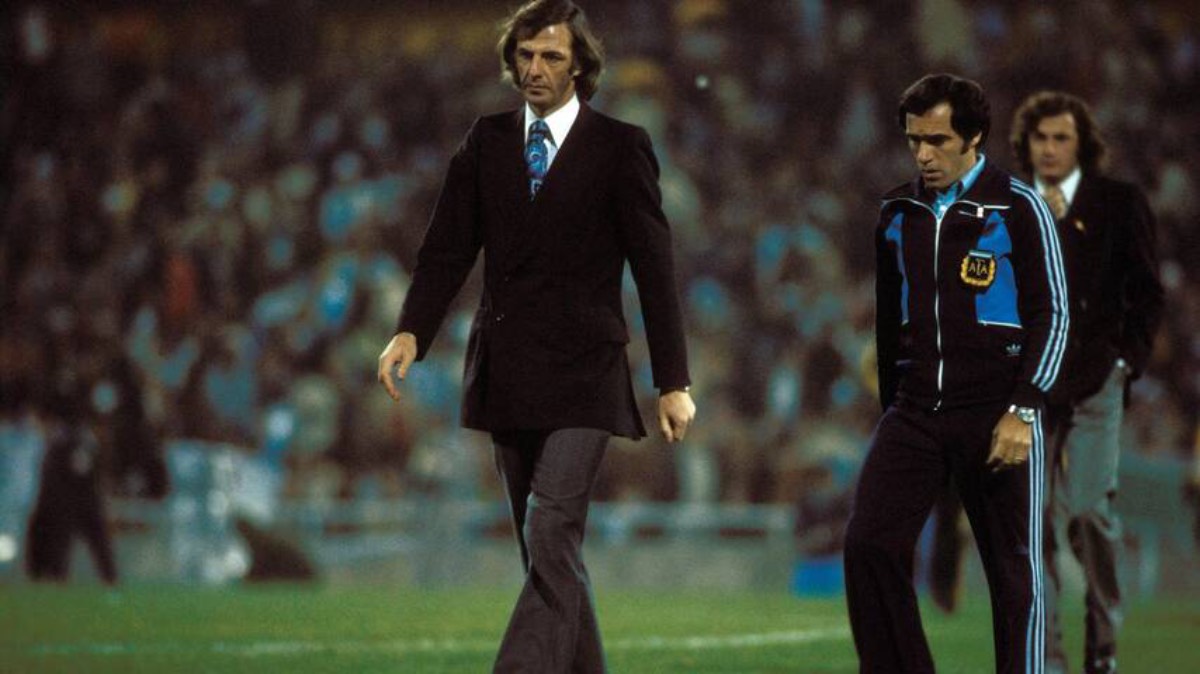
In contrast, that is, with the militarist Pozzo, who carried the Italian national team to the battlefields of the First World War, who played military marches with a gramophone in the dressing rooms, who planned football tactics as if he were in war, Menotti was the opposite ideological pole of the system of the criminal Argentine junta. In Pozzo’s case there was no dilemma about the stakes of footballing victory, even if he was not officially a supporter of the fascist party; his ideas about the homeland and football did not conflict with those of the dictator. But Menotti essentially had to win with a team in a tournament that was being instrumentalised by his ideological opponent. If Argentina is the country that ideologises its football like no other, as Jonathan Wilson writes, that was perhaps the moment when this ideologisation reached the level of philosophy, not of an abstract and perhaps indifferent philosophical search, but of entirely material philosophy, of ethics, of the stance toward the History of human beings.
In the dressing room, where football has no room for hypocrisy, Menotti finally told his players: “We are the people. We come from the oppressed classes and represent the only thing that is legitimate in this country – football. We are not playing for the expensive seats that are full of military men. We represent freedom, not dictatorship.” It is not certain that this position would have satisfied the mothers of the tens of thousands of disappeared who were desperately seeking international visibility and finally vindication; however it is certainly a page that writes a different chapter in the history of the relationship between football and power, diametrically opposed to that written by Pozzo.
Menotti’s Argentina had talent, naturally had the support of a bloodthirsty system, played at home, had an entirely new footballing philosophy and could, after decades, claim something that it had not even approached in the post-war World Cups in which it participated, even if there was always a great “if” about the 1966 tournament. In the opening match it beat Hungary, in the second match France, and in the last match of the first group stage it almost surrendered first place to Italy, losing 1-0. In the second group stage it beat Poland 2-0, drew goalless with Brazil and, in order to find itself in the final, had to beat Peru by more than four goals. The final score at the Gigante de Arroyito in Rosario, 6-0, provoked intense discussions, while the arrows were concentrated on the Argentine-born Peruvian goalkeeper Ramón Quiroga. The truth is that Quiroga was not bad in that game, making a series of difficult saves – even if this result was fixed, the responsible people had certainly fixed it in a much better way than by exposing Peru’s goalkeeper. Indeed, it is characteristic that in the first minutes of the match Peru had a shot against the post with Muñante and a great chance from a shot by Juan Carlos Oblitas.
The truth is that the only historical source that spoke clearly of a fixed result in that match was the English Sunday Times, which published an article stating that Argentina bought 35,000 tonnes of grain from Peru and released 50 million dollars of frozen Peruvian assets. Of course, this article was published on the day of the England-Argentina match at the 1986 World Cup, while the relevant evidence was not found, nor ever presented.
With this result Argentina passed to the Final of 25 June, where it faced the Netherlands, which was guided by a legendary figure of European football, Ernst Happel, but did not have in its composition Johan Cruyff. Although in many narratives it has remained implied that this refusal by Cruyff to travel had to do with his opposition to competing in the World Cup held under Videla’s regime, a careful reading of his biography leads to the conclusion that other reasons, connected with his personal life and fears for the safety of his family, led him to the decision not to move away from them that summer of ’78. Cruyff himself had given various interpretations from time to time in interviews about this stance, but it seems that the causes of his absence were not ideological.
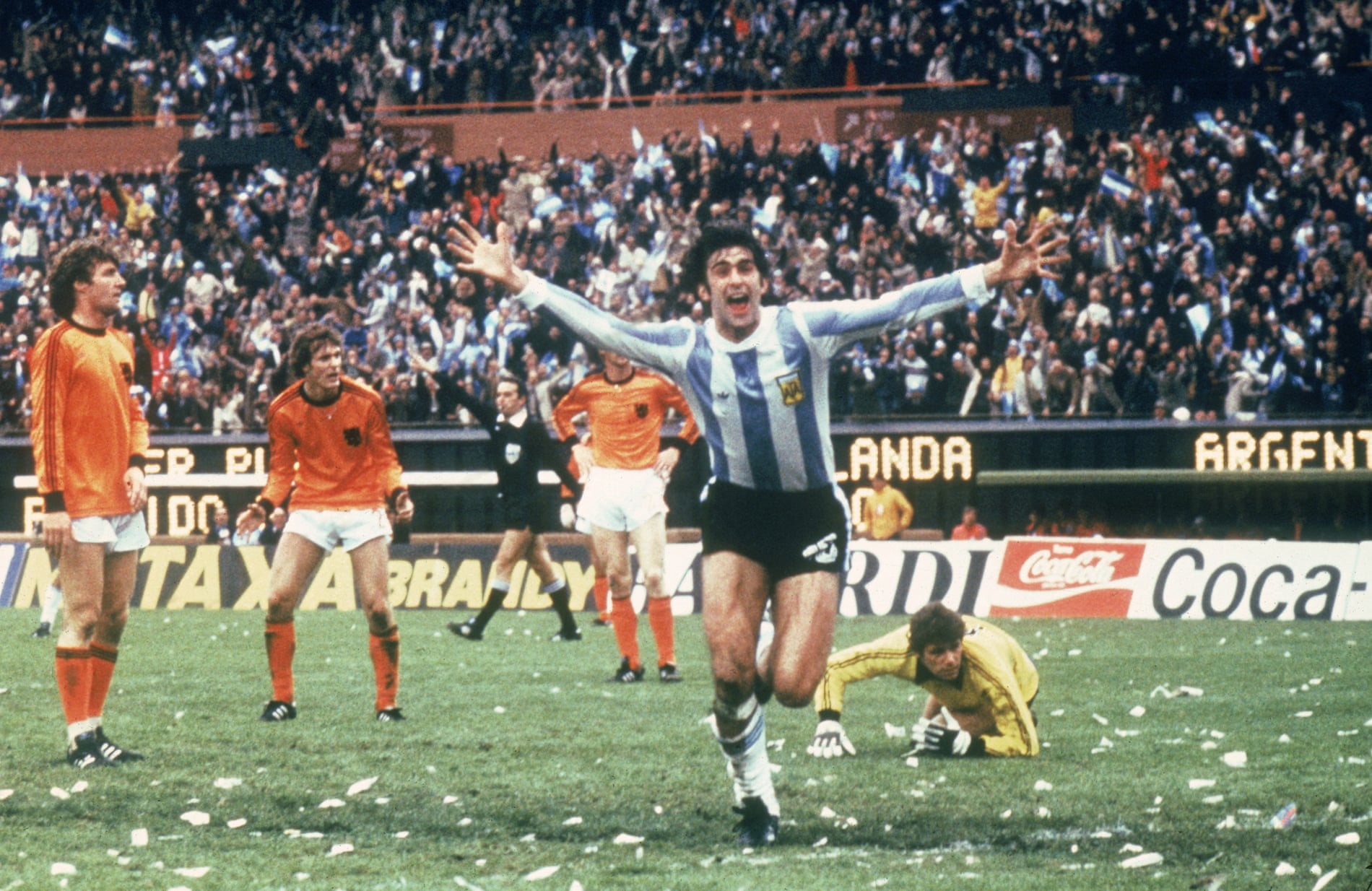
The Netherlands was nevertheless the team that continued to play the wondrous totaalvoetbal that moved the planet; however, even if it was more suspicious at the Monumental, it did not manage to beat Argentina in normal time and the albiceleste, with goals by Kempes and Bertoni in extra time, brought the World trophy for the first time into the hands of a country that had contributed as few had to the global spread and expansion of the sport. The regime obviously made full use of this success, leaving a black stain on the success of Menotti’s footballers.
And if Menotti’s modernised La Nuestra won the title on Argentine pitches, four years later, on the pitches of Spain, el flaco would have to face one more ghost from the past of Argentine footballing mythology. A short, stocky footballer, raised in the potreros of Villa Fiorito, in the middle of the 1970s began to enchant the minds of Argentines, appearing as the direct personification of that mythical figure, the Pibe, whom the columnist of El Gráfico, Borrocotó, described 50 years earlier as the mythical embodiment of the Argentine footballer. Diego Maradona, having first conquered domestic football, although he had missed the chance to play in the World Cup of ’78, would make his first appearance in 1982 as the greatest footballer in the world. The football of Argentina had yet another adventure ahead of it, one that would last for decades.
Far, however, from such romantic mythical approaches, the absolutely realist and technocrat Havelange envisioned a different tournament from the one he had received from Stanley Rous. Television contracts were now a central responsibility of FIFA, the sponsors tied to the chariot of the tournament were becoming even more numerous, and football had to conquer new markets, even where the game of this ball was something exotic and unknown. The creation of a series of new states during the years of decolonisation gave the opportunity for footballing national identities to be created everywhere in the world, identities that would be expressed and have the chance to radiate in FIFA’s dazzling tournament. The first step in this direction was the increase in the number of participating teams to 24 – more teams, more direct participation of millions of people, more matches, more money from television contracts and sponsors. The commodified World Cup was beginning on the pitches of a country which, even when no innovation could exist on its soil, was pioneering in the field of the development of the sport that was at once the favourite of the romantics and the tool of cynical technocrats all over the Earth.
Although the 1982 World Cup had been decided to take place in Spain 16 years earlier, in 1966, the timing was ideal for that country too, since the fall of the Francoist dictatorship allowed yet another narrative to be created, that of the country leaving behind its past of isolation and authoritarianism and also becoming part of a great peaceful and liberal international community. Footballingly, however, the 1982 World Cup signified the beginning of an era in which footballing discipline would dominate over creation, in other words the birth and death of a game.
The way the tournament was held brought face to face, in the 3rd group of the second group stage, World Champions Argentina, with Maradona in its composition, Brazil and Italy. In the first two games the Argentines suffered an equal number of defeats and the finalists of 1970 would clash on 5 July at Barcelona’s Estadio Sarriá, in a game of life and death for qualification to the semi-finals. The difference between the two teams was similar to that of the final in Mexico, 12 years earlier. Italy was a team devoted to the evolution of the system, faithful to the so-called zona mista within Italy, or gioco all’italiana internationally. This tactic, which began with Gigi Radice and Giovanni Trapattoni, was in essence an asymmetrical 4-4-2, with one fullback playing further forward on an open wing, as an addition to two central defenders and a libero who was the fixed line of defence, while a similar role further up the pitch was also held by the opposite midfielder who, playing beside the number ten, the regista, framed the actions on the sides of the opposing area. The tactical approach of Italian football in the era of totaalvoetbal has always faced the revulsion of lovers of attacking and creative play, perhaps for some inexplicable and paradoxical reason. The truth is that the zona mista rests on the same principles of covering spaces, perhaps without such intense positional interchange, since the way each player covers the pitch is different; however it was the reason why generations of wonderful number tens existed in Italian football.
Brazil, on its side, had talent to spare in its ranks, since in that game there appeared on the grass of the Catalan stadium Sócrates, Éder, Falcão, Zico and Serginho. In a few words there was an attacking-midfield quintet, within a 4-3-3 system, that fulfilled all the conditions for a victory of aesthetic superiority, as in that final of 1970. It is true that this did not happen, since Brazil could in no way crush that Italy in the same way, but nor did the opposite happen – the encounter was balanced, with the Italians taking the lead twice and the Brazilians equalising. It is very interesting to abstract from the result and think how that game would be interpreted today if Brazil had won; however, thanks to the hat-trick of a possessed Paolo Rossi, this did not happen and thus that encounter remained in the History of football as the end of innocent creativity and the beginning of the era of cynical tactics. This reading is certainly somewhat excessive, as excessive are all the myths built within the History of football, but it is a fact that Saldanha’s perception was not entirely wrong before the 1970 World Cup. The conditions under which the matches were held, the altitude, the temperature, favoured one side in 1970 and the other in 1982, with several other parameters obviously not remaining the same through time.
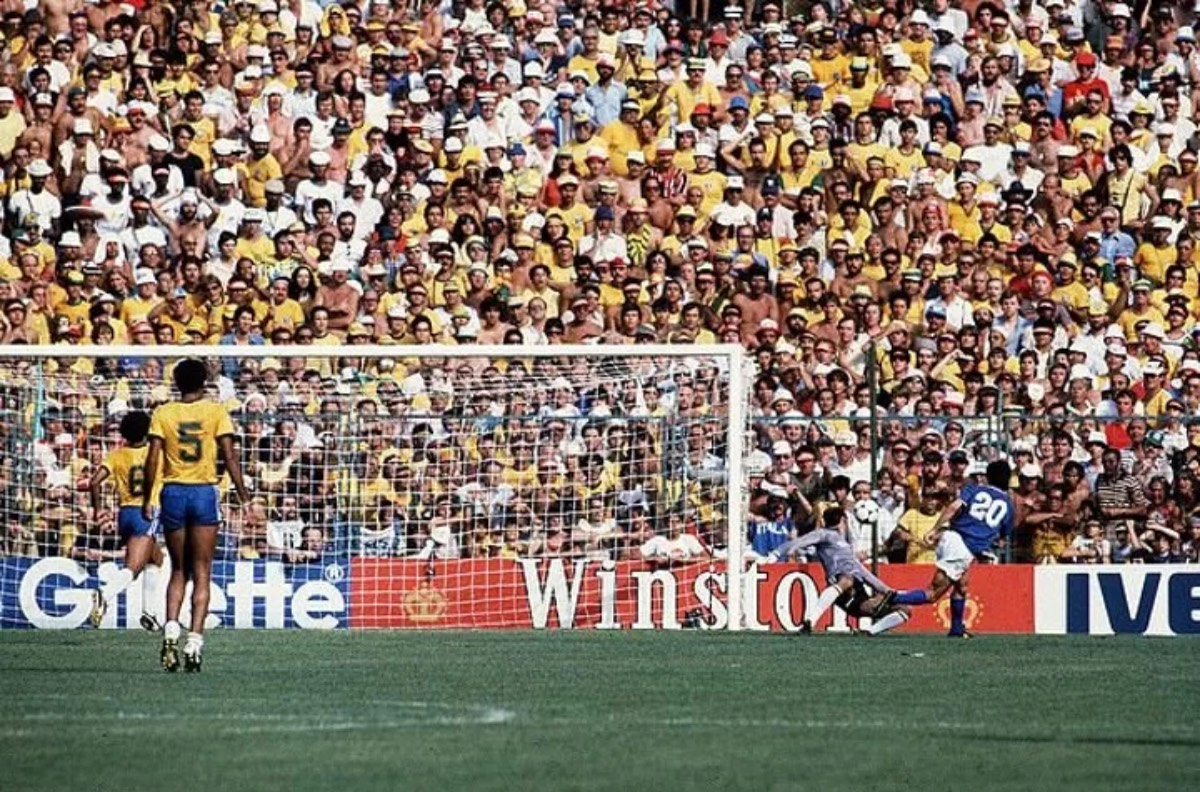
Italy passed much more easily from the semi-final, against Poland, as Rossi scored two more times, but the other semi-final, between West Germany and France, was the one that marked History. Goalkeeper Harald Schumacher’s harsh foul on Patrick Battiston broke two teeth, three ribs and damaged the spine of the French right-back. The brutality of the incident remained in History for the turn the sport was taking at a time when the emphasis on creative coverage of spaces coexisted with the parallel intensification of the harshness of anti-football. In the 1980s it seemed that the physical game had made a triumphant reappearance, almost a century after its historic defeat by Blackburn Olympic in the 1883 FA Cup final. West Germany, playing with an extra player for about 30 minutes in normal time and throughout extra time, managed not to lose and finally, in an exhausting penalty shoot-out, won qualification for the grand final. In the final, however, the Italians were unstoppable and, after 44 years, representing a country within which very different political ideas prevailed, even if they clashed unceasingly with those of old Italy in the years of lead, won a World Cup that did not bear the stamp of a dictator, nor military marches and corresponding militaristic formations on the pitch.
The World Cup now counted more than half a century of life and most tournaments had been held in countries that wanted to prove something by staging it, either at the moment the tournament was assigned to them, or at the moment of its holding. With the exception of Sweden in 1958 and Mexico in 1970, the World Cup had passed through Uruguay, which wanted to shine before the world, Mussolini’s Italy, Rimet’s France, Vargas’s Brazil, FIFA’s Switzerland, Alessandri’s Chile, which preferred to face the disasters after the greatest earthquake in History with a World Cup, Stanley Rous’s England, West Germany, which was re-entering the international community, Videla’s Argentina, Spain, which was opening its doors to the world after the Franco era. This history would continue in 1986 too, since one of Havelange’s first moves when he was elected president of FIFA was to give Colombia the responsibility of organising the tournament. However, the increase in the number of teams announced four years later and the great economic difficulties of the South American state led to its withdrawal from this obligation. Thus, in a process of finding a new host country, where only a few countries had the right, on the basis of specific criteria, to claim the tournament, the United States, Canada and Mexico appeared as candidates. For various unclear and perhaps incomprehensible reasons – even open irregularities – Mexico was chosen and thus became the first country to organise a second World Cup on its soil. The legacy of 1970 certainly did not make any football lover sad, who perhaps – if at some point a referendum were held to choose a country that would permanently organise the World Cup – would all easily choose Mexico. Where the most dazzling team in the History of the tournament had shone, some divine fate had written that its most mythical figure would leave his mark forever.
In 1986 in Argentina the political situation had changed, the military junta had been overthrown from the end of 1983 and Raúl Alfonsín, a historic figure of the Unión Cívica Radical, had been elected to the presidency. The last time the Unión Cívica had taken over government, the World Cup was an experimental tournament and Borrocotó was writing in El Gráfico about that mythical creature, the pibe, who symbolised the mythology of Argentine football of the potreros, the child “with a dirty face, with a mane that rebels against the comb … whose stance is characteristic, as if he were dribbling with a ragged ball”. When Argentina was certain that within its ranks it had the best footballer on the planet, fate brought it about that he resembled so closely a description that had been composed 32 years before his birth. On the pitches of Mexico the mystery had to be performed.
In the technical leadership of the national team was Carlos Bilardo, pupil of Osvaldo Zubeldía and great figure of anti-fútbol, succeeding Menotti after the failure of 1982. He himself perhaps aspired to become the coach who would prove in practice that one can win the World Cup playing bad football, with the result as the only aim. But Bilardo’s plans were spoiled by the presence of Maradona, who could not stop producing spectacle even if he decided only to walk on the pitch. Thus, the Argentine coach compromised with the idea of setting up a team around the jewel of the albiceleste. Tactically, how his experimentation with this peculiar 3-5-2, with Maradona playing further back as a second forward, reflecting the role of the Italian fantasista, worked out is a matter for wonder. The truth is that Maradona was in many more than one position, essentially applying as a one-man orchestra a particular version of total football, that of the football of Maradona. Among the various legacies that Maradona left to football culture this is perhaps one of the most important, since there are no corresponding examples of players who play in the forward line and essentially are at the same time also playmaker, while also covering spaces very “foreign” to their position. The fact that this is not discussed as much as the social reach of his footballing presence has more to do with the fact that, on the one hand, it requires more specialised knowledge and corresponding observation of the game, and on the other, that his total radiance was capable of covering the separate unique details of his talent.
Passing through the group stage with victories over South Korea and Bulgaria and a draw with World Champions Italy, Argentina met Uruguay in the second round, for the first time in a World Cup since 1930. With a goal by Pasculli it took the ticket for the match that took place on the day when god came down to Earth.
On 22 June 1986 the sun burned over Mexico City, with the forecast giving chances of afternoon rain. The temperature was 22 degrees Celsius and the Azteca stadium was packed with 114,580 spectators. Argentina would face England, for the first time after another World Cup quarter-final, that of 1966, which had been stigmatised by a mysterious referee appointment, the unjustified sending-off of Rattín, the very hard game played by both teams and the aggressive behaviour of the English spectators and more generally of the European delegations towards that Argentine team. It was also, however, the first match that found the two teams facing each other after the War in the Malvinas, which ended in triumphant fashion for Margaret Thatcher’s Government, while proving a fiasco for the Argentine military junta.
The two countries, however, did not begin to have footballing differences in 1966. The rivalry goes much further back and constitutes a matter of national identity for Argentines. The English were obviously the ones who introduced the game to Argentina. The British element was what developed the institutions of football and a Scot, Alexander Watson Hutton, is considered the “father of football” in Argentina. But the criollisation of football that took place during the 20th century was also accompanied by a need to show that in Argentina they know how to play better football than the English, because while the sport may have been codified in Britain, the people of the South American colony were the ones who knew, according to the ideological development of this position, how to evolve it like no one else. For this reason, even within strictly footballing frameworks, this rivalry was always special.
Of course, since the era of that football, of la nuestra and el pibe, Argentine football itself had taken a 180-degree turn, now having at the head of its national mission, as coach, Carlos Bilardo, continuator of the hard football and anti-fútbol of Spinetto and Zubeldía. Yet before that game, little importance had how the sport had evolved in the country; England had to be beaten at all costs, on the one hand because it was obviously an obstacle towards conquering the summit, and on the other because there had to be a moral revenge for the war, for Rattín and for whatever else one could imagine, as we all imagine when we watch football matches.
Because of their colours, the two teams play each time with one of them wearing its alternative kit. In that game Argentina was going to play in blue shirts, which were cotton, and Bilardo considered that this would be a great disadvantage under the midday burning Mexican sun. For this reason Le Coq Sportif, which was then the clothing sponsor of the national team, was asked to manufacture new blue shirts, especially for this match. The company, having only three days to solve the problem, answered negatively. Thus, Rubén Moschella, who was then a member of the technical staff, went for a walk in the market of Mexico City in order to find blue shirts. Moschella found two different shirts, presented them to the team and Maradona chose one of them saying that “with this one we will beat England”. Then Moschella went and bought 38 shirts, went to a tailor to make the federation emblem, using an older and more simplistic design, in order to stick it onto the shirts, while the numbers were also added with a decal of mediocre quality, and they came from designs for American Football teams (gridiron football). Who could possibly have imagined that perhaps the most emblematic shirt in the history of the sport was being designed and manufactured at that moment under those conditions?
In the 51st minute of the encounter Maradona had the ball in the centre and towards the left as Argentina developed its attacks. He played a poor pass to Valdano, who was at the right corner of the penalty area, with the Argentine centre-forward unable to control the ball, but only to throw it behind his back towards the centre of the English area. Maradona, continuing his run, was on a path of intersection with the ball that described a curve in Shilton’s area. From the opposite side to the path of the ball, however, the English goalkeeper was also running. At the point of intersection of the course of the three – of the falling ball, and of Shilton and Maradona approaching it – the first to come into contact was Maradona with the ball. A few fractions of a second later the ball was in Shilton’s net. Maradona managed to beat in the air the English goalkeeper, 20 centimetres taller than him. With the extension of his left fist he found the ball and sent it into the net. The Tunisian referee Ali Bin Nasser pointed to the centre circle, the linesman agreed with him, Maradona ran towards the stands raising the left fist that had scored. It was the apotheosis of football of purpose, of Zubeldía’s ideology, which had become the national school of Argentine football. Argentina was ahead on the score and held the advantage for a historic qualification.
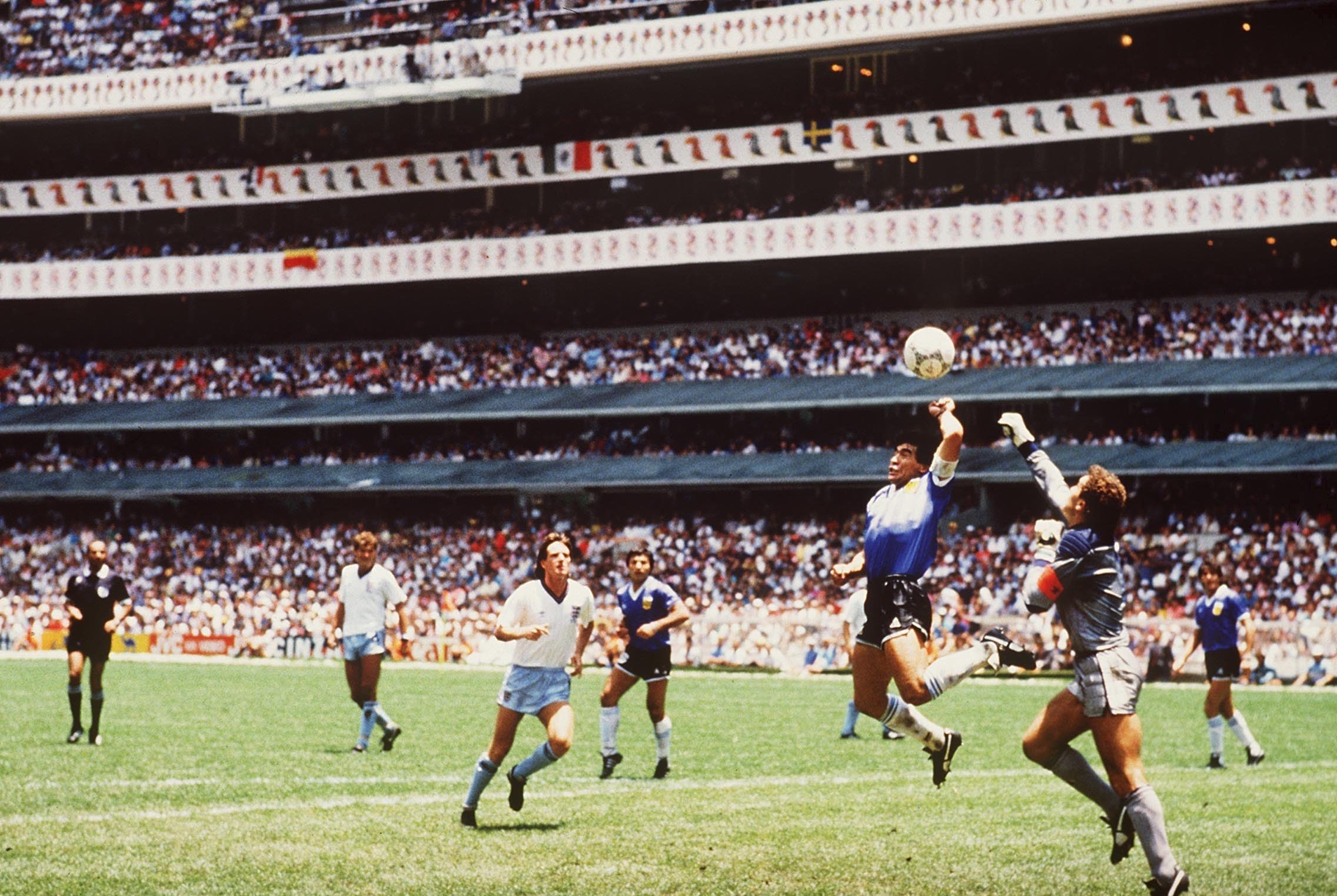
The English protested in vain to the referee; Maradona continued to raise his left fist. In his autobiography he said that at that moment he felt he was “putting his hand into England’s treasury”. When asked after the match whether it had been a handball, he answered that it had been “the hand of God”, leaving a phrase that would accompany him forever, “La Mano De Dios”, as well as a nickname that the faithful of football everywhere bestowed upon him without great hesitation. Maradona entered the pitch that day as a mortal and left as a god. And if the hand alone was not enough for him to acquire that right, his next feat was the passport to the Elysian Fields.
Four minutes later Maradona left another mark on History, leaving no one any margin to question that victory and his own and Argentina’s superiority in that game. The description by the Uruguayan commentator Víctor Hugo Morales has remained in history and that goal, “the goal of the century” as it was characterised, cannot and perhaps must never be described in other words: “He’s going to pass it to Diego, there Maradona has it, two are marking him, Maradona holds the ball, the genius of world football starts from the right, leaves opponents behind him and can pass to Burruchaga… Always Maradona! Genius! Genius! Genius! Ta-ta-ta-ta-ta-ta-ta… Goooooooaaaaaaal… Goooooal… I want to cry! My God, long live football! What a great goal! Diegooooal! Maradona! It is to cry, forgive me… Maradona, on an unforgettable run, in the play of all time… Cosmic kite… From what planet did you come to leave so many Englishmen behind you, for the whole country to shout with fist for Argentina? Argentina 2 – England 0. Diegoooal, Diegooooal, Diego Armando Maradona… Thank you, God, for football, for Maradona, for these tears, for this Argentina 2 – England 0.”
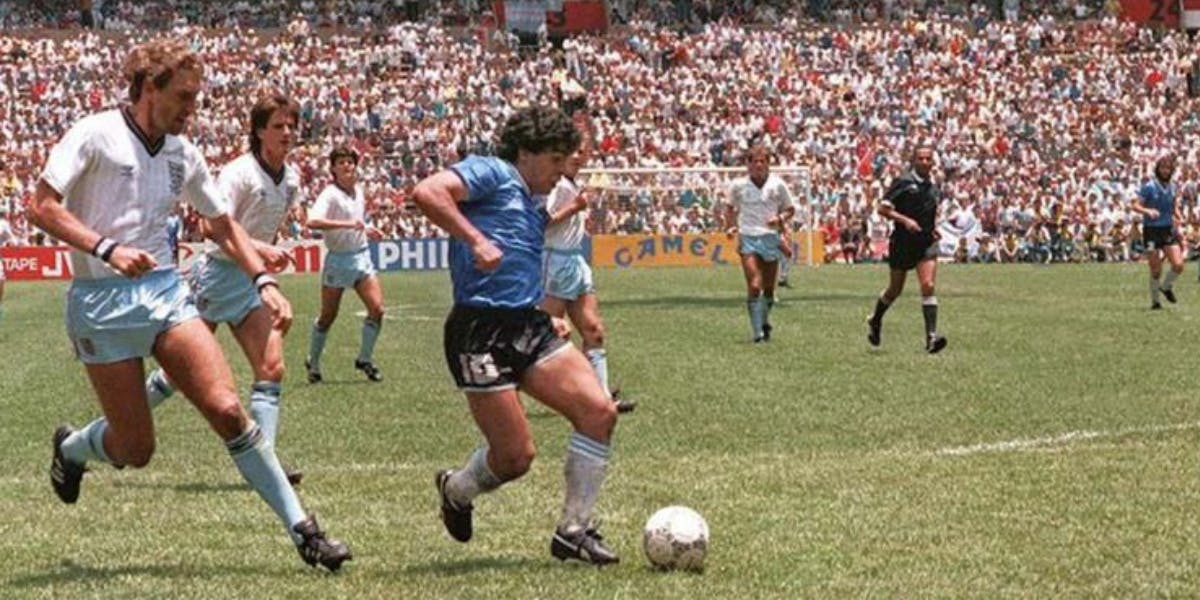
Maradona had done the unbelievable. He had taken the ball from the centre of the pitch and left behind him whichever Englishman he found, in order to enter the area, receive an epic kick and at the same time place the ball past Shilton, writing 2-0. It was the goal of the century, as many years later it was voted, without any doubt. But it was also much more for Argentina. If the first goal was the apotheosis of anti-fútbol and football of purpose, that second goal was the absolute embodiment of the beauty of la nuestra, of the skilful Argentine who passes the English as if they were standing still, whose physical condition is not enough to take on this footballing genius. It was the embodiment of that child, of the pibe, who exactly as Borocotó had described him in 1928, was 58 years later on the grass of the Azteca. How could the editor-in-chief of El Gráfico have known that what he described then was the faithful representation of a moment from the future? Maradona was not only God, he was something much more for Argentina, he was el pibe de oro, the golden boy, the pibe made of gold. He was the reward of History to an entire footballing ideology. There could be no greater victory for Argentine football than this goal. The fact that it was scored against England is perhaps only the necessary supplement that a perfect story needed.
In the semi-final Maradona repeated his feats, scoring two goals against Belgium, and in the final, where West Germany was present for the third time in four tournaments, things seemed easy for Argentina until the last quarter of the match, when Rummenigge and Völler managed to equalise. In a match that could very much recall the final of 2022, Maradona did not let the same development occur: with a pass of inconceivable inspiration to Burruchaga, who was coming down towards Schumacher’s goal together with Valdano, he gave an almost ready-made goal so that a few minutes later he would receive from Miguel de la Madrid the FIFA Cup in order to lift it under the burning Mexican sun of the Azteca, composing the holiest iconography of football History.
Today, 40 years after that epic of the Mexico World Cup, historical distance proves that no footballer ever came close to Maradona’s feat, to make one World Cup tournament his own affair, to have it referred to only together with his signature, as if he were the director and protagonist of the global game. Many can claim that there have been better footballers, either before or after Maradona. On the basis of strictly measurable data this argument indeed has a basis. But no one was able, ever, absolutely ever, to surpass his aura – for this reason no one will ever be able to surpass his mythical magnitude, which as History passes grows and constantly finds occasions to renew itself, especially after his death. It is difficult to say what Maradona would have been without the 1986 World Cup, but material history is given and, as it was shaped, it could only constitute the source for the deepest metaphysical relationship in the History of the sport: that of a footballer with his homeland, the supporters and the societies of the whole world, where his figure remains for ever and ever the form of the popular hero.
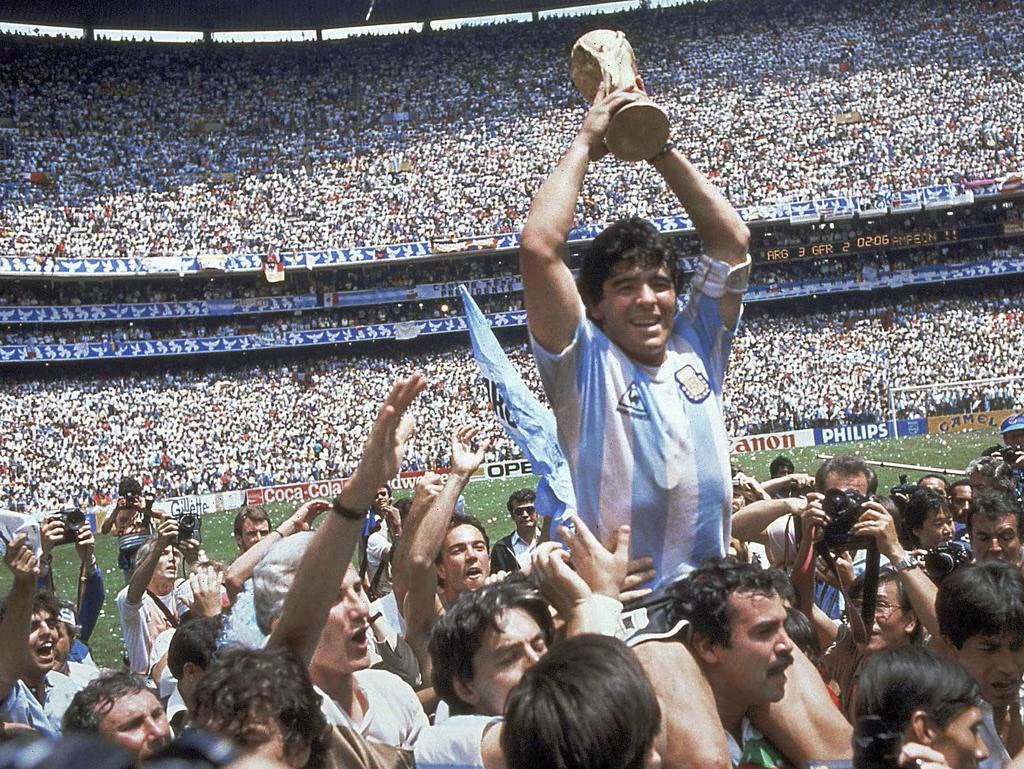
Even the next World Cup, held in 1990 on the pitches of Italy, could have borne his signature. It would certainly have been a different conquest, in a counter-role, in a different script. In the World Cup in which perhaps the worst football in the History of the institution was played, with most of the crucial matches, among them the final too, decided by penalties, Maradona had to reach that legendary game against the host Italy, inside the temple where he was worshipped, Napoli’s San Paolo, which today bears his name. In a process that began many days before the meeting of the two teams in the semi-finals of the institution and awakened the deep wounds of the question of the mezzogiorno, in simple words the contradiction in the development of Northern and Southern Italy and the racist treatment of the poor southern Italians, who by no coincidence at all are the biological ancestors of most Argentines, Maradona once again played the role of protagonist of a historical drama, much more than that of the best footballer in the world. The boos in the final in Rome, where the Italian capital’s supporters backed West Germany, in an extremely problematic historical context, also remained in History, beside his own personal presence, as one of the most symbolic events of the World Cups.
Politics, which so loves to instrumentalise football, had one more reason to make its emphatic entrance into the 1990 World Cup. On 8 July 1990, the day the tournament final was held at the Olimpico, not even a year had passed since the day when, within a broader climate of counter-revolution and capitalist restorations, the Berlin Wall, the one that had been built in the centre of the capital of East Germany after the proclamation of the sectors controlled by the USA, the United Kingdom and France as a single state, had begun to be torn down and the German Democratic Republic slowly absorbed by the western state of the Federal Republic. A week before the final the monetary union had taken place, everything showed that that final was the last game of the so-called West Germany, since very soon the Bundesrepublik would be the only one to bear the country’s name. The dissolution of the state of the People’s Republic was euphemistically called unification, in perhaps the most careless ideological-propagandistic terminology, which ignored the terms under which the deadliest war in human History ended. The team of West Germany, which otherwise constituted an exquisite footballing school with players who left history, not by chance but as the result of a long post-war industrial development, would do well to win that match so that this narrative too could be completed with football as its vehicle. The disputed penalty whistled by Edgardo Codesal and taken by Andreas Brehme in the 85th minute was enough to create this History. It is no coincidence, however, that no youngster in the world fell in love with football after that game.
If there was a team that, amid the pessimism about the future of football, gave birth to hope for the global sport, it came from where until then no one had learned to count. From the end of the 1950s and much more massively during the 1960s, sub-Saharan Africa began to acquire its independence. The first country to open the way, the Gold Coast, which was renamed Ghana, guided by its historic President and national leader Kwame Nkrumah, who had won the elections of 1956, was followed by Guinea, Cameroon, Togo, Mali, Madagascar, the People’s Republic of Congo of the hero Patrice Lumumba, Somalia, the lands of Dahomey, and many other countries. The first country of sub-Saharan Africa to participate in a World Cup was the former Belgian Congo, which had been renamed Zaire, in 1974. In a presence that could hardly be described as successful, Zaire lost all three matches in its group, indeed succumbing 9-0 against Yugoslavia, in a game in which Dušan Bajević scored a hat-trick. The next sub-Saharan country that would find itself in the great competition was Cameroon, which made its debut on the pitches of Spain in 1982, when there was now also a second African ticket because of the increase in participants. That year Cameroon managed to leave undefeated, taking three draws, one of them from the later champion Italy.
In 1990 Cameroon returned to the World Cup and in fact played in the opening match against World Champions Argentina. In a game that many would remember for the harshness of the Cameroonians’ play, François Omam-Biyik and the team of the Soviet Valery Nepomnyashchy wrote History differently. The 24-year-old forward sent the ball to meet Nery Pumpido’s nets in the 67th minute and “the indomitable lions” achieved one of the greatest surprises in the History of the World Cup. This, however, was only the beginning of their epic. In the next game they beat Romania 2-1 and although they were defeated 4-0 in the last game of the Soviet Union in a World Cup, they qualified from first place in their group to the knock-out phase. There they met Colombia and after a goalless draw in normal time two goals by 38-year-old Roger Milla were enough to give them qualification to the quarter-finals. Milla’s dance after those goals remained as one of the photographs that mark the game of human beings at its greatest moment – it was the reason why youngsters on every sub-Saharan dirt pitch wanted to kick a ball. With this approach, certainly much more important than Brehme’s goal in the final. Cameroon came very close to eliminating the mother of the sport, in a victory that would have exceeded the dimensions of a historical success that can be comprehended. Until the 83rd minute they were ahead in the quarter-final against England, but two penalties taken by Lineker led to the equalisation and finally to England’s victory in extra time, putting an end to this mythical, epic, fairy-tale, inspired course. Cameroon in 1990 set the bar for the African teams that wanted to surpass this success. Some repeated it and perhaps came very close to surpassing it for 32 years. Senegal in 2002, Ghana in 2010, until Morocco finally managed it in 2022.
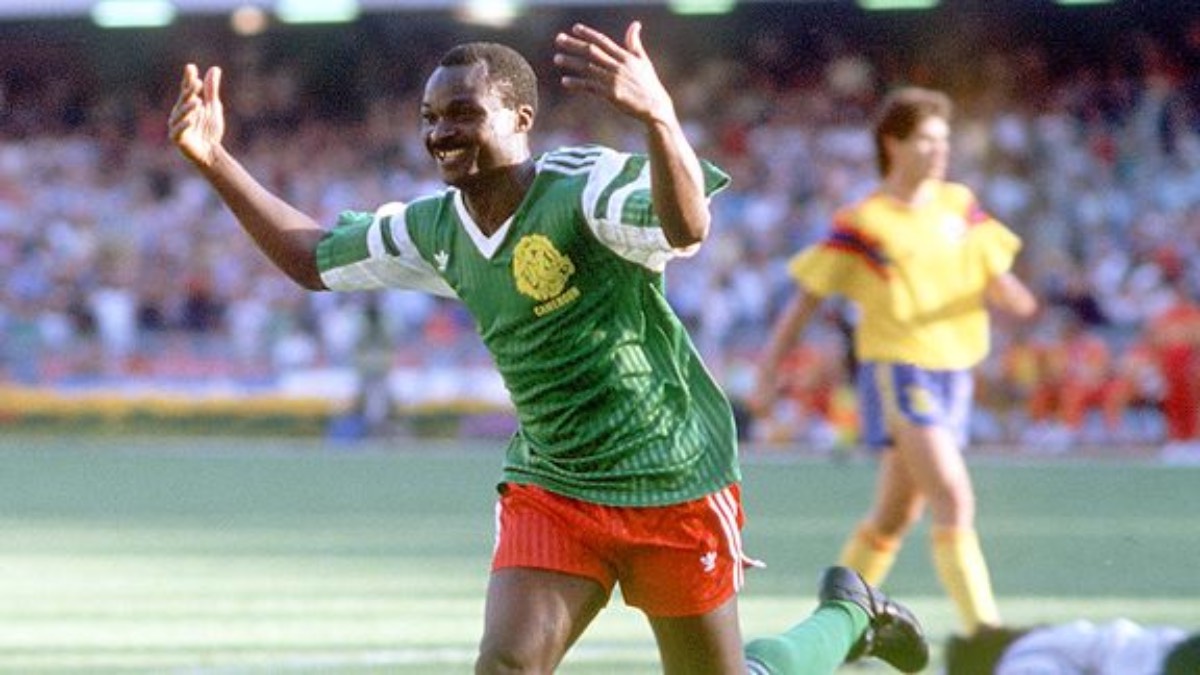
Football under Havelange could not fail to become an assistant to great political symbolisms. Although the 1986 tournament was not given to the United States also because of the tremors that existed over the treatment of football at the Los Angeles Olympic Games, FIFA decided on the venue of the 1994 World Cup in 1988 in Zurich, with the United States, Brazil and Morocco having submitted candidacies. Quite by chance that vote was held on 4 July. From the first round the American candidacy gathered the necessary votes for the World Cup to travel, for the first time, to a country where football was not the most popular sport, while at the moment of the vote there was not even a professional championship, essentially ignoring the very foundations of the founding and existence of FIFA.
The United States, despite its distance from football culture, wanted and always wants to organise football competitions, since, regardless of the sport’s reach in a national television index, its influence on the masses and above all on the migrants who constitute an enormous part of the population of the Superpower is indisputable. For this reason it is characteristic that at the head of the first attempt to take on the tournament, for the 1986 World Cup, was the Secretary of the State Department himself, Henry Kissinger. But 1994 was an even better moment for the USA. The so-called “Cold War” had ended, socialist power in the countries of Eastern Europe had been overthrown and the Soviet Union no longer existed. The promise of a new world of endless and peaceful capitalist development passed through the organisation of the greatest footballing celebration. From this footballing celebration, however, Yugoslavia had been excluded, as it was being dismembered in the Balkans with the contribution of the tanks of its organisers.
In one of the most anti-footballing opening ceremonies in Chicago, with Diana Ross emphatically missing a penalty kick that would split a goal in two, the symbolisms of the United States’ distance from the footballing game were created in a natural and spontaneous way. In the game that followed, the world champion had been renamed Germany and faced Bolivia. The perhaps most important player on the pitch, not according to footballing criteria, was Matthias Sammer, the 27-year-old East German, who, playing for Dynamo Dresden until 1990, won the last double of East Germany before transferring to VfB Stuttgart to become officially a professional footballer, since until then he had been an employee of the Volkspolizei. In the purely competitive part, Jürgen Klinsmann was the one who in the 61st minute scored the only goal of an encounter that dehydrated the footballers, as had happened eight years earlier in Mexico, so that their feats could be watched by the public in Europe.
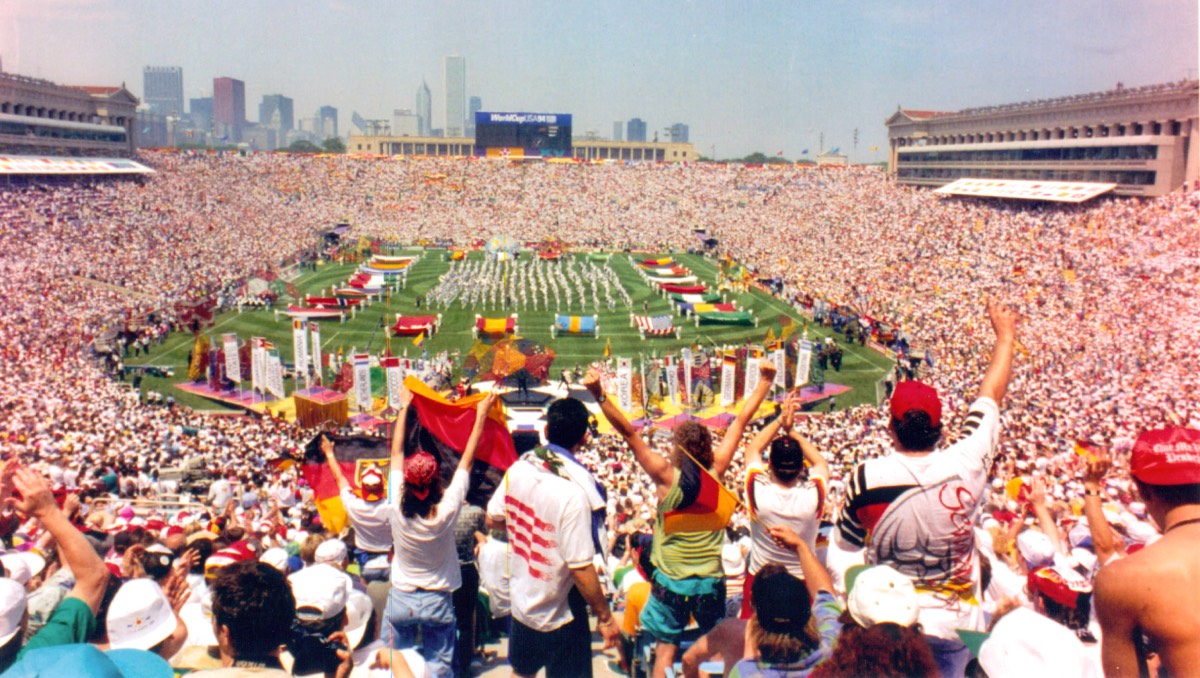
The drama of 1994 is certainly divided into two parts. The first unfolded during the group stage and was a tragic story. The second occurred in the final phase and was another chapter of the great footballing historical narrative. The first part concerned Argentina and Colombia, the second Brazil and Italy.
On 21 June the national team of Argentina, under the technical leadership of Alfio Basile, returned to the World Cup. In its ranks was Diego Maradona, reborn after the 15-month ban imposed on him because of drug use. Maradona, however, had worked tremendously for his return to the top competition and looked in excellent form. The first opponent was a team that went to the American pitches with the definition of anti-footballing organisation, yet glorifying more than anything else the spirit of the political reach of the World Cup: Greece. The great protagonist in scoring was the young bomber of the nets, Gabriel Omar Batistuta, but Maradona in this game scored his last goal in a World Cup. In the 60th minute he found the ball laid for him just outside the penalty area, roughly at the edge of the semicircle and towards the left. From there, with a thunderbolt shot, he sent the ball into Minou’s top corner and celebrated wildly. Running towards the camera that was beside the left touchline of the pitch, he struck his head against it, producing a spit that many (or all) understood as being directed towards FIFA and an entire system that in the previous years had been against him.
In the second game, against Nigeria, Caniggia scored twice to take the victory 2-1. At the end of the encounter a nurse went to take Maradona from the pitch for the anti-doping control. Perhaps as happy as ever, Diego took the nurse by the hand and walked with her towards the exit, greeting the crowd with a smile. A few days later it became known that that test came out positive for five prohibited substances based on ephedrine. Maradona was out of the World Cup, excluded once again because of the use of prohibited substances, this time not for drugs, but for doping. Diego stated countless times in the years that followed that he had never taken any substance, that the test was fixed, that it was another part of the attack being made on him by the same establishment. Maradona may never have taken these substances, at least not willingly; however, what exactly happened will perhaps remain a mystery in history. If his historical vindication on this specific issue with evidence ever occurs, then it will perhaps be the greatest scandal in the history of football worldwide. And the bar for first place is quite high in this category.
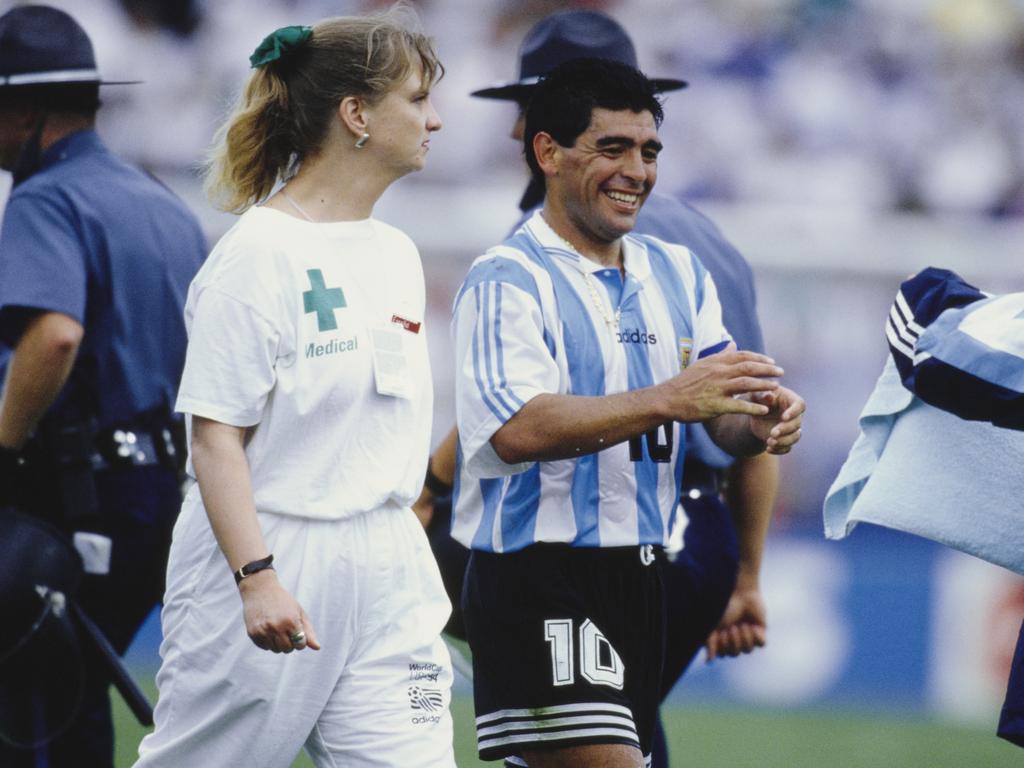
Argentina, after this event, collapsed, with two defeats in as many games against the astonishing representatives of the Balkans in the competition, Bulgaria in the Group and Romania in the second round, bidding a bleak farewell to the tournament and beginning a long course of regrouping and attempting to find the successor to the embodiment of the pibe.
The day after Argentina’s first match, Colombia of Carlos Valderrama played in the second game of its group against the United States. Having already been defeated in the opening match by Romania, in a game in which Hagi scored one of the most beautiful goals in the History of the competition, the cafeteros absolutely had to avoid defeat in order to have hopes of qualification, even as third in the group. However, in the 35th minute of the encounter Andrés Escobar saw luck turn its back on him and scored an own goal, giving the Americans a lead that they managed to extend and ultimately maintain until the end of the encounter. In combination with the result of Romania’s game against Switzerland, this meant that Colombia was out of the tournament.
The Colombian delegation returned home, to a country that was pregnant with hopes of a great distinction, even of the world title, a place where countless sums of money had been played in illegal bets and where major deals of the business underworld were linked to the national team’s course in the World Cup. On 2 July, in a restaurant in Medellín, some accused Escobar of the elimination, on the occasion of that own goal. The misunderstanding became a quarrel and a few moments later Humberto Muñoz, bodyguard and driver of the Gallón Henao brothers, cattle breeders and drug traffickers, shot the Colombian central defender six times with a revolver.
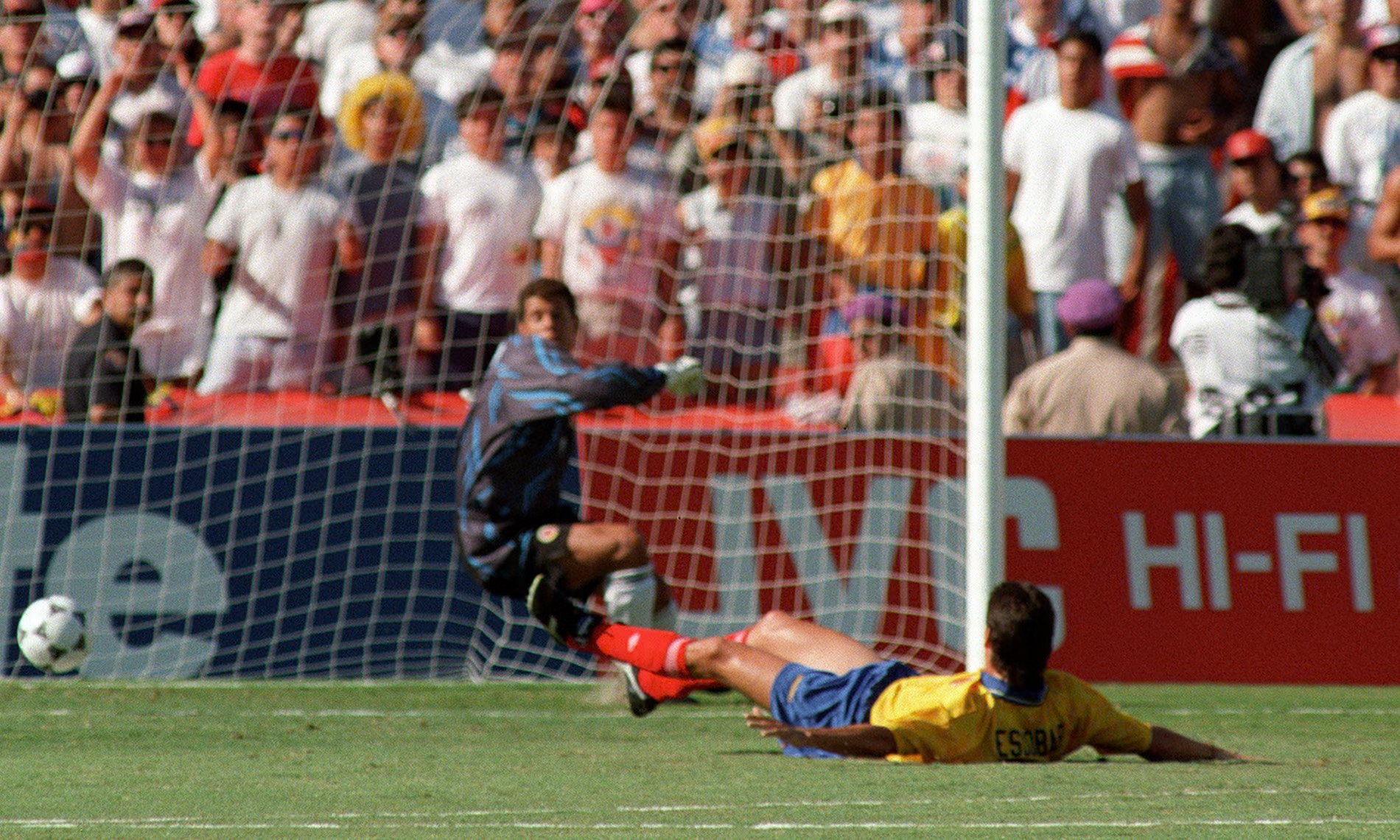
Within the extreme commodification of football, which had brought Havelange’s dream to a peak, there were nevertheless not a few teams that produced beautiful football and made historic runs. The astonishing Romania of Hagi, of Petrescu, Răducioiu, Lupescu and Belodedici, players with enormous experience on European pitches, reached the semi-finals, where it suffered elimination on penalties by another astonishing generation, the Sweden of Brolin, Larsson, Nilsson, Andersson and the unforgettable goalkeeper Ravelli. Bulgaria, with emblematic captain Hristo Stoichkov and beside him Letchkov, Emil Kostadinov as well as the cult figure of Trifon Ivanov, eliminated the World Champions Germany in the quarter-finals. Nigeria of Yekini failed by a hair to repeat Cameroon’s epic, while Saudi Arabia in its first participation qualified from a group in which the Netherlands, Belgium and Morocco also played, losing 2-1 to the Dutch and winning the other two games, with Said Al-Owairan scoring the most beautiful goal of the tournament in the game against Belgium.
But the great footballing battle was the one between the two finalists, Brazil and Italy. Both, after all, reached the American pitches with three World Cup conquests in their History and whichever won would become de facto the historic great power of the sport. Italy was guided by one of the greatest footballing minds of the 20th century, a true ideologue of football who, within an era in which the result was everything, argued that many can win a title, but the world will always remember the teams that won playing beautiful football. Arrigo Sacchi was the epitome of this view of his. The titles he won with Milan are comparatively fewer than those of other legendary coaches, but the team he built and with which he won the European Champion Clubs’ Cup in 1989 and 1990 passed into History as one of those that played, across time, the best football. At Milan he may have relied on a hyper-talented Dutch trio, Frank Rijkaard, Marco van Basten and Ruud Gullit, bringing the ideas of Dutch football into contact with an evolution of the zona mista, but in the Italian national team of 1994 he also had other protagonists with whom to draw up his plans. The greatest of them was the epitome of the attacking fantasista, a true legend of the Italian pitches, who could certainly have offered more also to the national team. Roberto Baggio, who had made his first appearance in a World Cup in 1990, was the necessary number ten that Italy needed in order to contest a great tournament, continuing a great Italian tradition in that position.
On the other side, Brazil, after years of low flights and the difficulty of managing the identity crisis brought about by the result of 1982, had a hyper-talented – as almost always – but much more effective and realistic team, with a fair dose of inspiration and, naturally, a footballer who symbolised the old malandragem, who refused to fit into the new professional frameworks, the orchestrator of its attack, Romário. Neither team reached the Final easily, in one of the perhaps most evenly balanced tournaments in History, without clear favourites.
Italy began with a defeat against Ireland, beat Norway 1-0 and drew with a beautiful Mexican team in order to pass literally by a hair to the next phase, literally last and drenched in sweat, as the fourth-best team that finished third in its group. In the second round it was losing in the encounter with Nigeria, thanks to a goal by Amunike, until the 88th minute, when Roberto Baggio took action and with two goals, one of them in extra time, gave it qualification. In the quarter-finals, in one of the most interesting games of the tournament, it managed to bend Spain’s resistance again in the 88th minute, with two goals scored by Dino and Roberto Baggio, while in the semi-finals Roberto Baggio was again the man who saved the situation, scoring two goals against Bulgaria.
Brazil in a relatively easy group had losses only in the game against the wonderful Sweden, beating Russia and Cameroon; in the second round it got past the American hosts by a thin 1-0, while in the quarter-finals it eliminated the Netherlands in a truly beautiful game, leaving in History also one of the most memorable celebrations, at Bebeto’s goal, dedicated to his pregnant wife. In the semi-final it needed 80 minutes to find the way to goal against Sweden, which came with a header by Romário, in order to find itself in the grand final at the Rose Bowl in Pasadena.
Although the two teams carried inexhaustible talent, the final was a depiction of the new commodified football, which had forgotten its identity and the reasons why it moves the planet somewhere along the way. Two teams that appeared with an approach of zonal defence, suffocating pressing, collective movement of the lines and compression of space, in a 4-4-2 formation, in order to cover every possibility of open corridors on the pitch. It was the epitome of the football that generations of people knew, before they would rediscover meaning in the footballing revolution that would happen later. The score reflected the spectacle, a goalless draw in normal time and extra time, with perhaps the most historic moment being Cafú’s entrance in the 21st minute, replacing Jorginho and playing in the first of his three consecutive finals. After the first two penalties had been taken, the score remained 0-0, while finally Italy’s attacking duo decided its fate, with Massaro failing to beat Taffarel and, in the most crucial penalty, Roberto Baggio sending the ball over the crossbar, in order to give the World Cup to Brazil and write the script for a whisky advertisement.
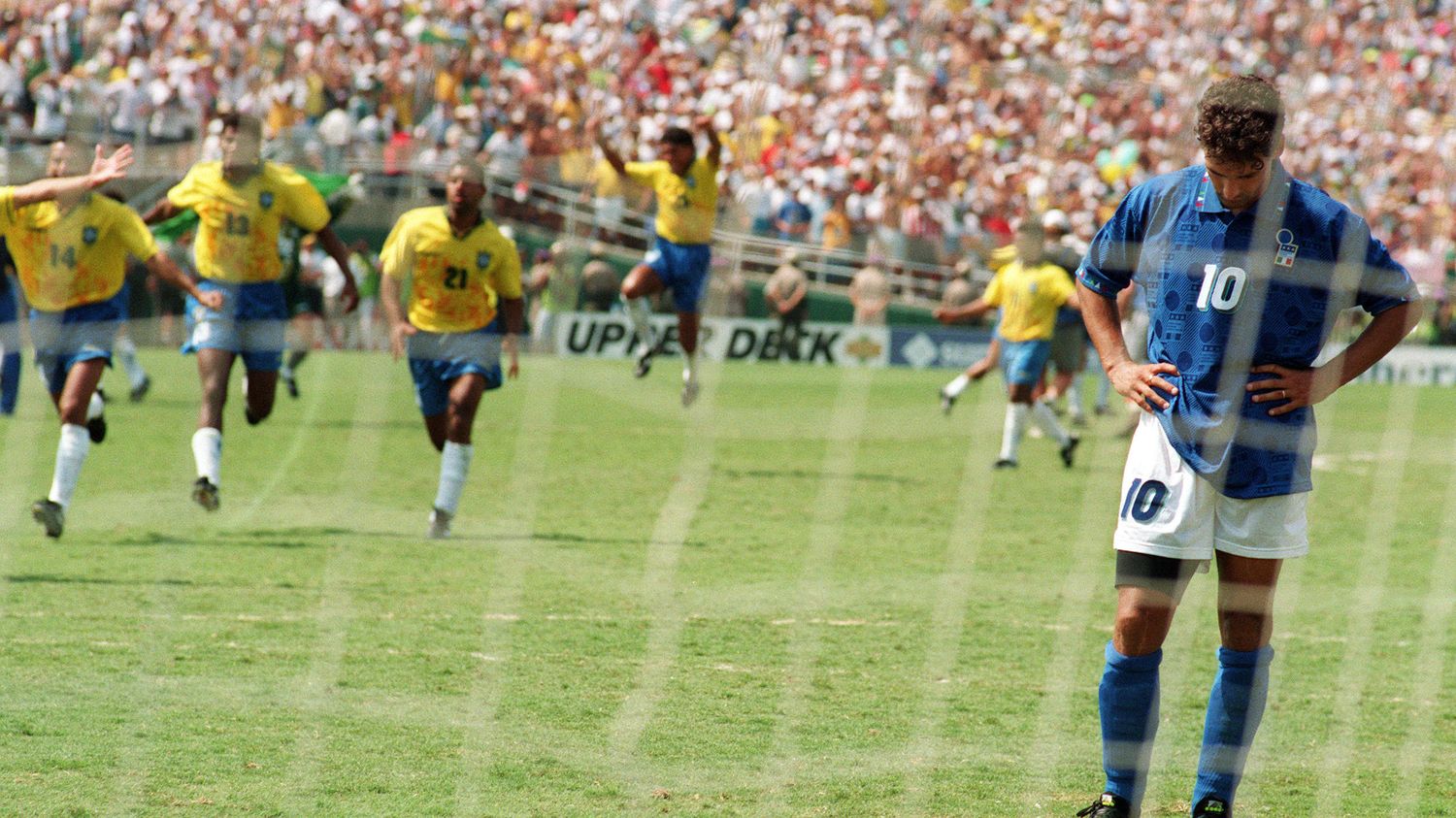
In the stands of the Rose Bowl Pelé celebrated, Vice-President Al Gore gave the FIFA trophy to Dunga, Romário was the great protagonist of that Brazilian generation and somewhere in the celebrations there also participated, with the number 20 on his shirt, a 17-year-old player from Cruzeiro who until then counted three appearances with the Seleção, Ronaldo Luís Nazario de Lima. Almost no one could have bet that the young footballer who that summer would cross an ocean would set at an unprecedented height the bar for the achievements of the modern footballer, giving birth to the era of modern superstars.
The 1994 World Cup was organised by the United States in order to symbolise the beginning of a new world. However, looking at it today, 32 years later, rather gives it the exact opposite identity: it was the end of another world. Football would then begin to become a truly organised global business, not simply as the product that a few groups, such as those of Havelange and Dassler, sell to the planet, but as the field in which those seeking political influence all over the Earth have reason to be active, with a fully professional organisation of the great clubs and championships, which transformed it from product into industry. Beyond the technocratic reading, however, the 1994 World Cup was the last of the era of spontaneous experiments in tactics and perception, the last of a course that began in 1974, when the romanticism of the beautiful game was left behind and the sport sought a new identity by apotheosising the result. It was also the last of a series of tournaments in which football did not necessarily occupy the central place. After this the real era of football would begin. Among other things, it was the last World Cup that Havelange watched as president of FIFA.
The era of football
On 2 July 1992, at the FIFA congress held in Zurich, it was decided that the organisation of the 1998 World Cup would be awarded to France. Thus, the homeland of Jules Rimet would become the second country to organise a World Cup for a second time, after the now distant 1938. In France, football was truly celebrated for the first time as part of human culture. On 12 December 1995, the draw for the qualifiers took place at the Louvre; the ball of the tournament, named tricolore, was the first coloured one, now emblematic as it kept the tango pattern that had lasted for 20 years, perhaps the second most common pattern for a football after the stereotypically classic one of the telstar, while even more teams from all Confederations would take part, with the increase of participants to 32.
A few months before the draw that took place at the Louvre, however, at the Cannes film festival, on 27 May 1995, the film La Haine was screened, a 98-minute black-and-white masterpiece by Mathieu Kassovitz that was received with a standing ovation in the festival hall and caused shock, as it presented French society in true colours in a realistic way that no one had dared until then. La Haine wrote its own history in French cinema and contemporary French history because it broke the stereotypical narrative of the western European country; it presented the heart of Europe after the centuries of colonialism, the draining of countries on other continents and the creation of a new, multi-collective culture that exists, lives, develops, but for official History is still on the margins. When FIFA chose France as the host country for the 1998 World Cup, Kassovitz’s masterpiece perhaps did not even exist as an idea, while certainly its content would in no case constitute one of the selected symbolisms for its precious tournament. Football, however, would defeat FIFA and its political symbolisms, placing in their position its own unfeigned truth.
The France of the 1990s, a state that stood at the centre of European integration, had begun to give birth within its society to the contradictions of the following decades. But it had also seen itself in the mirror – it was no longer a country only of white intellectuals and workers, devoted either to the old republican principles or to a liberal Gaullist discipline. Paris had a population of two million in its centre and approximately five times that population in its suburbs. There beat the heart of real France; from there its heart beat also in the World Cup, on and off the pitch. It was the France of blacks, whites and Arabs, the “black-blanc-beur” country, and as such it appeared in the World Cup taking place in its home, with its “black-blanc-beur” team. The new great edifice of the World Cup was also within the heart of this multiracial French working class. In the capital’s harshest suburb, Saint-Denis, rose the 80,000-seat Stade de France, whose design, with its almost suspended roof, still looks innovative today.
France, which had been absent from the tournaments of 1990 and 1994, having suffered a traumatic elimination from the goal of Emil Kostadinov, returned after 12 years to the World Cup, not simply as host, but as protagonist. From that first game at Marseille’s Vélodrome it showed that this World Cup had been made in order to tell its own footballing and social fairy tale. Sharing in this effort was also the organising committee, which took care – according to Platini’s later statement – to meet World Champions Brazil only in the final.
Footballingly, the team of France seemed more than complete. In goal, an idiosyncratic goalkeeper, rather short for the modern standards of the position, with an intact south-western accent, Fabien Barthez, showed that there are no stereotypes for any position even at the highest level. The defence resembled a factory: Thuram, Blanc, Desailly and Lizarazu, provincials and descendants of migrants, composed a steely line that conceded only two goals in the whole tournament. In front of them Didier Deschamps was the neuralgic player who linked the defensive function with creation, having Karembeu and Petit further forward on either side. At the top of the diamond, with countless space around him and enormous freedoms on the pitch, stood the embodiment of a different pibe – the son of Algerian migrants who settled in the cités of Marseille, who played football in the quarries behind the concrete working-class housing, who even as a professional at Torino took to the streets at night with Edgar Davids in order to find the joy of the game in the spontaneous nocturnal games of migrants, one of the greatest figures world football has produced, Zinedine Zidane, with a name that recalls the great legend of the Algerian national team who had played 12 years earlier in Mexico. Up front, the attacking duo was Djorkaeff and one of Henry, Guivarc’h or Dugarry.
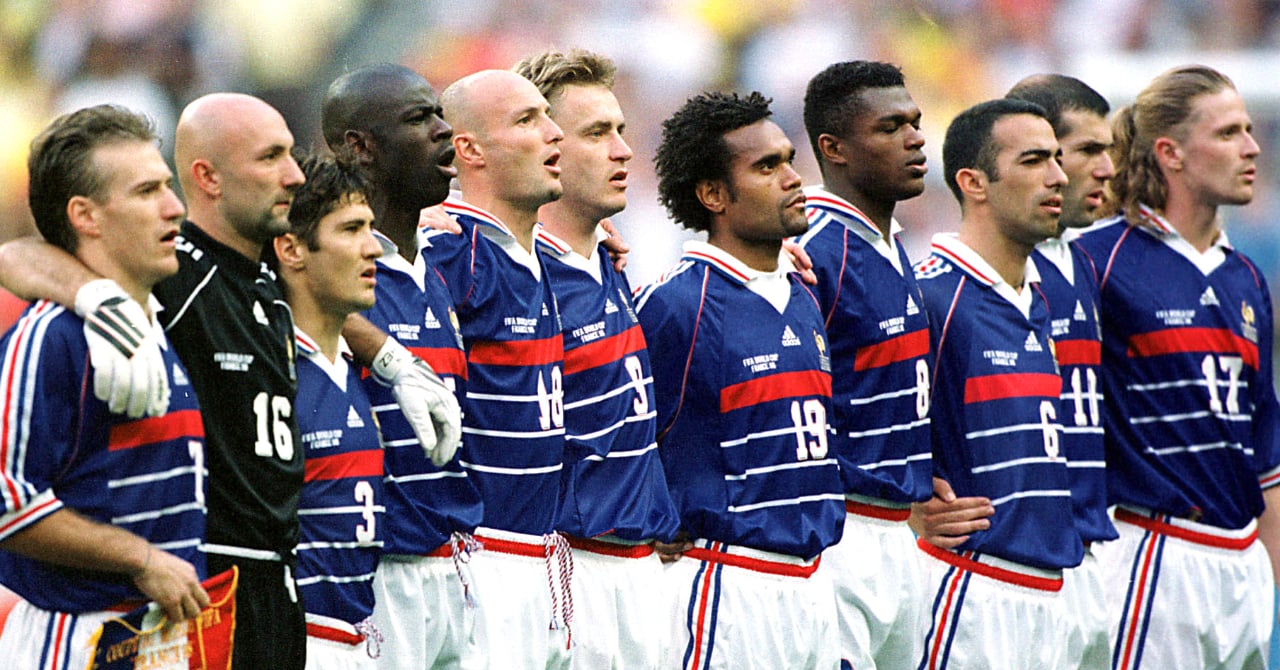
Beyond individual talent, however, the team directed by Aimé Jacquet perhaps quietly made one of the most symbolic steps in the history of football tactics. As Djorkaeff usually played a little behind the central centre-forward, essentially surrounding Zidane, France’s real system was a 4-3-2-1. Football, which from the 1870s began with the so-called “pyramid”, the 2-3-5 system, just before the first era of British professionalism, had turned the system upside down, thus inspiring Jonathan Wilson to name in this way his opus magnum, the bible of football tactics. With all these elements gathered together, the reflection of social composition in the era of its official reformulation, the innate footballing talent, the inspired tactics and the fact that it was playing at home, France did not appear only a great favourite to win the tournament, but also to realise a historical epic.
Opposite it, the strongest opponent seemed to be the World Champions, Brazil, which had in its ranks a footballer whose feats did not resemble anything the world had seen until then. With nature as an ally, having offered him a body that seemed bionic, capable of flying even on the heaviest pitch, with astonishing speed in legs and mind, Ronaldo was not accidentally called fenômeno. The season he had in 1996-97 with Barcelona and which ended in the conquest of the European Cup Winners’ Cup was inconceivable, to be repeated by another great season at Inter, performing miracles in the UEFA Cup final against Lazio. Among other things, Ronaldo had his own boots bearing the signature of the American Nike, which had entered the football market strongly, claiming a share from Adidas, which had a permanent contract with Havelange, while he was also the face of an unforgettable advertising campaign by Pirelli. He was the first truly modern superstar, the footballer who is at the same time a commercial face and a commercial product. What was certain was that many youngsters wanted to play football because Ronaldo existed.
Brazil had bottomless attacking talent, still having in its composition Rivaldo, Bebeto, Leonardo, while its leader was the captain of 1994, Dunga. Its two wide full-backs, Roberto Carlos and Cafú, also contributed to its attacking function. However, its overall defensive function in no case looked as steely as the French one. Brazil beat Scotland with difficulty in the opening match, 2-1; had an easy task against Morocco, which it beat 3-0; while in its last group game it was defeated by Norway. In the round of 16, in an attacking recital, it beat Chile 4-1, while in the quarter-finals it struggled greatly to overturn the 0-2 against it and beat Denmark 3-2. Finally, in the semi-finals, it needed to reach penalties in order to eliminate the Netherlands, an astonishing generation, the last compact team born of the great school of Ajax.
France, by contrast, scattered the newly arrived South Africa 3-0 in the opening match, a team participating for the first time in the World Cup as the Apartheid regime had ended, while with a larger score, 4-0, it beat Saudi Arabia, which had caused a positive impression on the pitches of the United States. The first great test against Denmark’s golden generation was also victorious, 2-1. In the round of 16 it needed a “golden goal” by Djorkaeff in extra time to bend Paraguay’s resistance, while in the quarter-finals it continued the Italians’ bad demon, eliminating them on penalties after a goalless draw. In the semi-final, however, the opponent was a new footballing school, which no one expected – probably wrongly – because all the conditions existed to allow it to hope for distinction.
The dissolution of united Yugoslavia in the Balkans meant in the mid-1990s also the dissolution of an enormous footballing school, connected with the ideas that evolved in Eastern Europe and part, even if peripheral, of the great footballing networks from the beginning of the century. And if the athletic tradition of the great federal country of the Slavs was inherited in many sports by the later Yugoslavia and Serbia, in 1998 Croatia showed that it was the heir of the footballing tradition. The first appearance of the national team at Euro 1996, on English pitches, was nothing special, but at the World Cup in France, two years later, it made the best appearance by a debutant team, if we exclude the interwar tournaments, where many great teams appeared in any case for the first time in the competition. The Croatia of Ćiro Blažević had a great composition, consisting of superstars such as Davor Šuker, Zvonimir Boban, Goran Vlaović, Alen Bokšić, Robert Prosinečki and Aljoša Asanović, who were already having careers in major European clubs. For this experience of theirs, however, neither Yugoslavia nor the war was responsible, but a Belgian footballer, Jean-Marc Bosman, who, making use of European Community law, opened the road for the participation of footballers of many nationalities in the teams of European championships. The Croats may not necessarily have played as “Community” players, but the ease with which more foreigners could play opened the road also for the other countries. Thus, national teams that did not have competitive championships could, from 1995 onwards, become particularly dangerous for any opponent, exporting their footballing talent. The first World Cup that took place after this development was the one organised in 1998 in France and, although many teams seemed to be reducing the distance from the giants of world football, Croatia was the one that symbolised this great change in the most resounding way. The Croats, after destroying Germany 3-0 in the quarter-finals, even came to take the lead with a goal by Šuker in the semi-final against France, before Thuram overturned the score with two goals at the Stade de France.
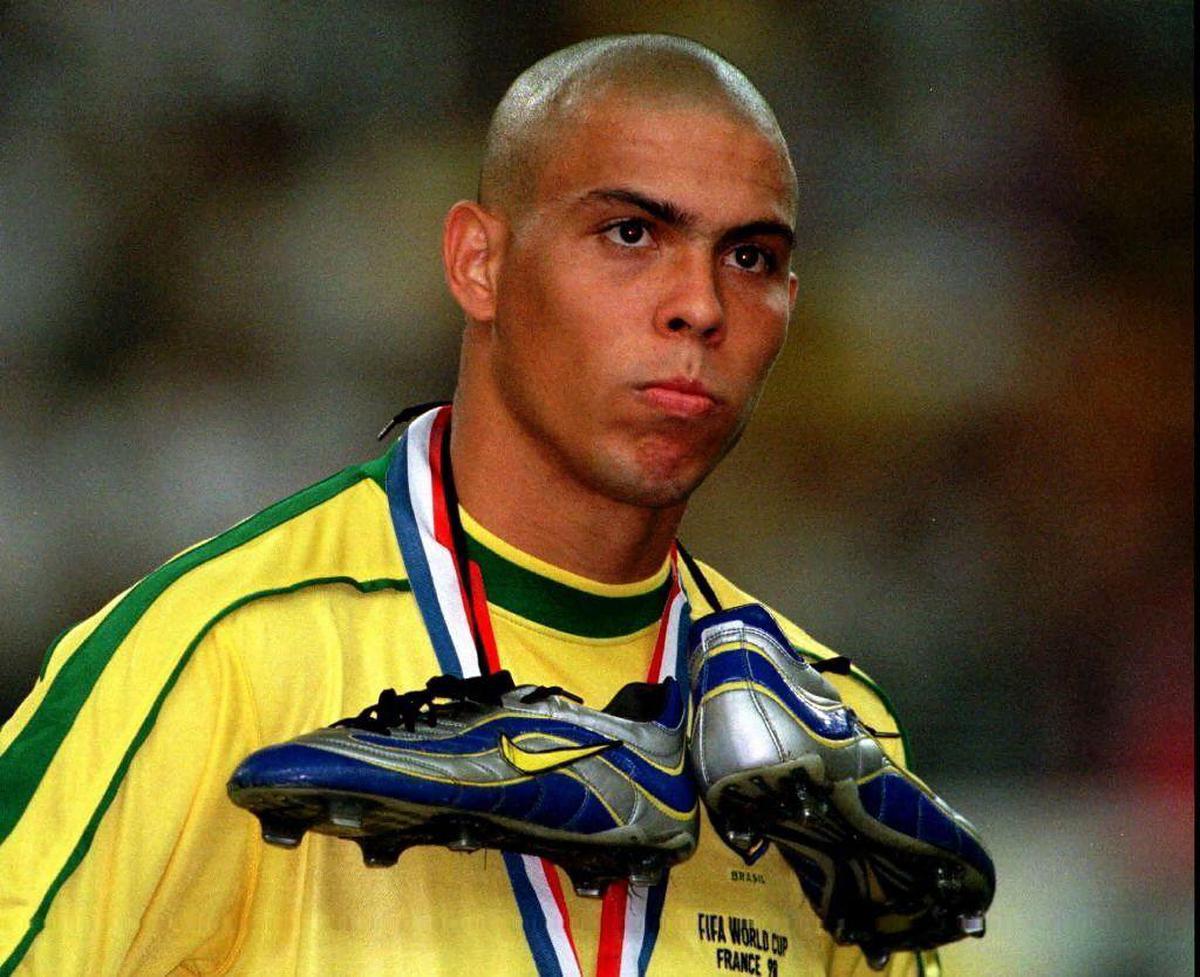
France, having also passed through the great surprise of the institution, had opposite it only Ronaldo’s Brazil, in a final that had perhaps been designed several months earlier, when the draw of the groups and crossings of that World Cup was taking place. The world was awaiting the great moment of the Brazilian, who had won the Ballon d’Or of 1997 and seemed unstoppable; however, the body – which has limits – does not obey the dictates of sponsors, and in that final of 12 July a ghost appeared in the place of the phenomenon. The exhausted Ronaldo was forced to play, beyond his own ambition, also in order to satisfy the needs of Nike, which had designed his expensive silver boots; however, the defensive line of France, which had made so many forwards disappear in that tournament, would not change its tactics for a commercial contract. Instead of Ronaldo, the great protagonist of that final was that descendant of Algerian migrants from Marseille, Zinedine Zidane, who was already writing his own epic with the shirt of Juventus at international level and very soon would become one of the greatest players ever to set foot on a football pitch. With two personal goals by Zidane and one by Emmanuel Petit before the end, France triumphed 3-0 and the national celebration for the storming of the Bastille, which is honoured on 14 July, that year began two days early.
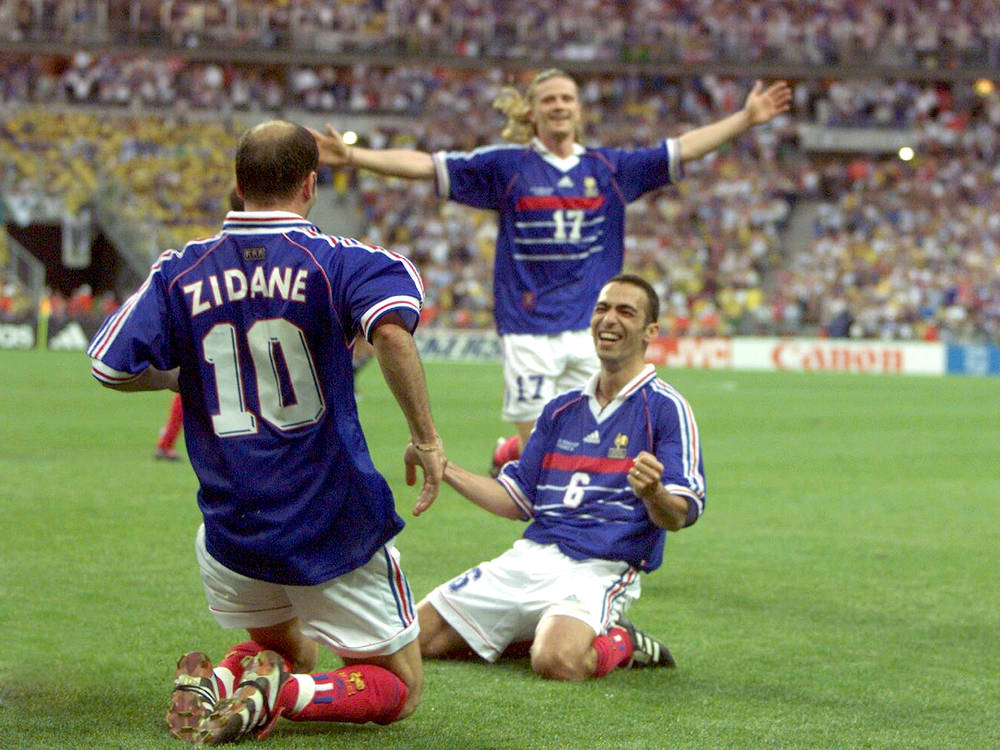
This time France, however, was not celebrating only its past, but also reconciliation with the reality of its present; the slogans Zidane Président dominated the Champs-Élysées, expressing a hidden desire for the proper application of that Égalité which would be an empty word as long as its “black-blanc-beur” identity was not expressed at every level of politics, beyond the social life of France.
Football had defeated the political narratives on the pitches of France, but European football was passing into a new era, which had begun from the beginning of the 1990s and would be ratified in the following season of club competitions. The old European Cup, the Cup of the Champion Clubs of Europe, had now changed name, identity, but also content, from the 1992-93 season, when it was renamed the Champions League. In the first years of the new competition the champion teams, instead of the traditional knock-out system, found themselves in two groups of four teams, with eight clubs competing for the first time in this institution that Marseille had won. Two years later the group stage had 16 teams, while from 1997-98 the entry of runners-up from the first eight countries of the UEFA ranking gave the possibility for these teams to become 24. The great change came, however, in the 1999-2000 season, when the teams increased to 32 and four teams participated from the largest championships, three from the immediately following ones, two from a series of countries reaching down to 15th place, creating an entirely different field for European club football. Now, the clubs of the traditional powers of football could participate steadily in its greatest competition, regardless of who won the championship, provided they were in the top positions of the table. This change created an elite that is becoming more and more a closed club at the summit of European football, which gathers footballing talent from all the other countries and has the resources to create faster evolution in footballing thought even than the World Cup.
From the beginning of the European Cup’s existence, many tactical innovations appeared first in this club institution and then passed through the national teams into the World Cups. But the World Cup was always the space where different footballing schools and approaches clashed, since in the pre-Bosman era clubs were usually composed to a large extent of indigenous players who carried the corresponding approach into the national team, either autonomously or through the appointment of each successful coach to the position of national coach. With the full internationalisation, however, of football contracts, as well as the rapid commodification of the game, the many more matches during the season at the highest level of the Old Continent, tactical evolution as a whole passed to these competitions and the institutions in which national teams participate are usually an echo of this evolution, since the borders of national schools have almost disappeared, players from every country become part of different footballing approaches, depending on the club in which they play, and it is much more difficult to find homogeneity in a whole that meets only a few weeks before a tournament of enormous prestige, of only a few matches.
This had as a direct consequence that from the 2000s onwards the distance of the weaker countries from the traditional footballing superpowers did indeed shrink, since their players played steadily at the top level of the world and acquired the corresponding experiences; however, at the same time a ceiling was also created for all countries that are outside Western Europe and whose footballers are more scattered in clubs that exist within the framework of a different national footballing culture, therefore making it more difficult for them to find the necessary homogeneity. In the World Cup of France, two of the four teams came from Western Europe; from the middle of the 2000s onwards this number never fell below three.
Football, the one that Havelange commodified, was changing once again, with a new commodified form of it acquiring the designation of “modern football”, while the previous commodified football became the fairy tale of the romantics. The same had happened to another generation when Havelange was beginning his long course, the same had happened earlier, before professionalism entered each country, the same pattern can be found all the way back to the first foundation of the first footballing institution, the Football Association. The problem of football, however, is not its modernisation. As a mass phenomenon, its parallel development with that of capitalist societies, within which it exists and develops, is law-governed. Even the expression of the opposite ideological position, of the footballing Gallic villages, is part of the same process, within the same great capitalist empire. Football will become truly popular through a process of perpetual modernisation that will follow and reflect human societies – and it will become the game controlled by the masses that love it when power too passes into their hands and the society that will serve their own purposes is built. That will be the most beautiful footballing modernism – the most romantic the world will ever have known.
However, the exact opposite tendency was expressed by the developments in FIFA on the margins of the 1998 World Cup. João Havelange was succeeded by one of his close collaborators, the Swiss Sepp Blatter, a man who had never been a footballer, a coach, or even someone who had existed in dressing rooms, but who for more than 20 years had been a technocratic employee of FIFA, gradually acquiring more responsibilities and power, being the General Secretary of the World Confederation from 1981. Blatter continued Havelange’s work, which aimed to carry football to every corner of the Earth, even if the sport had no radiance, seeing the countries on the world map not as footballing schools, but as markets. In this direction also moved the decision that the 2002 World Cup would be organised on the pitches of South Korea and Japan, in two countries only one of which had even a stable relationship with the sport, while in the second no one was occupied with the strange British game of those who run around a ball, as the masses were moved by the even stranger American game in which some hit a ball with a bat and run over little cushions. In view of the World Cup of the Far East, Blatter in fact “invented” the Asian origin of the game, elevating cuju, a Chinese ball game from the years of the Han dynasty, into a direct ancestor of the modern footballing game. The reality regarding this view we have analysed in the article on the prehistory of football.
The first World Cup organised in Asia was even more commodified than the previous ones, indeed abandoning many of its traditional elements, perhaps most characteristically the reformulation of the aesthetic design of the football. On the pitch the world expected France to defend its title, while another great favourite was a more than complete Argentine team, under the instructions of the philosopher of football, Marcelo Bielsa, which seemed to be overcoming the shock of the absence of the pibe de oro from its ranks. Instead, no one shone in that tournament apart from Brazil, the astonishing trio of Ronaldo, Ronaldinho, Rivaldo, Roberto Carlos and Cafú, the latter lifting the precious trophy in Yokohama on 30 June at the moment when he became the only footballer in history up to now to have played in three consecutive World Cup finals.
What remained engraved in memory from that World Cup, however, beyond the emphatic advance of the Brazilian superstars who raised even higher the global calibre of their footballing country, with the conquest of the fifth World Cup, were the refereeing massacres so that the team of South Korea would go as far as possible in the tournament. The game for the Round of 16 against Italy, in which the referee was the Ecuadorian Byron Moreno, remained in History as the most scandalous refereeing game in the History of the World Cups, while corresponding favour also existed in the quarter-final against Spain. Was this perhaps the first time something like this happened? The truth is that many stories exist from the pre-television World Cups, as well as from Olympic Games, in the years when the normal national teams still competed in them, concerning outrageous refereeing decisions. However, that match between South Korea and Italy was broadcast live in colour and in relatively high resolution throughout the planet – for this reason the impact of the decisions of a referee who was later sentenced to prison for participation in a drug-trafficking ring was such that the events of the day remained engraved in the collective consciousness of those who watched that encounter. More than a decade later FIFA adopted one of the most radical changes in the history of the evolution of the rules, integrating video into the tools for making the most crucial decisions in a match, in an attempt to protect its now very expensive product.
The 2006 World Cup was organised in Germany. Continuing the post-war pattern of decades, each time Germany appeared in the central shot of footballing direction, the narrative concerned the course of the country that regrouped after the Second World War, was divided, reunited, became a great industrial power and part of the international community. Germany was now not only a part of the great alliance of the so-called Western World, but also the locomotive of Europe, holding a dominant position within the European Union and acting diplomatically in many cases as an independent pole among the great imperialist powers, even autonomously in relation to the United States. To what extent this view was short-sighted would be judged by History in a process that in our days is in full development; however, because collective memory is created in moments, at that moment Germany seemed the greatest and absolutely dominant power of the European edifice.
The football played on the German pitches was also the result of another European edifice, which was built neither by the European Union nor by NATO, but by UEFA. The 2006 World Cup was perhaps the first in which the effects of the evolution of European club competitions appeared so strongly. In the round of 16, 10 teams were European; in the quarter-finals, six; while the semi-finals were a small Euro, with all teams coming from the “hard core” of footballing Western Europe. There had been World Cups before with four teams from the Old Continent in the semi-finals, in 1934 and 1966; however, then there was also a presence of teams from the eastern side of the continent. Now, the countries competing in the top four were not only geographically defined, but constituted the countries that were in the top positions (together with England and Spain) of the club ranking of the European confederation.
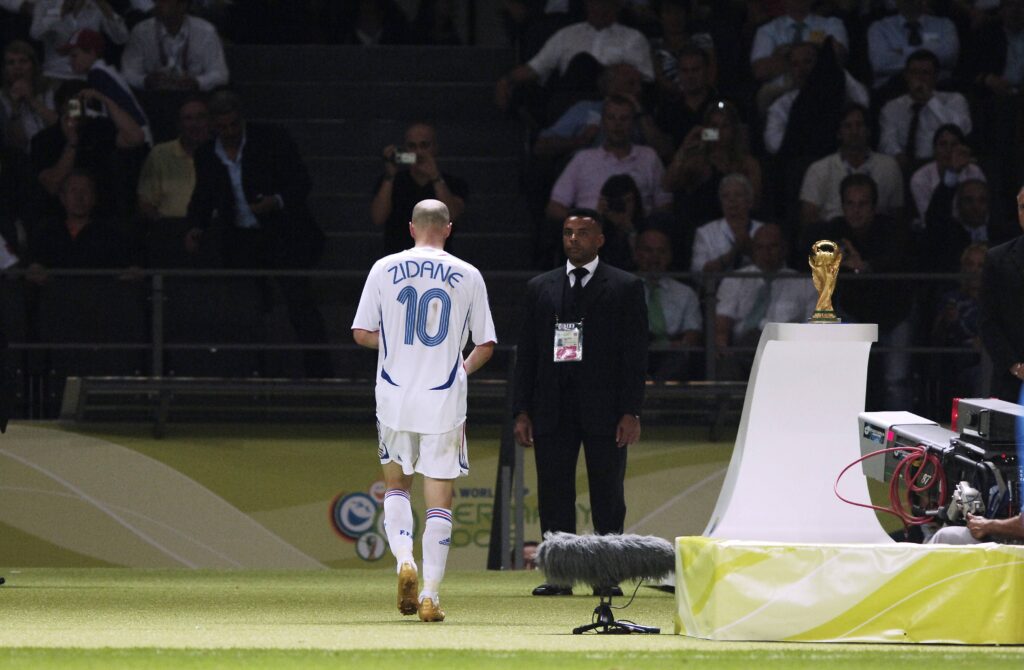
Three events marked the History of that World Cup: Italy’s victory after the revelation of the greatest footballing scandal in its History, which would lead to a slowing down of its club football, the downgrading of its championship and later – as now happens with a phase difference – very negative consequences in the course of its national team; the end of Zinedine Zidane’s career, which was marked by an extremely footballing gesture of defending the honour of his culture against the Italian defender Marco Materazzi; and the first appearance in a World Cup of a footballer who could worthily wear again that metaphysically heavy “10” of the albiceleste, Lionel Messi, who scored his first goal against the national team of Serbia and Montenegro, which on that day of 16 June 2006 represented a country that no longer existed or, under another reading, was the first national team to represent two countries in a World Cup.
A great moment for football, however, would come in 2010. Unlike 2002, when the World Cup travelled to a place where football is not part of the culture of the masses, the great footballing tournament had never taken place on a continent where millions of people live, breathe, play football and have the sport at the centre of their consciousness and activities – with the development of historic clubs, countless historical events, not always with a positive sign, and an approach to footballing ideology that is very exotic to the eyes of Europeans and South Americans. Africa, the continent that suffered the brutality of colonialism more than any other part of the world, seemed a place of the margins, not only in the global political and diplomatic arena, but also in football.
In a paradoxical way, the country that would organise the 2010 World Cup was one of the few where football cannot be considered the national sport, with the existence, however, of a great dichotomy of love for the sport, which has a clear racial sign. South Africa, excluded during the years of Apartheid from international sporting competitions, hosted the first World Cup, for rugby, on its soil after the end of the racist regime and the rise of the African National Congress and Nelson Mandela to power. That Rugby World Cup, whose history was mythologised also in the film Invictus by Clint Eastwood, starring Morgan Freeman and Matt Damon, was one of the sporting events with the greatest social influence, as it was utilised by the country’s new power and personally by Nelson Mandela so that it could get back on its feet after decades of racial conflicts. It would have been too good to be truly real, but that Rugby World Cup constituted one of the rare stories of instrumentalisation of sport with a positive sign.
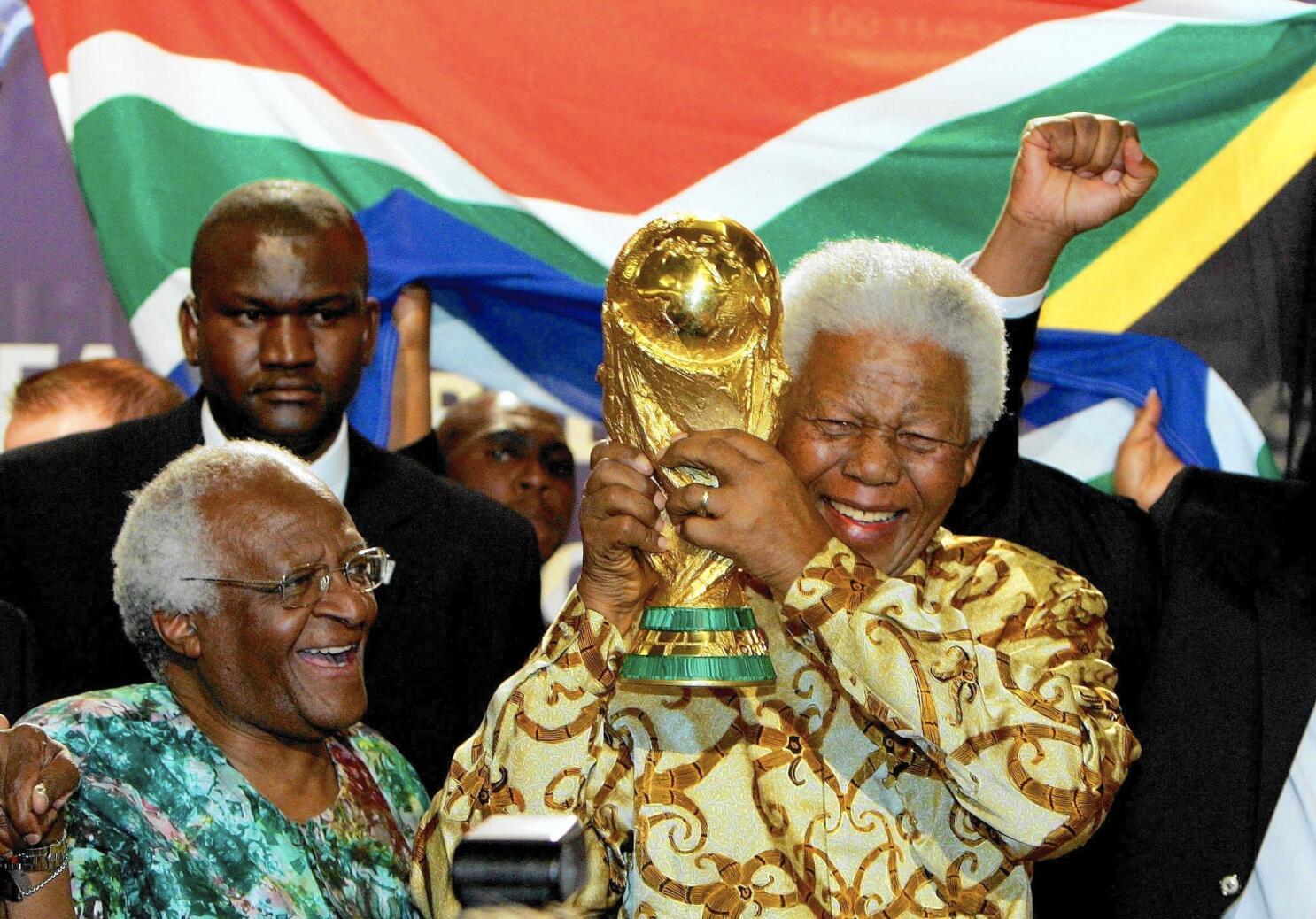
A corresponding positive sign was also proclaimed by FIFA’s officials when they gave the responsibility of organisation to South Africa and the trophy itself into Mandela’s hands on 15 May 2004. Unfortunately, the enthusiasm of football lovers everywhere for the first World Cup on the African continent was quickly covered by the news of the brutal exploitation of workers in the rebuilding of the stadiums, the enormous mobilisations against the unjust distribution of resources to football in a country sinking into poverty, and the prolonged, unceasing sound of the vuvuzela.
Aspiring to write yet another fairy tale in that tournament, Argentina appeared with Maradona as national coach, guiding a team in which the armband was worn by Messi; however, the experiment of playing football without a left-back did not have a good result, collapsing against Germany in a quarter-final that ended 4-0. As far as the other beautiful stories are concerned, the world awaited the African team that would perhaps surpass Cameroon’s success from 1990. In the end, this time Ghana reached the quarter-finals, but lost a borderline match thanks to a clever but illegal action by Luis Suárez, who at the death saved his goal from the goal that would have meant elimination. And if Uruguay managed to reach the semi-finals, breaking the monopoly of Western Europe that began in 2006, this happened also thanks to the crossings, since in that part of the bracket there was one team from Asia, one from North America, one from Africa and one from South America.
Western Europe triumphed again in a final which, as far as the History of football tactics is concerned, had particular interest, because it constituted a great exchange of roles. The Netherlands and Spain are two countries connected footballingly as few others are, without even sharing borders. Of course, the truth is that they have historical ties reflected in the national anthem of the Netherlands, the only one that mentions in its verses the Spanish monarch (as the Spanish anthem has no words). But as far as the footballing hierarchy is concerned, Spain was the country that became the melting pot of Dutch innovation and totaalvoetbal from the 1970s. First Rinus Michels, then Johan Cruyff, Neeskens, Van Gaal, later Guus Hiddink, were personalities who brought Dutch thought to Spanish clubs with a steady flow that became a tradition, especially at Barcelona, which through them defined its footballing physiognomy. The passage into the 2010s meant the rebirth of that club, which, based first on the work of Frank Rijkaard and then on that of Cruyff’s most emblematic pupil, Pep Guardiola, created the football that would be played for many years to come, reformulating its principles, abandoning stereotypical patterns and apotheosising creativity for the game in space, opening a new era for the aesthetics of the sport.
All these elements were absent from the Dutch team that appeared in the Final of Johannesburg on the night of 11 July, the third in the History of the oranje. Bert van Marwijk’s team was a tough, rugged ensemble, which, if someone had disappeared from the earth for a few decades, they could have considered an authentic descendant of that old Spanish Furia Roja. On the other side, Spain was the one evolving totaalvoetbal at the highest and most professional level, with its midfield, composed of Iniesta, Busquets, Xavi, Alonso and Pedro, being in a perpetual exchange of spaces and circulating the ball with indescribable ease, in a way of playing that was called tiki taka and whose aim was to wear down the opponent that contested possession. The differences between the two teams were decided by the goal scored by Iniesta in the 116th minute, four minutes before the end of extra time, while Iker Casillas had an enormous share in the success, having prevented Arjen Robben’s tête-à-tête. Spain, two years after winning the Euro, was at the summit and showed that it could remain there with great ease, as it also showed in the European Championship two years later. It would take a Dutch correction to destabilise a World Champion that deserved its title as few in History did.
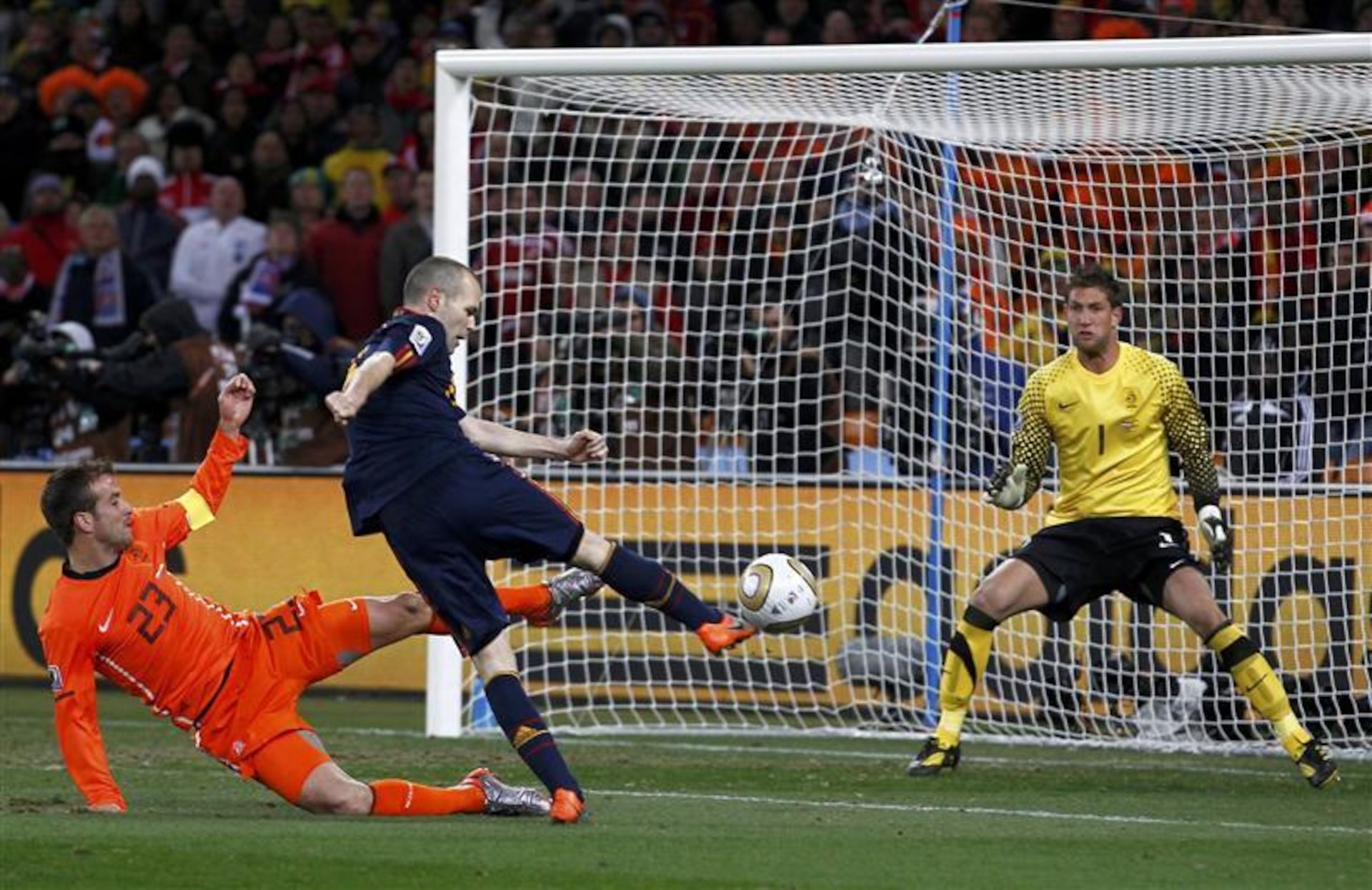
Sixty-four years after the last World Cup match that had taken place in Brazil, the great tournament returned to the country that in the meantime had won the title five times, more than any other. That last match, of course, had passed into collective memory as one of the greatest national tragedies, and in a country ravaged by poverty, crime, the generalised destitution that concerns the great majority of its inhabitants, the fact that a football match is considered a national tragedy shows the magnitude it has for the peoples of the whole world. However, unlike the national uplift of 1950 and the ideological propaganda of mestiçagem, of multiraciality with the maintenance of class barriers proclaimed by the power of Getulio Vargas, the path towards the 2014 tournament had a very different political content. Huge masses of Brazilians poured into the streets demonstrating, like the South Africans four years earlier, against the irrational use of resources for the organisation of the World Cup at the moment when they were living in misery. The social-democratic government of the country, which from the hands of Lula da Silva had passed to Dilma Rousseff, was not discouraged, since the interests of its bourgeois class linked to that World Cup could not be ignored.
The truth is that South American football as a whole was returning to the foreground in that tournament, since, beyond the fact that it was organised in Brazil, the top footballer of the world, part of that Barcelona which gave birth to the World Champions of 2010, wore Argentina’s shirt. The dominance of Western Europe had reasons to be broken, and the arena set up for that purpose seemed entirely suitable. Beyond everything else, the draw of the groups gave the possibility of a final between Argentina and Brazil, to the delight of football lovers all over the planet.
The two teams began comfortably in the groups, with Argentina making it a perfect run and Brazil bringing a goalless draw with Mexico. In the round of 16 they passed with difficulty, in extra time, Brazil against Chile and Argentina against Switzerland, while in the quarter-finals with a thin advantage they bent the resistance of Colombia and Belgium respectively. On 8 July 2014 Brazil would face Germany in Belo Horizonte with the aim of reaching a final again at the Maracanã, so as to unite the History of that stadium with a different national history. In the 11th minute, however, Thomas Müller scored the first German goal, which showed that this would not be an easy affair – yet no one could imagine what would follow. Klose in the 23rd minute, Kroos in the 24th and 26th, Khedira in the 29th scored the fastest four goals any team has ever scored in a World Cup, raising the half-time score to 5-0. Brazil was facing another tragedy, which grew with Schürrle’s goals in the second half. Seven goals in its home, with a performance that did not show at any point that the two teams competing in that match belonged to the same footballing level. Belo Horizonte was added to the Maracanã as one of the homes of great national humiliations, even if Júlio César was not condemned by society in the same way that Barbosa was condemned.
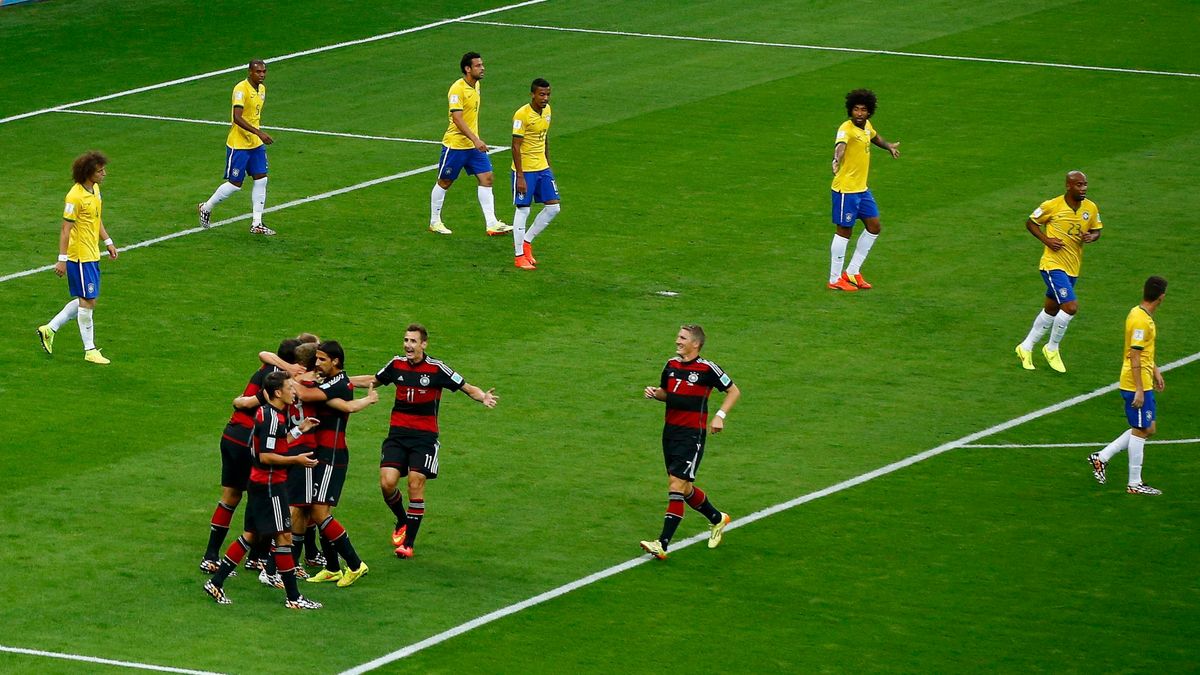
The Germans, who by general admission had presented the most stable performance throughout the tournament, achieving some very difficult victories but in matches of great intensity, such as against Algeria and France, managed to make Messi and Argentina bend in the 113th minute of the encounter with Mario Götze’s goal. On the one hand, in Germany they spoke of the multinational origin of their team, which constituted the corresponding reflection of contemporary Western Europe; on the other, in Argentina they spoke of Neuer’s foul on Higuaín, which recalled Schumacher. A refereeing decision seemed once again to have decided, after the final of 1990, the holder of the trophy. This would be changed by FIFA once and for all from the next tournament, as the result of a long course of reflection from the beginning of the 21st century.
The era of oligarchy
Before the next World Cup began, a scandal of megaton proportions concerning FIFA’s leadership became known, when Swiss police arrested, on 27 May 2015, seven FIFA officials who were preparing to attend the Confederation’s 65th Congress at the Baur au Lac in Zurich. In an enormous case, which contained evidence from the American authorities of bribery, fraud and money laundering, a series of FIFA executives found themselves accused over the way the Confederation functioned. Within the same year, more and more stories came to light involving leaders of countries, monarchs from the great European kingdoms, dictators and sheikhs, as well as a multitude of football officials. The question that arises today, knowing the History of FIFA as it evolved – and its relationship with the United States – is naturally whether the phenomena of corruption were suppressed or replaced by others. Without proof, any answer to this question has little value, but with the specific historical data it is very important that the question be posed.
The result of these developments was that the former General Secretary of UEFA, the Swiss-Italian Gianni Infantino, was elected to the position of FIFA President. One of Infantino’s first duties was to organise the World Cups in Russia in 2018 and in Qatar in 2022, as well as to lead the Confederation ahead of the selection of the host country for the 2026 tournament. In 2018 FIFA would travel to Russia for the 21st World Cup and its 68th Congress. Russia, after the capitalist restorations at the end of the 20th century, had by now evolved from a country that was on the margins into a great imperialist power. Internally, the old enemies of Soviet power, who had been supported ideologically and materially by western capitalism, were evolving into oligarch competitors of American-centred global domination. Thus, the friends of the past had become sworn enemies in the second decade of the 21st century, with the first conflict manifesting itself in Ukraine in 2014. Nevertheless, the relations of Western and Eastern imperialism still existed and all Western leaders rushed to give their own diplomatic presence at the World Cup organised by the permanently elected Russian president.
With an aesthetic that used the glorious Soviet footballing past, stripped of its ideological content, only as an indication of the national continuity of a great powerful state, Russia did not hesitate to wink ironically at the West, presenting as the ball of the World Cup a new telstar, recalling the era of the space race, claiming a share also of that glory of the Soviet Union. At the FIFA Congress held in Moscow, the tournament was awarded to the United States, which together with Canada and Mexico would host the World Cup in 2026. At that period Donald Trump had been elected to the White House, who after all maintained excellent positions with the regime of Russian oligarchs.
On the Russian pitches, where an astonishing footballing spectacle appeared, the national team of Russia seemed capable of a great distinction, but it did not manage to surpass the feats of the Soviet Union, in an appearance that would be its last before the world changed into an even greater dystopia. Otherwise, Western Europe, together with Croatia, which returned, even better 20 years later, from that great success of 1998, dominated by again having three teams in the semi-finals, with an astonishing generation of the national team of reborn Belgium eliminating Brazil and France eliminating in order Argentina and Uruguay. Among the statistical paradoxes was that the national team of England managed to qualify on penalties against Colombia in the round of 16.
The final, between France and Croatia, ultimately seemed a one-horse race, but if one image remained indelible, within the political developments of the following years too, it was that of the French President Emmanuel Macron celebrating wildly in the stands of the Luzhniki the success of his national team. The rain that followed the final suited the world that was taking shape for the worse; it recalled the metaphorical black interwar clouds of that World Cup in France 80 years earlier, and much less the victory of the “black-blanc-beur” in the resplendent Stade de France 20 years before that new day of triumph.
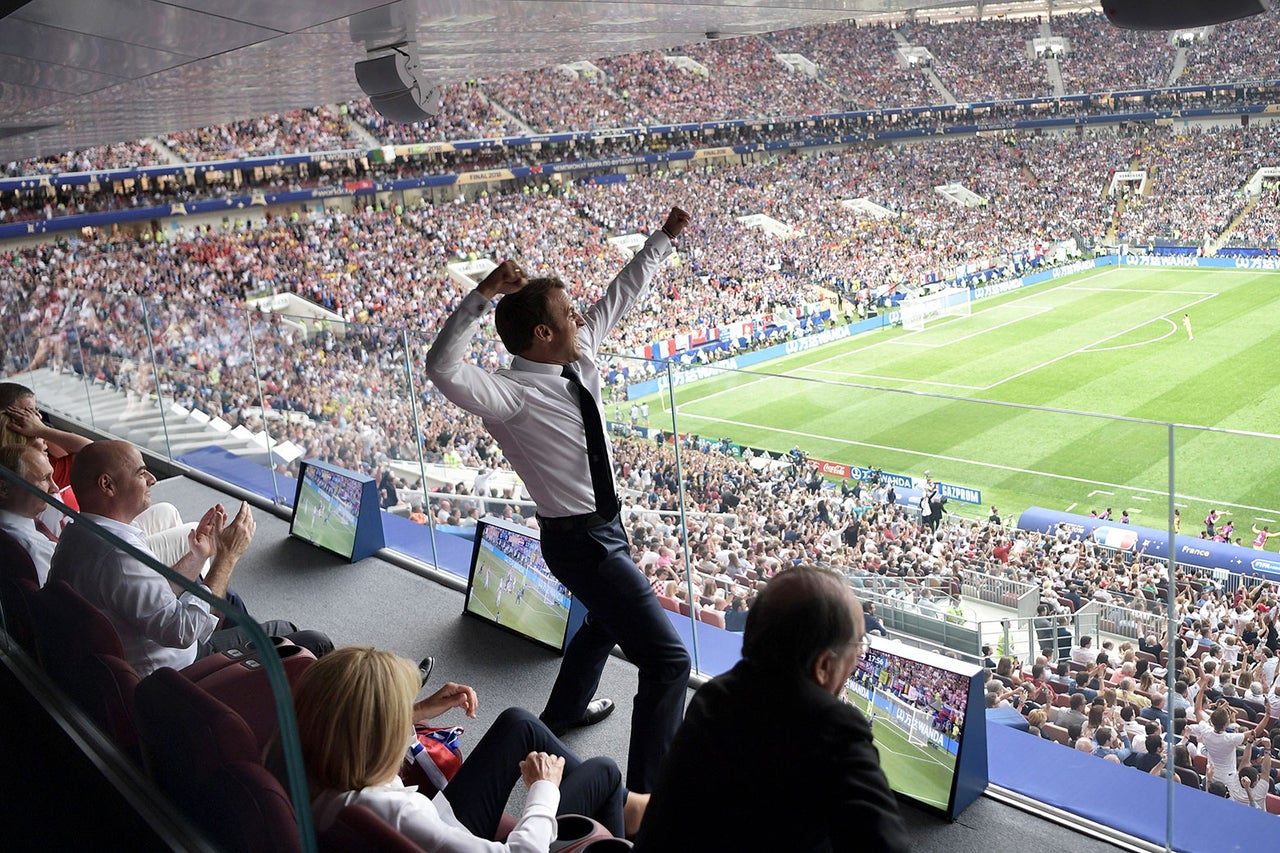
Football, which had passed through a long process of appropriation by the affluent classes, which slowly expelled the supporter masses from the stands with expensive tickets and resplendent tournaments, was now a game in the hands of oligarchs, who did not even need the people in the stands of their celebrations. This course would naturally continue also in the World Cup organised in Qatar four years later, after the outbreak of a war which for the first time in the post-war History of the world divided the planet into two non-communicating camps. A World Cup that was not accompanied by protests and demonstrations, but only by the ruthless exploitation of foreign workers who worked in conditions of slavery, without any human, let alone labour, right, so that the great footballing celebration could be set up in countries where it is customary for oil to come out, not goals to go in.
The Qatar World Cup would certainly have been a great disappointment for humanity, had there not been once again the intervention of football’s metaphysics, that divine intervention which seems to spoil the plans of those preparing their own narrative upon the body of the sport loved by the peoples. On 25 November 2020 one piece of news shook the world: Maradona died! Diego, betrayed by his heart, was found dead in his house, under circumstances that are still being examined today. The pandemic that had distanced the whole world from every social activity made the event seem even heavier, as if the whole planet wanted to fall silent for the loss of the author of our footballing dreams. The president of Argentina, Alberto Fernández, declared three days of national mourning. But the History of Argentina’s national team could not but be affected by this event. The albiceleste, which since 1994 had been seeking to find how it would continue its course without the most influential player in the History of the sport, had not won any title since Diego wore its shirt for the last time. A lost World Cup final, many humiliating defeats and eliminations, two Copa America finals lost on penalties, another one lost against Brazil – the game of fate seemed to have no end.
And yet, the next tournament after that day of Diego’s death was the Copa America that would be organised on the pitches of Brazil. On 10 July 2021, Argentina’s national team beat Brazil 1-0 at the seemingly haunted Maracanã to win its first title after 28 years. The following summer, with an emphatic victory at Wembley against the European Champions, Italy, it won the Finalissima and in a tournament that seemed to be Lionel Messi’s last it went to Qatar with a hidden hope for what no one could have expected four years earlier.
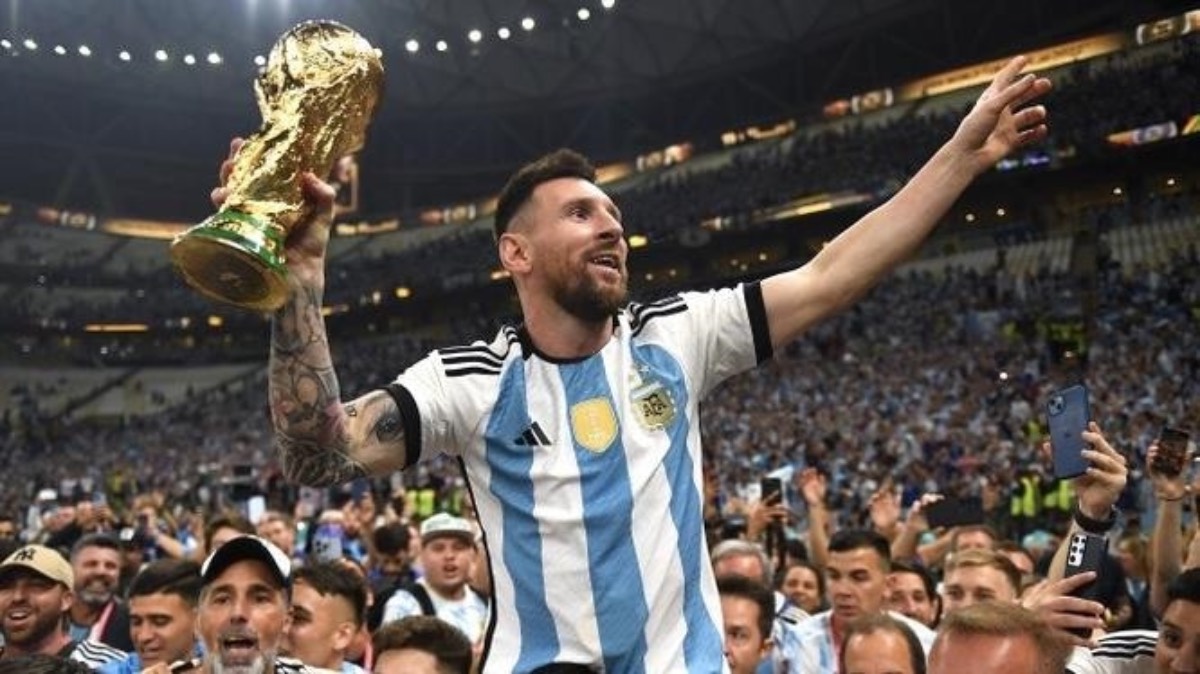
The start, however, did not look hopeful at all. A 1-2 defeat by Saudi Arabia and the ghosts of other eras seemed to appear once again in the path of the albiceleste. But a team that perhaps became the most beloved of the Argentines in the History of their much-loved national team showed match by match that it had a star to go far. 2-0 against Mexico, 2-0 against Poland, with Messi reaching a level of performance at 35 years old that placed him in the absolute footballing pantheon. A difficult 2-1 against Australia in the round of 16, qualification on penalties against the Netherlands after an eventful match that almost naively slipped away, and an aristocratic performance by Messi in the semi-final with 2018 finalists Croatia, with the score stopping at 3-0. In the final the opponent was World Champions France. The description of that game would require hours in order to analyse each significant separate element and event, in a game that was perhaps the most epic, if not by every footballing judgement the best, in the History of the World Cup. Dibu Martínez’s save in the last minute of extra time, from Kolo Muani’s shot, seemed to come from the sky, as did Messi’s words before Montiel’s decisive penalty: “from the Earth to the sky, until the end, Diego”… Argentina was World Champion again! Football managed on penalties to defeat its political instrumentalisation. One could say that this was the goal of its organisers – yes, perhaps that is always the case, because they know that since they cannot defeat football, let football defeat them so that in the meantime they can set up their own celebration. But football will continue to win forever – and this is the History of the whole World Cup: whoever organised it, however many black stains tried to soil its body, what remained was the game of the peoples, the only thing alive through wars, because in the end – even through death – life triumphs.
A story for the future
A few hours before the start of the 23rd FIFA World Cup, on the pitches of the United States, Canada and Mexico, few can know what the footballing spectacle that will unfold in the first tournament of the institution’s even greater expansion, with the participation of 48 teams, will be like. What is established, however, is FIFA’s strategy for the evolution of the institution and of the sport itself. Now, in the World Cup, it will not only be the best teams of the world that play, it will not only be the evolution of footballing thought that is measured, one school against another, but there will enter into it – more as extras than as real competitors – the national teams of the countries that can create their own footballing narrative so that football’s influence as a product may grow in every corner of the world, because as a sport it no longer needs FIFA’s political strategy.
At the same time, however, that little Curaçao participates in the greatest footballing tournament on the planet, FIFA leaves no room for illusions. Its ties with power and imperialist pursuits, which were never hidden, reached the point where it created its own “Peace Prize”, which it handed to President Trump, surpassing the limits of farce that in older times someone might perhaps have been able to define. But if only the concern over the 2026 World Cup stopped there. Football itself begins the tournament defeated, through exclusions: exclusions of supporters who were not able to secure the necessary travel visa; the near exclusion of the team of Iran, which is in a state of war with the United States, and finally the change of the team base location, with its transfer to Mexico; the exclusion of the Somali referee Omar Abdulkadir Artan, who after 11 hours of interrogation and detention was deported on a return flight to Istanbul; humiliating body searches of Senegal’s players outside the airplane upon their arrival on American soil. A World Cup made to symbolise the closing of the door to the peoples of the world, what the American political leadership wants to symbolise. A World Cup with its doors literally closed to the masses who adore the sport, because of the dizzying ticket prices that have ended up in a black market operating under FIFA’s aegis.
I wonder, even that Jules Rimet, who envisioned a new policy for world football, motivated by the line of the Catholic Church, how would he see today the evolution of his vision? How would Stanley Rous react to this closing of football stadiums to the working class? How would even João Havelange face the farce of the embrace with the American political leadership? It matters little – because what matters today and always mattered was what the peoples perceived through the World Cup. The peoples who supported the Austrian interwar star Matthias Sindelar, who never played with the team of the Nazis; the peoples who knew what was happening in Videla’s Argentina and stood beside the Mothers of May, aligning their thought with Menotti, later Maradona, against the American tragedies of the sport, together with “black-blanc-beur” France, against a Germany that was never united by a penalty, but by its multicultural working class, which can win in every one of its matches, even by more than seven goals.
As long as reality allows it, as long as human beings can think football, the most important unimportant thing in life, so long will the World Cup offer us images so that we may find our own stories, our own narratives, our own way through which, through football, which is the mirror of our societies, we see their future and our own. A future that, among its most beautiful images, has a little boy, or a little girl, kicking a ball either on dry earth, or on sand, or on green grass, even on snow. This is the narrative we want for the football we love. This is the narrative we want for the World Cup. This is the story we want for the world!
