

On 30 July 1930, Uruguay and Argentina faced each other in the very first FIFA World Cup final. While that match was inherently historic as the inaugural contest for the Jules Rimet trophy, the awarding of that cup was not necessarily the most defining aspect of the day. More than a final, it was a snapshot of football’s evolution — a turning point when a British export transformed into a cultural expression uniquely shaped by the societies who embraced it. Within those four chalked lines, football was no longer merely a sport — it was becoming the language of a people.

The 1920s were foundational years for the growth of Latin American football. The game brought over by British settlers bore their cultural stamp, their worldview, their ideals. By the late 19th century, the ships of the British Empire had brought thousands of expatriates to the ports of the continent. In 1880, 20% of British foreign investment was funnelled into Latin America. By 1890, over 45,000 Britons lived in Buenos Aires, while substantial communities also formed in São Paulo, Rio de Janeiro, Montevideo, Lima, and Santiago.
Those same ships brought football — football as the British knew it — which quickly became a pastime of the local middle class, often eager to imitate the customs of the robust and wealthy European newcomers. In 1867, just four years after the formation of the Football Association in England, the first rules of the game arrived in Argentina. The country’s first football club was founded as an offshoot of the Buenos Aires Cricket Club — a sport historically associated with aristocracy.
It took over two decades for Argentina’s football association to be established, in 1893. It was originally called the Argentinian Association Football League, and for the first ten years of its existence, it did not have a single Argentine president. Uruguay’s football federation was created in 1900 under similar circumstances, led by Albion FC, which invited a cricket club, an English-speaking athletic association, and a German club to take part. Two British schoolteachers are considered the founding fathers of football on either side of the Río de la Plata: the Scot Alexander Watson Hutton in Argentina and the Englishman William Leslie Poole in Uruguay.
Initially, British-style football was perceived as a sport that showcased athletic vigour — at least this is how the local middle class interpreted it during those early decades. But by the mid-1920s, the sport began to change. Beyond the significant offside rule revision in 1925 that transformed the game in Britain, football was also evolving in its adopted Latin American homelands, reshaping not only how the game was played but also what it meant.
The ideal of muscular confrontation no longer captivated a football culture that was expanding into the working-class barrios and bustling port communities of the South. In Argentina, imitation of the British model gave way to a complete cultural redefinition of the sport. Football became fútbol. The national federation adopted Spanish as its official language and renamed itself Asociación del Fútbol Argentino. Football, once the sport of tea-time gentility, became the sport of tango. Physicality ceded to skill, improvisation, and artistry. From this was born La Nuestra — Argentina’s own style of play, dominant for decades and still alive in the nation’s eternal debate about football’s true soul.
Uruguayan writer Eduardo Galeano captured this transformation beautifully:
“Like tango, football blossomed in the poor neighbourhoods. It required no money and could be played with nothing but pure desire. In fields, alleys, and on beaches, local children and immigrant youths played spontaneously, using balls made from old socks stuffed with rags or paper, and two stones for goalposts. Thanks to football — a language that soon became universal — rural workers displaced from their land could communicate effortlessly with urban labourers exiled from Europe. The Esperanto of the ball united the local poor with the damned who had crossed the sea from Vigo, Lisbon, Naples, Beirut or Bessarabia with dreams of building a new America — laying roads, hauling cargo, baking bread, or sweeping streets. Football had made a magnificent journey: first institutionalised in the colleges and universities of England, and then bringing joy to the lives of South Americans who had never set foot in a school.”

Uruguay followed a remarkably similar path to that of Argentina — unsurprisingly, given how deeply intertwined the two nations are in terms of history, geography, and culture. They share a language, a river, a way of life, and a footballing soul. The small country of the Charrúas has long been linguistically “boxed in” — with Brazil’s vast Portuguese-speaking territory to its north — which only deepened its cultural affinity with Argentina.
This closeness made Uruguay the first to embody and project the new Latin American vision of football to the wider world. It was the first country to export this transformation across the Atlantic, far from the milongas and docks of the Río de la Plata. At the 1924 Paris Olympics, Uruguay made its grand European debut — and triumphed in unforgettable style. They dismantled Yugoslavia 7–0, beat the USA 3–0, crushed hosts France 5–1, edged the Netherlands 2–1 (a team that was consistently in the tournament’s top four), and in the final, they danced circles around Switzerland — one of the emerging powers of Central European football — winning 3–0 at the Colombes stadium.
Four years later, in Amsterdam, Argentina decided to make the voyage as well, sensing it was their time to shine. The two South American teams were untouchable. Uruguay defeated the Netherlands 2–0, Germany 4–1, and Italy 3–2 en route to the final. Argentina, meanwhile, demolished the USA 11–2 in their debut, followed by a 6–3 victory over Belgium and a 6–0 thrashing of Egypt.
The stage was set. In the final, the two giants drew 1–1 in the first match, forcing a replay. In that decisive match, Uruguay emerged victorious with a 2–1 win, thanks to a legendary 73rd-minute goal by Héctor Scarone. As Borjas received the ball with his back to goal, he spotted Scarone beside him and shouted, “It’s yours, Héctor!” Scarone volleyed it in stride past Argentine keeper Bossio. When the ball hit the back of the net and bounced back onto the pitch, Figueroa kicked it back in again — it was considered bad luck for the ball to remain outside the goal after a score.
These back-to-back triumphs by teams that had deliberately turned away from the British style of play marked the first chapter in football’s great transformation during the first half of the 20th century — its de-Anglicisation. Until then, the English were seen as the “experts,” the infallible originators, whose understanding of the game was sacred.
That myth of British footballing supremacy began to unravel in the 1920s and reached its symbolic end in 1953 — when Hungary marched into Wembley and humiliated England 6–3, sounding the definitive death knell of the old order.

At the very moment when the two Latin American powerhouses were conquering the Olympic football tournaments, another seismic shift was taking place in the world of football. Already the most popular and widespread sport on the planet, football had become professionalised in almost every corner of the globe. This growing professionalism sparked a disagreement between the International Olympic Committee (IOC) and FIFA over the sport’s place in the 1932 Olympic Games in Los Angeles.
As a result, FIFA advanced with President Jules Rimet’s vision of creating a standalone tournament: the first FIFA World Cup.
Given that Uruguay were the reigning Olympic champions and among the most prominent exponents of the new footballing identity, it was awarded the honour of hosting the inaugural World Cup. Thirteen nations accepted the invitation to take part. England, however, was not among them — they would not participate in a World Cup until 20 years later, by which time the myth of unquestioned British superiority had faded, as English clubs had already suffered defeats at the hands of continental European sides.
The tournament began on 13 July 1930 in Montevideo, with matches played across three stadiums. The format included four groups: one group of four teams and three groups of three. Argentina and Uruguay emerged undefeated from their respective groups — Argentina winning all three of their matches, Uruguay two.
In the semi-finals, Argentina faced the United States and Uruguay played Yugoslavia. Both South American sides dominated, winning 6–1, and setting the stage for a grand final on 30 July at the newly built Estadio Centenario — a footballing temple built in record time to mark the centenary of Uruguay’s constitution and the dawn of a new footballing era.
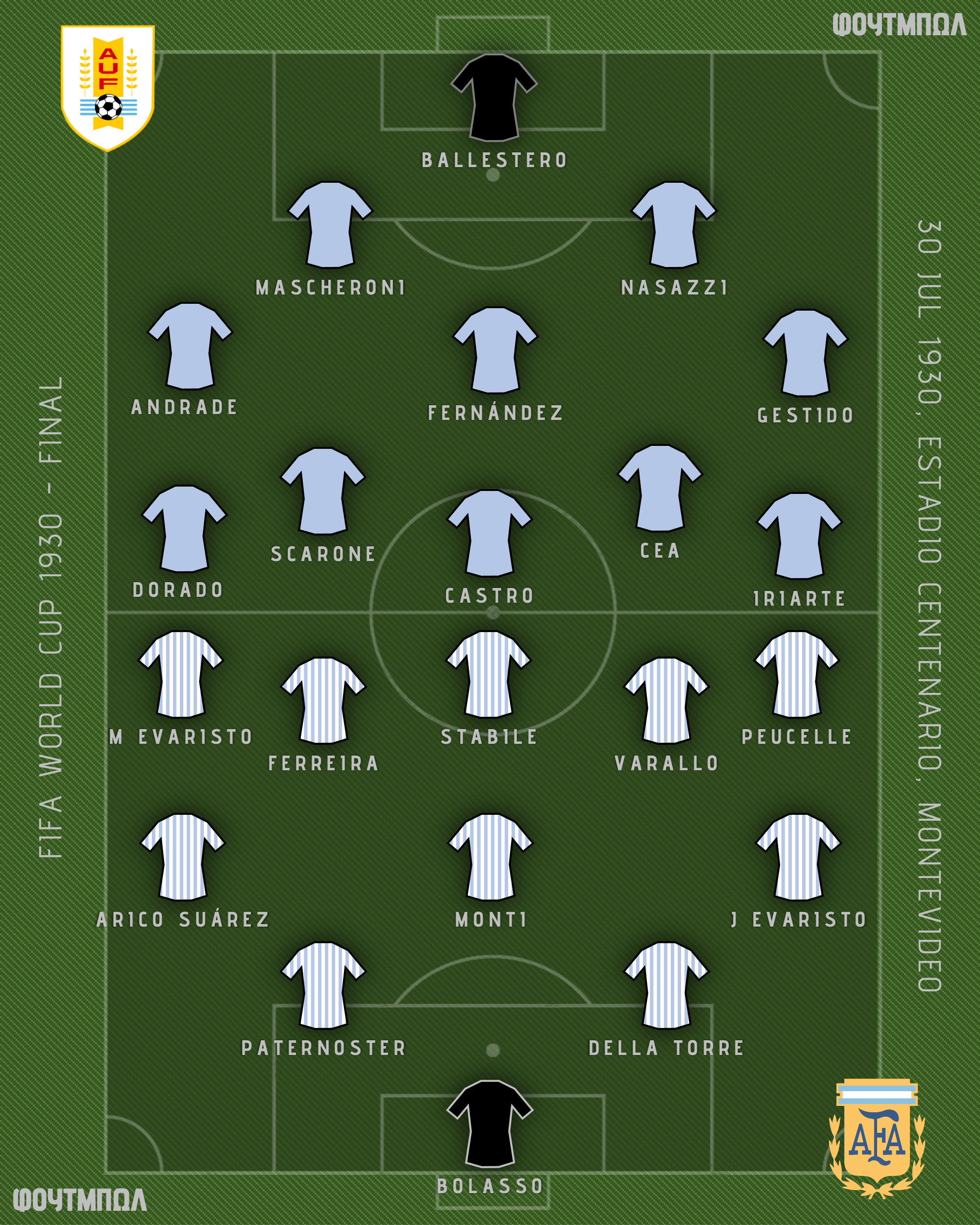
Tactical football had triumphed over the football of the charge. El toque — the delicate touch on the ball, likened to the stroke of a guitar string in tango — had prevailed over the brute-force strike of a chaotic, almost warlike approach to the game.
Indeed, the real war now seemed to unfold off the pitch. At the Estadio Centenario, 70,000 spectators filled the stands, while Belgian referee John Langenus requested a life insurance policy before agreeing to officiate the final. The tension was such that even the match ball became a matter of negotiation: the two teams agreed to use their own balls in each half. The first half was played with Argentina’s ball, the second with Uruguay’s.
In the first 45 minutes, Argentina led 2–1, with goals from Peucelle and Stábile, cancelling out an early strike by Dorado. But in the second half — with the hosts’ own ball — Uruguay mounted a comeback. Goals from Cea, Iriarte, and the one-armed Castro sealed a 4–2 victory.
Uruguay celebrated at home, in their brand-new stadium, an immense and historic success. But the most important outcome of that final wasn’t who lifted the trophy. It was that both the winners and the runners-up had together defeated not just their opponents, but an entire footballing past.
That final at the Centenario marked the closing of an era. The old British game — built on power, directness, and militaristic order — was placed firmly in football’s historical archive. In its place emerged a new language of the sport, born from the streets of Montevideo and Buenos Aires, where tango met tactics, and football became art.

In the World Cups that followed, Argentina and Uruguay may not have always won — but many Argentinians certainly did, with four players who had featured for the albiceleste in the 1930 final going on to play for the Squadra Azzurra, including Luis Monti, who appeared in the 1934 final.
Uruguay lifted the trophy once more in 1950, in the other all–Latin American final in World Cup history, and has since remained a “sleeping giant.” Argentina has won it three times: once through Menotti’s revival of La Nuestra, once through Maradona’s tango, and once through the redemption of the Scaloneta — a modern European-style football that met the talent of Messi and his heirs.
As for England, they almost never won — aside from that controversial Hurst goal at Wembley. That was the fate carved out for football by that defining decade, and its family photograph will forever be the 1930 final.
