
There are some days that feel ordinary, unremarkable, forgettable—just like so many others that never leave a trace. As the hours pass, nothing seems to shift. But sometimes, on such a day, something happens—something no prediction could contain—and suddenly, everything before and after that moment takes on new meaning. Every instant, every breath feels charged with a different weight, because the event wraps itself around everything that led you there.
Such a day was October 10th, 2024, in London…
That Thursday felt like so many other dull London Thursdays. It might have still been early October, but the temperature barely crept above 11 or 12 degrees, the sky was grey, and that annoying drizzle was falling—the kind that’s not quite rain but also doesn’t let you be. London has a meteorological superpower: without ever producing extreme weather, it forces you to think about the weather all the time. Perhaps it offers more meteorological monotony than a human being can reasonably withstand.
After a few tough days of pressure and sleepless nights—with what seemed like half the city’s 9 million residents coughing, sneezing, and grotesquely sniffing in the streets and, most of all, in the Underground—I went to work with my mind on the evening “obligation.” At 4 p.m., the grey routine would end, and I’d have to rush off for that “commitment” I had penciled in—though it wasn’t an obligation at all. It was just one more exhausting run through one more exhausting day.
The Underground was at its limit. Every train car was bursting with people. Even if the next train was two minutes away, you didn’t risk waiting. The platforms were so crowded you had to hold your ground at the edge while people shoved—some pushing right, some left, some diving in ahead of you beyond the yellow line. Chaos. I found that tiny spot next to the door—where the ceiling starts to slope down around 1.60 meters, just low enough to remind you this wasn’t made for people of average height—and just stood there. Waiting to arrive. No thoughts. Dead time.
At 4, I took the Piccadilly line back home. I had to drop off my backpack, since Wembley doesn’t allow them, but I couldn’t go to work without my laptop. At 4:17 I was at Russell Square. By 4:47, I was at Earl’s Court. By 5:22, I was back at Earl’s Court—no backpack this time—carrying nothing but a plan and a purpose: my first visit to Wembley.
I took the District line to Westminster, then switched to the Jubilee heading toward Wembley Park. Naturally, on a day like this, the most convenient line—coming down from the north with a transfer at Baker Street—wasn’t running. Of course, when 100,000 people need to get to one place, that’s exactly when you schedule maintenance and cut service. That’s everyday life for ordinary people living and working in London. Everyone else is here as a hobby—and there are many of them, too.
Inside that Jubilee line train, every story I’ve ever read about stadium disasters flashed through my mind—stampedes, suffocating crushes of human bodies. People pressed against the same poorly designed doors originally meant for tunnels from the century before last. The stops were many. No one got off. When they did, twice as many got on. Everyone was headed to the same place. That entire train car was just a fraction of the capacity of Britain’s largest stadium, which was already known to be sold out.
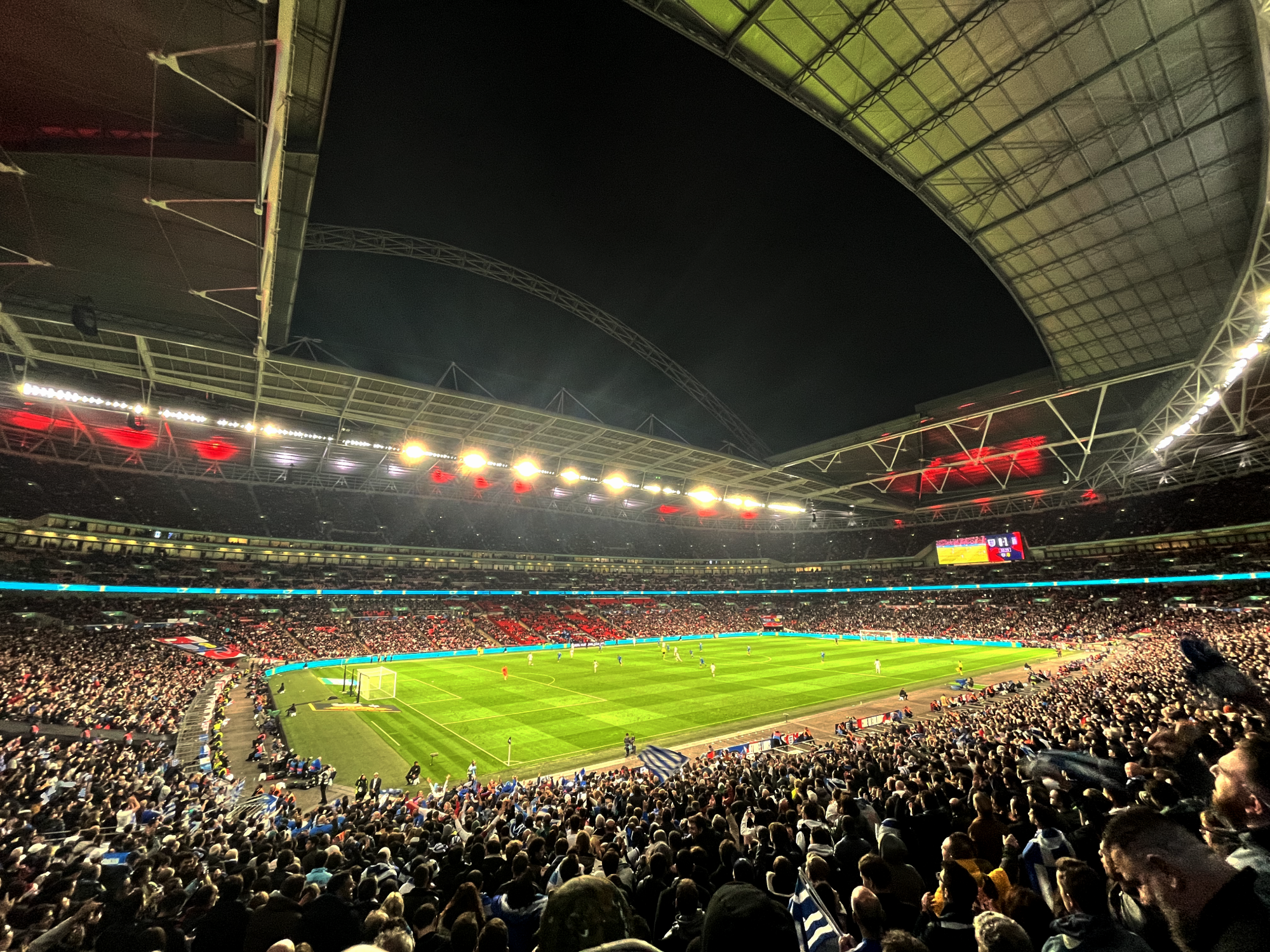
At 6:12, finally—air. Breath. From 40 degrees inside the carriage to the “fresh” air outside. And that’s when the sights began. Exiting the prehistoric tube station, just a few steps away, the ultra-modern structure came into view—its perimeter fencing, its clean lines, all built to replace in 2009 what was perhaps the most legendary stadium the planet has ever known. The twin towers may be gone, but that new metallic “rainbow” arch leaves no doubt: this is Wembley.

The pedestrian walkway that connects the stadium’s north stand with Wembley Park station turns into the biggest human avenue every time the venue opens its gates. But I had to rush—I wasn’t heading to the north entrance. I needed to reach the southwest side, the red zone, where everyone holding a ticket for the away stand was to gather—those with Greek passports.
My ticket clearly stated: strict entry between 6:45 and 7:15 p.m., with kickoff at 7:45. I didn’t want anything to go wrong.
By 6:30, I had made it to Gate N, in the red zone. Things were different now—you could hear far more Greek around you, even more than the loud Greek voices from the main “avenue,” where many had stopped to pose with their flags, scarves, or banners in front of the legendary stadium. Outside the entrance, I met up with the others I had arranged to go with. They’d arrived earlier and were passing the time in one of the countless pubs scattered around the ground. “We’re at White Horse—come here.” But I wasn’t going anywhere. All I wanted was to get inside.
Moments like these always make me anxious—I’m convinced something is going to go wrong. I pull out my phone to open the ticket file—no signal. It won’t load from the cloud. Eventually, I found it saved elsewhere—I’d backed it up in three different places, just in case. Then I started worrying about whether it would scan correctly at the turnstile. I checked again to make sure I had my passport in my pocket in case they asked (no one did). I approached the gate—no queue. A guy in a purple UEFA vest explained the process to me in Greek (in case I’d never been to a stadium before). I scanned the barcode. The light turned green. The turnstile spun—I was in!
Despite my (admittedly unnecessary) anxiety, I always try to arrive early at the stadium. I like to wander, to feel the atmosphere slowly build. For a 2-hour match, I usually spend a total of 5 hours. I know, someone might say it’s not worth it. And at Wembley, I would have spent even more time outside if I’d had a better sense of distances and logistics—but I’d never been in a stadium that holds 90,000 people. I remembered the chaos around Stade de France (with its 80,000 capacity) and didn’t want to miss even a second of the “ritual” this time.
Because I don’t just care about what happens around the stadium—I care deeply about what happens inside it. I like entering when it’s empty—and leaving when it’s emptied out. I want to see the goalkeepers come out to warm up, to watch every drill they go through in their gradual prep, all the way up to their full diving saves. I like walking around the stands—seeing the view from different angles, as much as the stadium layout and my ticket allow.
And at Wembley, all this meant even more. As kids, we grow up hearing about two mythical stadiums: Wembley and the Maracanã. One day I hope to visit the Maracanã too—and I’ll probably spend even more time on the build-up there.
Every time I walk into a stadium, my mind replays the moments I’ve seen there on TV. When I first entered Stade de France in 2011, I stared at the goal where Zidane scored twice in that July 12th final. At Mestalla, I was flooded with teenage memories of Champions League nights, watching that incredible 90s Valencia side.
The best years of Liverpool—the ones I’ve personally lived—are still too recent to carry that kind of nostalgic power. As for Toumba, it has always been something familiar, something close. What impressed me most about Toumba wasn’t just the atmosphere—it was knowing I could be an ocean away and still spot the same seats I had learned to recognize as “home.”
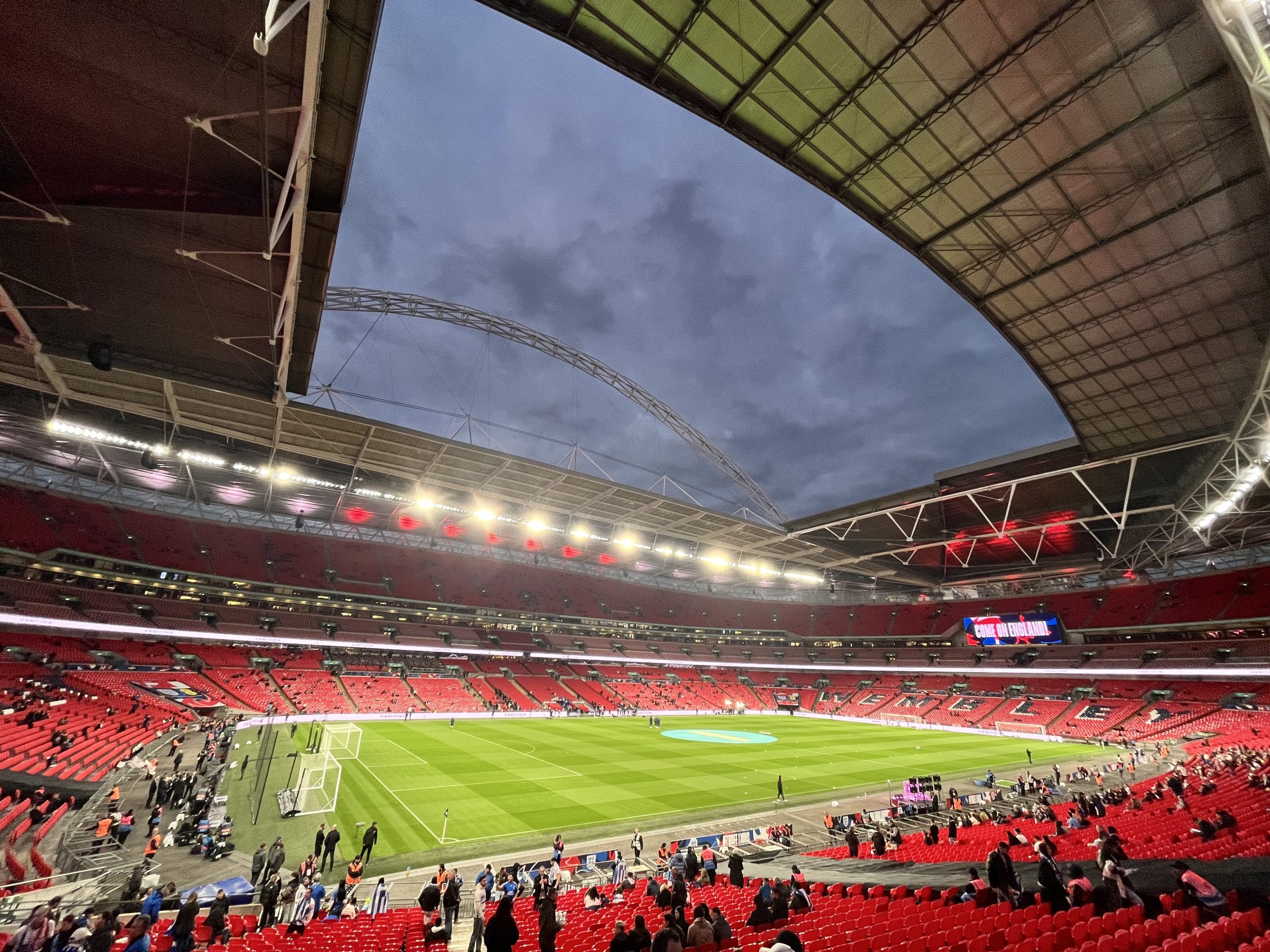
At Wembley, though, I couldn’t quite picture Hurst’s goal, or Neeskens’ surges in the 1971 final. There were only a few recent images I could truly conjure—because the old, legendary stadium simply wasn’t there anymore. But that didn’t matter. The new Wembley is a marvel of architecture. A stadium of monumental proportions that, especially from the lower tier, feels… just normal. From every angle, you have a perfect view of the pitch. You feel close to the action.
Above you, the massive roof and the great semi-circular metal arch give a sense of vertical depth. The stands disappear into the upper levels, where the people packed in look like tiny dots, and the seats on the far side—spelling out the name of the stadium—appear like literal pixels.
Wembley is the definition of the modern stadium. It may not offer the charm or romance of the old, classic British grounds (see my previous piece from QPR’s Loftus Road), but it captures the character of our era. You can sit there for hours, doing nothing but staring at it in awe.
As I sat in my seat, soaking it all in—determined not to move for anyone—a very familiar space began to take shape around me. A miniature Greece was forming in that southwestern corner of the stadium. There’s nothing romantic about this: it had everything—both the good and, inevitably, all the flaws of the society we know. Which, of course, means it was authentic, representative.
The machismo, the bravado, the café-style one-liners—all right there alongside the shared truth: that everyone in that stand bore the same identity, even if they hadn’t chosen it. It was the identity that placed us all there, side by side, ready to be represented—equally—by the same eleven players on the grass just a few minutes later.
This heterogenous mixture of collective fandom is something unique to football—and it doesn’t only happen in national team games.
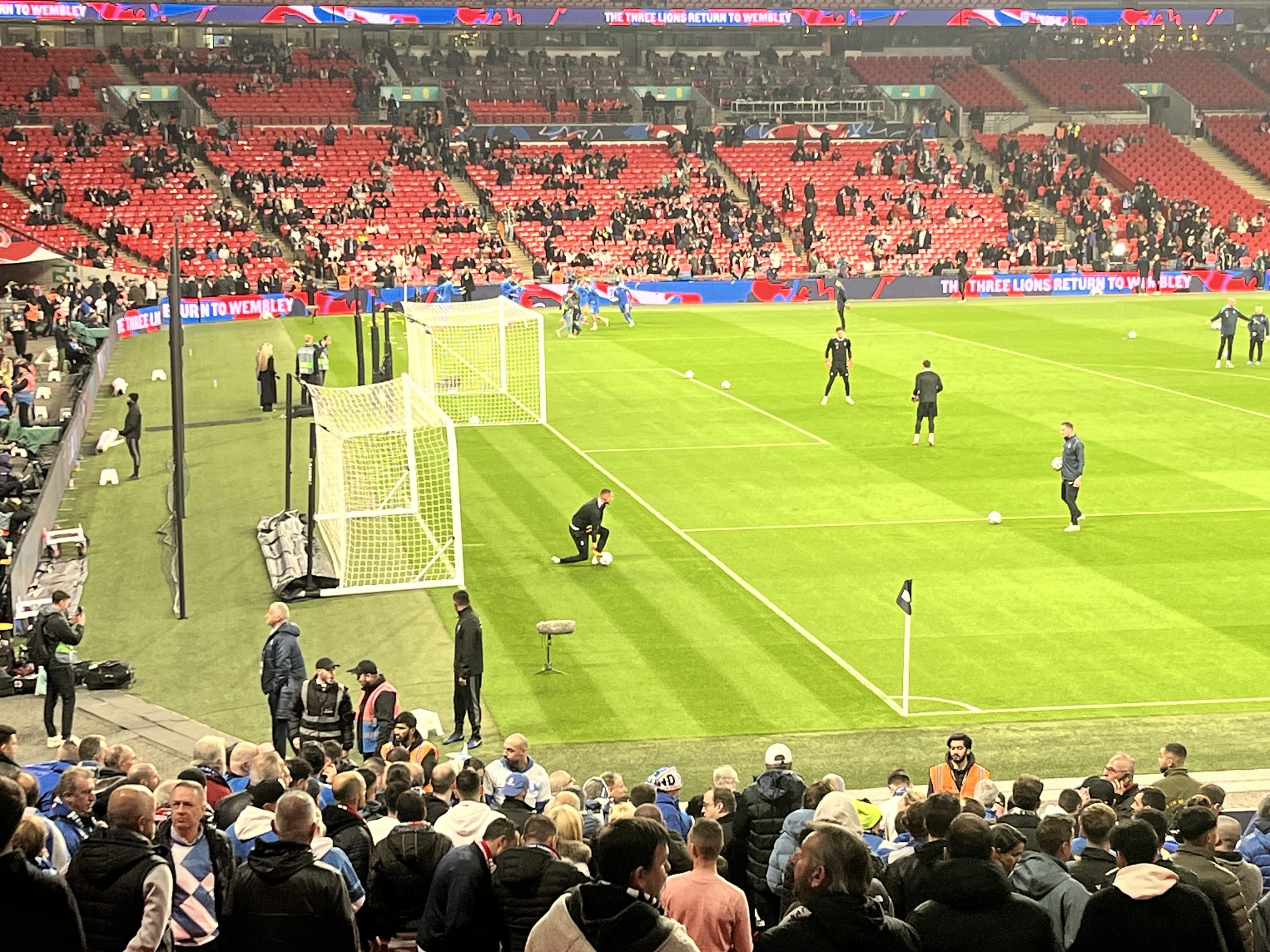
Around ten to seven, the three Greek goalkeepers came out first to warm up. Their routine was so relaxed, I started wondering if they were taking the match seriously at all. I’ve watched goalkeepers warm up at nearly every match I’ve attended—and I dare say I had never seen keepers look more tired during a warm-up. Their spirits seemed high, yes, but it was clear that whatever had happened the day before had taken a toll.
I knew they hadn’t slept well. They weren’t feeling well. They couldn’t approach the match with full composure. Maybe that was affecting my own judgment too, but from what I saw, the intensity just wasn’t there. Still, I tried to convince myself: “They’re saving the fire for the match.” An unfounded hope—but a hope nonetheless.
At 7 p.m. sharp, the pre-game show kicked off. A DJ took over the task of filling the vast stadium with sound, as fans gradually filtered through the turnstiles. And then, at exactly 7:22, I felt it: the fatal mistake for the English.
The DJ decided to play “The Final Countdown”—that 1986 synth anthem by Europe. And suddenly, you could smell the tyrinini in the air. You know, that electricity—the atmosphere crackling, the kind of charged tension that football always carries in its metaphysical dimension. At that moment, something shifted in me. I began to get that strange feeling… that maybe something special was about to happen.
That perhaps, the memory of this night wouldn’t just rest on the phrase “I saw the Greek national team at Wembley.”
That’s when the rest of the group arrived. “Hey, we’re out at the bar.” I went to meet them—they were thinking about grabbing something to eat. I’d already wolfed down a quick bite at home, knowing full well I had other business to attend to here. I found them—“Hey, Vlachodimos is warming up, I’m heading in. Catch you later in the stands.”—and made my way back to my seat.
The stadium had begun to fill. The sold out that every outlet had reported still seemed hard to believe at first—but the upper tier (the third ring) was filling faster than the rest. The Greek section too. Some had flown in from Greece, others came from nearby countries, from cities around England, or just different parts of London.
Supporters of Greek-heritage clubs were proudly wearing their shirts—Apollon Smyrnis, Anorthosis Famagusta, PAS Giannina… and a few others. I showed up in civilian clothes—my PAOK jersey is reserved for the matches I actually playin here in London (goalkeeper privilege: we get to wear whatever colours we want). The flags started taking their places, too. Among them: one Scottish flag… and one—yes—PASOK flag.
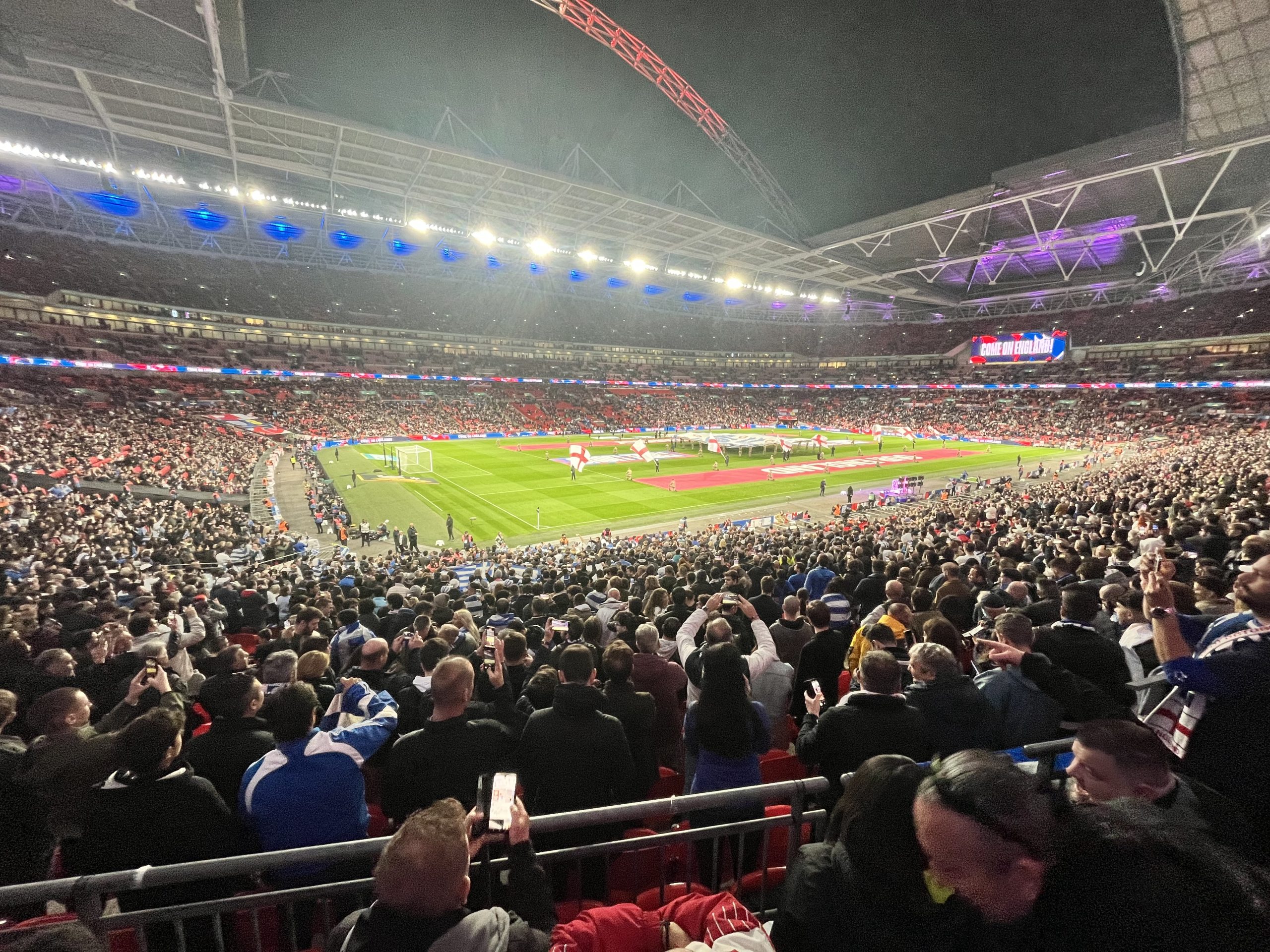
At some point, we were ready. The ritual could begin. We were about to watch the Greek national team at Wembley—and that, in itself, was enough. But this night wasn’t just about ticking off a footballing bucket list. We were there on a night when these players—our players—needed people around them. They were under immense shock from everything that had unfolded in the days prior. They needed presence, not just applause. And there we were—about 5,000 of us—a whole Greek village tucked into a corner of the world’s most iconic stadium.
A proper Greek village, no exaggeration. Football jerseys and flags everywhere, yes—but also workers, students, the well-off, aunties in trench coats with handbags, everyone. Everyone. I don’t know what the other 80,000 seats felt like. I can’t speak for the rest of Wembley that night. But that one corner—that southwestern pocket— That was ours. That was home.
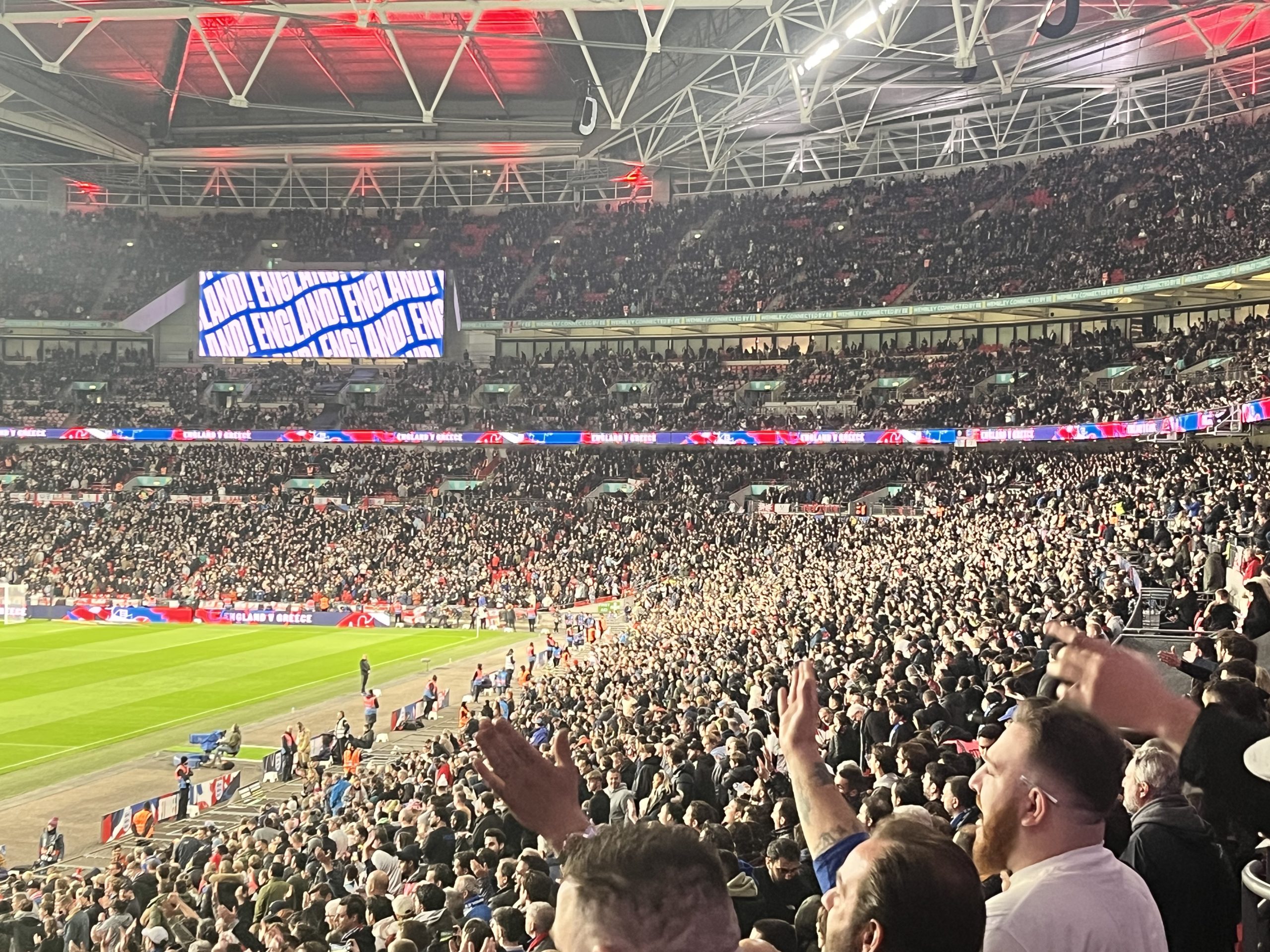
As the teams walked onto the pitch, the ceremony of the national anthems began. And that’s when I confirmed a long-held suspicion of mine: we might just be the most atonal people on the planet. (Alright, that’s an exaggeration—but come on, we’re terrible at this.)
What I forgot to mention earlier is that this wasn’t just my first time at Wembley—it was also the first time I ever watched the Greek national team live. And given this “first,” I wasn’t quite sure if what I always noticed on TV was just a broadcast issue… or if it really did happen in real life.
But let me tell you—it’s real.
If you go back and find videos from Portugal 2004, you’ll see it clearly: we don’t know how to sing our national anthem. Or at least, we don’t know how to sing it in time with the music. For some mysterious reason, the Greek crowd doesn’t sing the anthem—they shout it. And they do so slightly… faster than the music.
The sound system at Wembley was crystal clear. That didn’t stop the anthem from drifting awkwardly out of sync—verses surging ahead or falling behind—like two trains trying to run on the same track, but one keeps skipping stations.
That was the final moment of the evening that wasn’t about football. Because what followed was football—at its most human and most vulnerable. The minute’s silence for George Baldock. And yes, that silence was football—because it was about the players, about their lives. The lives shaped by a system that presents them as invincible stars, glossy and immune to pain—while in reality, it sometimes produces the most tragic of stories. Stories so raw and uncontainable, that no matter what words you try to dress them with, they all end up sounding inadequate. Clumsy. Almost laughable in the face of real grief. Some people did, unfortunately, manage to be even more ridiculous than those clumsy words— Not at Wembley, thankfully. But in a television studio.
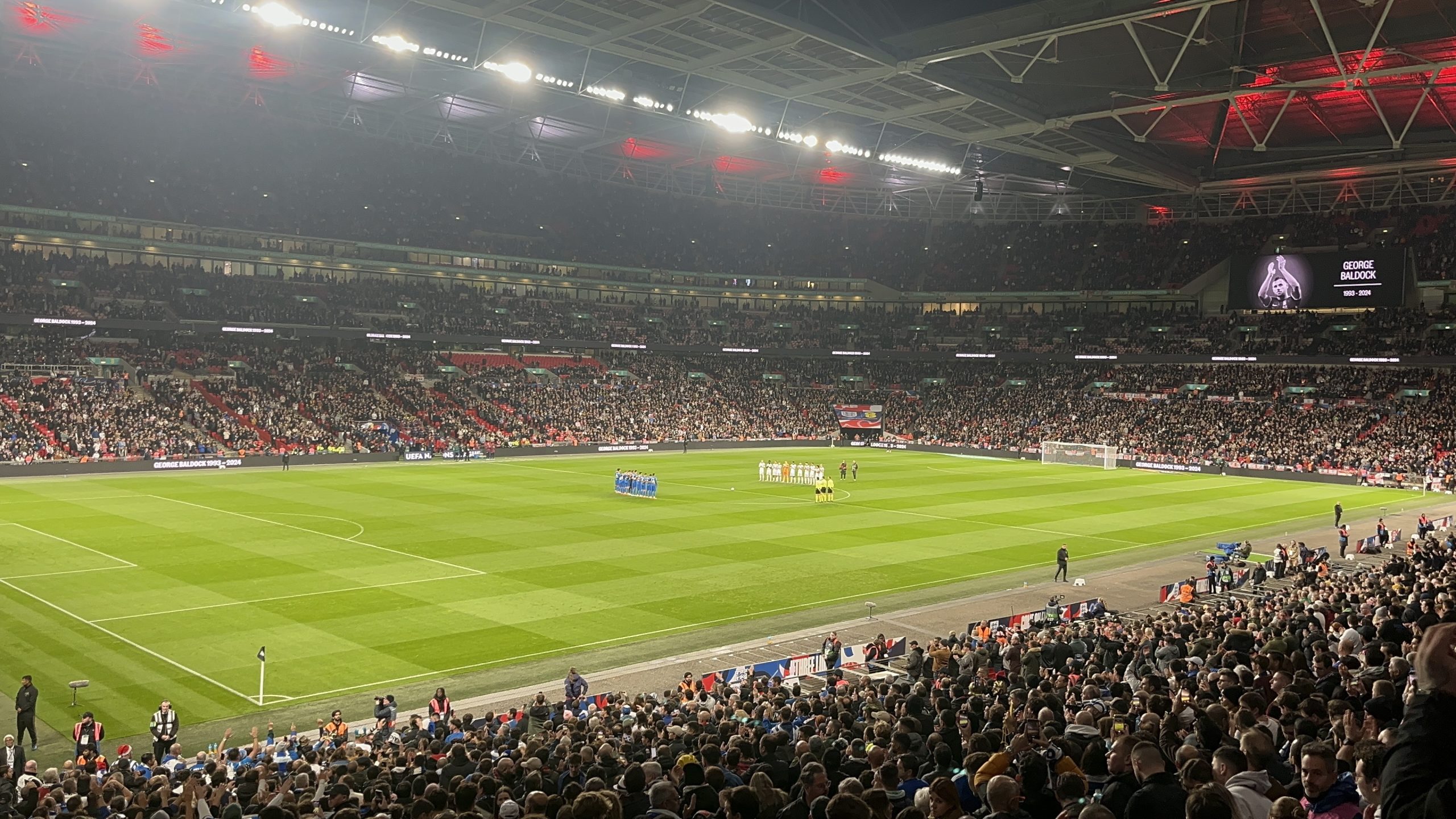
And the match begins, and we’re waiting to see what will happen, how the Greek team will hold up in there, a team which, over the last decade—despite its recent positive steps—hasn’t exactly gotten us used to great performances and emotional moments.
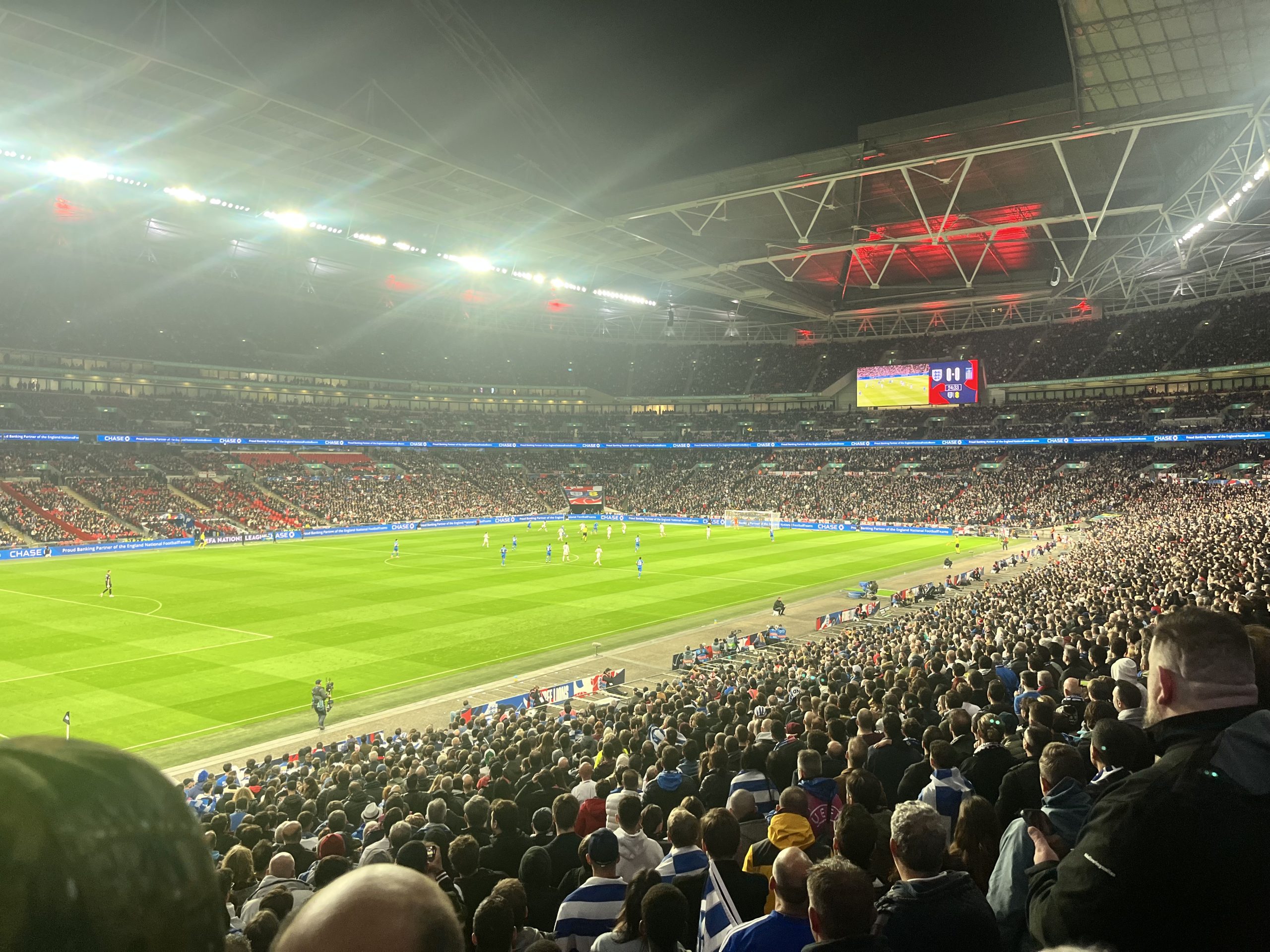
Bellingham enters with confidence, looking to take control of the match on his own. One dribble, two, down the left side as England attacks, on the edge of the box, a nice shot—big save by Vlachodimos. A good warm-up! 2–3 minutes later, Koulierakis chops him down, gets a yellow card, but also takes away the swagger of the opposition’s star, who now realizes he’ll need to dig deep to get through this defense.
The English may be pressing from early on, the crowd calling out ‘just clear it already!’, but the defense starts the buildup from the very first metre of the pitch. Rota wins the ball, dribbles, passes inside to Mavropanos, he to Vlachodimos, he to Koulierakis, just five metres from the goal line—and the plan doesn’t break down, even with England pressing. That’s when we realized the national team came to Wembley to play football. We were already satisfied, because the team came to play—even if we were going to lose by however much. Respect football, and it will respect you.
But the national team wasn’t just doing buildup—they showed they were much more dangerous than their opponents. Defensively, they shut the doors, and when those didn’t close perfectly, they committed the necessary fouls to avoid danger. But they also had transition—amazing transition—with Tzolis on a phenomenal day and Pavlidis playing like Superman. The attacking midfield line looked like the best national teams we’ve seen on the pitch—dangerous every time they crossed midfield. That’s how we nearly celebrated the first goal, when we saw the ball cleared off the line. Of course, from where we were, we couldn’t see the line—we just didn’t see the net ripple. A few minutes later, though, we celebrated the first offside of the night—if only we knew how many more were to come!
Between the 25th and 30th minute (in the stands you lose sense of time a bit), the pressure started—a toothless pressure, but with possession for England that didn’t exactly make us feel comfortable. That’s when the crowd showed it knows its football. Sure, some were calling for long balls and clearances, but the cheers and applause were far louder when we kept the ball and began each buildup rationally, even if it ended quickly. Thankfully, halftime came—we had time to reset things properly. The Greek national team was playing better football than England. It was a proper team, playing with a proper system, up against a bizarre 4-6-0 from the English, which became a 4-2-4, or a 4-4-2, or even a 4-2-2-2 depending on how you looked at it. The one certainty was they had no attacking focal point—the center forward the Italians quite rightly call the ‘punta’.
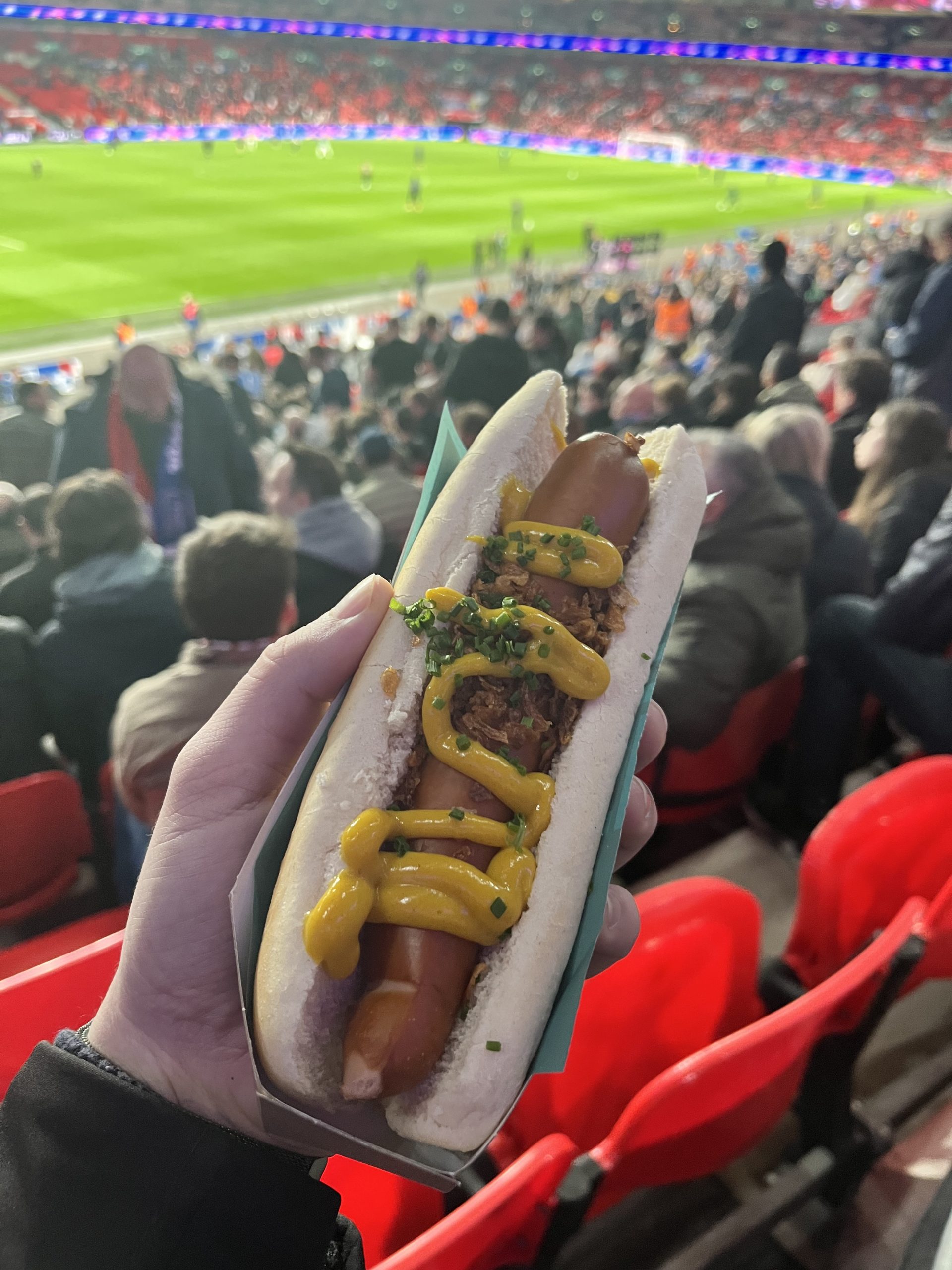
At halftime, it was time for another ritual: the stadium hot dog. One of the best I’ve had at English grounds—a sandwich with sausage and mustard, for £8.85, which is just over 10 euros. The commodification of the masses’ love becomes a burden on their wallets. But that was enough—I was waiting to see this very interesting game unfold, which had a balance very different from what we’d expected before kick-off.
The second half began and half the stadium was empty—people were still drinking their beers (which are banned in the stands) and queuing for the toilets. England made an attempt to raise the tempo, came out with energy playing the ball out wide (one of the few times in the match), but they couldn’t get near the box—not even with a formal request.
And then, in the 48th minute, with the Greek stand almost full and the rest of the stadium still asleep, Koulierakis made a move unusual for a centre-back in front of the English penalty area, found Pavlidis, and he—as if he were playing on the neighborhood pitch—slipped between three English players and shot under pressure from two more, sending the ball into Pickford’s net. This time it wasn’t offside—it was real—we were inside Wembley and we were ahead on the scoreboard! It felt like a lie!
My group didn’t see the goal—they were all trapped between beers and toilet lines. Luckily, I had a feeling and managed to record it on video, a clip I’ll keep as a memory for life: a goal just as I saw it with my own eyes, as I lived it from where I stood—giving meaning to that strange habit of the digital age. In another similar habit, since the match still had a long way to go, we also took a few photos of the scoreboard with that unexpected scoreline, just to remember that we really did witness it.
And then came another goal—but (the incredible) Tzolis had delayed the pass just a bit, and Pavlidis was offside. And then came yet another goal, one we celebrated more wildly than anything else—it was now a fact: Greece was doing whatever it wanted inside Wembley. On the pitch, eleven players were scoring one goal after another against the hosts, and in the stands, 5,000 people on their feet—who hadn’t even sat down during halftime—were utterly outclassing the other 80,000. It was the difference between supporters and fans, as the opponent’s language so aptly distinguishes. The only thing stopping us all was the VAR, which—though correct, as all the videos show—at that moment felt like it was depriving us of a one-of-a-kind dream.
The game was going amazingly well for Greece—but that didn’t mean it wasn’t a tightly contested match. A mistake could happen at any moment. Luckily, England were so poor that they couldn’t create chances even where they might have. On the other hand, Greece’s defensive performance was so solid that it made up even for the occasional error. That changed in the 87th minute, when there was a major lapse, allowing the ball to fall to Bellingham, and even though he was still outside the box (as we said, they rarely stepped into the area), he fired a shot that Vlachodimos couldn’t fully stop. That was the only moment we heard that unique sound effect of tens of thousands of people shouting “goal”—something that seems to have a much higher frequency than regular human speech. It sounded more like a crack of thunder than a cheer.
That’s when reality hit us. OK, maybe it was too good to be true. Maybe it would have been greedy to want to beat England—a team we’ve never beaten—at Wembley, a stadium where we had never even scored until about 40 minutes earlier. And that’s when football reality starts slapping realism across the face.
As the game entered stoppage time, all we could think was that we couldn’t possibly walk away from this with a loss. The light-heartedness had turned to anxiety and nerves. The English fans had started to leave by the 80th minute, and more so by the 85th, keeping to their habit of emptying stadiums early for no reason—perhaps trying to imitate those Americans who’d leave 2 seconds before the finish of Carl Lewis’ 10-second sprint. But our 5,000-strong corner was still there—that’s another hallmark of the away crowd: they’re always there, on a mission, regardless of the circumstances.
We counted the minutes as if each was a breath we had to survive. Phones were back in pockets, and everyone was staring at the pitch or at each other—tense, no one still, no one frozen. That was the moment when nerves surpass anxiety, and a held breath turns into full-body motion, as if somehow moving would make time pass faster. And then, around 9:41 p.m., came the unexpected, the unbelievable, the totally real.
Three Greek players were in England’s box, surrounded by more defenders and one tragic goalkeeper. It was as if the three of them had made a silent, spontaneous vow not to leave that penalty area unless they made it count. Konstantelias and Pelkas pressured the English defense, with the latter artfully diving in to lay the ball off to Pavlidis, who—on what was perhaps the best night of his career—slipped the ball between defenders’ legs and buried it in the back of England’s net. Pandemonium. That’s when everyone’s passion exploded.
First, the anger of the English fans from the upper tier, who started throwing every plastic bottle and (drinkable) liquid they had into our section, with the stadium security’s characteristic inertia (!) doing nothing to stop them. But above all, it was our own passions that exploded—all of us who’ve lived in this country as outsiders, fighting our own personal battles to become part of a strange and stubbornly closed metropolitan society. An outburst of emotion—some tears, of joy and of rage—revenge against daily life, the release of a long-held pressure, the kind that doesn’t come from a football match but from being an outsider in society itself. Each of us turned to the opposite stand to first release our own personal burdens—and then, in a secondary way, the footballing, supporter-related ones. And even though each of us was a separate story, we all shared a piece of history that we were living together in that moment.
The night we experienced at Wembley—all of us, in that corner of the legendary stadium—was a moment for a lifetime. Even if we were in the away end of this temple of football, playing against the strongest of opponents, fully aware of the emotional burden carried by our team. Some of us—perhaps many of us—found a sense of representation facing a team from a place that treats us as second-class citizens, with limited rights and the constant need to prove, day in and day out, that we simply deserve to exist.
That’s why sports—especially mass sports like football—carry such a metaphysical weight: because for two hours, we played a home game from the away end. A little later, we returned by Tube to places far from what we feel is our “home ground,” but at least we had lived that illusion with our eyes wide open. Because in football, the fate of the immigrant can also include some radiant moments—perhaps even a few experiences of luxury.
