
Football is, at its core, an athletic phenomenon, but by extension, also a social one. This dual nature often makes it difficult—or even ethically ambiguous—for its audience and for History itself to respond to its outcomes and protagonists. There are teams that do not enjoy popular sympathy because they have cannibalized football at a national or continental level, yet they play thrilling, high-aesthetic football. There are footballers no one would wish to have as a friend, yet they are artists of the highest order within the four lines that define the pitch. And there are, finally, historic victories where one struggles to know whether to rejoice for their protagonists—the players, the coaches, even the people they represent—or to mourn the fact that these victories are ultimately reaped by external forces.
In today’s global political climate, given the ravenous clash between two imperialist worlds, one figure whose ramifications might make many question the extent to which their impact on world football should be admired is that of Oleg Blokhin. Unfortunately, the frequent urge to link footballing sympathy with a temporary or even lasting ideological alignment tends to obscure the recognition of a player’s influence and the context in which their talent was expressed. For this reason, I will attempt throughout this text to unfold his footballing and personal story in a way that aligns with the realities of each era—not through the fleeting interpretations of History as it is often presented in the press or opinion columns.
Blokhin was perhaps the greatest footballing jewel of the Soviet Union, his name deeply connected to the national team of that country. He is also one of the most prominent figures in Ukrainian football—not so much as an active player, but as a coach and, even more so, as a legendary star. The fact that Blokhin’s two countries are now bound up with a third—Russia, with whom Ukraine is currently at war—cannot be ignored, but it must be placed in its proper context, so that the past may be rightly interpreted and historical influence analyzed within a broader historical scope. After all, this introduction sets the necessary tone of the times.
Blokhin’s own story is not disconnected from the particular history of Russia. A few months before the official formation of the Union of Soviet Socialist Republics on December 30th, 1922, Vladimir Ivanovich Blokhin was born in Moscow—in Soviet Russia. Vladimir studied chemistry in Kharkiv, which belonged to the Soviet Republic of Ukraine (and which, at the time of writing, is Ukrainian territory under Russian occupation). Upon graduating, he was conscripted and served in the republics of Kyrgyzstan and Uzbekistan. During the Great Patriotic War, however, Vladimir—then in the prime of his youth—became one of the Heroes to whom humanity owes its victory against the monster of fascism, as he fought in the Siege of Leningrad, and survived it!
His post-war path led him to Kyiv, where he took command of the 81st Reserve Battalion. At that time, the Soviet Army was the institution through which Soviet athletics were essentially maintained, supported, and administered. As such, Vladimir found himself, among other responsibilities, overseeing athletic activities—a role that eventually led him to the presidency of the Modern Pentathlon Federation.
This relationship with sport is of enormous significance in our story, for through this involvement Vladimir met, in 1950, Kateryna Zakharivna Adamenko, who was the Soviet Union’s champion in pentathlon, long jump, the 80-meter sprint, and the 100-meter hurdles. Adamenko was one of the greatest figures in Soviet athletics, achieving no fewer than 87 national records over the course of her remarkable career. In 1952, Vladimir Blokhin and Adamenko gave birth to their son, Oleg, on November 5th.
Because of his parents, Oleg essentially grew up within the Dynamo Kyiv system—a massive athletic institution that also offered its athletes and staff benefits such as access to basic education for their children. Growing up in this environment—and with the motivation and guidance of his parents—Oleg displayed astonishing athletic prowess. From an early age, his favorite sport was football, although he clearly had the potential to excel in others as well. Notably, at the age of 16, he clocked a time of 11 seconds in the 100-meter dash—a time that corresponded to championship-level performance in the discipline. Blokhin, however, chose to apply his superb physical attributes by tirelessly refining his football technique in order to stand out in the sport he loved.
At that time, in the mid-1960s, the head coach of Dynamo’s first team was Viktor Maslov, who is considered the “father” of the 4-4-2 formation and of high pressing on the field—innovations that laid the foundation for sweeping tactical evolution in European football over the coming decades. The forward-thinking Maslov never hesitated to make bold decisions, and this was likely a crucial factor in Oleg making his debut for the first team just days after his 17th birthday, on November 25th, 1969. In the match held at Lokomotiv Tbilisi’s ground, Blokhin started in the starting eleven.
That first season, Blokhin played in one more match for the Soviet Cup. His regular presence in Dynamo’s starting eleven—and therefore in the national championship—began in earnest in 1972.
Having already represented the Soviet Union in all its youth national teams, the first major international tournament in which he participated was the 1972 Olympic Games in Munich, where the Soviet Union won the bronze medal, along with East Germany. In that debut tournament, Blokhin scored six goals.
In the season that followed, Blokhin began to unfold his talent, making 27 appearances in 1972 and 29 in 1973. In just his second full season as a starting player, his accomplishments were such that he won the award for best footballer in the Soviet Union. But this was only the beginning of what was to come.

The arrival of Valeriy Lobanovskyi at Dynamo would propel the club’s success, as well as that of Blokhin personally. Lobanovskyi, who understood football as a chaotic system capable of being analyzed mathematically—so long as the individual performance of each player was quantitatively accounted for—strengthened Dynamo’s Scientific Institute, ushering in a revolution on which much of modern football analytics would later be built. Blokhin thus became the best player on a team that had the unique privilege of being the first to apply modern methods that would slowly trickle into the global game.
Playing as a second striker due to his ability to dismantle opposing defenses with his incredible speed, he scored using both feet and could comfortably be deployed as a central forward or a playmaker. Nevertheless, it was his surging runs—usually down the left wing—that made history and defined his unique personal style.
That Dynamo side, already in tremendous form since the days of Maslov, kept improving, showing signs that there may not have been any limit to what it could achieve. In 1972 and 1973, with Blokhin as top scorer, Dynamo finished in second place, while in 1974 and 1975, they won the championship—with Blokhin once again leading the scoring charts.
In 1974, Dynamo also won the Cup, overcoming Zorya Voroshilovgrad with a 3-0 win in extra time, earning a place in the 1974–75 Cup Winners’ Cup. It was in that European competition that the characteristics of Lobanovskyi’s team would fully emerge—and Blokhin would become widely known in the West, which rarely followed the leagues of Socialist countries, particularly at a time when access to international televised football content was difficult.
In the first round, Dynamo faced CSKA Sofia, advancing with two wins, both 1-0. In the second round, however, things got much tougher as they faced the West German Cup winners, Eintracht Frankfurt. Dynamo won at the Waldstadion 2-3, coming from behind, with Blokhin scoring the team’s second goal. In Kyiv, another victory—2-1 this time—secured a place in the quarter-finals. There, Dynamo met Bursaspor, who they also beat twice: 0-1 away and 2-0 at home.
The crowning moment for that Dynamo team, however, came on April 9, 1975, in the first leg of the semi-final against Eindhoven. That season, the brilliant PSV side had won the Dutch league in one of the finest eras of Dutch football. Their squad included the van der Kerkhof brothers—René of whom had played in the 1974 World Cup final as part of a national team dominated by Ajax players that would soon be dismantled. Dynamo blew PSV away 3-0 with goals from Kolotov, Onyschenko, and Blokhin—those three forming an unstoppable attacking trio throughout the tournament. PSV won the return leg 2-1, but Dynamo advanced to the final.
The final was played on May 14 at St. Jakob Stadium in Basel. Lobanovskyi’s Dynamo put on a show, demolishing Ferencváros 3-0. Onyschenko scored the first two goals, and Blokhin the third. This was the first European title for a Soviet club, making Kyiv the de facto capital of Soviet football. It was the triumph of innovation, rooted in a system of athletic organization built on state institutions, which gave Maslov and Lobanovskyi the space to develop a completely new approach to club management, player development, and tactical planning. It was also the second consecutive title won by a club from a socialist country, following Magdeburg’s triumph the previous year on behalf of the GDR.
If the achievements in the Cup Winners’ Cup marked the zenith of Lobanovskyi’s football modernism, the European Super Cup against Bayern Munich allowed Blokhin to leave yet another towering personal mark. In the first leg at the Olympiastadion, Blokhin scored the only goal—one that would go down in history. Darting past every defender who dared to challenge him—including none other than Beckenbauer himself—he cut in from the left, entered Bayern’s box solo, and with the ball glued to his feet, finished coolly, leaving German players and fans stunned. In the return leg in Kyiv, Blokhin scored twice, sealing Dynamo’s comprehensive triumph and bringing yet another European trophy to Kyiv within a few months. In that game, he seemed like a one-man team. Bayern’s entire defensive structure (not just their backline) focused entirely on stopping him, but his dribbles left one German player after another on the turf. Blokhin could take on any defense—even that of the European Champions.
Amidst that triumph, Blokhin was the undisputed lead—“the king,” as he would later be proclaimed in the tradition of his country, “the tsar” for all the other peoples who watched a blond, lightning-fast forward strike fear into the hearts of Europe’s defenses. His unique style had the power to move anyone who had the chance to watch him on television—unfortunately, on the rare occasions that such a thing was even possible. Nevertheless, that year, Blokhin would go on to win the greatest accolade that could be awarded to a European footballer: the Ballon d’Or, which at the time was still awarded exclusively to European players by the French magazine France Football.

After the 1975 league title, Lobanovskiy also took charge of the USSR national team. However, the performance of the champions did not continue at the same level. The same drop was reflected in Blokhin’s personal statistics. Nevertheless, in 1976, the participation of the two in the Olympic Games earned a bronze medal, as the Soviet Union won the third-place match in Montreal against Brazil. In that tournament, Blokhin scored only once—against North Korea.

In 1977, Dynamo won the championship once again, with Blokhin being named top scorer of the season for the last time, while two more consecutive league titles were won in 1980 and 1981. The loss of the title in 1982 led to Lobanovskiy’s departure, as he then took over—exclusively this time—the leadership of the national team. The Soviet Union, which had been excluded from the 1974 World Cup after refusing to play at Santiago’s Olympic Stadium in the playoff against Chile (as the stadium had been turned into a hellhole for Pinochet’s enemies), had also missed out on qualification for the 1978 World Cup in Argentina. Thus, the return at the World Cup in Germany marked the national team’s first participation in a major tournament after a decade. On the Spanish fields, Blokhin was unquestionably its brightest star. During the qualification campaign for the World Cup, Blokhin had scored in both games against Turkey, in the home match against Wales, and in the final game in Prague, where his goal in the 14th minute against Czechoslovakia effectively secured the Soviets the top spot in the group.
In Group 6, which was hosted in Seville and Málaga, the USSR began its duties against Brazil, in a match where Blokhin once again left behind countless highlights in the history of world football. However, his team lost, and it then needed a win against New Zealand—secured with a 3-0 score, where Blokhin scored the second goal—and a draw with Scotland. In a dramatic finale, both teams scored one goal in the final ten minutes, allowing the Soviet Union to advance to the second group stage. There, in the first match at Camp Nou, they defeated Belgium 1-0, but the 0-0 draw three days later, also at Camp Nou, against Poland, deprived them of a place in the semifinals.
That same year, Blokhin also took part in the European XI squad that faced the World XI in a match held to support UNICEF, at the Giants Stadium in New York.
In the following years, Blokhin continued at Dynamo without Lobanovskiy, who returned in 1985 to bring the team back to the top. In the 1985–86 season, Dynamo once again participated in the Cup Winners’ Cup, writing another golden chapter in its history. In the first round, they overcame Utrecht, losing 2-1 away but overturning the result with an emphatic 4-1 win in Kyiv—a match in which Blokhin equalized the score in the 10th minute. Universitatea Craiova proved to be an easier opponent: the away match ended in a 2-2 draw, and in Kyiv, a 3-0 win sent Dynamo through. In the quarterfinals, Dynamo put on a show of strength against Rapid Vienna, scoring four goals away and five at home, securing their place in the semis against the greatest team of Czechoslovakian football during the socialist years. Facing Dukla Prague, Dynamo won 3-0 in Kyiv with two goals from Blokhin, and the 1-1 draw in Prague secured their spot in the grand final.

On May 2, 1986, at the Stade de Gerland in Lyon, Lobanovskiy’s Dynamo, with Blokhin as its most crucial cog, delivered a masterclass in footballing socialist modernism. Blokhin scored the second of Dynamo’s three goals—one of the true gems in the global history of football, not for a display of individual skill this time, but for the way a team moves the ball across the field, making full use of geometric analysis of the game to achieve the goal. In this case, Blokhin was the final recipient of a breathtaking buildup that began on the left flank, but it was with a masterful finish that he completed the product of Lobanovskiy’s revolution.
A few weeks later, on the fields of Mexico, the Soviet Union had a team even better than that of 1982, ready to chase glory. Playing in Group 3 in León, they began their campaign with an astonishing 6–0 victory over Hungary, although Blokhin did not feature in that match. In the second game, against France, Blokhin came on as a substitute in the 58th minute, and the match ended in a 1–1 draw. But in the third game, Blokhin started and captained the side against Canada, even scoring in the 58th minute to open the scoring in a match the USSR won 2–0. The Soviet Union advanced from the group stage in first place to the second round, where they were to face Belgium. In a match where Blokhin again did not play, and which saw wild score fluctuations and a monumentally poor refereeing performance, the Soviet Union lost their chance to advance in extra time.
Blokhin played one more season with Dynamo, closing the chapter of his career at the club that raised him with an astonishing record of 585 appearances and 280 goals. Of these, 211 were in the league, 31 in the Cup, and 34 in European competitions (a total of 266 in official matches). With these achievements, he remains to this day the top scorer in the club’s history, and second in appearances, behind Oleksandr Shovkovskyi.

In the national team, he scored a total of 42 goals and made 112 appearances, forever standing in history as the all-time top scorer and record-holder in caps for the team of the largest country that ever existed on Earth in the 20th century.
In the summer of 1987, Blokhin transferred to Austrian side Vorwärts, where he played for two seasons, while he spent the final season of his career wearing the colors of Aris Limassol, scoring 7 goals in 28 official appearances.
Effectively, Blokhin had retired from competitive action, with his testimonial match, marking his farewell from football, taking place in Kyiv on the 28th of June, 1989. That same day, during a concert held in his honor at the Palace of Sports in the Ukrainian capital, Tamara Gverdtsiteli performed the song “Vivat, Korol!” (“Long Live the King!”), written for Blokhin by Yuri Rybchinsky and Gennady Tatarchenko. The lyrics are characteristic of the scale of Blokhin’s footballing persona and the impact he had on Ukrainians and Soviet citizens more broadly.
“Life is a theatre,” said Shakespeare
“And we are but players”
Pierced hearts that play
Stirring quarrels and elation
For your soulful game
The people crowned you
And even your enemy sometimes said
Hiding his fear, that you are the king
That you – are the king!
Long live the king, long live! Long live the king!
You knew no rest
Without cannons or soldiers – only with your game –
You conquered lands
And you conquered me, because you were true
Because you were yourself
And your love was not a game
A hollow game
Long live the king, long live! Long live the king!
You were yourself!
Long live the king, long live! Long live the king!
Long live, my love!
You shared only with me
Your pain and your sorrow
But to others you always gave
The gold of victory
You played so skillfully, you were an artist,
And now it is your final act!
You played so skillfully, you were the king
And now the role is empty
The role is empty
Farewell, king, farewell! Farewell, king!
Everyone sings for you.
What a shame: May never lasts, nor does the thunder,
The thunder of applause
Your eyes are full of sorrow
And the heart aches
And everyone grieves
Farewell, king, farewell! Today the last ball
Belongs to you!
Farewell, king, farewell! Farewell, king!
Today you part with the game!
Farewell, king, farewell! Farewell, king!
Now you are only mine!
Farewell, king, farewell! Farewell, king!
Don’t cry, my love, don’t be sad!
Farewell, king, farewell! Farewell, king!
I am not the only one saying goodbye!
In the 1990s, Blokhin would pass through a series of Greek clubs as a coach, beginning with Olympiacos and continuing with stints at PAOK (twice), Ionikos (also twice), and AEK. During the same period, still a member of the Communist Party of Ukraine—which was the continuation of the CPSU in the newly established bourgeois republic—he was elected to Parliament with the Gromada party in 1998 and 2002, before later joining the ranks of the Social Democratic Party of Ukraine. In 2003, he took over as head coach of the Ukrainian national team, leading them to their first ever participation in a World Cup. On German soil, Blokhin’s Ukraine started poorly, with a 4-0 loss to Spain, but with two wins—4-0 against Saudi Arabia and 1-0 over Tunisia—they advanced to the second round. There, after a goalless match, they overcame Switzerland in a penalty shoot-out, with the Swiss failing in all three of their attempts! The eventual World Champions Italy, however, were a much tougher opponent in the quarterfinals, and with the score ending 3-0, the Ukrainians bid farewell to the tournament after an impressive run in their debut campaign.
Blokhin returned to the national team bench in 2011, albeit without much success, while in 2012 he took over Dynamo Kyiv for two seasons. That would be his final involvement with any club or national team role. In recent years, Blokhin has occasionally appeared as a football pundit, remaining a towering figure—not just for his country. More recently, as might be expected, he appeared during the Russian invasion of Ukraine, pointedly distinguishing in a public statement between the citizens of the country and the state itself that was waging war on what had become his second homeland.
Blokhin’s stature, of course, cannot be confined to the achievements he attained on the pitch. Beyond the song commemorating his retirement from football, there exists a fan club dedicated to him in Ukraine, and several biographies have been written about him, starting as early as the 1980s. In 2017, a documentary titled “The Best Footballer in Europe” featured a special tribute to the three Ukrainians who have won the Ballon d’Or: Blokhin (1975), Belanov (1986), and Shevchenko (2004).

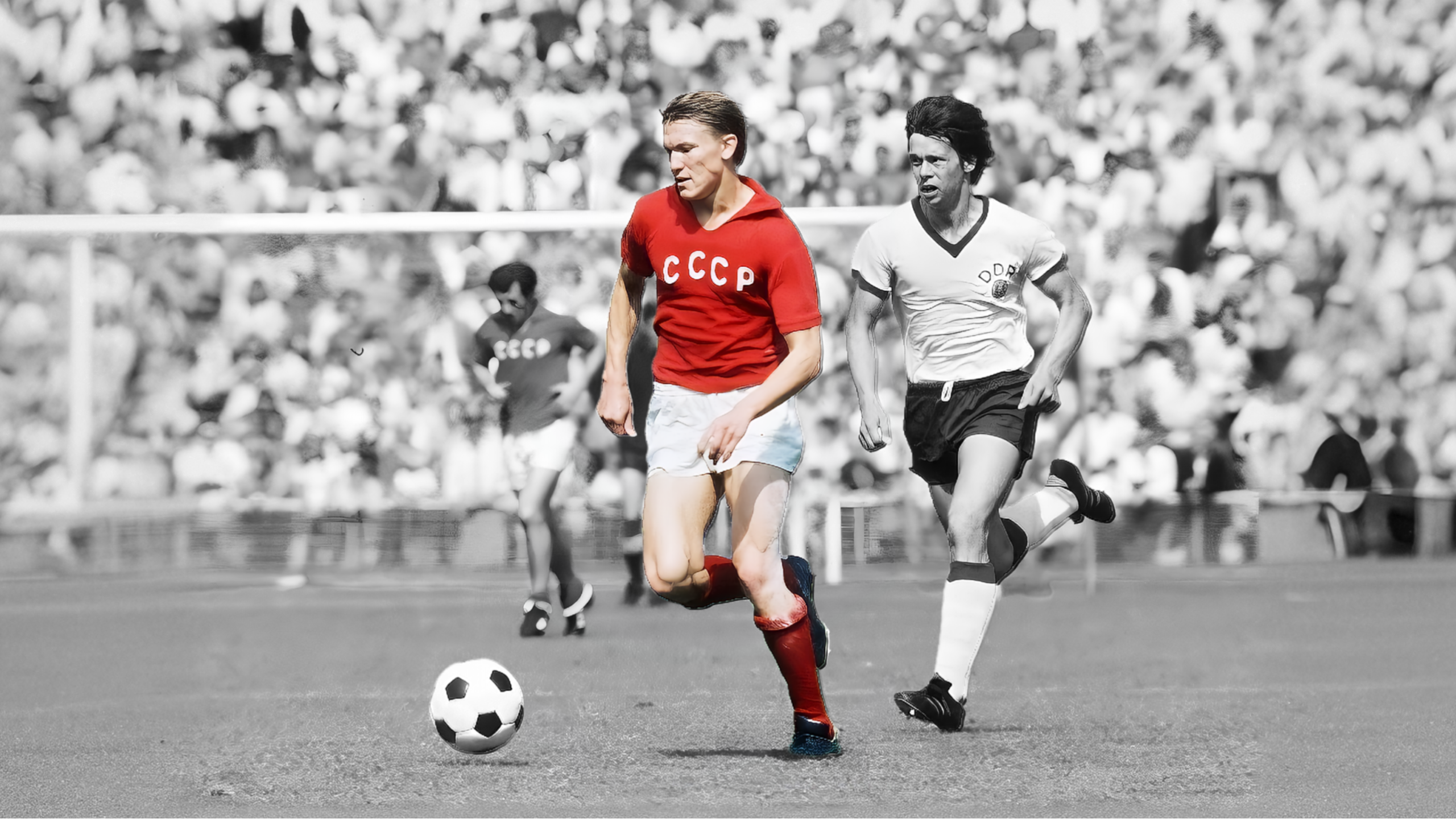
The greatest imprint in Blokhin’s history, however, is that figure who tames the grass and the wind, with blond hair flowing—and as it is captured in a moment, through a photograph, it resembles the modernist statue of a runner, leaving behind a mark in time. With movements that seem like a dance, weaving between opponents’ legs, Blokhin appears to hover, to play in another dimension, one that no one can interrupt. That regal style, which earned him the nickname “The Tsar,” is his poster in the bible of football. But above all, it is the fact that his image is the first that comes to mind when one remembers that red jersey, with the four white letters across the chest: CCCP.
