

The hours of Sunday pass by, the sun has already crossed its zenith and is now on its way to the oceans, leaving the Mediterranean behind. It’s the hour when the voices begin, when people start to gather. The road leads through the old bed of the Túria and winds its way from Carrer de Misser Mascó—with all the cafés packed—towards the Avenida de Suècia, where scarves are sold, where people wait for the buses, where you catch sight of the spiralling towers that carry human rivers to the highest and steepest balconies of football viewing.
In between, though, stands the great black and orange wall, with its balconies, its iron railings, its carved bats—and from the second floor emerges the band to complete the grand welcome. The bus draws near, the brass instruments sound the melody of “ès un equip de primera, nostre Valencia Club de Futbol”, and the emotion before any match begins to take on colour and scent: the golden-orange hue of the afternoon sun striking the stadium’s main entrance, the scent of tobacco smoke, and even the illusion of the eternal springtime that this city seems to exude.

The buses have arrived; you head left onto Calle de les Arts Gràfiques, towards the small, jet-black door on the corner. The seats on your ticket are on the opposite side, from the Avenida d’Aragò, but there’s still a climb ahead to reach the third tier—the stadium is not dug into the ground; it is a tower rising 40 metres above Valencian soil. You step into this modernist creation—a three-dimensional labyrinth of concrete and iron, painted orange and black—and as you ascend, a sense of vertigo grips you when you look down to the place where you began. You reach the ‘exit’, your gate, step out onto the slope and begin to ‘fly’ above the pitch of Mestalla. The band returns along with the crowd settling next to you, the anthem of the Valencian Community rings out, the line-ups are announced in Valencian, and there you are—on the edge, on the balcony, ready for flight, not by aeroplane but perhaps with some imagined bat wings you wear across your chest—ready to defend the team as the bat once defended the city, with cries that made it its emblem.

The sun continues its descent behind the main stand and illuminates the massive Grada de la Mar. The sky above shifts through every shade—blue, pale blue, pink, orange, purple, grey, and into the deep blue of yet another starry night. Whatever the scoreboard may read, this is the experience of one of the oldest stadiums on Earth, one of the longest-standing arenas in existence—a ground that has never been torn down, only grown over time to become a unique architectural monument, inseparable from the local culture of a city. Even the concrete seems to hold memory here, the collective memory of those who sat upon it, and later upon the little seats whose colours changed over the years until they became today’s orange—mirroring the city and its community itself.
The construction of the Estadio de Mestalla was completed in 1923, in order to provide a home for the rising force of Valencian football—Valencia Club de Fútbol—founded four years earlier, on 18 March 1919. In its early years, the team had played at the Camp d’Algirós, just a few dozen metres closer to the then-river Túria. The stadium’s construction wasn’t merely an ambitious project but a response to the growing crowds attending matches of the city’s new club. The first stands were wooden and held 17,000 people. That number would continue to grow, with the tiers stacked one atop the other as a natural evolution—just like the trunk of a tree expanding with time.
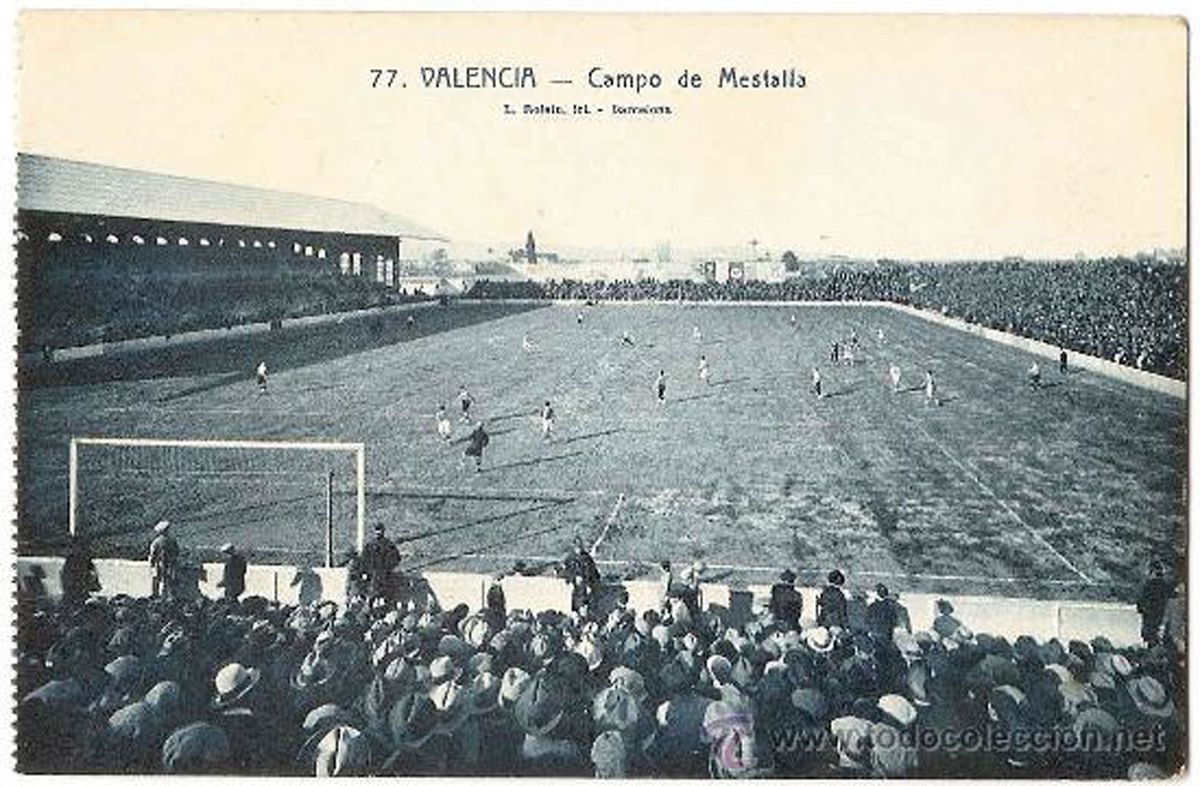
Mestalla’s memories are today inscribed all across its structure: in the balconies of its tiers bearing the names of domestic and European titles, in the shirts, boots, and little flags displayed in the corridor vitrines, in Españeta’s chair inside the dressing room—where, since his passing into the world beyond, a bouquet is placed upon his mat, a tribute to the man who made the club bloom by caring for its home. The trophies are displayed in the grand cabinet above the characteristic Valencian tiles at the entrance to the Tribuna Baja: the league titles, the cups, the European honours, the award for the world’s best football team in 2004—and, of course, the great white flag.

But football, which grows continuously like a living organism—not merely made up of people, but as if it were itself a person—also passes through phases. One such phase began a few decades ago with its intensive “gentrification”. As part of this process, many things had to change—not merely modernised, but reshaped into a footballing experience that felt more like a visit than a pilgrimage, more like tourism than belonging to a collective. This “gentrification” also struck the greatest Valencia CF of all time, which in 2007 decided to cast a piece of its legend—and its soul—into the dustbin of history, in order to construct a new, but colourless and odourless, home. One made of steel, resembling a spacecraft, designed to hold more spectators and increase the club’s financial might.

The universe (or the global economy) laughed, and the 2008 Financial Crisis tossed the plans for a prompt relocation in the first decade of the 21st century into the bin, leaving the “Nou Mestalla” project a concrete skeleton, left to decay for nearly 15 years—seemingly without future. But that “future” was reborn in the financial schemes of businessmen who view gentrified football purely as a field for profit—without even pretending, as others do, to be benefactors of the clubs.
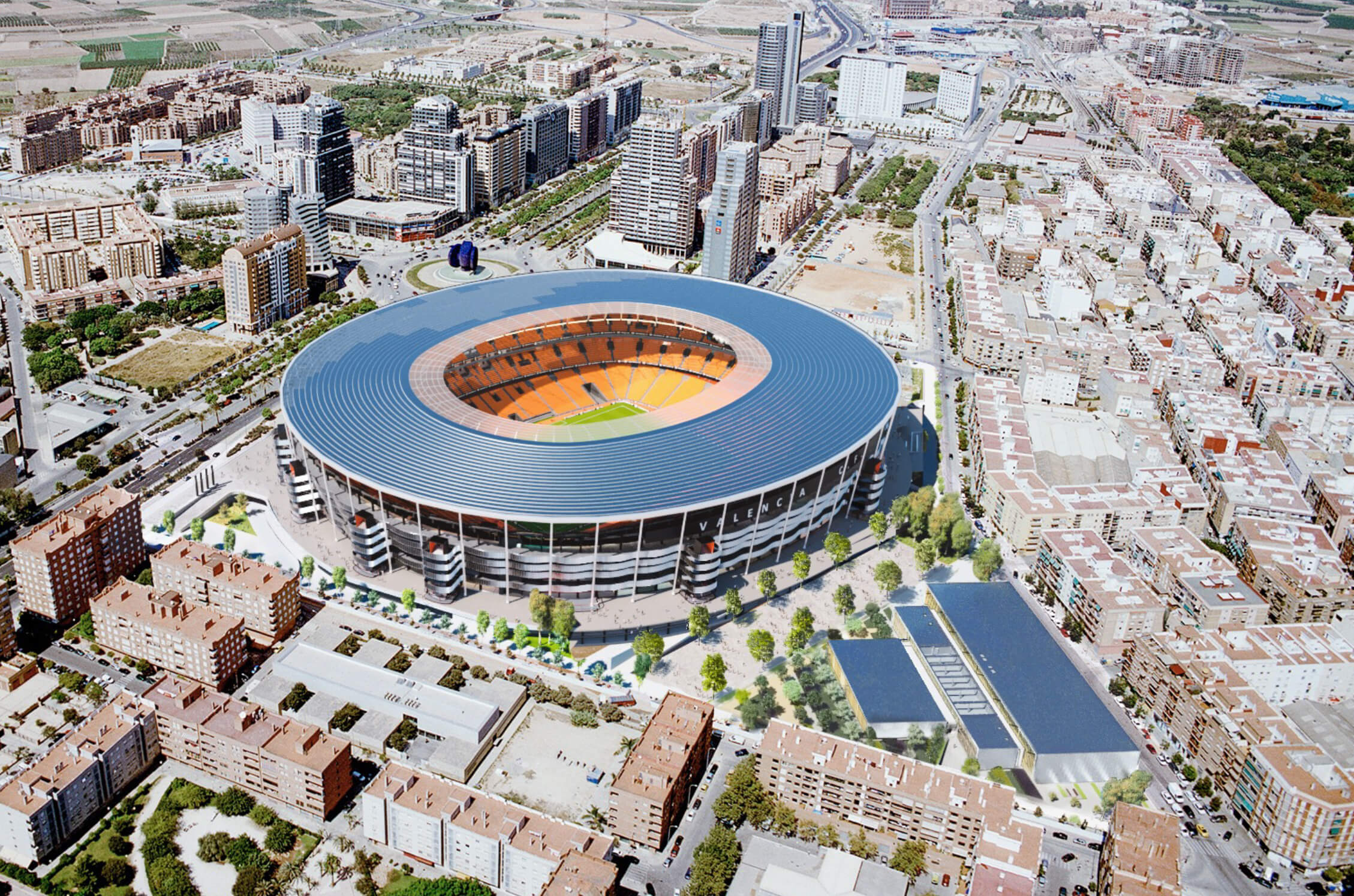
The plan was presented: the old, legendary Mestalla would be mortgaged, handed over to a bank that would provide the liquidity needed to construct the new, revamped stadium. Then the old ground would be demolished, and in its place the bank would sell property and luxury residences. Would it be the first time such a thing happened? Many legendary English stadiums met the same fate—leaving their clubs stripped of a piece of their historic and cultural identity. Perhaps no example is more telling than Arsenal, which has become the most “soulless” London club since leaving Highbury, with the Emirates Stadium often described as the worst for atmosphere in the Premier League. But what does that matter, so long as the stands are full of tourists and ticket prices remain high? A Mediterranean city, after all, can easily attract all those buyers of its “gentrified” football product.
But not everyone agrees with this vision. The Valencia fans—who for years have been protesting behind the barriers, demanding the removal of the club’s owner, Peter Lim—have become bitterly acquainted with “gentrification”. The mistake of letting a fan-based club fall into the hands of an ultra-wealthy businessman now activates the same instincts when it comes to the promised sporting rebirth supposedly tied to moving into the new stadium. But there’s a thorn in this stadium story that has made many resist: the demolition of an architectural monument that has lived alongside the city for over a century. To “erase” it from the urban landscape would be a massive blow to the very society and cultural bedrock upon which everything east of the Túria unfolds.

Beyond Mestalla’s fate, the fans raise concerns showing that the relocation plan endangers not just the historic stadium but the very existence of the club itself. One after another, all the promises tied to the move have been broken: the sports complex is not being built, the new stadium’s safety standards fall short of modern regulations, and—above all—its architecture is already outdated, pushing fans away from the pitch and stripping the Valencian ground of a core element of its identity. Why, after all, demolish a century-old architectural monument only to replace it with a building designed two decades ago?
Standing against them—aside from the club’s management and its owner—is the bank set to profit from the deal, along with officials in the local administration, mainly from the Partido Popular. These are the sorts who believe in a “gentrified” market, not a civilised society. That’s why more and more banners are calling for the preservation of Valencia CF’s historic home as essential to the club’s very salvation. One such banner, aimed directly at Peter Lim, was hung on the construction site of the Nou Mestalla—visually contrasting the broken promises with the real future of the club under its current management.

At the same time, working groups of supporters—including engineers, lawyers, and other relevant professionals—are not only fighting against the construction of the new ground and the potential relocation, but also presenting proposals to modernise the old Mestalla: expanding its capacity, improving its structural integrity, and enhancing sightlines from every seat. Can the champions of “gentrified markets” not see that this solution better aligns with the experience they claim to sell under the Mediterranean sun that shines all year round in this city? Of course they can—but the payoff from the land grab is far greater. One then realises that these are not merely investors with questionable plans—they are, quite plainly, cynical predators.

Against the seizure of football’s soul—a soul built by the people who inhabit its temples, the stadiums—perhaps we all ought to listen and become part of the same struggle: the struggle to save Mestalla, so that we may continue to cry ¡Visca! for the kind of football that will always defeat its predators.
