
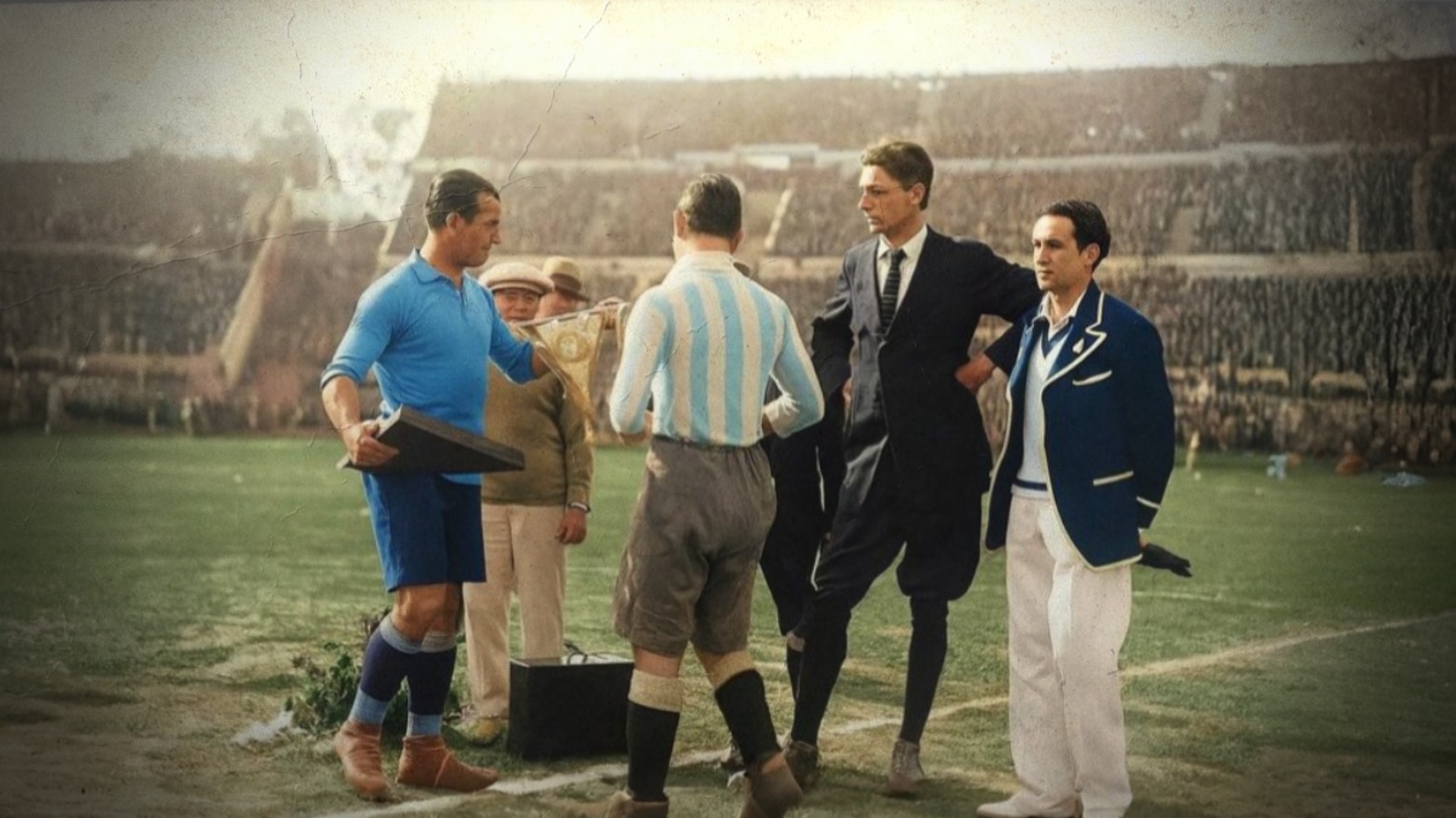
To Argentina FC London,
On 30 July 1930, shortly after 4 in the afternoon, at the Estadio Centenario in Montevideo, the second half of the first Great Final of the FIFA World Cup has begun. More than 68,000 spectators are in the concrete stands of the majestic modern stadium, watching with passion and reactions that touch the limits of ferocity the greatest football match that had ever been played, up to that day. In the first half, which was played with a Scottish ball brought by the Argentine team, the Argentines were dancing on the grass of the pitch that celebrated the centenary of Uruguay’s existence. Although La Celeste had opened the scoring in the 12th minute through Pablo Dorado, Carlos Peucelle and Guillermo Stabile had turned the situation around. But that moment of the second half belonged to a 20-year-old from La Plata, the inside-right forward Pancho Varallo, footballer of Gimnasia y Esgrima, who was charging forward in yet another Argentine counterattack.
The days before the final had been difficult for Varallo: his knee was injured and, had it been any ordinary match, he certainly would not have played that day. But it was the final of the first World Cup and, above all, a final against Uruguay. It was a match that made the players sleep the previous night wearing their albiceleste shirts, a clash that sent thousands of Argentines onto steamships that were trying, most of them in vain, to reach the other shore of the Río de la Plata, a rendezvous accompanied by thousands of telegrams that even reached the dressing rooms shortly before kick-off. Varallo would not miss this battle for anything — and none of his teammates wanted to see him sidelined, nor did Carlos Gardel, who visited the Argentine delegation the previous night. So, from the morning, Pancho went to the chicken coop next to the hotel in the Santa Lucía area and began kicking a ball, again and again, in order to trust his injured knee. Everything showed that he could play…
And at that moment he was not only playing, but was a few steps away from writing the History of the football world. Opposite him, the Uruguayan goalkeeper Enrique Ballestero waits, Varallo attempts a shot with the heavy English ball of the second half, it takes a trajectory that passes Ballestero and the Centenario falls silent, watching the spherical object heading towards the hosts’ net …but the sound of the net is never heard; instead, the blow of the ball against the junction of the posts means that the Final is not over. The only thing that ended at that moment was Varallo’s knee, which not only failed to write football History in the way he had wanted, but could no longer compete under good conditions for the rest of the match. Given that there were no substitutions, this meant that Argentina was losing a valuable unit on the field of play of the Centenario. Pedro Cea, Santos Iriarte and Héctor Castro scored for Uruguay and the History of football that gives birth to myths wrote Uruguay as champion on this first page of the World Cup, in perhaps the most important episode of this first era of global football development.
This era, as well as the world’s entry into the notion of football mythology, was marked by the three countries of South America that carry the greatest share of the counterweight to footballing Europe, the three world champions: Argentina, Uruguay and Brazil. And if the world trophies are divided between the two sides of the Atlantic, the way myths are born, the ability to create identity, even national identity, through football, never managed to surpass the magnitude that was created in those years in these three countries.
How, though, did they get there?
Landing in the virgin land
On 25 August 1535, 11 ships with 2,000 men set off from Sanlúcar de Barrameda, just outside Cádiz, to cross the Atlantic and carry out the mission assigned by Carlos V (the first Habsburg) to the scion of an aristocratic family of Andalusia, Pedro de Mendoza. Mendoza, an opportunist like every conquistador, aspired to repeat the achievements of Pizarro in a region that a Venetian explorer, Sebastian Cabot, had named the “river of silver”, Río de la Plata. It was an estuarine complex, the so-called estuario, on whose banks Cabot left the continuators of his voyages to believe that untold riches were to be found, thus creating the first historical myth that characterizes the region.
This estuary lay in the southern part of the region between the 25th and 37th southern parallel, which was called Nueva Andalucía, according to the division of South America defined by the Spanish king. It was the region that Juan Díaz de Solís, as well as Magellan, had charted with their voyages, both of them seeking nothing other than a passage to the Pacific Ocean and Asia. The journey was not easy for Mendoza. Adding 3 ships to his fleet in the Canaries, he lost 2 in a storm off Brazil, while he himself fell seriously ill. Finally, on 2 February 1536, he reached the mouth of the Riachuelo, the small river today known as Matanza. There he decided to create the city that he expected would become the centre of his dominion. Perhaps wanting to appease the divine after his difficult journey, he decided to dedicate the city to Our Lady of the Good Winds, Santa María del Buen Ayre.
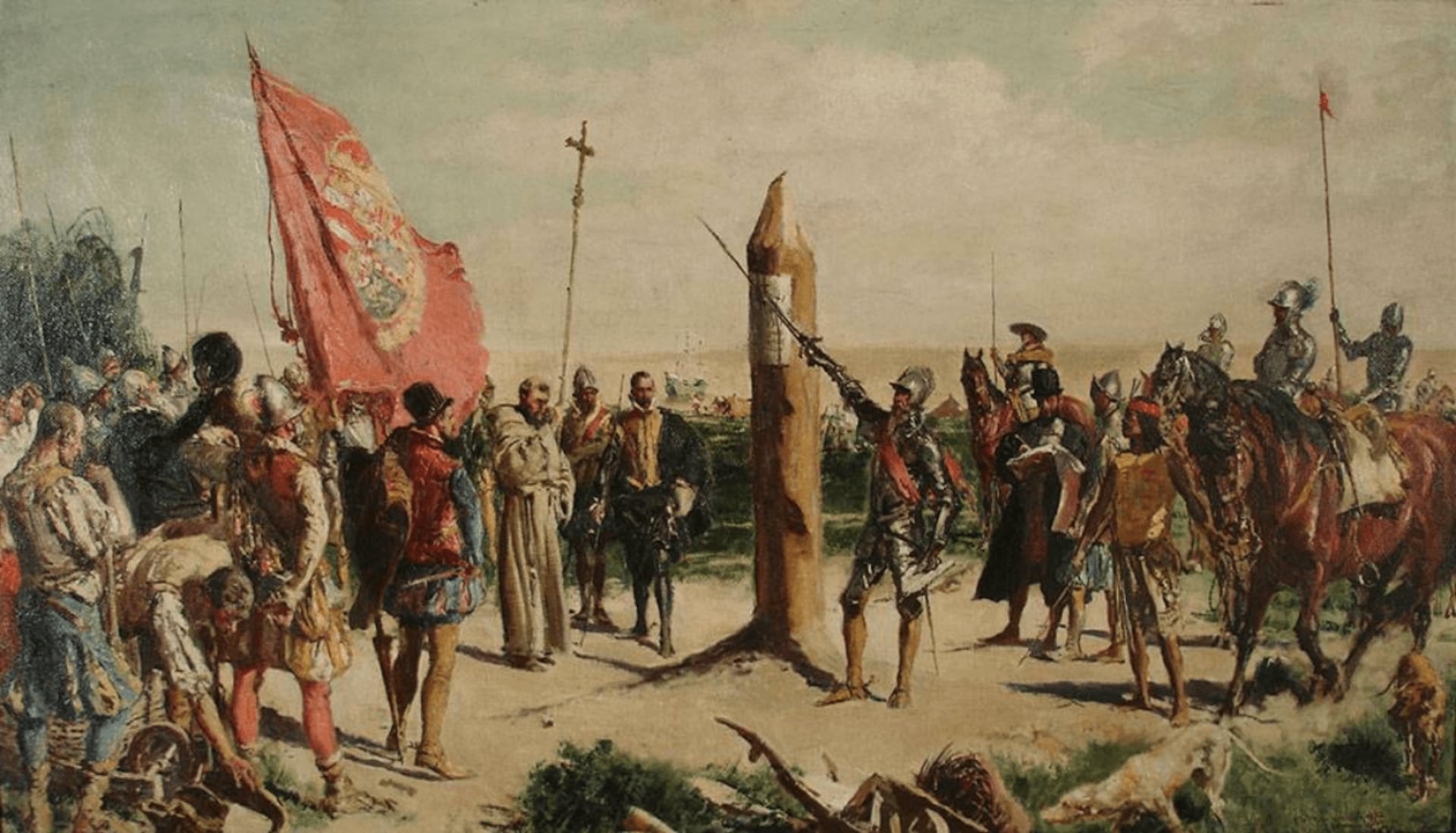
The invocation of divine help, however, does not seem to have greatly changed the fate of Mendoza and his men, as the settlers, instead of finding a place full of riches, found an empty and uncultivated land, and suffered from hunger, disease and the attacks of the Querandí, the indigenous tribe that lived in the area. Historical sources report that the settlers came to eat rats, snakes, even their shoes, before arriving at cannibalism. Mendoza himself took the road back in 1537, without ever managing to reach Spain, since he died on the way, while the settlers he left behind were unable to take root in the envisioned Southern Land of Promise and in 1541 took the road north, passing into the province of Nueva Tolédo, to settle in a place found by Gonzalo de Mendoza, a relative of Pedro, in 1537 and which, in order to appease the divine will even further, he dedicated to Our Lady of the Assumption, Nuestra Señora Santa María de la Asunción, today’s capital of Paraguay.
The settlers may not have managed to settle firmly at the mouth of the euphemistically named Río de la Plata, however another species of the animal kingdom did much better than humans, shaping the History of the region in the centuries that would follow. Seven horses and five mares that travelled with Mendoza’s expedition, according to historical sources, would adapt astonishingly well to the immense plains of the southern tip of the American subcontinent, creating centuries later also a distinct human culture that would become an element of national cultural identity.
And if the settlement of the Spaniards in the South Atlantic was particularly eventful and traumatic, the same was not true of the Portuguese settlers, who were heading a little further north, to a piece of land defined by a meridian between the 46th and 47th, or more specifically, as written in the Treaty of Tordesillas, 370 leagues west of the Cape Verde islands. In this space, which begins a little north of the Tropic of Capricorn, the Lusitanians were in permanent war for about two centuries with the local indigenous populations, without however ever being decisively decimated, as happened with Mendoza’s army of settlers. Perhaps this was also one reason why, in the naming of the region, instead of indirectly asking for divine affection, they praised the very nature of the region, rich in a type of legume, particularly generous in the provision of food, the so-called pau-brazil, which the local Tupi called ybyrapytanga.
From the middle of the 16th century, however, the Lusitanian settlers discovered another species that essentially constituted the source of wealth as an exportable product to Europe. It was not silver and gold, but sugar cane, which was found in such abundance, while the climatic conditions also favoured its rapid production, that the available hands were not enough to cover the needs of this new production. At first the settlers put the indigenous people to work as slaves on the sugar plantations, however their plans were hindered by a pandemic that decimated the indigenous people in the Bahia region in 1562–63 and by the landing of the Jesuits, who defended the rights of the so-called “Indians” and finally, in 1570, managed to have their right to freedom recognized by a royal decree which, however, lasted only 4 years. The Portuguese, who established in the new land of Brazil a feudal system, with the land of the engenho as the basic component of feudal power and the so-called senhor de engenho as the feudal lord, were constantly engaged in a struggle to enslave the local populations, in order to satisfy the needs of production.
This “problem” they solved with one of the most criminal enterprises in the history of humanity, the transatlantic slave trade. In the 16th century, thousands of Africans were transported by caravels from the Portuguese possessions of central Africa to the opposite shore of the ocean, so that by the end of it around 13 to 15 thousand Africans were working on the sugar cane plantations, making up about 70% of the labour force. During the 17th century, the numbers of transported slaves increased, with historical sources supporting a figure of 4,000 slaves a year in the first half and 8,000 slaves in the second half of the century. This gigantic forced transfer of population, however, would constitute the source that would give characteristics to the modern society that would be created in that Lusitanian possession which would spread around the Amazon.
The development of human societies, however, south of the 25th parallel would be slower. The river of silver, as Cabot had named it, carried nothing other than water and other alluvial materials, while even further south, throughout Nueva Andalucía and Nueva León, vast deserted expanses lacked possibilities for agricultural cultivation, as well as mineral wealth, in contrast to the more northern Spanish provinces of Perú and México, where a genocide of indigenous populations was accompanied by the milking of the wealth of the virgin land found by the descendants of Pizarro and his companions.
Nevertheless, around 40 years after the ascent to Asunción, on 15 June 1580, Juan de Garay, together with an army of new opportunists to whom he promised landed property and free use of animals for the organization of their personal agricultural production, descended again to the port of the good winds, founding Buenos Aires for the second time. A total of 65 new owners with their families began this enterprise of recovering the southern lands, which for about two centuries constituted a frontier peripheral society.
The Spanish-born founders (or refounders) of Buenos Aires did not have slaves, even if they steadily engaged in war and the decimation of the indigenous populations, following the imperial example of their compatriots in other provinces. However, their interest was to create their own wealth in a region claimed by no other part of the settlers, since it seemed, in essence, cursed. In this task they did rather well — and certainly better than the first arrivals at the estuario — as they created a community that expanded towards the southern expanses, while other groups, following their example, moved south of Asunción in order to build cities in today’s northern provinces of Argentina. Indeed, Juan de Garay himself had first founded Santa Fe de la Vera Cruz, in 1573, before beginning the search for the new inhabitants of Buenos Aires.
The network of these cities, which flourished, though at a very slow pace, led to a strategic choice at the end of the 18th century. The fact that Asunción was now connected by a relatively dense network of communities and cities with Buenos Aires and the mouth of the Río de la Plata, while the city located at the confluence of the Pilcomayo and Paraguay rivers, at the point considered the beginning of the Paraná, effectively communicated with the eastern slopes of the Andes and the wealth-producing regions of Upper Peru (that is, present-day Bolivia), showed that all this region of old Nueva Andalucía had a geostrategic significance that could not have appeared earlier, without the existence of this network.
The creation of a strong state entity east of the Andes, with Buenos Aires constituting the port-exit towards the Atlantic, had the potential to reshape the routes of Spanish trade and for this reason, in 1776, the Viceroyalty of the Río de la Plata was founded, with Pedro Antonio de Cevallos Cortés y Calderón as the first head of political power, a military man who had been governor of Buenos Aires from 1757 to 1766 and had essentially repelled the expansion of the Portuguese as head of the first and second Spanish campaigns during two Spanish-Portuguese wars. Cevallos himself, as Viceroy of the Río de la Plata, was the one who also led the detachment of the territories of today’s Uruguay, forcing the Portuguese to retreat northwards. Perhaps, however, his most influential contribution was the introduction of the Trade Law of 1778, which gave Buenos Aires the possibility of maintaining direct trade with Spain, without the tradable products having to pass through the until-then powerful Viceroyalty of Perú. This move would play a decisive role in developments.
Buenos Aires, as capital of the new Viceroyalty, was transformed from a peripheral city into an administrative centre and port with a decisive role in trade between the Metropolis and the colonies. Indeed, in combination with the foundation of the fortress of San Felipe y Santiago de Montevideo, where populations mainly from Galicia and the Canaries settled and which became Spain’s most important naval base in the South Atlantic, the region of the estuario suddenly acquired enormous geostrategic importance, concentrated economic activities and was led into a perpetual hypertrophy which continues to this day.
Beyond the emergence of Buenos Aires’ hegemonic position, as well as of its common course with Montevideo on the other bank of the estuario, this development also determined the temperament of an entire local culture. The society that would develop in the region is by nature extroverted, has the most direct bond with Europe compared with any other of the newly conquered continent, and constitutes a “station” in the journey of many generations that would seek their fate on the other side of the ocean.
In the same period there was an opposite, in terms of its organization, economic development in the interior. The colonizers who did not acquire, or did not claim, a share in the management of the hegemonic port of Buenos Aires turned towards large landed property in the interior and thus the Pampas were transformed from deserted expanses into large feudal-type estates, the so-called estancias, which functioned almost as self-sufficient societies.
Thus, the colonial geography of South America, east of the Andes, was formed into a system of ports, with Buenos Aires the most important, the naval base of Montevideo, as well as Portuguese Río de Janeiro, and enormous feudal expanses, the estancias in the Spanish possessions and the fazendas in the Portuguese ones. As regards these latifundia, however, two different types of populations would shape the two regions differently. The strong presence of the African population in the Portuguese plantations would create a racial mosaic that for centuries composed the society of Brazil, developed on the foundations of slavery, while the appearance of a particular social model, perhaps corresponding to the North American cowboy, characterized by the same sense of individual freedom but carrying Spanish cultural characteristics, spread across the Pampas, thanks also to the enormous population of horses that began with the animals that accompanied Mendoza’s men on their journey two centuries earlier.
This formation of societies is not a detail, but a basic link in the evolution of the societies of the three countries, Argentina, Uruguay and Brazil, as well as of their national football, because it was not momentary, but constituted the definitive setting of the canvas on which all subsequent social phenomena would take place. This is also the most important particularity of South American football: the fact that it was a phenomenon born upon a freshly made social canvas, was strongly influenced by the particular local characteristics, but influenced their popular narrative even more strongly.
As regards the recording of the great events of History, however, the complete formation of the social ground on which these until-then provinces operated became the cause for the change of the world map. The self-sufficiency of societies, the complete system of administration and power, the different social structure that no longer fit within the culture of the European kingdoms and, naturally above all, the separation of the economic interests of those holding local power, at the beginning of the 19th century, a century sealed by national-liberation revolutions, constituted reasons for independent state entities to be created and exist in South America as well.
Y los libres del mundo responden
In Europe, the beginning of the 19th century everywhere smelled of the aroma of the French Revolution and of the dream of bourgeois democracy. In France itself, of course, this dream seemed rather fragile, as Napoleon’s presence in political leadership led to the end of the First Republic and installed the Imperial System from 1804, with the Corsican soldier proclaiming himself emperor and looking towards the conquest of territories in every corner of the Old Continent. Nevertheless, Napoleon’s imperial system seemed to be the new force that would tear down the thrones of old Europe and was gaining liberal supporters in every country, who contributed to internal destabilization, mainly in times of crisis when popular discontent intensified and royal laws tightened the belt even more around the rising bourgeoisie. The same happened in Spain, which, in terms of foreign policy, found itself in a state of alliance and rivalry with Napoleonic France, while internally there was ferment.
After the Battle of Trafalgar, where the Franco-Spanish fleet was defeated by the British fleet of Admiral Nelson, Britain was in a favourable position to strengthen its position on the European coasts of the North Atlantic. Faced with this possibility, France and Spain agreed at Fontainebleau that the French army would pass through Spanish territories in order to achieve the occupation of Portugal, attempting the continental blockade of the British. In November 1807 the French occupied Lisbon and the Portuguese Crown was transferred to Brazil. However, in February 1808 Napoleon’s French troops also attacked Spain, from the Pyrenees, occupying the nationally oppressed regions of Navarre and Catalonia, so that the Peninsular War would begin, eventually lasting until 1814, with the participation of the British as well as a series of other European countries.
This weakening of Spain, which had to face enemies on internal and mainly external fronts, was found by the elites of Buenos Aires as an opportunity to move with the aim of the independence of their own territories. In February 1810 Napoleon’s troops had now come to control even a large part of Andalusia, with the Spanish administration essentially deciding its dissolution in Cádiz, on 1 February. With the pretext of resistance to Napoleon, who at that period was seemingly the ruler of Spain, as well as with possible guidance and help from the British, a group of lawyers from the port of Buenos Aires decided to hold a cabildo, that is, an open assembly, in order to determine the fate of the Viceroyalty of the Río de la Plata, on 22 May. This move provoked the reaction of the Spanish regime, which saw the cabildo as apostasy, resulting in the unrest that led to the so-called Revolution and the resignation of the Spanish Administration on 25 May 1810 at the palace of Cisneros. This day, which is considered the founding date of Argentina, is also the date of the beginning of the War of Independence.
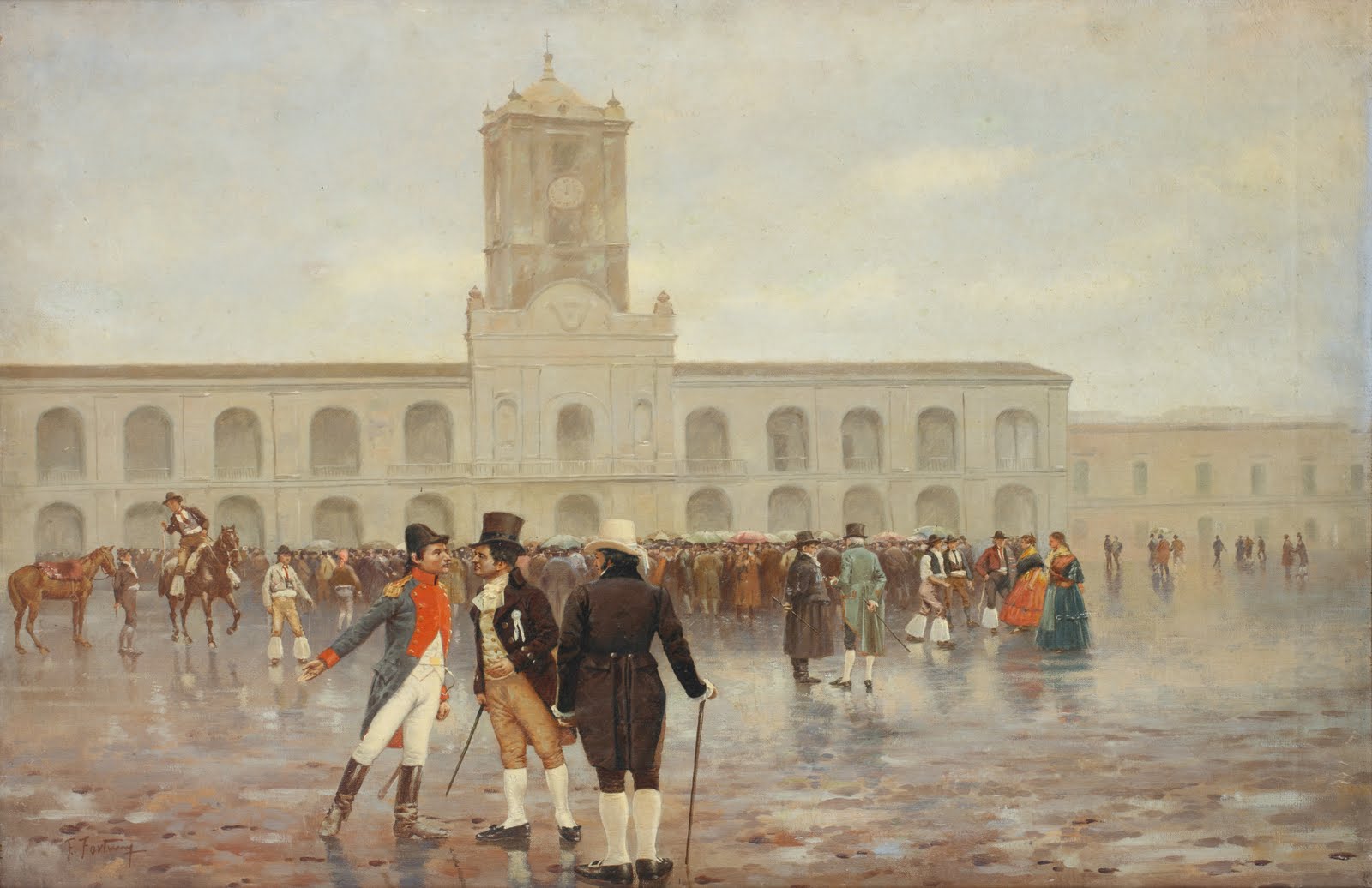
The so-called bond of the prominent citizens of Buenos Aires, the so-called junta in Spanish, with Cornelio Saavedra as its President and War Secretary Mariano Moreno as a prominent personality, took the power of the city into its hands and its aim was the liberation of all the so-called Southern Provinces, that is, the entire region that constituted the Viceroyalty of the Río de la Plata, and their incorporation into a new single independent state.
However, their venture had a major problem. The so-called First Junta of Buenos Aires expressed exclusively the interests of the ruling class of the port-capital. This absence of broad representation with regard to serving political and economic interests, as well as the substantive refusal of the new power to grant rights to other groups of local lords, considering that these did not reflect the given correlations of power, led to conflicts between the regions under independence and eventually to the birth of new national entities. Initially, in 1811, Asunción, which historically was bound to the existence of Buenos Aires, escaped the control of the power of the porteños and on 15 May Paraguay was created. Later, José Gervasio Artigas, under the threat — or the pretext of the threat — of a campaign from the north by Portugal, broke his ties with the central administration of the United Provinces and proceeded to the secession of the section northeast of the Estuario, the so-called Banda Oriental, essentially creating in 1814 the historical basis for the existence of the Uruguayan nation. From that moment onwards the common History of Argentina and Uruguay ceases to exist. Two countries that came out of the same womb, that are united by the same culture, would follow different political paths and later still different and conflicting legendary football trajectories. Uruguay would eventually be attacked by Brazil and occupied in 1816, so as to win its independence definitively on 27 August 1828.
Around the same period, and after the end of the Napoleonic wars with Napoleon’s defeat at Waterloo, the Portuguese king decided to return to Portugal, leaving behind him an administrative vacuum that the ministers he left in his place made sure to exploit. Led by Dom Pedro, fourth son of King João VI and therefore without hopes of succession to the throne, the local elites organized a plan of constitutional independence which, after a series of conflicts with the Portuguese Crown, led to the independence of Brazil on 7 September 1822. Thus, by 1830 all the old colonies of the South Atlantic were now independent states, with a national composition that reflected the developments of the previous centuries.
It is important to dwell on this period of independence of the American states of the South Atlantic, since, unlike the national-liberation movements in Europe, which usually constituted the struggle of oppressed nationalities aiming to throw off the yoke of whatever old empire, in order to create the so-called nation-states, the historical background in those countries was not the same. Obviously the societies were now evolving differently from Spain and Portugal, yet national consciousness was not distinct, since all — among the “European” settlers — knew that they were part of the same national culture, having the same language, the same religion and generally the same cultural tradition as the European country of which they were also subjects.
The struggle for the independence of the American states was a purely political affair, not in the sense of class conflict, but as a conflict for political power as an expression of existing correlations of power, that is, the inability of the old kingdoms and empires to impose themselves on the rapidly developing local elites. But because no independence can happen without some ideological background, this would have to be found even after the fact — and for this reason the life of those states began as an endless hunt for their national identity, something that was expressed excessively in football, to the point that the sport itself became part of it.
On a new world map, however, these new countries would have to change much more than a national ideology. Secession from their metropolises also changed their allies, their commercial partners. Would they find a way to stand in this new world without collapsing, and was this change the result or the cause of the battle for their independence?
And then came the English
The independence of the American countries of the South Atlantic had every reason to be met with the most positive feelings by the British, who, in the middle of the 19th century, expanded the red on the map, that is, their own imperial colonialism, but also the so-called “informal empire”, that is, countries and locations that they did not occupy, but where they made sure to develop particular activity to the point that they acquired a dominant position in economic activities, often placing strategic infrastructure under their control. Britain’s goal at that time, not only in South America, but also in Europe, was the creation of new independent states, which would dismember the great empires, that is, the enemies of the British Crown, and would constitute state entities into which British interests could invade much more easily.
The interest of the British in the region of the South Atlantic and particularly in the estuario of the Río de la Plata had already been expressed in 1806 and 1807 with the first British invasions. The ports of Buenos Aires and Montevideo matched perfectly the mode of development of the informal British empire, which was not so much interested in the hinterland as in the ports, from which it began the development of railway infrastructure so that economic activities within each state would follow. But their personnel, the military and political leadership where they held power, or the businessmen and technocrats where other state entities existed, were concentrated in the ports and generally in coastal areas, since these were considered the heart of the whole system of each national economy.
The British, who certainly had reasons to want the Southern Provinces of the Viceroyalty of the Río de la Plata, as well as Brazil, to disengage from the European and rival colonial powers, perhaps did not have such a neutral role in the process of their independence. The fact that sympathy and support for the project of independence has been historically recorded perhaps is not a fact without political background, perhaps that is, it is the result of an intervention and not simply the exploitation of an already formed situation.
The way in which the independence of the United Provinces of the Río de la Plata was ideologically supported, that is, the initial form of the state that evolved into Argentina, matched perfectly the way in which the British operated outside Old Albion. The risk taken by the First Junta in overemphasizing an absolutely port-based administration, at the expense of the interests of the lords of the interior provinces, placing the very project of liberation from powerful and traditionally strong Spain in great danger, perhaps is not explained only as the result of an expression of an internal correlation of power. But the greatest historical fact that remains to this day a difficult riddle for historians is the seemingly erratic military career of José de San Martín, the supposed liberator of Argentina, Chile and Peru.
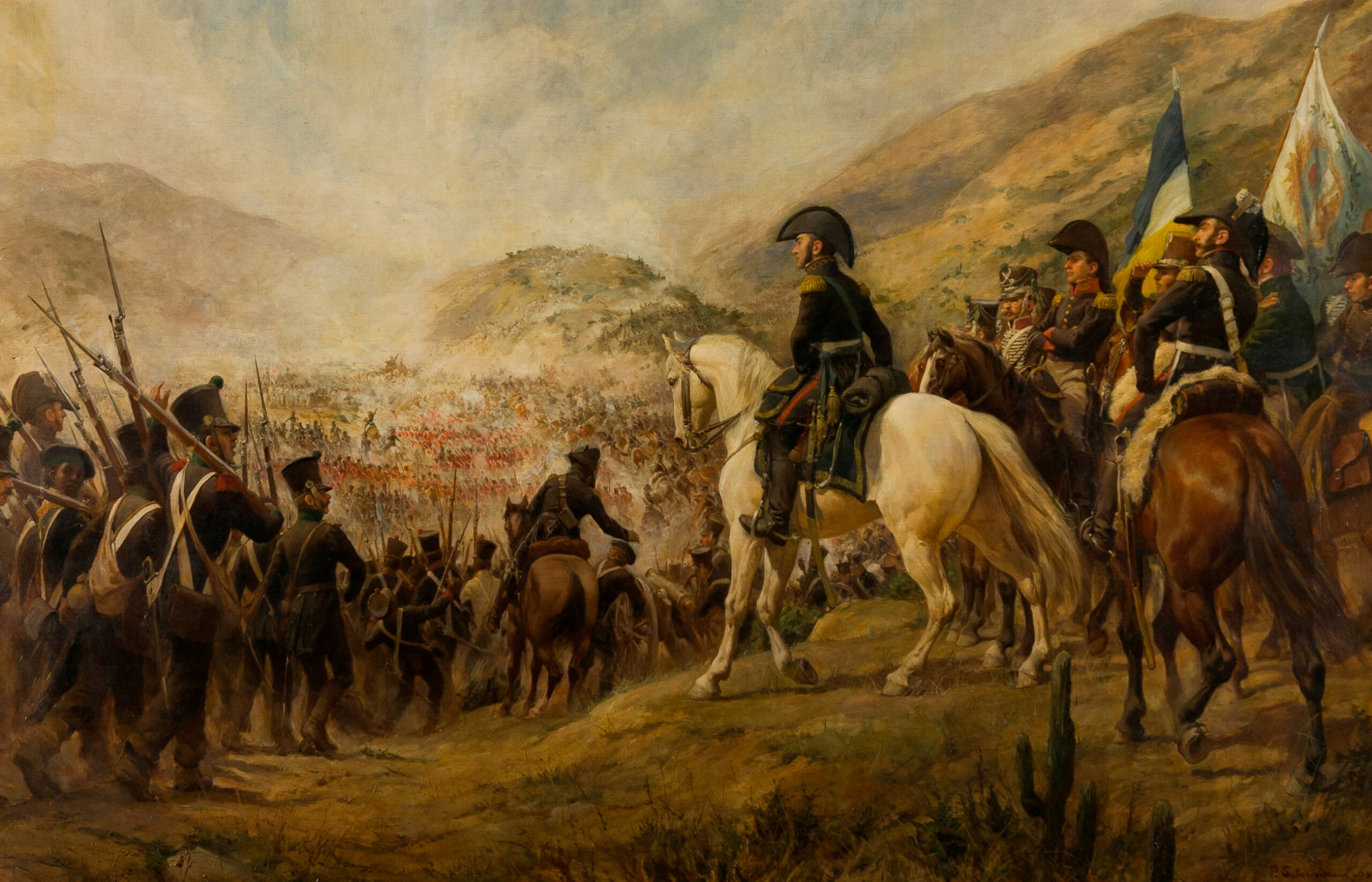
Born probably in 1778 in Yapeyú of the then Viceroyalty of the Río de la Plata, José Francisco de San Martín y Matorras initially moved with his family in 1781 to Buenos Aires and permanently to Spain in 1783. There, from the age of 11, he began his military education, essentially spending his entire life as a cadre of the Spanish Army, fighting for the Crown in a series of battles and campaigns, including the Peninsular War. But suddenly, in 1811, at the age of 35, he resigned from the Spanish army, in order to return to South America under the protection of the English. The historical narratives for this choice of his are three: either that he missed the ancestral land, which he had nevertheless left when he was only 7 years old, and felt a duty to fight for its liberation from the country that, however, as a soldier he served; or that he was recruited by the English; or that ideologically he did not fit into the polarity between Enlightenment and absolutism that characterized the conflicts on the European continent, one of which was the Peninsular War. His participation in the Masonic organization of the Lodge of Rational Knights complicates things even further, as the mystical character of the organization conceals the network of real interests that lay behind the process of liberation of the states of South America. In any case, the protection offered by the English to San Martín is direct proof that after the failed invasions of 1806 and 1807 the British did indeed adopt the line of economic dependence, seeking only the secession of the colonies from Spain and not their annexation to the British-controlled territory. Indeed, beyond San Martín, who is the outstanding personality in this process, there were also other military men, officers of the Spanish army in the Peninsular War, who followed a similar course, while the activity of more openly Anglophile lodges in Buenos Aires, connected with members of the First Junta, is also known.
In Brazil, where the process of independence was a much more peaceful affair, with conflict raging even within the royal family, the British do not appear so much in the foreground. However, they made sure to secure their interests in the region in another way. Seeing that Brazil had essentially managed to outflank the power of the Portuguese Crown, announcing its independence in 1822, Britain appeared as a calm colonial power that negotiated the terms under which it would recognize the new independent state. Thus, after first ensuring that Brazilian independence had been recognized by Portugal itself, it negotiated Brazil’s promise to abolish the slave trade, but also a preferential tariff in the new era of trade, which was now conducted freely with all countries, naturally cutting the exclusive ties with the metropolis.
In this way, the British had secured a privileged position in the region of the South Atlantic. As a great naval power they had, moreover, favourable terms in their commercial activities, with the result that they essentially controlled a very large percentage of the volume of trade between the two continents. This position of Britain led, as in other places, to the transfer of an entire army of technocrats, administrative cadres, but also of the British working class to the three countries of South America. At the same time that wars were raging in the hinterland over the division of lands and the drawing of the new national borders, and at the moment when in the later Argentina the civil wars between the porteños — who envisioned a strong united state centred on Buenos Aires — and the caudillos of the interior provinces — who looked towards a federal state entity with relative autonomy for their regions — did not allow the development of any sense of smooth development of the new state entity, British activity flourished in the port. British import and export trading houses were established, trade was financed by British banks, British merchants bought and exported hides and meat, as well as other livestock products, and thus defined de facto the country’s export model, which was harmonized with their own interests. When, indeed, things on the country’s internal political scene did not go as they wanted, they blockaded the port and with bloody embargoes, such as in 1845, as well as interventions, imposed their will.
And if in Argentina the presence of the English in the first half of the 19th century defined the export model of the country and progressively its production, in Brazil the British prohibition of the slave trade shaped new conditions for social development. The British merchants and the elites that controlled international trade and transatlantic transactions, of course, did not have any moral sensitivity against slavery. What had changed for Britain was the political conception of labour within the framework of the industrial revolution; wage labour instead of slavery was proving to be a more stable system, protected from slave revolts by people who had nothing to lose, at the moment when the same thing was not visible to the class-unconscious working class. For Brazil, however, initially the abolition of the slave trade meant the stopping of the flow of Africans to its territories, while the final abolition of slavery, which happened with the law of 1888, created the new conditions of racial discrimination, consolidated hierarchical relations within an apparently liberal social system, and made it now visible that the former slaves, the Black and mixed populations, had no possibility of social advancement beside the white elite. This system of non-institutionalized exclusions would constitute the root of the national narrative of a nation.
The presence of the British, however, as it acquired permanent characteristics, was not limited to economic activities and diplomatic and political intervention. In Buenos Aires the first British school was founded in 1838: St. Andrew’s Scots School, on Calle Piedras, number 55, which began operating on 1 September in the space where the Presbyterian church was located. In 1844 the Hospital Británico was founded, headed by the Reverend Barton Lodge, with the aim of providing care mainly for the British workers and sailors who were in the city. Many other schools and social institutions, as well as religious foundations, concerning the organization of the British settlers, formed part of the cultural puzzle of the new port capital. Correspondingly, in Montevideo the first British hospital was founded in 1857, while earlier, in 1828, a British cemetery had opened. Among the most important elements, however, of the cultural penetration of the British was the founding of the newspaper The Standard, by the brothers Edward and Michael Mulhall, in 1861 in Buenos Aires. The Standard would become the basic organ of the British community and was one of the most important sources of business news.
As regards business activities, the British transferred the History of the industrial revolution from their homeland to all three countries, putting in place two of the most important pillars that had been needed for it: the railway and the banks. In 1857 the first railway line of Argentina opened with the use of the steam locomotive La Porteña, which had been built in Leeds; in 1862 the Buenos Aires Great Southern Railway was founded, and in 1867 the São Paulo Railway Company, to constitute only the beginning of the development of a railway network that would expand towards the hinterland, create new products exportable to Europe and require specialized British workers for its operation. Indeed, this expansion of economic development towards the interior and the Pampas played a decisive role in achieving stability and peace, as the ruling class of those provinces too now had a share in the profits brought by the modernization of the newly created state. As regards the banks, in 1862 the Banco de Londres y Río de la Plata was founded in Buenos Aires, while the following year the London and Brazilian Bank was founded in Rio de Janeiro. The British banks constituted the credit machine of South American development, essentially binding it with loans to British interests, something that would torment the economies of the countries for more than a century and the effects of this lending would continue to be expressed down to our days.
But the British were not the only ones arriving on the American coasts of the South Atlantic.
The discovery of America by the working class of the Mediterranean
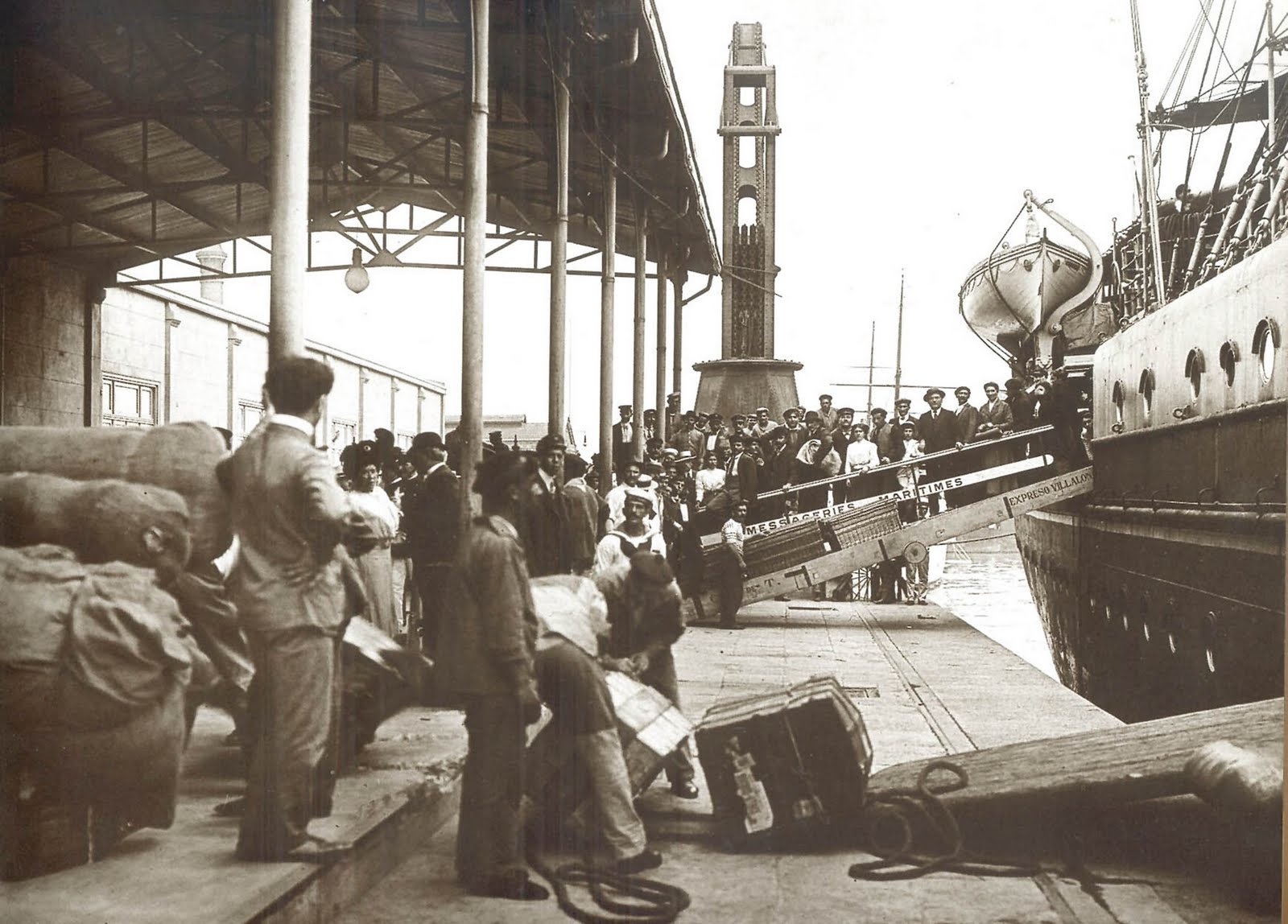
About three centuries after the first landing of the European colonialists in South America, with expeditions sealed by royal decrees and aiming at the discovery of untold wealth for every small or great opportunist and explorer, another great landing, of a different type, began to take place in the middle of the 19th century. The export of the industrial revolution to the South Atlantic offered opportunities for work and improvement of life to thousands of inhabitants of the southern European countries, who lived in poverty, food insecurity, often working the land as sharecroppers, under feudal relations of exploitation. For thousands of Italians above all, but also Spaniards and Portuguese, the three countries offered new opportunities in an environment that was culturally quite familiar to them, with the result that during the 19th century they contributed decisively to the formation of the cultural mosaic of these societies.
Argentina in 1870, the year in which intense economic development had now been consolidated, had a population of less than 2 million. Within the next 50 years, the arrivals of Spaniards and Italians amounted to around 3.5 million, forming an entirely new social canvas, but preserving a permanent cultural characteristic: Argentina was the symbolic country of immigrants. Indeed, the fact that the slave trade from Africa to the two countries of the Río de la Plata was not as intense as towards Brazil, where the great majority of the working class was Black, as well as the fact that the smaller Black population was steadily mixed with these waves of the Mediterranean working class, led to the shrinking of the purely African population, creating the narrative of the “most European country of South America”, something that would strongly affect the national football development in the first decades of the 20th century.
In Brazil, where sugar had given way to coffee as the main export product by the end of the century, tens of thousands of southern European immigrants were arriving with São Paulo as their main destination, where since 1887 there had also been an immigrant reception office, the Hospedaria de Imigrantes, which directed the newly arrived to where there was demand for labour power. This particular institution, beyond its practical usefulness, had also been founded for ideological reasons, as the ruling class desired the “whitening” of the population, something to which the arrivals of the poor southern European immigrants obviously contributed. By 1920 more than 1 million Italians had entered São Paulo, while roughly one tenth of that number were Spanish immigrants.
Unlike the British, who conducted their lives within the generally closed communities of their expatriate compatriots, the southern European immigrants who spoke the same language, had the same religious beliefs, while also carrying to some extent a common national path, became part of the local population and culture, decisively shaping the latter. Settled in the new metropolises, in neighbourhoods that constituted small community-cells of the new nation, they connected their settlement with the development of the barrio, as a geographical entity within the framework of which people develop collective bonds and therefore an identity of belonging, the so-called pertenencia.
These new immigrants did not create only communities, racial types and stereotypes, such as for example cocoliche, the hybrid Spanish-Italian dialect of Buenos Aires, and a way of life, but also created new characteristics of the culture of these countries. Mixed with the poor populations that had pre-existed from colonialism, without national complexes because of their class origin, they embraced the rhythm and music that Africans had created, incorporating into their leisure habits the milonga, music of African origin described by this fully African word, the candombe, which Africans danced at the carnival of Montevideo, the rhythm of the Cuban habanera, as well as the payada, which came from the hinterland and was the music of the gauchos. Living life at night, during the hours when they were not working, they connected it with these sounds, which outside forms and frameworks evolved so that a distinct kind of dance and music was created, almost identical with the life of the underworld, with prostitution, gangs and the harsh, though today romanticized, life of the port: the tango. The tango, in which scholars find elements from many European musical and dance genres, such as for example the polka and flamenco, would become the most recognizable cultural element of Argentina and Uruguay, and this prominent position in popular culture would later be shared only with football. The tango remained as the dance that contains the melancholy of the immigrant, the harshness of the life of the port, accompanied however also by intense feelings, the breaking of the propriety that befits so-called “high society”, and the movements of the body that reflect the absence of limits in the natural social relations of poor people.
In Brazil, the greater presence of the African population correspondingly developed music as well, without being influenced so strongly by the European musical tradition, creating the much faster and more joyful samba, which evolved into a great umbrella of musical traditions, expressed with different patterns in each province of the enormous Portuguese-speaking country. Samba, however, like tango, became a point of reference for the mythological explanation of the characteristics of a nation formed late in the History of humans — by today’s scale — and of the corresponding national football mythology. The most important element of these dance and musical traditions is that they are related to the parallel development of the almost stereotypical patterns of working-class communities, the barrio in the Spanish-speaking countries and the favela in Brazil. Their “humble” class origin connected them even with illegality and the underworld, as one can observe, however, in very many popular musical traditions, before these acquired the respect of the intellectual avant-garde and were elevated to elements of national cultural heritage.
The contribution of the European worker-migrants in all three countries was enormous and is decisively useful in explaining the social phenomena of the decades that would follow, since at the moment when the British were creating the economic basis on which the evolution of these countries would rest, the workers from Italy, Spain, Portugal, somewhat fewer also from France, together with the poor natives now of European and African origin, were creating national identity itself.
“Things for crazy English”
The first accounts concerning the arrival of football, or more correctly of football games, in South America are recorded long before the era of the codification of the game. Football culture had been a national cultural element for the British since the Middle Ages, with the word foot-ball describing a family of ball games which, as a general rule, had two teams trying to drive it towards some goal at the opposite end of whatever defined field of play. The free time of the British was intertwined with this activity and it is very natural that this was how the British sailors who arrived with the ships of the Empire at the other end of the ocean during the first half of the 19th century spent their time. Thus, descriptions from around 1840 reach us of sailors playing such games on the docks of Buenos Aires. This occupation is something entirely foreign to the culture of the locals, who see the game as something exotic; indeed, the Buenos Aires newspaper La Razón describes it as a game “consisting of running around a ball”. It is, perhaps, an extraordinary coincidence that even today those who have and want to have nothing to do with football use the same expression. Perhaps the Spanish-speaking editors of that passage had imagined very differently the future relationship of their country with this strange occupation.
Argentina is one of the first countries in which the rules of football are published. In 1867, just 4 years after the meeting at the Freemason’s Tavern in London, where the Football Association was founded and the first rules of the sport were agreed, the British newspaper The Standard published the rules in this distant land. The coming of football seems once again to be the result of the conditions concerning the economic base, where British interests dominate. The English may not be in the barrios, they may not dance tango and may not mingle with the cultural mélange of the port of the Río de la Plata, but they bring a cultural element from their own culture, which would later be embraced not only by Argentina, Uruguay and Brazil, but also by every country on the planet as its own.
The rules were not necessarily unknown to the British colony of Buenos Aires. Their publication, after all, in the newspaper The Standard was not without purpose: on 6 May 1867, in the same printed medium, Tomás Hogg published an article-announcement titled “Foot Ball: A Preliminary Meeting”, calling on those interested to gather in a meeting where the foundation of perhaps the first football institution of the continent would be decided. On Thursday 9 May 1867, on Calle Temple, today’s Viamonte street, the “Buenos Aires Football Club” was founded, with founding members mainly railway workers from Northern England, while members of the elite, such as Thomas Hogg and his brother James, participated in its composition and administration. The new club set the subscription cost at 30 pesos and stated in its statutes that it adopted the rules of the Football Association, slightly modified. The announcement of the first match was also published in The Standard and it was scheduled for the exceptionally important day of 25 May, that is, the anniversary of the country’s national independence. However, this game never took place, because of heavy rain.
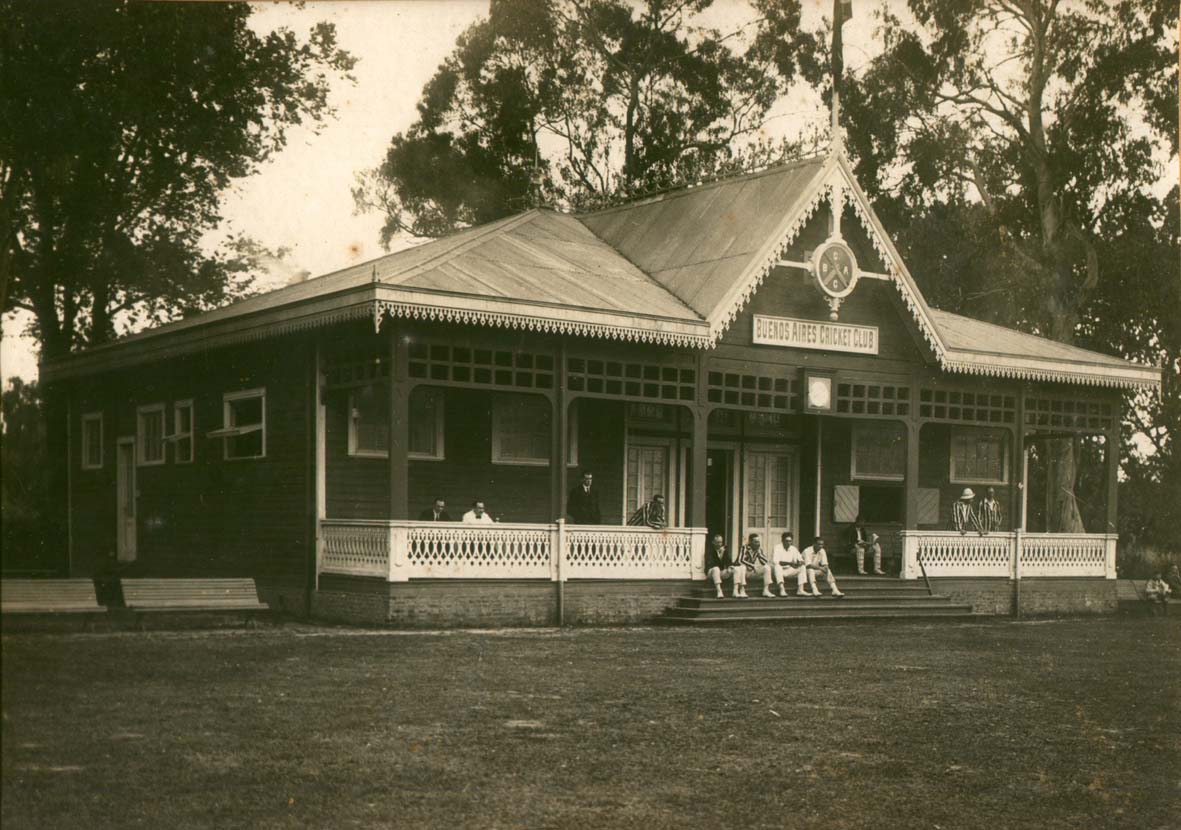
About a month later, on the day of the national celebration of the Argentine flag, which was set on the day of the death of its inspirer, Manuel Belgrano, on 20 June, the Buenos Aires Cricket Ground, in the district of Palermo, became the site of the first football game in the history of Argentina. The Cricket Ground was the field of the Cricket Club, which had been founded in 1831; from it the Football Club was created, and as its name testifies, it concerned the athletic occupations of the elite and of its own beloved game. However, it went down in history, as it is the first ground that hosted a football match (1867) and a rugby match (1873) in Argentina, the two most popular sports of the country to this day. 20 June 1867 is considered the date of birth of football in Argentina and Thomas Hogg the Prometheus who transferred this flame that burns unquenched in the souls of an entire nation. Only 3 years had to pass for the newspaper El Nacional to write that football is “this English game, it will not be long before we get used to it”.
The match was played between two teams which, despite the exclusive participation of Britons, borrowed names from the Spanish language, and the Colorados, who wore red caps, faced the Blancos, who wore white. The captain of one team was the 24-year-old Thomas Hogg and of the other the 29-year-old Walter Heald, both members of the administration of the Buenos Aires Football Club. Based on the codified rules, two halves of 50 minutes were played and each team consisted of 8 players on the field. This first game was won by the Colorados 4-0, while on 9 August, when the two teams met again, the Colorados won once more, 3-0.
However, the references to the discussions concerning the preparation of the game are of great importance, with the concerns they expressed, such as whether it was proper for men to compete in short trousers in front of female spectators, revealing that the whole organization was fully influenced by the social conventions of the social elites. Heald, captain of the Blancos, mentions in the pages of his diary that his team took the train to Palermo, marked out the field of play with flags and then headed to the Confitería for bread, cheese and porter beer, while waiting for the rest. He also mentions the terrible lower-back pains felt by the over-exhausted footballers after the encounter, revealing some elements about their physical condition.
The Football Club, however, did not last long. The yellow fever epidemic, which cost the lives of about 8% of the inhabitants of Buenos Aires in 1870, interrupted its operation and when it was reconstituted, in 1873, it adopted the rules of rugby union, which had been codified by the Rugby Football Union 2 years earlier. Thus, the club itself changed name and is known to this day as Buenos Aires Cricket and Rugby Club, with football needing other continuators, perhaps with different motives from these first elites who collaborated with the British railway workers only in order to maintain an occupation of their class in the distant land that hosted them.
If Thomas Hogg and the Englishmen of the Cricket Club can be considered the messengers of football in the capital of Argentina, its real founders were Scots. This fact, in combination with the evolution of football thought in Britain at the end of the 19th century, decisively influenced the Argentine national style, as well as that of Uruguay. Between the teams of the elite, which understood the football game as a contest of physical strength, and the teams of the working class, which gradually created a game of cooperation, the so-called combination game, a dividing line appeared between two schools of football thought. These two conceptions, at national level, also corresponded to the approach of the national team of England, the first, and that of Scotland, the second, which already from 1870 had begun to play regularly against each other, with Scotland in fact building a dominance over the English game from the middle of the 1870s onwards.
The place where the real establishment of football in Argentina began was St. Andrew’s Scots School, which had initially been founded as a girls’ school in 1838 and later began to admit boys as well. In 1882 Alexander Watson Hutton arrived in Buenos Aires to teach at the school. Watson Hutton had been born in 1853 in the Gorbals of Glasgow and studied at the University of Edinburgh. Being himself an athlete, he shared the views that were increasingly prevailing in Victorian England, that sport was a necessary part of education. Thus, crossing the Atlantic, he perhaps made it his life’s purpose to establish football not only within schools, but also to work for the development of football culture in local society.
Two years after his hiring at St. Andrew’s, Watson Hutton would leave the school, which did not have the necessary resources to create sporting facilities. In 1884, he would found the Buenos Aires English High School, which would become the centre of his activities, which increasingly concerned football rather than letters. The school’s initial location was Calle Perú, in the centre of the capital, and sports held a prominent place in its programme, since beyond football, a series of sports, such as rowing, swimming, tennis, fencing and boxing, were included in the activities of an educational institution made in this way according to the standards of Christian muscularity.
In 1886 Watson Hutton invited the son of his former landlady in Glasgow, William Waters, to take on duties as football coach at the school unit. Waters arrived in Argentina with a sack full of leather balls. At customs the officials could not recognize the practical value of these objects and wondered whether they were wine skins or leather hats, with one of them deciding that they were “Things for crazy English”. Waters later became one of the most prominent importers of sporting goods in Argentina. Together with Watson Hutton, however, they created a football school whose conception was inspired by the combination game of Scotland’s Queen’s Park, which had won the so-called World Championship, that is, the match between the cup-winners of England and Scotland, in 1881 and 1882, in the second case in fact crushing 8-0 the aristocratic team of the Old Carthusians, which still played the game of physical strength, the so-called rushing game.
At the same time, however, that Watson Hutton and Waters were sowing the seed of Argentine football in Buenos Aires, on the opposite bank of the Río de la Plata another English teacher of Scottish origin was creating his own football movement at the English High School of Montevideo. Born in 1866 in Kent and educated at Cambridge, William Leslie Poole arrived in Uruguay in 1885. In the capital of the country of the estuario, the British had already founded the clubs that practised the sports of the elite, namely cricket and rowing, but there was no developed football institution. Indeed, the first recorded football match in the country was held in June 1881 between these two clubs. In other words, there was a parallel path of development of the sporting occupations of the British with that in Buenos Aires. After all, the two countries that shared a common history and culture, but separate political paths, perhaps could not but also have parallel histories with regard to the birth of football.
And if Watson Hutton needed the arrival of Waters to develop the combination game of Queen’s Park in Argentina, Poole was the mentor of Henry Candid Lichtenberger, a Uruguayan athlete of Anglo-Brazilian-Alsatian origin, who at the age of 18 founded the country’s first football club, Club Albion, which in fact accepted only natives as its members. The development of football within the British communities, whose members had multiplied from 1880 onwards because of the development of the railways, was rapid. Thus, in August 1889 the first international game away from Old Albion was held, as a team of select players from Buenos Aires faced a corresponding one from Montevideo at the Cricket Club of the Uruguayan capital. In this unofficial first game between the two countries, the representatives of Argentina won 3-1, while the match was included in the celebrations for Queen Victoria’s 70 years.
The first foundation of Argentine football
The greatest rupture, however, in the history of South American football, with enormous significance for the evolution of the sport globally, happened in Argentina in 1891. Twenty years after the start of the first football institution, the FA Cup, and 3 years after the foundation of the Football League and the acceptance of professionalism in Britain, the first football championship was organized outside Great Britain. On 14 February, The Standard published the invitation to a meeting, calling on footballers who were interested to attend in order for the Argentine Association Football League to be formed. On 7 March the founding act was signed and on 12 April the first football championship in Argentina began, with the participation of 5 teams. These historic clubs were Old Caledonians, Buenos Aires and Rosario Railway, Buenos Aires Football Club, Belgrano Football Club and St. Andrew’s, which also signed the founding declaration, while although it declared its participation, Hurlingham ultimately did not play any match.
The inspirer of this move, according also to the acknowledgement of the Argentine federation today, was Alec Lamont, the director of St. Andrew’s, from which Watson Hutton had departed a few years earlier. Beyond the school’s namesake team, Old Caledonians were the team of Scottish workers of an English company active in sewage works, Buenos Aires and Rosario Railway was the factory team of the company of the same name, Buenos Aires Football Club had no relation to Thomas Hogg’s club, but was another team that competed only in this tournament, as did Belgrano FC, while Hurlingham was above all a team of the British elite, which to this day maintains an enormous tradition in polo and cricket.
In this historic tournament, Old Caledonians and St. Andrew’s finished level with 6 wins, 1 draw and 1 defeat, with Old Caledonians having the better goal difference and St. Andrew’s the better results in the matches between them — one win and one draw — but there was no rule defining how the tie should be resolved and so both were declared champions. On 13 September, the match between them decided the awarding of the trophy and medals. St. Andrew’s won 3-1 after extra time, thanks to a hat-trick by Charles Douglas Moffatt, and thus Lamont saw his team win the first trophy of the institution he had envisioned. Today, the global football statistics service RSSSF recognizes both clubs as winners of the tournament and the play-off match as a game of formality for the awarding of the trophy, but the Argentine Football Association, AFA, records St. Andrew’s as the winners of the tournament. One more element that highlights the contribution of the Scottish football school to these first steps of Argentine football is the fact that all the footballers of St. Andrew’s were Scots, while the captain and coach was William Waters, who had left Watson Hutton’s English High School.
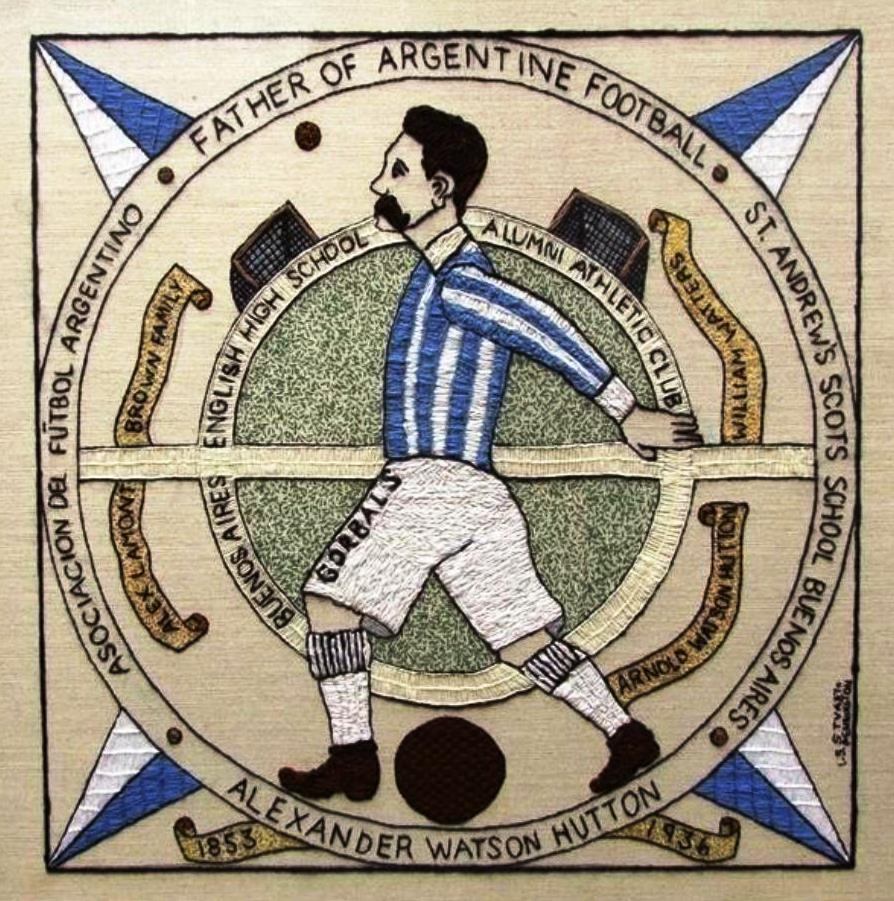
Despite the fact that the league’s statutes stated that the tournament would be held every year, in 1892 it was not possible for the championship to be repeated because of a lack of resources. The first glorious venture had an inglorious end, but only one year was needed for Alexander Watson Hutton to achieve what Alec Lamont did not complete: to establish football in Argentina once and for all. On 21 February 1893, Watson Hutton, together with representatives of Quilmes, Old Caledonians, St. Andrew’s, Buenos Aires High School, Lomas and Flores, refounded the league under the same name. This is considered to this day the founding date of the Argentine Football Association, AFA, which constitutes the same entity through the evolution of its statutes. Indeed, on the basis of this founding date, the Argentine Association is the first of its kind to have been founded outside Europe.
The great force of the first years of the Argentine championship was Lomas Athletic Club, which had been founded in the suburb of Lomas de Zamora, in southern Buenos Aires. From 1893 to 1898, Lomas won 5 of the 6 titles, while in 1897 the tournament was won by Lomas Academy, that is, the club’s second team, created so that there would be greater competition in the championship. The football club was founded in 1891 from the bowels of the Cricket Club of the same name, whose founder was James Hogg, that is, the brother of Thomas Hogg and co-founder of Buenos Aires Football Club in 1867. It was a club made within a district where there was a large concentration of English workers and technocrats and one of the founding clubs of the River Plate Rugby Championship, something that to this day reflects more the long history of the club, which now maintains only a rugby section in the first division, while its football section was dissolved in 1909.
The new tournament, despite the fact that it had few teams by today’s standards, increasingly attracted the interest of the British and progressively of the native population. Its success can be seen from a series of elements, such as the 500 spectators at the title match against Flores, with reports informing us that several of them had climbed trees to watch the encounter in 1893, while in 1899 a second division was also added, though without a system of promotion and relegation until 1906.
The foundation in Uruguay
To what extent the foundation and success of the Argentine league influenced football developments in Uruguay is something for which there are no specific sources to support it. However, it was after this first era of glory of the Argentine championship that a corresponding institution began on the other bank of the Río de la Plata. Montevideo, existing permanently in competition with and in parallel to Buenos Aires, from the years of Artigas onwards, experienced football flourishing in a corresponding way. Beyond the arrival of Poole and the extremely important foundation of Albion Football Club as a club of the natives, at a time when in Argentina football was played almost exclusively by the British, other teams that reflected the culture of the settlers from Northern Europe had been founded, forming a football network of a peculiar elite, which considered itself superior to the racially mixed working class, as well as to that originating from Southern Europe.
What is certain is that the criollo working masses had not yet embraced the sport as much as the British of upper and lower class positions. Thus, Albion Club was forced to retreat from its initial position of excluding the British, in order to ensure its viability. Alongside it, other important clubs were founded, such as Central Uruguay Railway Cricket Club, which was the factory team of Central Uruguay Railway and began its football journey in 1891; Uruguay Athletic Club, founded in 1898 in Punta Carretas from the union of two other clubs, American and Nacional Football Club; as well as Deutscher Fussball Klub, which was in reality founded in 1896 by German settlers, although its statutes were approved on 23 May 1897. These four teams, with enormous participation of Northern European settlers in their line-ups, started the country’s football championship in 1900, also founding the Uruguayan Football Association in the same year.
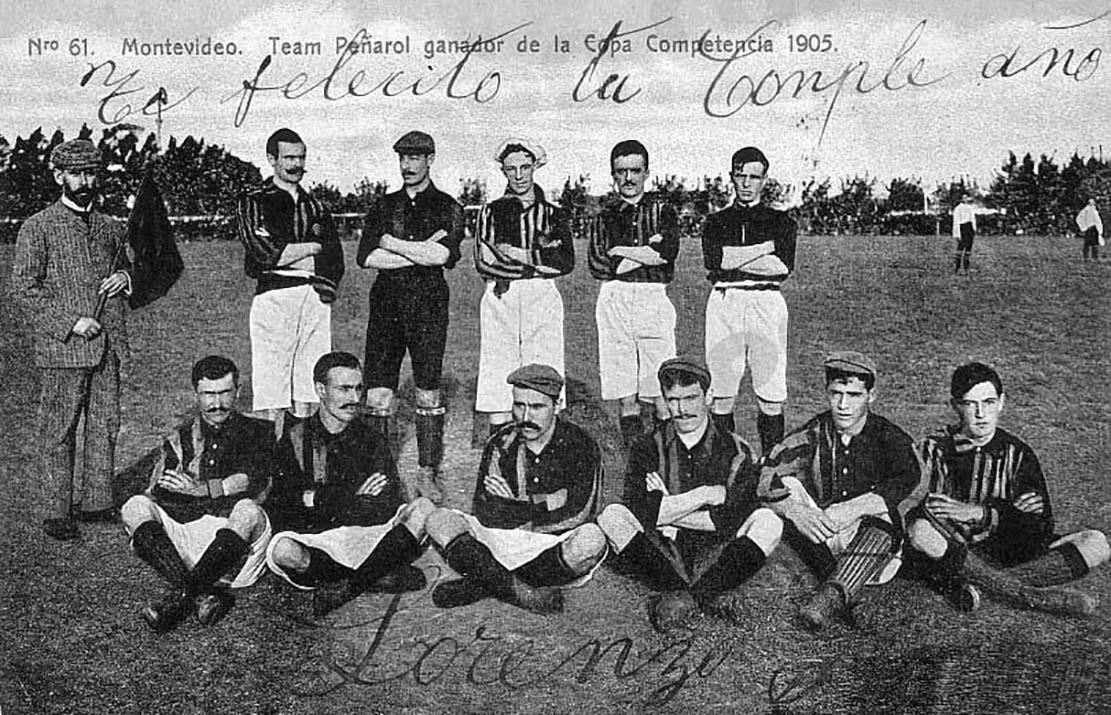
As a counterweight to the existence of these clubs, however, came the foundation of Club Nacional de Football. In Uruguay at that time, it seems they did not have much imagination when it came to names. Thus, while the British-dominated Athletic Club of Punta Carretas was the result of a merger in which Nacional Football Club participated, the criollo Club Nacional de Football was the result of the merger of the Athletic Club of La Unión, another area of Montevideo, in 1899. The colours of this “national” club were blue, white and red, inspired by the colours of the flag of the national liberator Artígas. The fact that the clubs of the settlers organized football for the purpose of their own entertainment and not the spread of football culture in the societies in which they lived is proven by the refusal of the 4 founding clubs of the federation to accept Nacional in the first championship of 1900. CURCC won that first tournament, while the following year Nacional was finally accepted and finished second, again behind CURCC. Nacional eventually won its first championship in 1902 and from those first years began an excessively monotonous rivalry between the two clubs, which continues to this day. At the moment these lines are being written, Nacional has won 50 championships, while CURCC, renamed Peñarol, has won 52. Of course, there are quite a few who argue that Peñarol is not really the evolution of CURCC, because in that case Nacional is the most successful club of the institution — but in which country do such mythical football stories not exist?
The fact that there were two championships in the two neighbouring countries, however, gave birth to yet another institution, which previously existed only in the metropolis of the sport — international competitions. The first game in history in which teams from the two capitals took part may have been organized by the British in 1889, but that first match, like the corresponding encounters that followed, were more friendly meetings between organized clubs that did not represent any national football culture and, naturally, the teams had not been selected or appointed by any national football institution. The matches of Albion, which played against teams from Buenos Aires, moved in the same spirit. These games looked more like early inter-club friendlies and had nothing to do with international encounters, as happened, for example, in Britain. Even a match held in 1901, where the teams appeared under the title “combined national teams”, was essentially an encounter between Albion and a random delegation of footballers from Argentina.
The first official game between the national teams of the two countries, which is at the same time the first recognized by the two football federations, took place on 20 July 1902, at Albion’s ground in Paso de Molino, Montevideo. The referee was Roberto W. Ruud, who came from Argentina, and attendance was measured at 8,000 spectators. For Argentina, the president of the federation Francis Hepburn Chevallier-Boutell as well as the Lomas player Juan Oswald Anderson selected the representative team, while Chevallier-Boutell also proposed the kits, with Uruguay playing in blue shirts that bore a diagonal stripe starting from the right shoulder, while Argentina played in light blue shirts, which looked more like the national football colours that Uruguay later adopted. For Argentina, 5 teams were represented by players who wore the national colours: champions Alumni with 5 players, Quilmes and Belgrano with 2 each, and one player from Lomas and Barracas Athletic Club made up this first eleven, which in its entirety consisted of footballers with English names. For Uruguay, by contrast, 9 Albion players and 2 Nacional players played in this match, with their names as a whole reflecting the criollo population of Montevideo. Argentina’s national team left this game triumphant with a 0-6 score, having in fact 6 different scorers. The most important thing, however, was that this encounter gave birth to one of the most historic classic international football rivalries, inspired the creation of the Lipton Cup and the Newton Cup, and also formed the background for a tradition that would continue on the world stage — and indeed much faster than anyone at the time could have calculated.
In Argentina, the British also dominated completely in the national championship, creating its first legend, which perhaps also sealed the end of a football era, that of the first foundation of national football. Alumni, that is, the team created by the graduates of Watson Hutton’s British High School, began from 1900 a tremendous run of success, winning 10 championships until 1911, losing only the titles of 1904 and 1908 to Belgrano Athletic Club, which was the continuation of Buenos Aires and Rosario Railway Athletic Club and was also made up of Englishmen, despite its name referring to the Argentine national leader of independence. Today the epic of Alumni lives only through the colours of Barracas Central, which was founded in 1904 and chose the same colours for its kit as the superpower of the era.
Football in the tropics
It may seem paradoxical today, but football was quite late, compared with the two countries of the Río de la Plata, in taking its first steps in Brazil. The climatic conditions, with the tropical climate constituting a condition very different from the one the British knew as ideal for sports and free time, perhaps did not leave the margins for those corresponding nuclei of “mad Englishmen” to be created, who would gather to “run around a ball”. The British of Brazil enjoyed the high temperatures as if they were on permanent holiday and showed little interest in the development of sports, even cricket, whose existence was almost identical with the existence of a British elite in any part of the world.
The story of how football began in Brazil is more a myth than a real historical development connected with social processes, something that perhaps also shows the small to negligible size of any football activity until the end of the 19th century. Instead of there being the first pioneers, then the evangelists who institutionalized the sport and afterwards the gradual development of competitions and a federation, the history of footballing Brazil begins directly from a single person. On 24 November 1874, Charles William Miller was born in São Paulo, and naturally, for a pattern that now seems stereotypical in historical narration to be repeated, he could only be the son of a Scottish railway engineer. Before he had even turned 10, in 1884, Miller went to study at Banister Court public school in Southampton, where he came into contact with football and cricket. In 1894, ten years after his departure, he returned by sea to São Paulo, arriving at Santos, the port of the Brazilian metropolis. On the dock his father was waiting for him “as if he were at my funeral”, as Miller himself later said, expecting his son to disembark with his degree in his luggage. What he saw, however, was 19-year-old Charles getting off the steamer holding two balls, one in each hand. “What are these, Charles?” his father asked him. “My degree,” Miller answered. “What did you say?” he asked again, astonished, only to receive the disarming reply: “Yes! Your son graduated in football…” Myth or truth? Even if this account comes from Miller himself, it is certain that the story could not have happened in this way, since his father had died 8 years earlier in Glasgow. Miller was simply placing himself in this way in the position of the evangelist of football for a country that lives and breathes for it, as well as for the mythology that accompanies it.
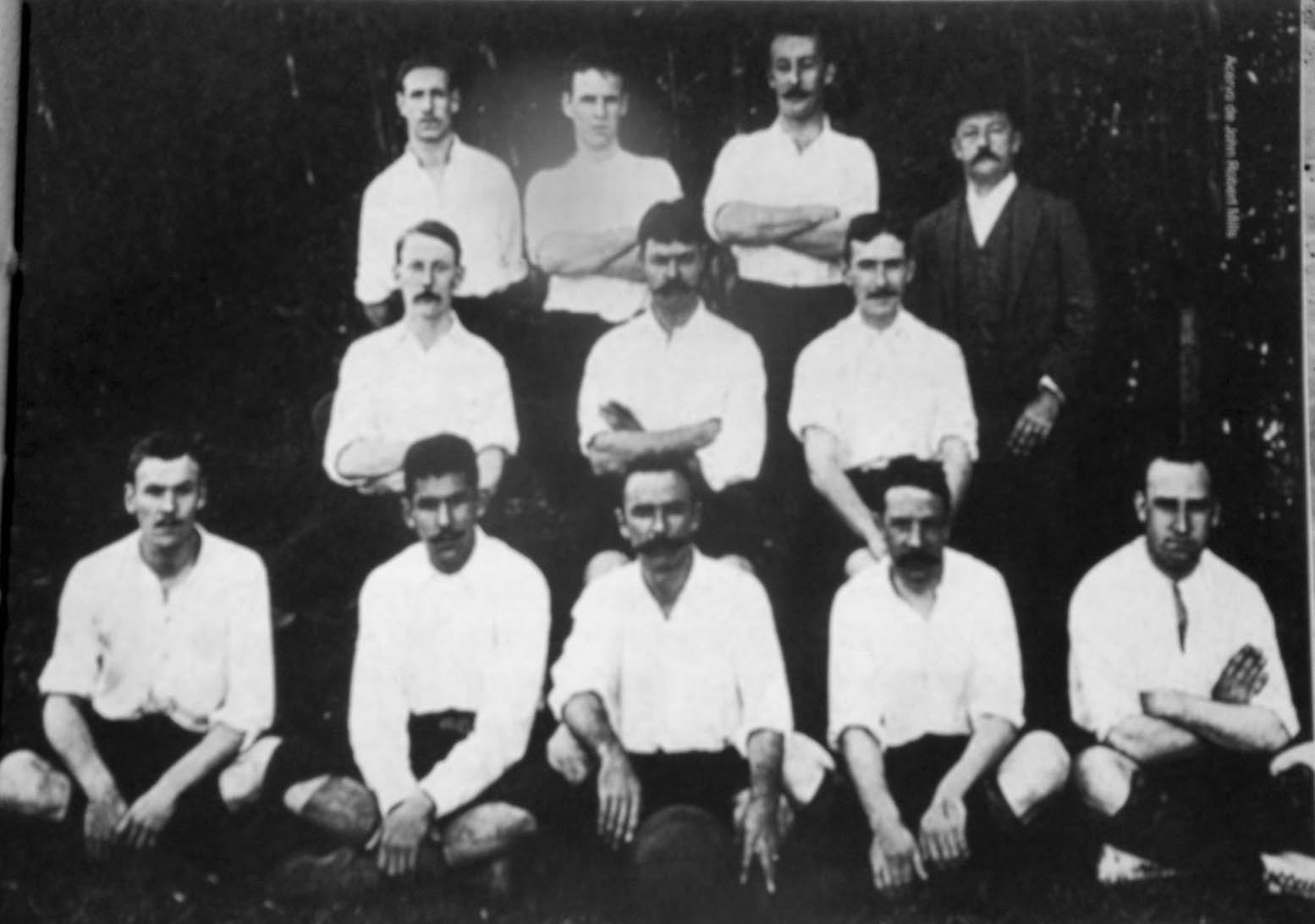
Beyond the myths, however, Miller was also excellent at organizing football in reality. Scattered references that survive speak of spontaneous games among church-connected Britons from 1872, while a report from 1874 informs us of the spontaneous organization of a game with modified rules by sailors in Rio de Janeiro. The first game, however, organized with the purpose of constituting the official beginning of football activities was the one that Miller organized within the framework of São Paulo Athletic Club, SPAC, in 1895. The club, although founded in 1888, had until then had a cricket section — following the usual order of appearance of sports in British clubs — and Miller was the one who organized its football section, making use — again according to himself — of another object that was in his luggage: a set of rules of the Hampshire Football Association.
Miller was also responsible for the creation of the Liga Paulista, the championship of the province of São Paulo that exists to this day and constitutes part of a peculiar football tradition of local championships, with the participation of the top teams that also participate in the national championship. The league was founded on 14 December 1901, with 5 clubs as its members: São Paulo Athletic Club, Internacional, Mackenzie, Germânia and Paulistano. All these clubs represented the elites of São Paulo, however, through their participation in such a football institution, they contributed decisively to the spread of the game’s popularity to all social strata.
Beyond the existence of the championship, one more event helped football win a more central place in the interests of the inhabitants of São Paulo. In 1910, the British team of London’s elite, Corinthian FC, for which Miller had played while he was in England, made a tour of Rio de Janeiro and São Paulo. The purely amateur team, which represented the ideals of the ruling class and for this reason did not adopt professionalism, regularly included tours in other countries among its activities, since it did not follow the calendar of the Football Association, refusing to accept the existence of professionalism. Corinthian FC emphatically won the matches it played, even against a peculiar national team under the name Brazil XIs, displaying a different style of football and demonstrating that the difference in level between the football played in Brazil and that of Britain was enormous. This, however, instead of discouraging the officials and footballers of the Brazilian clubs, acted as motivation for the organization and improvement of football at national level.
The tour of the Corinthians in fact left its mark forever on São Paulo, since the club founded in the year of the first tour, on 1 September 1910 by railway workers of Bom Retiro, and which is one of the most popular in the city, was named in honour of that British club: Sport Club Corinthians Paulista, historically transforming a name of the elite into a symbol of the popular strata. The foundation of Corinthians also has another great symbolic significance, since in the same area of Bom Retiro, around 1895, a game was being played by Englishmen about which a comment of the time said: “In Bom Retiro, … a group of Englishmen, a bunch of maniacs as they all are, meets every so often to kick something that looks like a bull’s bladder. It gives them enormous satisfaction and fills them with sorrow when this peculiar yellow bladder enters a rectangle formed by wooden posts.” Fifteen years after this vivid description of exotic football, that exact same place was becoming the home of a club that would represent its working class.
In Rio de Janeiro, although development came a little later, it followed steps similar to those of footballing São Paulo. The evangelist of carioca football was Oscar Cox, who was born in the city as the scion of a family of British origin on 20 January 1880. Instead of England, where Miller went, Cox travelled to French-speaking Switzerland and Lausanne for his studies, where he also came into contact with the football game. Returning in 1897 to his birthplace, he did not mention any story with balls corresponding to Miller’s, however, 4 years later, on 22 September 1901, he organized the first game in Rio de Janeiro, composing an eleven that faced Miller’s team, São Paulo Athletic Club. Within the following year he also founded one of the traditional great clubs of the city, which for decades constituted the football representative of the elite, Fluminense. Cox’s club, together with Botafogo, the factory team of Bangu, which broke the monopoly of whites in Brazilian football, Football and Athletic, Payssandu Cricket Club and Rio Cricket, competed in the first Campeonato Carioca in 1906. Fluminense won that first title, as well as three more in the following years, the second jointly with Botafogo, to emerge as the first great force of the city’s football. Indeed, in the 1908 championship, Edwin Cox, Oscar’s brother, finished as the competition’s top scorer in the colours of Fluminense, scoring 12 goals.
The second foundation of Argentine football
During the years when the British were occupied with founding cricket clubs and then developing football clubs, in order to satisfy the need to make use of their free time and transfer their culture to the place where they had settled, the local populations — those who counted themselves as local and bound to their new homeland, regardless of their origin — had other things to deal with, with the political history of Argentina during the 19th century consisting of successive conflicts, mainly between porteño power and the lords of the interior provinces. The independence of the new state itself, in fact, led to a very different state entity, mainly geographically, from the one envisioned by the pioneers of its creation, for whom the priority was to secure the political character of their vision, with the hegemonic role of Buenos Aires.
Beyond the loss of the Banda Oriental, which constituted a military centre of vital importance for the newly created republic, the conflicts in Upper Peru, between the forces of the Río de la Plata, the royal administration of Peru and the national-liberation forces of Bolivar, led in 1825 to the independence of the country that, in honour of the liberating hero, was named Bolivia. Much earlier, the lords of the provinces around historic Asunción, which was a city with extremely close historical and cultural ties with Buenos Aires, seeing the plans of the port’s First Junta, made sure to declare the independence of their territories, creating the state of Paraguay in 1811, with its constitutional establishment achieved in 1813 and final recognition by neighbouring states in 1843.
Thus, the only space that remained for the expansion of the republic of the Río de la Plata, east of the Andes, was the great expanses of the Pampas and Patagonia, where, however, indigenous populations were settled, while power was held by the local lords, who never wanted to compromise with the imposition of the authority of Buenos Aires. The day of national independence may be considered 10 May 1810, yet the territorial composition of the state of the United Provinces of the Río de la Plata remained fluid for many decades. The turning-point event for the constitutional institutionalization of the state that was finally named Argentina happened in 1852, when the leader of Buenos Aires, Juan Manuel de Rosas, was defeated at Caseros, and the following year the country’s constitution was drafted and adopted in Santa Fe, based on the American constitution and, together with whatever appendices, still in force to this day. However, this constitutional condition was signed without Buenos Aires, which withdrew from the confederation. The real union of the country would happen with the entrance of the capital into it in 1860 and its transformation from a confederation into a republic, which was, after all, the basic demand of the port administration.
The final unification of the country was ultimately what led to the creation of a new export model, with products such as meat and wheat being loaded onto steamships and floating refrigerators, the so-called frigoríficos, which formed the basis of rapid economic development. By the end of the 19th century, with the rise to power of Julio Roca, who applied an oligarchic plan of administration, with powers concentrated in Buenos Aires but also the securing of the hegemony of landowners in the interior, Argentina had become a capitalist paradise, promising opportunities to anyone seeking their fortune on its lands.
But the working class that arrived in order to find a better prospect in life brought its ideas with it too, ideas incompatible with a republican disguise of a colonial-type oligarchic system. Destitution in the working-class neighbourhoods and the hard life of immigrants, who now constituted the majority of the Argentine population, became the ground for trade-union activity to flourish, with perhaps the most crucial event being the foundation of the Unión Cívica Radical, a party based on pro-labour rhetoric which, beyond whatever participation and success it has had in national elections to this day, played an enormous role because it was a pioneer in the appearance of a political expression — and not always practice, something far more complex — that had nothing to do with the interests of one or another oligarch in the country.
The national unification of Argentina, the creation of a society that was no longer an old-type colonial fief but a bourgeois republic, was a necessary condition for football institutions also to be founded by the citizens of a state who were no longer only subjects and did not live there only to secure their survival. Thus, at the time when the national championship had already begun with the participation of teams that had almost exclusively footballers with British names, one after another, all the great clubs of Argentina, which excelled in the more than one-century path down to our days, began to be founded. The existence of a second and third division in the championship was, in fact, an incentive for the regular practice of football and participation in matches that created, beyond teams, the supporter base, the local identity and therefore the myth of each club.
Gimnasia y Esgrima
In 1901 the club of La Plata, Gimnasia y Esgrima, which had been founded in 1887 as a fencing club, as its name also testifies, created a football section. Gimnasia, as it is widely known, was founded by 50 members of the Spanish-speaking community of the city, only 5 years after the foundation of La Plata itself. The fact that it was not a British club places it in a prominent position in the history of Argentine football, since to this day Gimnasia holds the title of the oldest club participating in the Argentine championship.
River Plate
On the day of national independence, 25 May 1901, one of the greatest clubs of the country was founded in the port district of Boca, its name: Club Atlético River Plate! The club, which was based on port workers, was the result of the merger of two other clubs, Santa Rosa and Club La Rosales, while its name was the proposal of Pedro Martínez, who was inspired by reading the inscriptions “River Plate” on the crates of pier 3, that is, the British name for the Río de la Plata. The club’s first ground was located at Dársena Sud in the port of Buenos Aires, behind coal warehouses of the British firm “Wilson”, with the owner and the administrative executives of the company also being financiers of the club. From red fabrics of the same unit the first stripes on the white shirts of River’s footballers were also sewn, creating one of the most recognizable football kits in the world. River Plate’s working-class origin is also reflected in the fact that its first president, the doctor Leopoldo Bard, later became a deputy of the Unión Cívica.
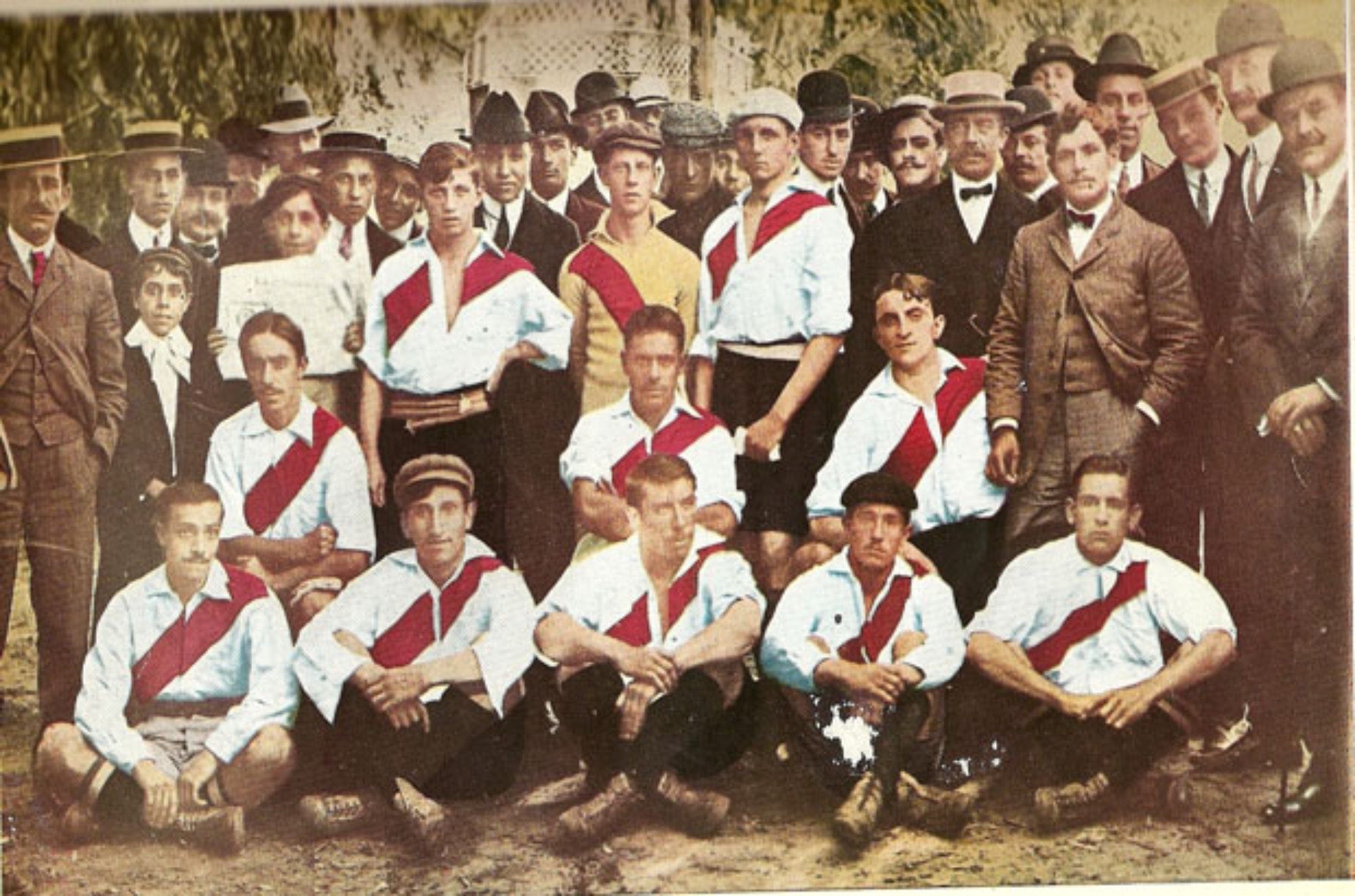
River Plate changed the location of its home several times, moving from Dársena Sud to the district that gave birth to it, Boca, then further south to Sarandí, then again to Boca, before ending up in 1923 in the middle-class area of Recoleta, changing its social space beyond its geography, until by the 1930s it had become the dominant team of the ruling class, with resources that completely changed its temperament, to the point that the club was called “millionaire”, millonario. In this way, it constitutes one of the rare examples of a people-born team that ultimately became the property and representative of the upper social strata, at a moment when the more usual transformation of football clubs has historically happened in the opposite direction.
Racing Club
In the same period, in a much more urban environment, the academic framework of the Colegio Nacional de Buenos Aires, a group of students founded Football Club Barracas al Sud on 12 May 1901. Barracas al Sud was then the name of the area now called Avellaneda, an industrial area south of the district of Barracas, as its name also testifies. This student club had the characteristic that it consisted exclusively of criollo members, something that until then had never happened in the history of Argentine football. There may have been clubs in which Britons did not participate, but there was significant participation by first-generation immigrants who brought their knowledge and passion for football from other countries. For example, the participation of Italians in the foundation of River Plate was very important.
About two years later, on 25 March 1903, this student team merged with the club Colorados Unidos al Sud, in order to create Racing Club. Socially, beyond its criollo characteristics, the foundation of Racing is of great importance, since it constitutes the foundation of a club not in the port, which is the centre of life and activities of immigrants, but in an industrial area that was developing because of the growth of Argentina’s economy, which no longer only transported meat and wheat from the interior to the port, but also produced industrial products, creating neighbourhoods of corresponding class composition in the capital. The participation, indeed, of many railway workers in the first steps of the club, who worked for Buenos Aires Great Southern Railway, proved that the social path of the creation of clubs by the British was not different from the one that ultimately created the clubs of the criollo populations too, while it also did not differ from the way many football associations were founded in Britain, creating a social pattern for the birth of the cells of football activity.
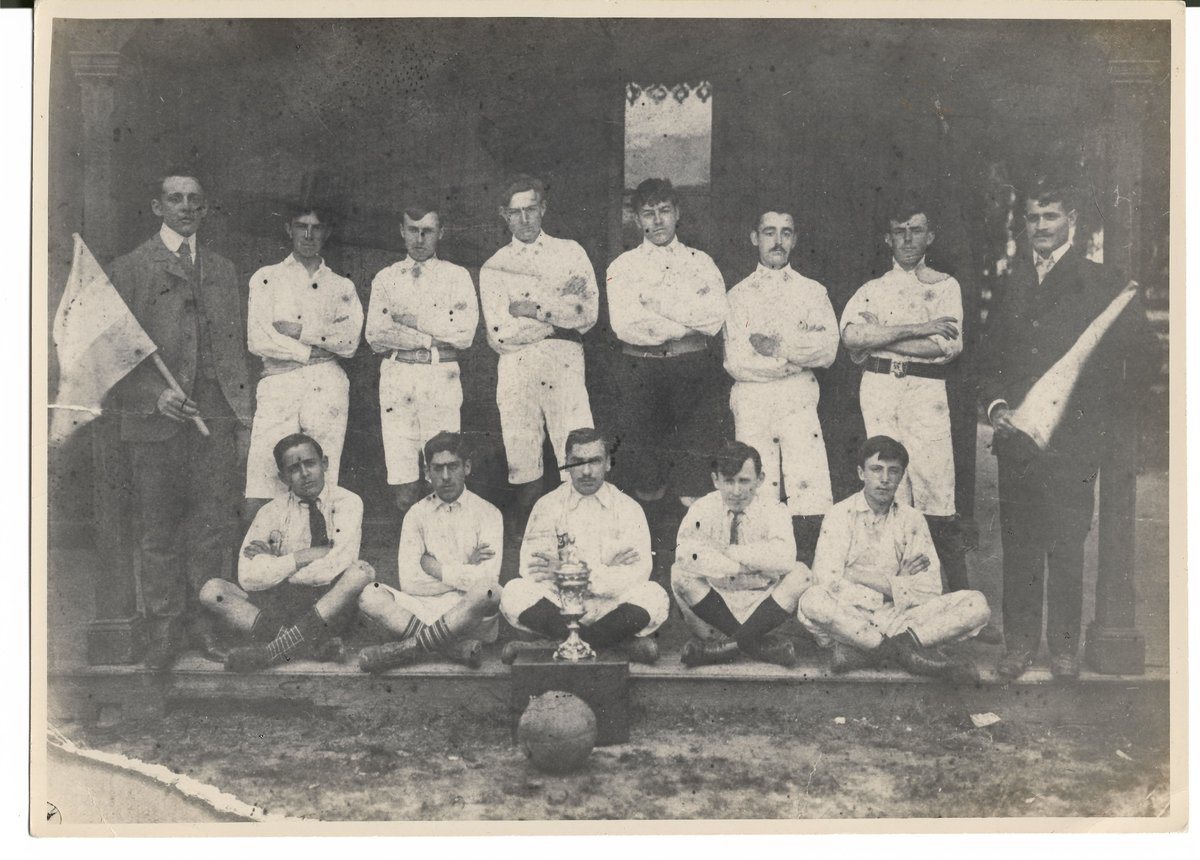
As regards the name of the team, it is said that it was proposed by the French-born Germán Vidaillac, when he read the title of a French motoring magazine. Other sources, however, mention something that perhaps has much greater historical relevance: Vidaillac did indeed read the name Racing in a sports magazine, but this name was already common for French sports clubs and in reality the reference concerned Racing Club de France, which in those years was one of the clubs that starred in French rugby and football, having its roots also in a college, the Lycée Condorcet, located in the 9th arrondissement of Paris.
Given the class composition of Racing’s members, as well as its social base, its first colours were yellow and black, as a reference to Central Uruguay Railway Cricket Club of Villa Peñarol in Montevideo. However, according to historical sources, there was the wish to avoid identification with a club from the neighbouring country and so the colours quickly changed to light blue and pink, which one might say recall the colours of the flag of Paris, while later light blue and white were adopted, which besides being the national colours of Argentina were by devilish coincidence also the colours of Racing Club de France.
Independiente
Racing would unexpectedly find, a few years later, housemates in industrial Avellaneda. A group of workers in a luxury clothing store in the centre of Buenos Aires decided to reject the invitation of Atlanta, which called them to its foundation, in order to found Independiente Foot-ball Club. Finding a ground in the centre of the capital, however, was a difficult matter for a working-class club, with the result that it began a nomadic path, using as its home grounds located in various areas, including Recoleta, where the Colegio Nacional was located, the school of Racing’s founders, while later it became the home of River Plate, from 1923 to 1937.
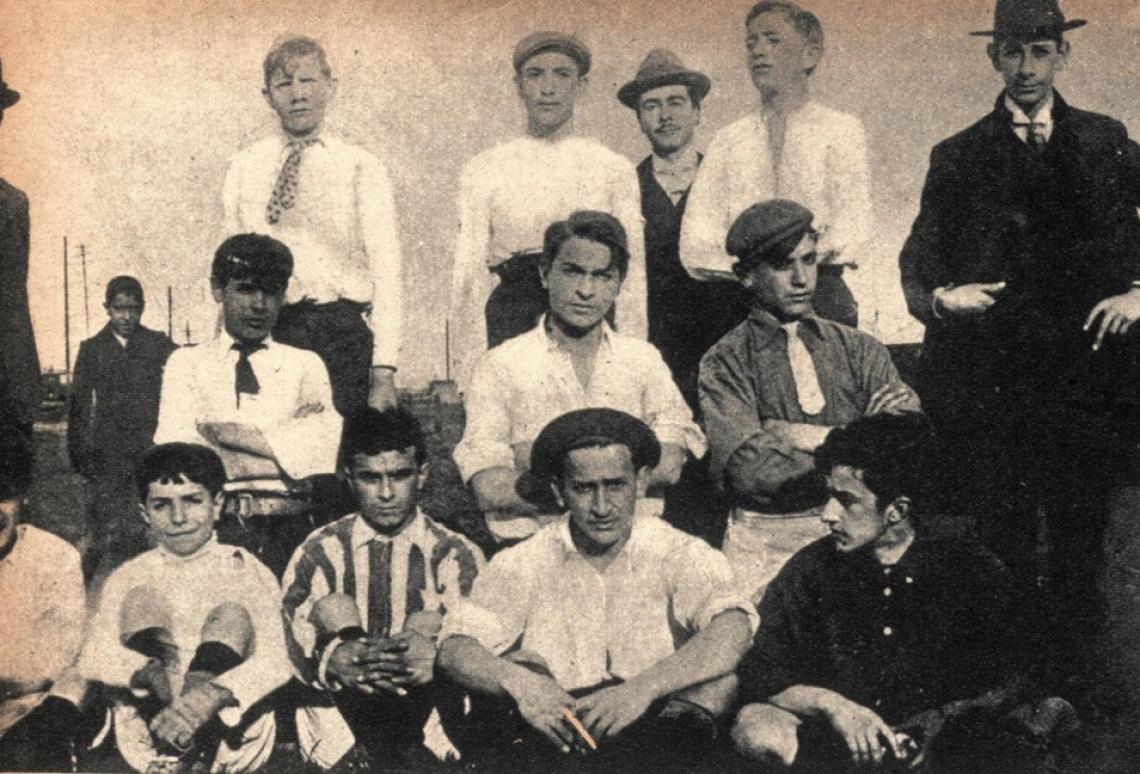
The club finally found an area in which to create its home on the southern side of the capital, where large expanses were still available. They found this area in Crucecita, which forms part of the wider area of Avellaneda. Thus, Independiente settled in 1907 in Racing’s vital space. This move created a great historical rivalry between the two clubs, while from 1928 Independiente moved literally next to its great rival, in central Avellaneda, with the grounds of the two teams less than 300 metres apart, without any construction visibly separating the space between them. At least Independiente, which initially played in a white shirt with blue details — and therefore would have looked very much like Racing — adopted red kits on 10 May of the same year, after the tour of Nottingham Forest in 1908.
Boca Juniors
A little further north, however, in the port, another football rivalry was beginning, one of the most legendary humanity has known to this day. On 1 April 1905, a group of boys who played in the football club Independencia Sud met in Plaza Solís of Boca with the aim of founding their own football team. At that time Boca was full of Italian immigrants, who naturally played their role in the foundation of River Plate too, but the children founding the new club were also united by the specific origin from Liguria, thus giving a more limited geographical component of origin that would accompany the history of the club forever. After several discussions, two days after that first meeting, they ended up adopting as the name of their club the name of the neighbourhood, Boca, adding Juniors as an indication of the age of its founders. 3 April 1905 is thus considered the club’s foundation date and Plaza Solís the place of foundation — to be precise, a bench. Having as their first colours white and black, they later adopted a light blue kit, until the arrival of the ship Oskar II of Nordstjernan/Johnson, which carried the Swedish flag, on 5 February 1907, inspired the blue and yellow colours of the club’s legendary shirt.
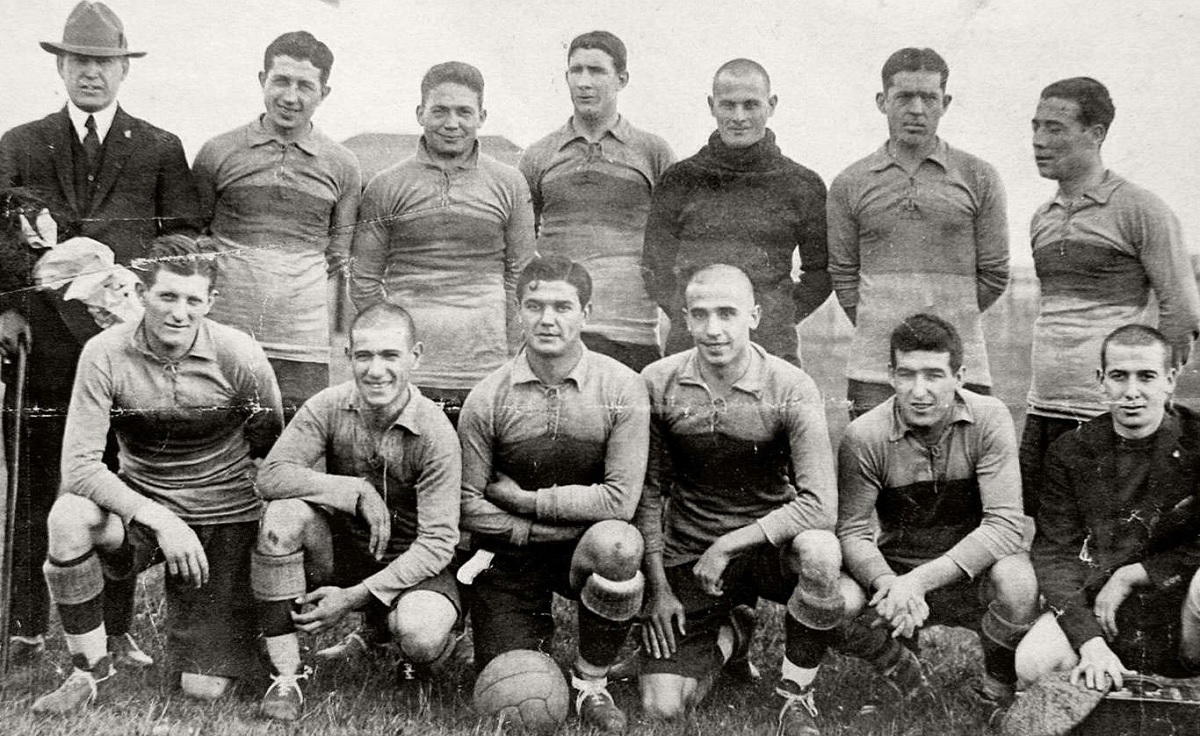
These four teams carry a history composed of a mixture of parallel and opposite paths. It is characteristic that while Racing’s roots are located in the middle-class area of Recoleta and the Colegio Nacional, the place that gave birth to the football club was industrial Avellaneda, connecting it with a very different social background. River’s path was exactly the opposite. Independiente, which began from the cosmopolitan centre, found itself in the humble industrial area competing with a team that was already there, though part of its history came from higher social strata. Boca, which appeared as a rival club of River, began its history opposite the team that was already settled in the port, only to see it leave, change identity and, in its mythology, betray its working-class and immigrant roots. In football, historical facts never grow old; they create eternal identities — and because historical facts do not change, the rivalry between clubs can only take place on the basis of a narrative that is interested more in mythical narratives than in an academic approach. After all, no one ever shouted a chant because they read something in a book; many, however, were moved by a story they heard, even if it was nothing more than a beautiful fairy tale.
San Lorenzo
This historic quartet of Buenos Aires clubs was completed, within the same decade, by a club that was created neither by workers, nor by students, nor by children of the port, nor by immigrants, nor by Britons, nor even by some section of the bourgeois elite. The fifth great club of Buenos Aires was born from another institution with a prominent place in the social history of Argentina and its capital: the Catholic Church. In Britain there were quite a few cases in which priests founded football clubs, with the aim of spreading the ideals of so-called Christian muscularity, while during the 19th century attracting young boys to football was also considered a way for them to avoid sinful acts, among them masturbation.
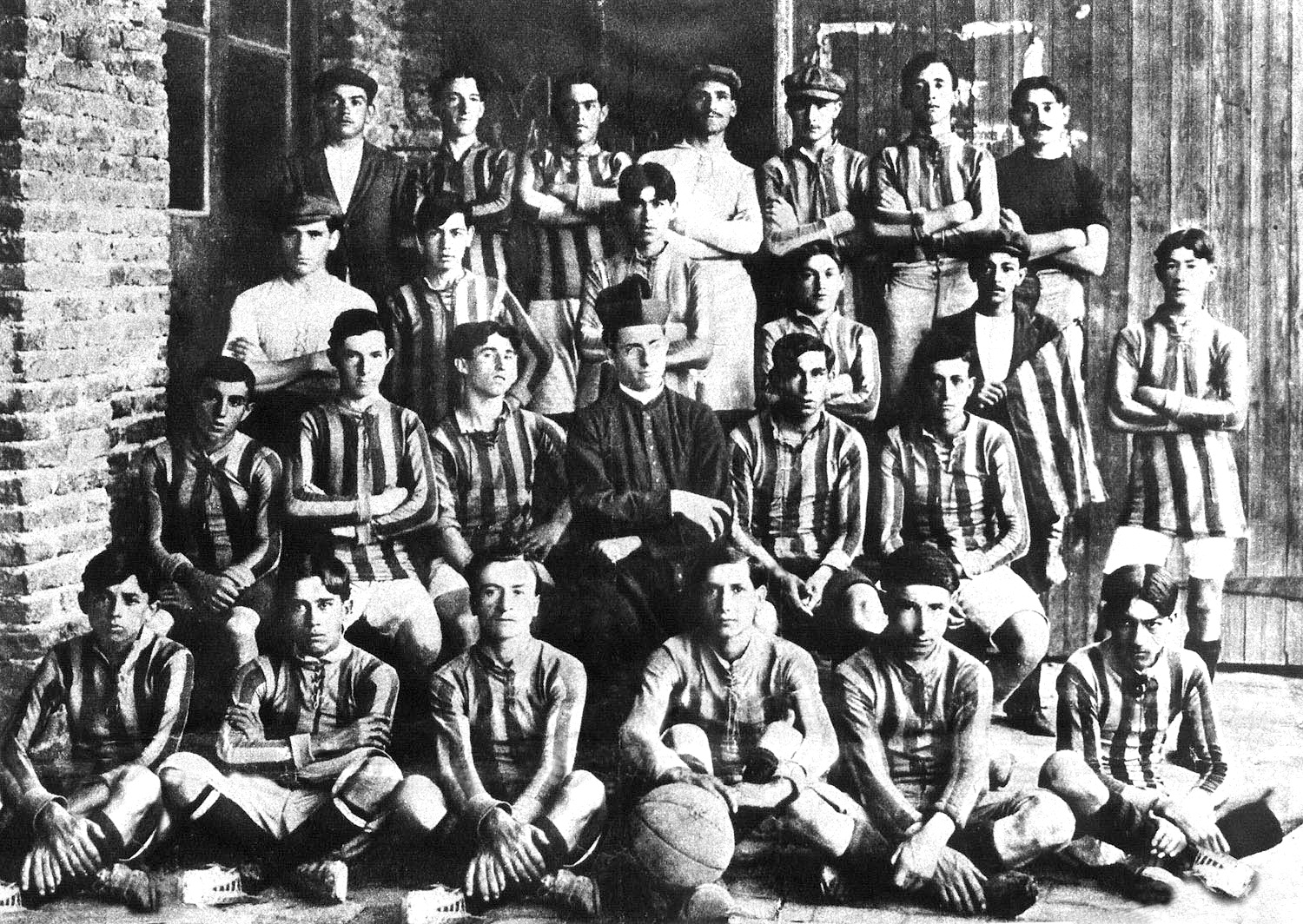
It is not recorded whether these thoughts passed through the mind of Lorenzo Massa, a Catholic priest, when he saw children playing in the streets of the district of Almagro. Massa found the space for the home of the new football club a little further southwest, in Bajo Flores, in order to found a club that would — by coincidence — also bear his own name: Club Atlético San Lorenzo de Almagro, which with this name honoured the origin of the children who found through the church their own football home, as well as Saint Lawrence of Rome and the battle of San Lorenzo of 3 February 1813, the only battle within the present territory of Argentina in which the country’s national hero, José de San Martín, fought.
These five great clubs founded by non-Britons during the first decade of the 20th century in Buenos Aires would monopolize Argentine football for decades and to this day constitute the cinco grandes, the giants that may at times be stronger and at other times weaker, but carry the tradition and heritage of the capital’s football. In the other cities of Argentina, in the same period, the clubs that would star in the national championship were also being created. In La Plata, from a split by students who did not fit within the elitist structure of Gimnasia y Esgrima, Estudiantes de la Plata was created on 4 August 1905, while in Rosario the teams that would star in the city, dividing it absolutely into two camps, were founded by Britons. Initially, the railway employees — who else, after all — of the Central Argentine Railway founded, on Christmas Eve 1889, the Central Argentine Railway Athletic Club, which was later renamed Rosario Central, while on 3 November 1903 Claudio Newell would found, within the framework of the Anglican College, the team Old Boys, which a few years later would also take the name of his father, founder of the college, Isaac Newell.
In the first decade of the 20th century there is an explosion of football clubs reflecting local identity, national origin, class position, the ideology of their founders. Every cause that brings together people who love football becomes a symbol in the name, colours and emblem of a club. Beyond the national championship, which by then had many divisions, in 1907, according to research by Julio Frydenberg, cited by Jonathan Wilson in his book Angels With Dirty Faces, there are over 300 clubs competing in Buenos Aires outside the official championship. One such mythical club is Sacachispas, a club of children who do whatever mischief they can in order to gather money to buy a ball, shirts and equipment for the neighbourhood team, recalling to a great extent the thirst of children to defend their own neighbourhood, at the same historical moment, in another part of the world, the “Paul Street Boys” of Ferenc Molnár, published in 1906 and referring to Budapest in 1889, proving that the history of humans is common and for this reason the same is true of the history of football.
And if in the Danubian countries the grund was the open space in the geography of the reconstructed city where the talents of an enormous national football school were born, a corresponding open space in the new urban geography of Argentina would create its own mythology. Open lots with uneven and hard ground, hosting games where the ball was not bought but often made thanks to the inventiveness of the players, with various available materials, where technique was necessary in order for one to develop their game against defenders, the ground and the erratic course of the ball, were the spaces that would give birth to the greatest myth of Argentine football. The potrero is the space considered to be reflected in the way the criollo populations approached football, within the barrios, the neighbourhoods dominated by destitution, where football was the only path of collective entertainment, in complete contrast to the cricket clubs and their well-trimmed green lawns, where the British had begun to play their own game. There was born the makeshift ball made by the hands of these footballers of poverty, the pelota de trapo; there lies the source of dexterity, of the gambeta, the dribble that defies the obstacles of the hard and uneven ground; there too was born the perception that in these difficult conditions a team game can develop only with short passes and cooperation.
The mélange of clubs that appeared within and outside the official championships was creating a country with its own football culture. This had to be expressed also at the level of institutions. The Argentine Association Football League, founded by Watson Hutton in 1893, was renamed Argentine Football Association, AFA, in 1903 and despite the fact that it remained connected to the English Football Association, it adopted Spanish as the official language of its proceedings. Within less than a decade, in 1912, players of British origin were clearly a minority, since of the teams competing in the first division, Porteño, San Isidro and River Plate had only 3 Englishmen in their ranks, Gimnasia and Estudiantes one each, and Racing none.
1912 was, however, also a year of great changes at institutional level. On 1 February the league, which essentially also constituted the national federation, was renamed, translating its name into Spanish, Asociación Argentina de Football, while nevertheless keeping the name of the sport in its British spelling. However, the path of the fully Spanish-speaking federation — in name too — was not strewn with rose petals, since a few months later it faced the first schism in the history of Argentine football. The revenues brought by the sport, especially from the tours of European and particularly British clubs, created an imbalance between the clubs that had established themselves and developed stadium facilities and those trying to stand on their feet. Thus, the latter created the Federación Argentina de Football on 14 June and organized a separate championship. Six teams participated in the Asociación tournament, with the remaining players of Alumni, whose epic had been completed the previous season, joining Quilmes. Eight teams competed in the Federación championship. Quilmes won one championship, and Porteño managed in the play-off match to beat Independiente, with whom it had finished level, to win the other.
This competition, however, seems to have strengthened the top division of inter-club football in the country, since the following season, in 1913, the two championships were held with the participation of many more teams: specifically, 15 teams competed in the Asociación championship, among them Racing, River and Boca, while 10 teams contested the Federación championship. In the Asociación championship, two very important historical events occurred, with particular symbolic significance for the sport’s passage into a new quality and content. In chronological order, on 24 August, at Racing’s ground in Avellaneda, in the presence of 7,000 spectators, the first official derby between River and Boca was held, which River won 2-1, having in its line-up only one British footballer. But the even more important element was the outcome of the championship.
After the completion of the competitive season, three teams were level, with 24 points, at the top of the table: Racing, San Isidro and River Plate. By now, there was a rule defining the destination of the trophy in the event of a tie, and it concerned goal difference. But Racing and San Isidro both had a positive difference of 36 goals, while River Plate had 23. Thus, on 28 December, the championship final between the hosts and San Isidro was held at Racing’s ground. With attendance reaching 9,000 spectators and Racing captain Alberto Ohaco scoring in the 11th and 70th minutes, the team from Avellaneda became the first champion of Argentina made up of an exclusively Argentine eleven. This success marked the passage into the era of football independent from the British presence, while a significant element is that San Isidro too had in its line-up only one footballer of British origin, the goalkeeper Carlos Wilson. The conquest of this championship by Racing went down in history as the “second foundation of Argentine football” and the club received the name El Primer Grande, which recalls this historic first.
After 1913 Racing won another 6 championships, 7 in a row in total, until 1919, between two schisms of Argentine football. Indeed, the last of these came with 13 wins in as many matches. This continuity in primacy definitively erased the myth of Alumni, since now a criollo team was repeating the same achievement. The fact that Racing was the first Argentine club to set the standards for the level of the sport at national level also gave it its best-known nickname, that of the Academy, La Académia, which does not reflect its industrial social base, but only its role as a pioneer in the development of a game with a purely Argentine identity, since it taught football to the other Argentine teams.
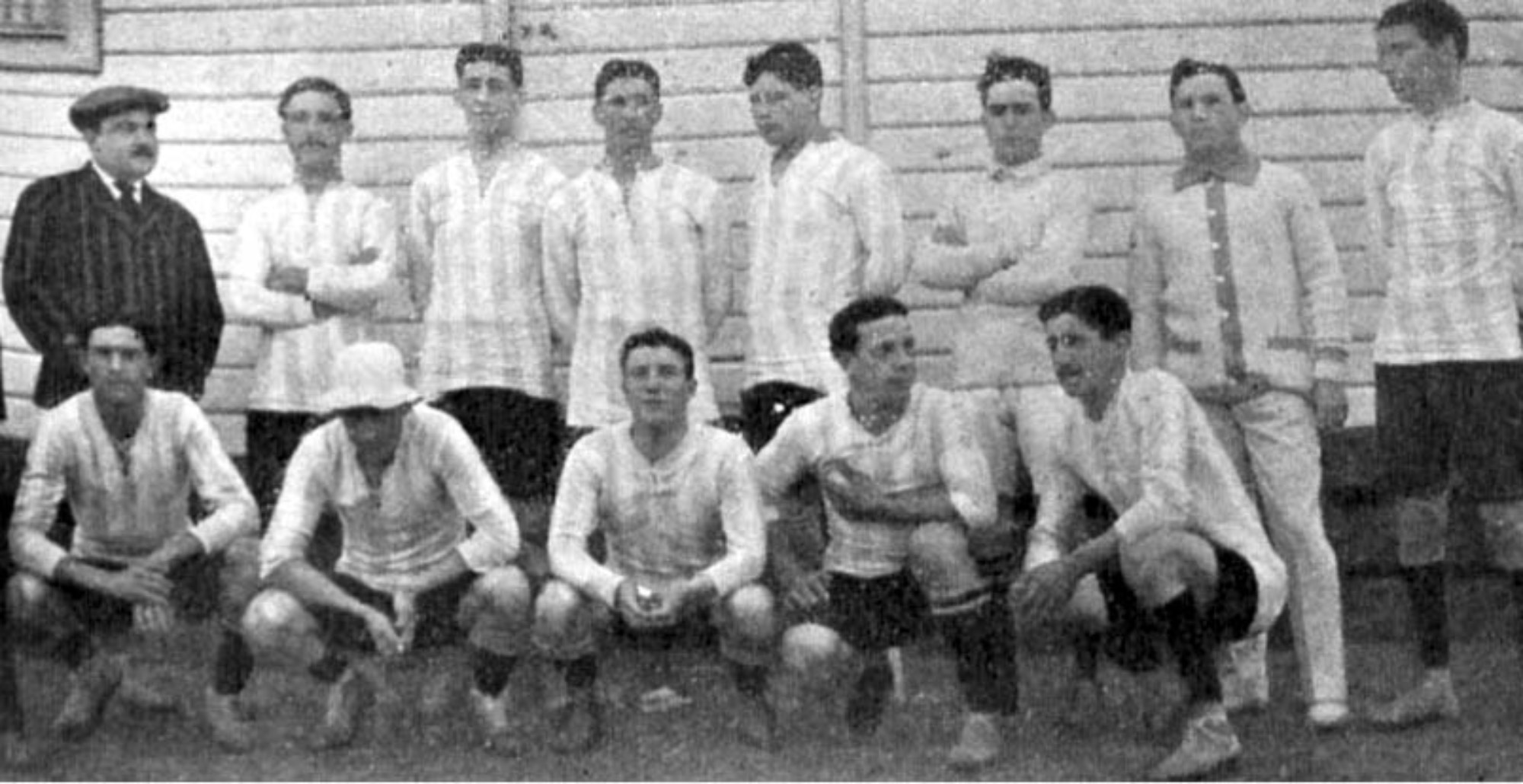
The victory of a purely — indeed exclusively — Argentine footballing ensemble was not only symbolic, however; it was the beginning of the superiority of a different style of play. Although the football of Buenos Aires was strongly influenced by the Scottish conception and therefore did not follow the temperament of the English game of physical strength, criollo football already had more elements of improvisation and personal inspiration, which had to do both with the physical and the social space in which it was evolving. Racing’s victory would constitute a rupture for the beginning, more than anywhere else, of a deep ideologization of the national football style, a narrative that found its starting point in 1913 and was also connected with the necessary, at political level, disengagement from British culture.
And if the overthrow in the dominance of Argentina’s national football, through Racing’s dominance, appears historically to mark the so-called criollization of the game, there is yet another side that is rarely examined in the available bibliography, on the basis of exactly the same facts. One of the most important changes that took place in Britain with the professionalization of the game at the end of the 19th century was the entrance of working-class thought, of its own style, which historically eclipsed the aristocratic style of the game beginning with Blackburn Olympic’s victory in the FA Cup final of 1883. This class redirection is not so visible in the Río de la Plata, since because of the era in which football developed in these countries, which was related to the period of rapid economic development and the mass arrival of the British, the style that arrived and dominated from the beginning was already the one that reflected the game of the British bourgeoisie and, at national level, of Scotland. But this style came “from above”. The first football style that won in Argentine football and came “from below” was that of Racing, of the Académia. This change would constitute the basis of the later national narrative which, connected with the political history of the 20th century, would make full use of this “humble” class origin of the national football style.
Uruguay, from the shadow into the light
Given its history, Uruguay was a state that seemed condemned to live in Argentina’s shadow. Montevideo existed as a naval base next to the important commercial port of Buenos Aires; Artigas detached the Banda Oriental from the United Provinces of the Río de la Plata, which seemed to be the natural space of the province; while as regards football, every step was happening in parallel, perhaps with a very small phase difference, with Argentina, and all the footballing extroversion of the inhabitants of Montevideo had one direction: towards the other bank of the Río de la Plata, where an autonomous and self-luminous football network was developing without having the same need for comparison with the small country opposite. But if there was an opportunity for Uruguay to emerge from this shadow in which, for historical-political reasons, it seemed condemned to live, that opportunity was football.
The 19th century is a constant conflictual struggle between the Colorados and the Blancos. Even this conflict, however, follows a parallel path with the civil wars of Argentina. The Colorados, who represent the interests of the urban centre of Montevideo, resemble quite closely, ideologically too, given their liberal economic conception, the Unitarios, while the Blancos resemble the Federales who represent the interests of large landowners. From 1865, however, and for about a century, governmental power remained permanently in the hands of the Colorados, who envisioned an extroverted Uruguay, based on export trade and transactions with Europe, welcoming immigrants in order to cover the ever greater needs of this economic development. Initially in 1903 and then in 1911, José Batlle y Ordoñez assumed the presidency of the country, connecting his name with this frenzied economic development. Batlle y Ordoñez was the son of the 8th President of Uruguay, the uncle of the country’s 30th President, and the brother of the grandfather of the 38th President of the state whose flag bears 9 white and blue horizontal stripes! The small country of the estuario seemed like a small South American paradise, which for decades was referred to as the “Switzerland of America”, while Montevideo was called the “Athens of the Río de la Plata” because of its cultural development, a nickname that probably did not refer to Athens of that era, but to the city-state of classical times. Within the framework of this development, the urban space was shaped with provision for the existence of open recreational spaces that would become the seed of an enormous football school.
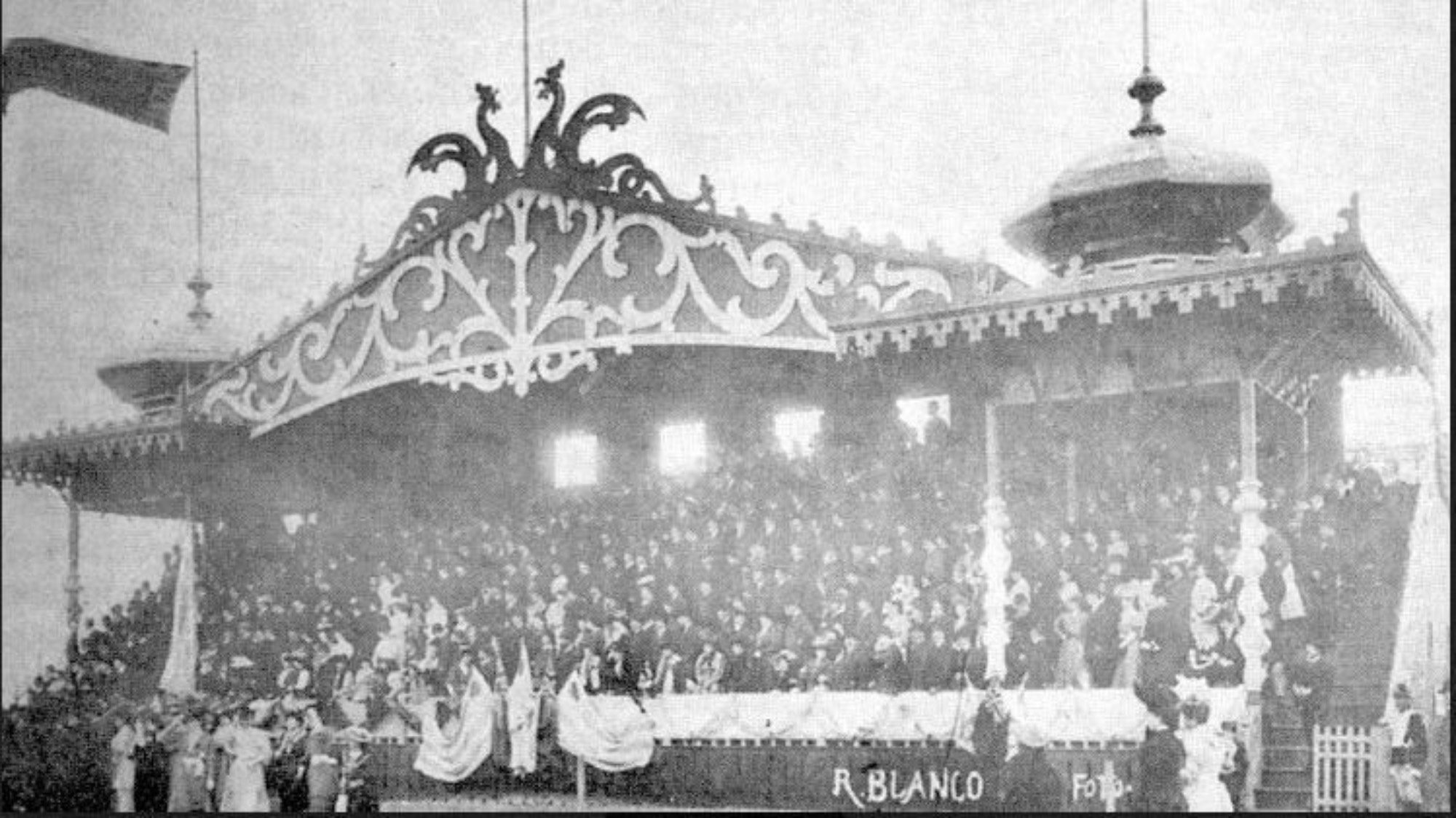
The championship that had started in 1900 also had the characteristics of the cultural opposition of Argentine football, only in Montevideo these were not expressed by an evolution that passed football from the British elite to the barrios of the criollos, but by two teams that expressed these two schools. Albion of Henry Lichtenberger may have been the first club that attempted to represent exclusively the criollo community of Montevideo, but the national pride of the country was historically undertaken by Nacional, dressed in the colours of Artigas’ flag. Opposite it stood a club that would become its eternal rival, Central Uruguay Railway Cricket Club, the team born from British railway workers and winner of the first two championships. A Scot, John Harley, born in Glasgow in 1886, was its captain and inspirer for 8 years. By the time of his retirement from active action, however, he and his team had been assimilated by the new homeland. Harley played as centre half for the national team of the country and CURCC was renamed Peñarol in 1913, taking the name of the neighbourhood where its home was located and cutting its ties with the railway administration. The colours remained yellow and black, inspired by Robert Stephenson’s locomotive Rocket, a legendary vehicle that began its journey on the most footballing railway connection in the world, between Liverpool and Manchester.
The national significance of the development of football, however, was recognized by an official of another team. Héctor Rivadavia Gómez, born in 1880 in the city of Dolores in western Uruguay, was a deputy of the Colorados, president of the Football Association, AUF, from 1907 to 1912, and an official of Montevideo Wanderers, later also assuming presidential duties. Wanderers were a club that broke the Nacional-CURCC duopoly twice in the first decade of the national championship, while another two championships up to 1910 were won by River Plate, a team that had begun its path 4 years before its Argentine namesake, and also had similar colours in its kits. River Plate was in fact the team that in 1910 managed to beat Argentine Alumni at the height of its glory, wearing kits that would later become the national colours of Uruguay.
As president of the Association, Héctor Rivadavia Gómez recognized the need for the national team to be organized in a more systematic and modern way. Thus, from a random selection of players, which was more or less what had happened until then, he introduced the idea that it should consist of the very best that national football had to show, that it should be prepared with the aim of demonstrating its superiority in relation to that of other countries and not merely offering an international spectacle with gate receipts from each match as an end in itself. Thus, while in Argentina the style of the game was changing identity and symbolism through the dominance of Racing, Gómez was not interested only in seeing this overturning, but in preparing it with the appropriate narrative his nation needed.
The first country against which the results of this path had to be tested was naturally Argentina. Between August and October 1912, the two national teams played each other for 4 international cups: the Copa Lipton, which had begun as an annual institution in 1905; the Copa Premier Honor Uruguayo, which began to be organized in 1911 and was played every year in Montevideo; the Copa Premier Honor Argentino, which had begun in 1908 and was played correspondingly in Buenos Aires; and the Copa Newton, which had been played almost alternately in the two countries since 1906. Uruguay did not lose any of these four games, winning three of them and drawing 3-3 in Avellaneda, while its 3-0 victory at Parque Central in Montevideo on 25 August stood out. These results, regardless of the fact that they did not continue with the creation of a one-sided dominance, showed that Uruguay could, with the organization of its national team, defeat its great neighbour.
That year two different types of heroes were also born for Uruguayan football. On the one hand there was the footballing excellence of Ángel Romano, who in fact transferred from Nacional to CURCC and then for 3 years to Boca, and who played in any position, standing out for his ability to dribble past all opposing players, including the goalkeeper, before scoring; and on the other hand there was the footballing romanticism of the existence of Abdón Porte, nicknamed El Indio, who played 200 matches for Nacional before committing suicide with a bullet to the heart, one night at the centre spot of the empty Parque Central.
The class division of Brazilian football
In Brazil, the beginning of the 20th century is marked by the so-called República Velha, the Old Republic, which constitutes a period of oligarchic dominance, through a federal system of power in which the local elites of the provinces, foremost among them those of São Paulo and Minas Gerais, concentrated power to a great extent. This system is based on the export of coffee, which has now become the main export product, replacing sugar, and although slavery has been abolished since 1888, this abolition in no way means social or racial equality. Post-slavery racism remains deep, characterizes the country’s social relations, while class exploitation through wage labour is surrounded and protected by a system that made every thought of class sociability forbidden, something that of course was not a uniquely Brazilian characteristic of capitalist production. The social strata are clearly divided into the bourgeoisie, a middle class that serves it and oversees the interests of the first, salaried employees in various positions characterized by relatively better conditions, and the great working masses living in destitution.
Football, which began with the enthusiasm of the elite, with young women of the bourgeoisie being impressed by the feats of the footballers to the point of writing poems about them, was also an enterprise of exclusion. But as the game gained in popularity, no one could stop the popular strata from playing in every open space, within the newly formed cities of an extremely divided urban planning. This was also the material basis for the foundation of working-class football clubs, which had not necessarily been founded by workers, but had been created for them. In São Paulo, the first working-class club was Clube Atlético Ypiranga, founded in 1906, while a few years later Corinthians was also founded, in 1910, as the team of the railway workers of Bom Retiro.
In the 1912 Paulista championship, Ypiranga was the last team in the league table and perhaps few paid attention to the presence of a club that did not come from the higher social strata in the game of the others. But in 1913 Corinthians would also participate in the championship. The danger that the teams of the lower social strata might increase even more gave birth to the anger of the officials of Paulistano, who decided to leave the league, creating their own, in which they were followed by Mackenzie and Associação Atlética das Palmeiras, which has no relation to the club of the same name that has written history down to our days. Thus, in the Paulista of 1913, 6 teams participated, with Americano emerging as champion, undefeated from 1911 to 1916; Ypiranga finished second, while Internacional also participated, a team founded by Brazilians, Germans, French, Italians, Portuguese and Englishmen; Germânia, with a clear national origin, which was later named Pinheiros; Corinthians; and a team of the port officials, Santos.
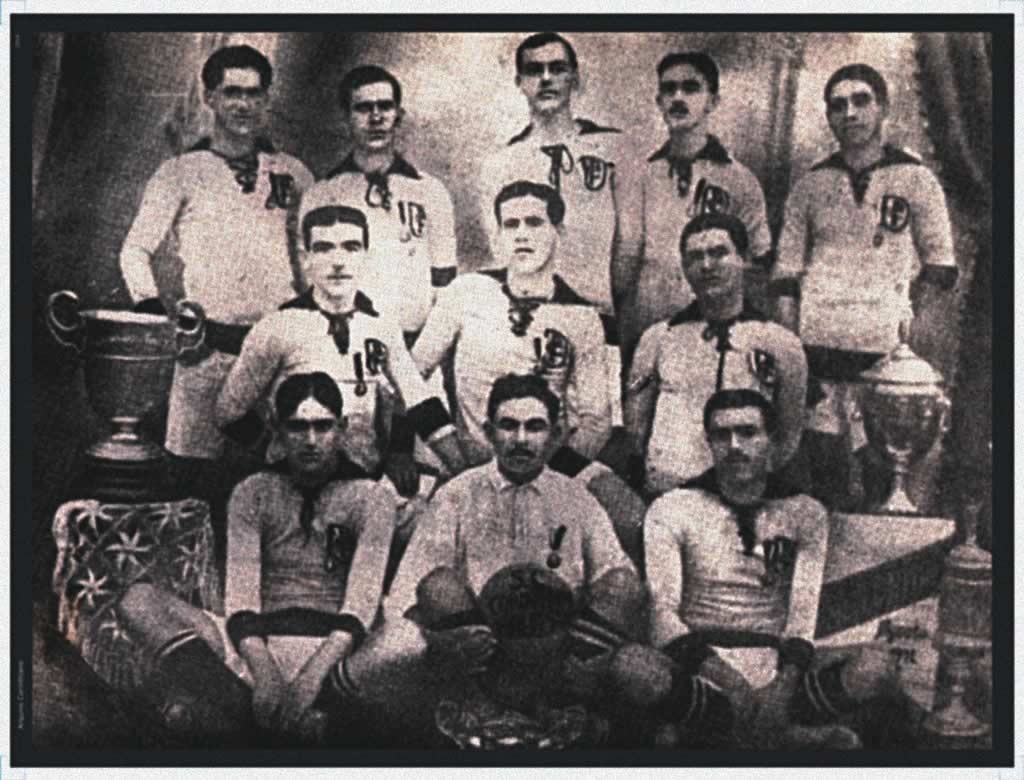
In 1914, the Paulista was won for the first time by a working-class team, Corinthians, which was admitted to the championship of the elite as “the best of the rest”. However, this move, which perhaps should never have been chosen by the officials of the Coringão, proved to be a farce, since the elites welcomed the club into their association, but forbade it to compete in their championship, limiting its activity to participation in friendly matches. In 1916, with the return of Corinthians, the LPF championship seemed ready to write a historic triumph, with the participation of 14 teams; however, the venture proved too ambitious to succeed, with the result that it was ingloriously interrupted in December, with Corinthians at the top of the league table and officially proclaimed champion. The first once-again unified championship of São Paulo was organized in 1917, and the ideological representative of the elite’s exclusivity in the sport, Paulistano, emerged as winner, though with the participation of the working-class teams, as well as of a new team of Italian immigrants, founded after the tours of Pro Vercelli and Torino in the city, in 1914. This was Palestra Itália, which would later be renamed Palmeiras, to become one of the football giants of São Paulo in its more than century-long history.
In those same years in Rio de Janeiro there was no schism, but this does not mean that there were no racial and class exclusions; on the contrary, the working-class teams were never accepted into the carioca championship. Perhaps the first working-class team of the city was Bangu Atlético Clube, which was founded in 1904 and, in order to break the exclusions, created the Liga Metropolitana in 1905. And if Bangu had quite a strong British element among the workers of the factory of the same name, a club that represented the racial and national mosaic in the working-class neighbourhoods was São Cristóvão, founded in the working-class neighbourhood of the same name in the port of Rio in 1909 and which played in the Liga Metropolitana from 1910. The powerful aristocratic teams of the city, such as Botafogo, Fluminense, América and, after the foundation of its football section, Flamengo, played in a championship where plebeians did not fit, nor of course those who were not white.
As perhaps happens throughout time, but in those years perhaps more openly, the racism of officials disappears when, with the help of some excluded race, they can win. Thus, a footballer of Fluminense, Carlos Alberto, son of a photographer, did not have skin white enough to be considered and feel equal in the 1916 match against his previous team, America. He therefore decided to cover his face with rice powder, which made the colour of his skin appear lighter. The supporters of America understood this trick, with the result that they began mockingly calling their opponents pó de arroz, that is, rice powder, thus giving one of the most characteristic nicknames that Fluminense would accept and adopt in its later history.
But the greatest Brazilian footballer of the era could in no way be characterized as white either, especially according to the terms of the racism of the elites of the period. Arthur Friedenreich, who was born in 1892, was the grandson of a German immigrant and the son of an Afro-Brazilian teacher, with racial mixture obviously visible in his features. However, his European surname was probably enough for the foremost among the racists, Paulistano, to include him in its line-up. Friedenreich was the deadliest scorer of the era, acquiring nicknames such as El Tigre in Uruguay and Golden Foot in Brazil. The presence of mulatto players with some of the elite clubs, however, showed the way for the conception of organizing the national team, which had to enter international football competition later than the southern neighbouring countries, which were already playing steadily against each other and represented the more advanced version of football on the South American continent. However, this choice of inclusion would not come without mishaps.
Brazil’s national team was late in being formed, since the country’s football was divided into the two great championships of São Paulo and Rio de Janeiro, which also fielded representative sides that played against European teams. Thus, comparison with the other countries of South America took place only with the help of intermediaries, that is, by observing how well the Brazilian representative sides of the cities did in relation to the clubs of Argentina and Uruguay. For example, Torino’s tour in 1914 showed the relative weakness of Brazilian football’s development, since the Italian team was too strong for the Brazilians, but did not manage to overcome the all-powerful Racing in Avellaneda.
The first official appearance of a national team representing the entire country is recorded on 20 September 1914, in a match held at Gimnasia’s ground in La Plata. However, a week later, the first Copa Julio Roca was organized, an institution in which the two teams, Argentina and Brazil, participated for the first time in honour of Alejo Julio Argentino Roca, the president of Argentina who connected his name with economic development at the end of the 19th century, a few days before his death. At Gimnasia’s ground, Brazil this time managed, perhaps unexpectedly, to win the encounter against a much more experienced Argentine team, achieving the first victory of its History, as well as the first victory against its most traditional rival. Now the three great countries of South America have constituted Federations and national teams, while other countries of the continent, such as Chile, which followed Argentina’s steps in almost all developments — political, social and footballing — follow the same path.
1916 – The first great institution
On the occasion of the celebration of 100 years since the Revolution of 25 May, in 1910, the Argentine Federation invited the national teams of Uruguay and Chile to a three-nation tournament named Copa Centenario Revolución de Mayo. This was the first international tournament held on the South American continent and the only one, beyond the British Home Championship and the Olympic Games, known to the football world up to that point. With the presence of several Britons still in the line-ups of all the participants, Argentina managed to prevail 5-1 over Chile and 4-1 over Uruguay in order to win the title.
This institution did not continue, but a few years later, on the occasion of another Argentine national anniversary, the 100 years since the signing of the Declaration of Independence of Argentina, on 9 July 1816, the Argentine federation once again invited the same teams, as well as Brazil, to a multinational championship, where each team would face all the others, named Campeonato Sudamericano. This was a first-rate opportunity for a network of officials, foremost among them Héctor Rivadavia Gómez, the Colorado deputy of Uruguay and official of Montevideo Wanderers, to set in motion a vision for the creation of a football network, with permanent characteristics and competitions, in South America.
Despite the fact that FIFA had been founded in 1904, the federations that were founded in South America were, at the beginning of the 20th century, dominated by the British, while up to a point they also had organic relations with the Football Association, with the result that they could not be considered autonomous national football federations and join the new international confederation. Nevertheless, even the British federation itself was not an enthusiastic supporter of the idea of a world institutional authority for football, especially outside its own lands, considering that the footballing quality of every other country in the world could not be regarded as equal to that of the metropolis of the sport. For this reason, despite the fact that it entered FIFA in 1905, it withdrew and returned twice, finally remaining a permanent member in 1946. This means that at the moment when almost no one in Europe was playing football, as the murderous First World War, the war of the trenches, was raging, the footballing flowering in South America had reason to organize itself at regional level, creating the first continental confederation, the Confederación Sudamericana de Fútbol, or CONMEBOL, with Héctor Rivadavia Gómez as its first president and with the date of foundation being the centenary of the Argentine Declaration of Independence, 9 July 1916.
The foundation of CONMEBOL was not merely pioneering; it was an element that set South American football apart and contributed profoundly to its evolution into the locomotive of world football until the middle of the 20th century, since about 40 years passed before the next confederations were founded, the AFC in Asia and UEFA in Europe, on 7 May and 15 June 1954 respectively. As regards the Campeonato Sudamericano, which would later evolve into the famous Copa América, it would find equivalent competitions 50 years later, in 1956 in Asia, in 1957 in Africa and in 1960 in Europe, with political developments and the two World Wars naturally playing a decisive role in this delay, since beyond the destruction they caused and the economic and social delay, they expressed the hostile relations between states that would not, under these conditions, create a common football network.
That first South American football championship began on 2 July 1916, with Uruguay beating Chile 4-0, while a few days later, on 6 July, Argentina also faced Chile, winning 6-1. On 8 July Brazil played its first match, also against Chile, but the Seleção failed to leave victorious, obtaining a 1-1 draw. The score was the same two days later, in the match between Argentina and Brazil, while on 12 July Uruguay beat the Brazilians 2-1. It is characteristic that the tournament had been made for the great duel between Argentina and Uruguay, since Chile first and Brazil afterwards played all their matches successively, almost every two days, before the ground was prepared for the decisive match of the competition.
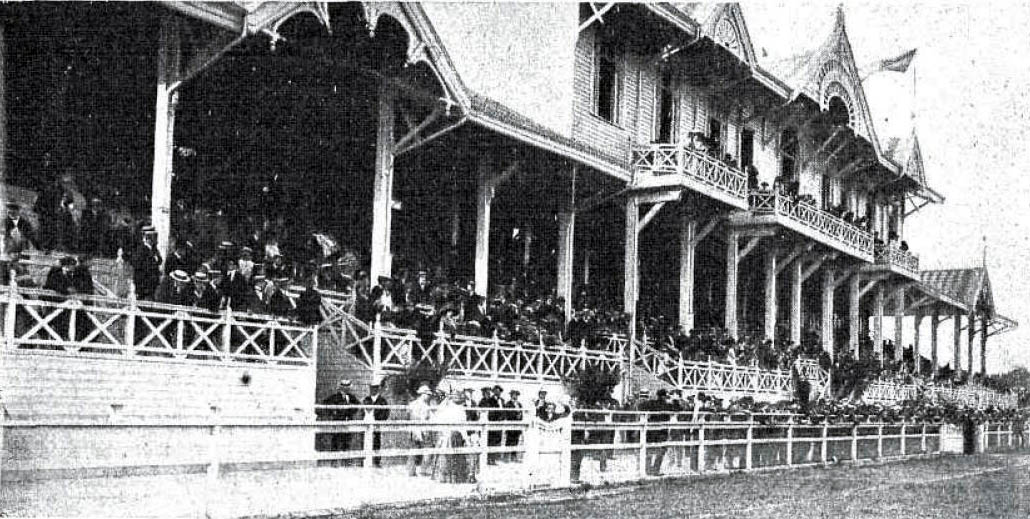
On 16 July 1916, one more symbolic historical stamp was placed on South American football, showing that it had left the hands of the British settlers once and for all. The sport that had begun on cricket grounds, with teams eating sandwiches and drinking beer before matches, with closed clubs that did not welcome the working masses, had now been handed over to popular feeling, and the intensity of the national football conflict between the traditional rivals, Argentina and Uruguay, did not allow their match to be played for more than 5 minutes, as incidents broke out at Gimnasia’s ground. Argentina absolutely needed victory in order to win this first institution, while Uruguay, which had also beaten Brazil, could leave with the trophy even with a draw. The day after the incidents, the match continued under the eyes of 17,000 spectators at Racing’s ground, and ended with a goalless draw that gave Uruguay its first international title!
The incidents at Gimnasia’s ground were not the only ones that left their mark on the history of Latin American football. The racism that existed in the societies of the time was also expressed inside the ground, with consequences for the national teams and for the physiognomy of their game, which would determine developments for several decades. In Argentina’s match against Brazil, the home supporters called the Brazilian players “monkeys”, with the Federation considering this the greatest shame of its presence and forbidding the participation of non-white players in the representative team. The Argentines, inhabitants of a country into which millions of white Mediterranean immigrants had flowed, which had been shaped demographically after successive invasions of the interior provinces combined with hecatombs and the essential disappearance of the indigenous people, as well as the comparatively fewer slaves of African origin having mixed for centuries with other races, believed that they were a Latin American nation of purely Europeans, using this stereotypically given quality as an element of superiority over the rest of the peoples of South America.
In complete contradiction, however, with the racist theories that existed in the heads of Argentines and Brazilians, the top scorer of the tournament was the Black Uruguayan Isabelino Gradín, the Peñarol footballer who scored 2 goals against Chile and 1 against Brazil and in the following years would win 4 gold medals in the 200 and 400 metres, in 2 editions of the South American Athletics Championship. Gradín developed into a legend of Peñarol, while the way he played inspired the Peruvian poet Juan Parra del Riego to compose in his honour the poem Polirritmo al jugador. Without things being idyllic as regards racial exclusions in Uruguay, the multi-racial character of the national team was never questioned and was used as one of the most important weapons for the small country to achieve its aim of international recognition through football.
The following year, the Campeonato Sudamericano was organized with the same four countries participating in Uruguay. The calendar was more balanced for the two theoretically inferior teams, Brazil and Chile, with Brazil however beating Chile 5-0 in their match, yet it had been made in such a way that it would again be decided on the last matchday between Argentina and Uruguay, who won their matches against the other two teams. The “final” at Parque Pereira was decided by the goal of Carlos Scarone, who together with the tournament’s top scorer, Ángel Moreno, had returned to Uruguay after a brief spell in the Argentine championship and both played for Nacional.
In 1919, the third edition of the Campeonato Sudamericano would take place in Rio de Janeiro, and Brazil wanted to prove more that it had a correct theory than a good football team. More precisely, it wanted through its football team to confirm dominant theories of racial eugenics, which, with the necessary scientific cloak, came from racist Europe. These theories argued that the youth of the nation, with attention concentrated on white youth, had to go outside, exercise, in order to become representatives of these eugenic theories. Behind these theories stood an entire system of intellectuals, such as the playwright Coelho Neto and the journalist Carlos Sussekind de Mendonça. Despite their ideological identification, the former saw football as the path towards the ideal physical reshaping of the white race, while the latter feared that this game, which was becoming the property of every race in the streets of the great Brazilian cities, constituted decline for the youth of the country. In the opposite direction, however, stood other intellectuals, such as Lima Barreto and Graciliano Ramos, with the former emphatically supporting a local multi-racial game and the latter blasting the funding of elitist clubs at a time when there was hunger and destitution among the popular strata, before being imprisoned as a member of the Communist Party.
Against the critics of the ideology of an oligarchic state based on racial exploitation, as naturally an expression of class exploitation, the national team of Brazil would compete at Estádio das Laranjeiras, an expanse in the area of the same name, where the middle and upper strata of the city of Rio lived and which constituted the home of Fluminense. In the first match, against Chile, came the first triumph, 6-0 with a hat-trick by the hero of the local team, Friedenreich, while a week later, in a ground to which 21,000 spectators had arrived, Brazil imposed itself on Argentina by a score of 3-1. Meanwhile Uruguay had beaten Argentina 3-2 and thus the Albiceleste was out of the battle for the title, while Uruguay also beat Chile 2-0, so that the scene of the previous years was repeated, though this time it was made for Brazil to meet Uruguay in the informal final of the tournament. Despite the fact that the Celeste took the lead with goals by Gradìn and Scarone, Neco in the 29th and 63rd minutes equalized for the hosts and that was the final score of the match. Given the tie in points, the play-off match for the title was set for 3 days later, with 27,500 spectators flocking to Laranjeiras. The match was tied in normal time, 0-0. Thus the two teams continued into extra time, which consisted of two 30-minute halves, the longest in the history of the institution. In the 122nd minute Friedenreich scored and gave Brazil its first international title.
29 May 1919 was the day Brazil came out of the footballing margins of South America and began a path towards the fantasy of the world summit and eventually its conquest many years later. This national victory was celebrated with paroxysm and the theories of eugenics ignored the fact that the footballer who gave victory to the national team was the son of an Afro-Brazilian teacher. Even the sounds that held popular memory, the song of the Black flautist, saxophonist and composer Pixinguinha, titled Um Zero, that is one-nil, were a result of racial mixture and of the musical tradition of the Africans who built the country enjoyed by the white elites, descendants of colonialists, landowners and industrialists.
In 1920 it was Chile’s turn to organize the Sudamericano, with Uruguay returning to the top, as Chile took the crucial draw from Argentina, while the institution had to reach its 5th edition, that of 1921, for the country that had inspired it and theoretically surpassed all the others when it began, Argentina, to win its first title, creating a tradition that today places it as the most successful team of the institution. The great protagonist was the tournament’s top scorer, Julio Libonatti, footballer of Newell’s Old Boys, born in 1901 in Rosario, who later played in Italy for Torino, Genoa and Libertas Rimini. Libonatti, a descendant of Calabrian immigrants, would later also play for the Italian national team, being the first of the Latin American footballers who took Italian citizenship in order to play with the Squadra Azzurra, the so-called Oriundi. In the 1921 Sudamericano he scored the decisive goals that settled the results against Brazil and Uruguay, while he also opened the scoring in the 3-0 victory of the albiceleste over Chile. As also happened in Brazil, Argentina’s international victory opened the doors for what was perhaps the most deeply ideologized mythology of a country’s football identity.
Pibe, El Gráfico and Borocotó
In the elections of 1916, the Unión Cívica Radical, UCR, that populist and labourist party which appeared at the end of the 19th century, breaking the political monopoly of the landowners and the ruling class of the port over political power, won the national elections and Hipólito Yrigoyen, also known as the “father of the poor”, assumed the presidency of the country. These were the first direct elections in Argentina with universal participation of the population and secret ballot and for this reason they are considered the country’s first truly free elections. The republic that had begun its course a century earlier was now becoming, in substance, a bourgeois democracy, with the participation of the popular masses in the electoral process and the emphatic entrance of a completely different political force that had no relation either with the colonial past or with the elites that initially emerged from it and then rose as the ruling class of the new state.
Football had already passed into the possession of the popular strata of the industrial cities with Racing, at least as regards collective consciousness; the national federation had renounced all the old British characteristics it had carried until the end of the first decade of the 20th century; and the political situation of the country seemed to reflect exactly the same thing that was also reflected in its football competitions. This is yet another indication that football is the reflection of social, political and, naturally, class correlations. Usually, historically, it follows them, but when for whatever reason the latter cannot be expressed, football, as a social phenomenon that expresses the material basis of movement of each society, can also express them in a precursor way.
What was expressed on 2 April 1916 could not but also seek the ideological basis on which perhaps the entire History of a country would rest from that moment onwards. A new conception of the nation, which after colonialism had been hidden inside conflicts between lords, had to go hand in hand with popular tradition, with the inhabitants of the barrios, the immigrants, the port, industry, and nevertheless not constitute neutral ground, but a distinct culture capable of irrigating with pride. Football was obviously instrumentalized in this affair, as a prominent phenomenon capable of creating every kind of identity and sense of belonging, but it was also shaped through this process. Argentina became the country which, as Jonathan Wilson writes, “ideologizes its football more than any other.”
A strange historical mixture composed this national expression, which today, through historical distance, seems paradoxical and unnatural. For example, Italian immigrants, who came by crossing the great ocean, with several of them, the so-called golondrinas — the swallows — working seasonally in their two homelands, dressed in the outfits of the gauchos, the free horsemen of the pampas, in the attempt to prove that the two elements, the culture of the country they had left and a completely foreign piece of the culture in the country they had reached, constituted an indivisible whole. With ever greater frenzy, the population of Buenos Aires and of the other cities, regardless of its cultural origins, adopted a peculiar Argentine way of life, organizing asados, drinking mate, in order to create a forced unified national culture capable of erasing the characteristics of a mosaic of ethnicities inhabiting Argentine land. This was the process of Argentinidad.
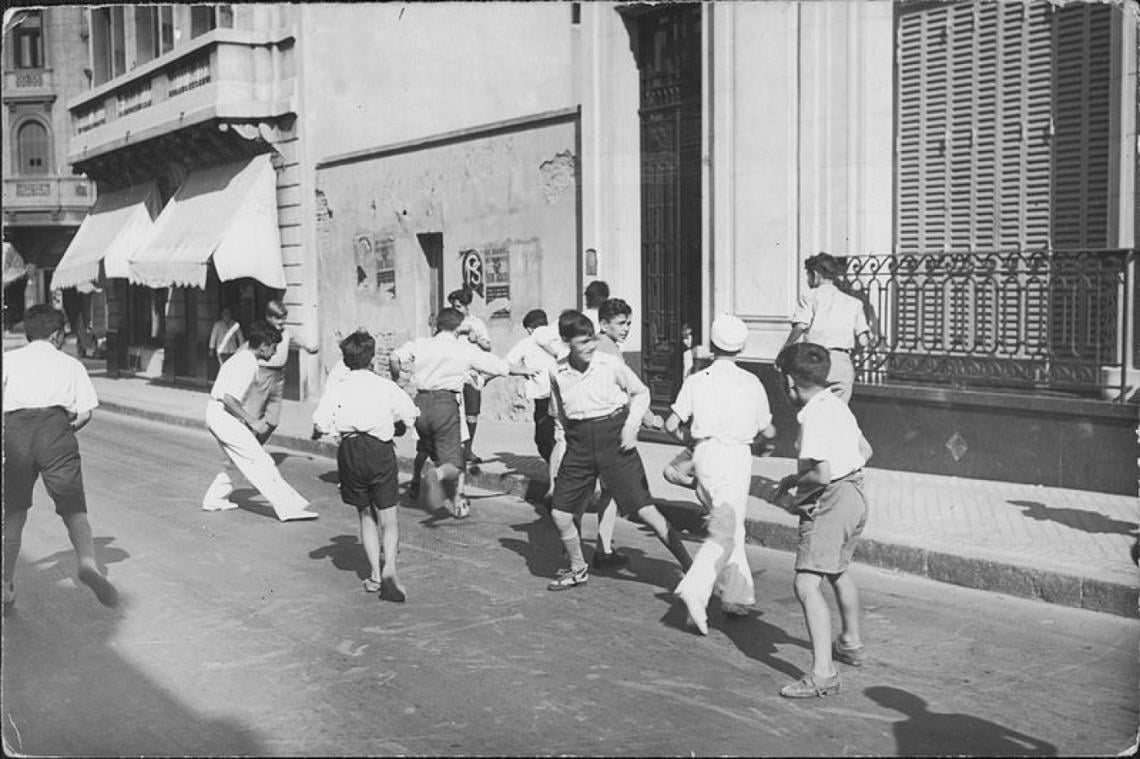
The most important ideological organ of this process was a weekly printed medium, the magazine El Gráfico, which first circulated on 30 May 1919. Its first issue had on the cover a full-page photograph of the crowd outside the Casa Rosada, the presidential palace, for the anniversary of 25 May, with the inscription “the graduates of the public schools of the Capital parade before the President of the Republic”, making clear its political position beside Yrigoyen, the Unión Cívica and the new order of things in Argentina. Initially functioning as a political publication, it later became an exclusively sports-information medium in 1925.
Within the entire editorial production of Gráfico, however, the article-writing stood out, and specifically the columns of the columnist Borocotó, which was the pseudonym of Ricardo Lorenzo Rodríguez, a journalist born on 2 January 1902 in Montevideo. Although Borocotó was not himself Argentine-born, perhaps this was also one reason why he could see with a more effective critical eye the elements of Argentine football that could be ideologized in order to acquire cultural dimensions. His pseudonym itself came from the rhythm of candombe, a constituent element and precursor music of tango. Thanks to Borocotó, the Argentine vocabulary of football acquired its basic terms, naming the dribble gambeta, from a gaucho term referring to the running of the ostrich; Argentines did not start playing ball in the potreros with soul, but with picardía, while their mythical symbol had the name that characterized a child who from the barrio lives his football life in the potrero, identifies with the space where he lives and with football, and with this child all Argentina identifies. This is how Borocotó described this mythical figure, the pibe, in 1928:
“A child with a dirty face, with a mane that rebels against the comb. With intelligent, wandering, cunning and persuasive eyes, and a sparkling look that seems to hint at a roguish laugh that does not manage to form on his mouth, full of little teeth that may have been worn down eating yesterday’s bread. His trousers are a few crudely sewn patches, his vest with Argentine stripes, with a very low neckline seam and many holes eaten away by the invisible mice of use. A piece of cloth tied around his waist and crossing his chest like a belt serves as suspenders. His knees are covered with the scabs of wounds disinfected by fate, barefoot or with shoes whose holes at the toes show that they have been worn down from excessive use in shooting. His posture must be characteristic; he must look as if he is dribbling with a ragged ball. This is important: the ball cannot be any other. A ragged ball, preferably tied with an old sock.” Borocotó said that “if this monument is ever erected, many of us will take our hats off to it, as we do in church.”
Naturally, when Argentina found the human incarnation of this idol, the whole planet, footballing and non-footballing, recognized it.
The Pibe was the mythical incarnation of a popular and footballing culture, but Argentina’s footballing style, which could perhaps conquer the world, so particularly made by this unique Argentinidad that was shaped through a century of liberation, migration, industrial transformation and endless extroversion, needed its own definition. Given the political need to support also the disengagement from the British interests that essentially defined the country’s political and economic course from its independence, there was no better symbol than the appropriation and proof of the mutation of Britain’s most popular cultural element, football. The football of the Académia, which eclipsed that of the clubs of British cultural background, was not simply another style, but the particular “our own” style in Argentina — thus was born La Nuestra, the ideological footballing map for generations of Argentines, whose characteristics would take many decades before anyone dared question them: short passes, dexterity, the presentation of excessive spectacle that comes from the deep conviction that our football is so much better that we do not need to play pragmatically in order to win.
The fairy tale of footballing Argentina had been set up, it had its mythical heroes, but it remained to prove that it could also win on the grass. When this did not happen, the rage of the believers flooded the world, as happened in that final of 1916 at Gimnasia’s ground. The Sudamericano had to return to Argentina for the albiceleste to win its first title in 1921; otherwise, who knows how far the rage of its mythical football monsters might have gone. However, internally, this football would remain split for seven years, with the results naturally affecting the course of the national team too.
In 1919, shortly before the start of the championship, which had already gone through a three-year schism between 1912 and 1914, a major conflict broke out within the federation, as a series of prominent clubs were accused of amateurismo marrón, that is, under conditions of amateurism, clubs either paying their footballers in indirect ways or essentially taking care of their survival by offering them fictitious work in businesses usually connected with their officials. This conflict led to the expulsion from the Federation of six clubs: Estudiantil Porteño, Independiente, Platense, Racing Club, River Plate and Tigre. These clubs were followed by another six: Atlanta, Defensores de Belgrano, Estudiantes of Buenos Aires, Gimnasia y Esgrima, San Isidro, San Lorenzo and Sportivo Barracas, in order to organize a separate championship, until the final unification of the national championship with the bridging of the gap in 1926, when little by little the teams were heading towards professionalism.
One basic reason, perhaps, for the end of this introversion was the fact that while in Argentina the conviction of the superiority of its football was deep, the inability to organize it left room for its greatest rival, neighbouring Uruguay, to triumph at international level. Thus, on 19 November 1926, by presidential decree of Marcelo Torcuato de Alvear, also elected with the Unión Cívica, the agreement between the two sides was imposed, in order to achieve the reconstruction of the most important ideological weapon of Argentina’s new political power.
The footballing conquest of the Old Continent
The issue of professionalism also touched Uruguay during the 1920s. In the countries where football had entered society more deeply than anywhere else, with the natural exception of Britain, which already had a professional championship, it seemed that professionalism was inherent in the popularity of the sport. The time had long passed when football was a simple free-time occupation; rivalries, at club and international level, raised the demands for the organization of teams in a professional way, for the full devotion of the players, and naturally what was at stake in every football match was something far more than the result of a game that was only imaginatively ideologically neutral. Thus, the conflicts concerning the existence of amateurismo marrón had less to do with the acceptance of professionalism — this, probably, everyone could perceive as a natural state, given the path of the sport in England too — than with the danger that such a change held for those who were in a strong position in the football of Uruguay, and of every country, and who wanted for no reason to risk a change in whatever balances existed.
In Uruguay the schism began in 1922 and the main club that left the federation’s championship was Peñarol, since the occasion for its exclusion was the friendly it played against Racing, which at that time had withdrawn from the Argentine Federation. Together with Central, the descendant-club of the British football traditions of Montevideo created the Federación Uruguaya del Football, which organized 2 championships: the first was won by Montevideo Wanderers of Héctor Rivadavia Gómez and the second by Peñarol. Correspondingly to Argentina, the agreement that reunited football at national level was achieved through a presidential decree in 1925.
The schism of 1923 in Uruguay was an event that, once again, looked like a photocopy of previous developments in Argentina. However, its impact certainly had very different dimensions. As regards the similarity of internal events, the Uruguayan schism resembled the Argentine one of 1919; but as regards international relations and external impact, then the similarities are greater with the schism in Argentina in 1912. The Asociación Argentina de Football, under the presidency of Hugo Wilson, seeing the difficult situation internally, which was in fact being stirred up by the teams connected with the local criollo population, made sure to legitimize its position at international level. In those years the president of FIFA was the Englishman Daniel Burley Woolfall and so the British who still administered the national federation came to an understanding with him so that the newly founded federation would not acquire the prestige of the sport’s supervising institution in the country, sidelining their own organization. However, although Argentina thus became a member of FIFA at the Stockholm Congress in 1912, within the framework of the Olympic Games, this was not translated into Argentina’s participation in global competitions.
But the situation in the International Confederation was very different after the end of the First World War. From 28 August 1920, the Frenchman Jules Rimet had assumed the presidency on an interim basis, and he was finally elected to the position of president on 1 March 1921. With a term that lasted 33 years and 112 days, he remains to this day the longest-serving President in the History of FIFA and certainly the figure who changed world football like few others, transforming it from a regional sporting and social phenomenon into a central activity with global dimensions and manifestations in society, the economy, politics, culture, popular culture, even world diplomacy.
Thus, in 1923, at the first interwar FIFA Congress, which took place in Geneva and confirmed Rimet’s election, a series of countries became members of the Confederation. At precisely that time the Asociación Uruguaya de Football needed international legitimation against the Federación. This development inevitably led to the repetition of Wilson’s administrative handling on behalf of the Argentine federation 11 years earlier. The president of Nacional and of the Asociación, José María Reyes Lerena, made Uruguay one of the 10 federations in total that joined FIFA that year, also protecting the prestige of the institution he served. Together with Uruguay, Brazil also became a member of FIFA, completing South America’s quartet, since Chile had joined the World Confederation in 1913.
In contrast to Argentina, however, whose entry into FIFA did not practically mean many things, Uruguay became an excellent experiment for Jules Rimet’s vision, since the strategic aim of the FIFA president and the ideologically supported aim for football on the part of Uruguay’s political and footballing authorities often coincided. Uruguay would carry out Rimet’s great dream, and Rimet would help it wherever needed in order to succeed.
The first major global football tournament after the Geneva Congress was the Paris Olympic Games, one year later. Football was at the centre of the event in Rimet’s homeland. In 1912, in Stockholm, the Olympic Committee may have needed many discussions to decide whether there was reason to include the sport in the programme of the Games, but only 12 years later the sport was indisputably the most popular, ultimately securing one third of the event’s revenues. And if the Olympic Committee could be happy about this development of an Olympic sport, this joy would not last long, because the countdown for its disengagement from it had already begun.
Uruguay’s participation would be the first by a South American team in the football tournament of the event, which at that time constituted the only football meeting of global scope, and Jules Rimet needed to pull the strings for this to happen. The European federations, still attached to the amateur character of sport, which made it the privilege of the few, of those who had free time and free space, without needing to secure their livelihood, had several objections to a possible participation of the Celeste, the representative team of a country where there was already a schism because of the existence of informal professionalism. Rimet made sure these obstacles were bypassed, seeing in any case that football had already materially escaped this amateur framework and that its development would come from universal professionalization. The Olympic Games were simply a tool in his hands to show this path, and Uruguay’s participation was a necessary element of the corresponding processes. Why Rimet seems to have helped Uruguay, at the moment when for the same reason — that is, the existence of concealed professionalism — Argentina did not participate in that tournament, remains a mystery. Perhaps the relations between the Uruguayan federation and FIFA at that time had simply become closer because of the necessity for the national and the world confederation to align against the Federación, something the Argentine federation, already connected to FIFA, did not have an immediate need to do.
It is a matter for wonder how footballing Europe, which apparently knew very well what was happening inside the Uruguayan federation, did not know, according to historical accounts and journalistic impressions, the quality of the Uruguayan team. It is even said that when the Uruguayans trained with the gates open at the Olympic Stadium of Colombes, they pretended that they did not possess even the basic qualities to compete, let alone distinguish themselves, in such a tournament. And yet, one would again have to ignore a whole series of other elements not to consider Uruguay a very considerable force, even the favourite for the tournament. This was the national team that was steadily winning the Campeonato Sudamericano and had continuous production of talent and football activity in a period when war was raging in Europe and a generation of footballers was essentially lost. In addition, the fact that in its Spanish tour, which was undertaken to gather the necessary funds for participation in the Olympic Games, the Celeste achieved 9 wins in as many matches, playing against Celta Vigo, Athletic Bilbao, Real Sociedad, Deportivo La Coruña, Athletic de Madrid, as Atlético was then called, and Racing de Madrid, could hardly be random or unrepresentative of the quality it possessed.
Uruguay’s first match had been scheduled for Monday 26 May, at 4 p.m. at the Olympic Stadium. The first opponent was the Kingdom of Serbs, Croats and Slovenes, that is, Yugoslavia. Uruguay did not continue the training games: 3 goals in the first half and 4 in the second shaped the final 7-0 and everyone understood that the South Americans, at least, were not joking. Of course, it was still early to define the quality of a team, since in the first round many large scores were recorded, with Switzerland beating Lithuania 9-0, Hungary imposing itself 5-0 on Poland and Czechoslovakia defeating Turkey by 5-2. In the second round, when other strong teams entered the tournament, these scores continued, with France-Latvia ending 7-0, Portugal-Romania 6-0, while Sweden demolished the holder of the Olympic gold medal from the Antwerp Games, held 4 years earlier, Belgium, by 8-1. Uruguay, against the United States, which was never a considerable force in the sport, achieved a moderately enthusiastic 3-0 victory.
But on 1 June 1924, the Uruguayans would face the national team of France and this was an additional reason for all eyes, the interest of the journalists and, naturally, the hostile stance of the public to turn towards them. In the match held at Colombes, Scarone opened the scoring early for Uruguay, in the 2nd minute, but Paul Nicolas, footballer of Red Star of Paris, founded by Jules Rimet, equalized 10 minutes later. From there on the pounding began. In a match where one of the largest crowds in the non-British History of football up to that point appeared, with 30,868 spectators officially recorded, Scarone scored again in the 24th minute to shape the half-time score. In the second half, 2 goals by Pedro Petrone Schiavone and one more by Ángel Romano shaped the final 5-1. Uruguay was already the great revelation of the tournament.
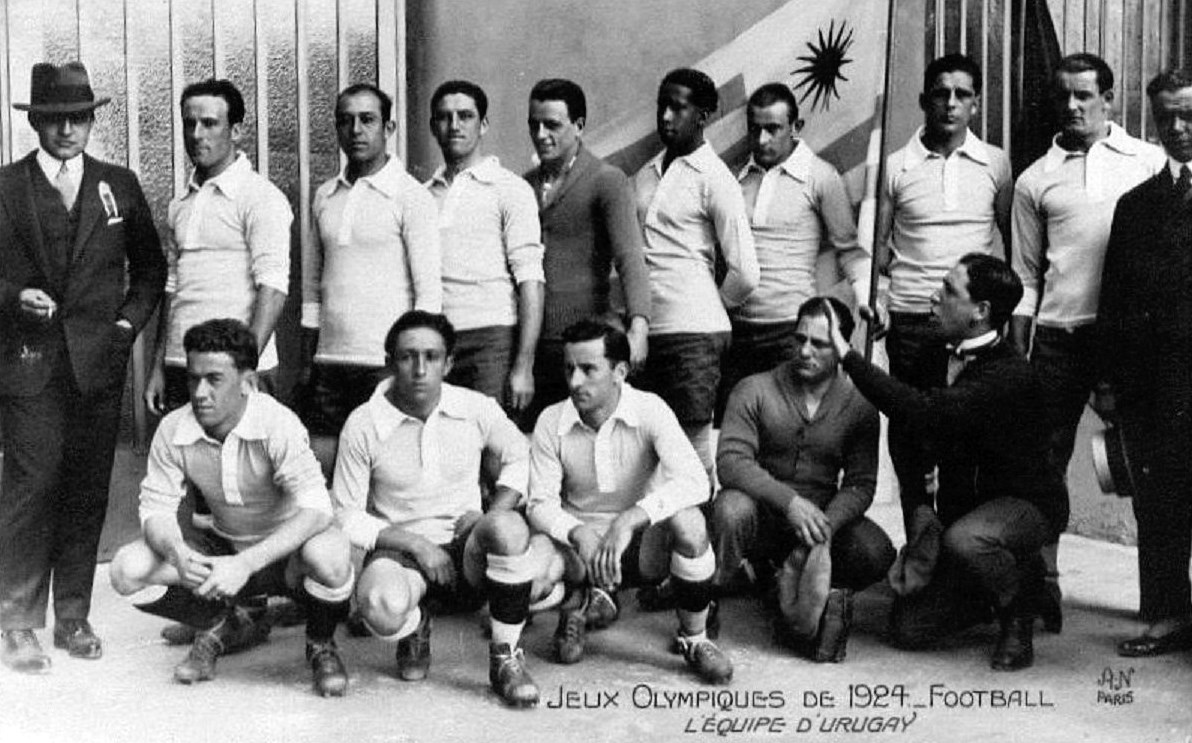
The footballers of Uruguay gathered eyes around them; they were already the great protagonists of the tournament, not only of football, but because they were the protagonists of football it was almost a natural consequence that they would be protagonists of the entire event too. However, no one magnetized the eyes as much as José Leandro Andrade, who was perhaps the first footballer to become a major popular star of international scope. Andrade had been born in Salto in 1901, son of an Argentine mother and an unknown father, although it is speculated that he was an Afro-Brazilian magician. As a child he worked as a shoeshiner, but his physical build and football talent changed the course of his life. He stood out for his perception of space and for a signature move, the tijera, the scissors, which was the extension of one leg and control with the other. His external appearance, however, also gave him a second stage, beyond the footballing one, to conquer in the City of Light.
Andrade caused a sensation dancing tango in Paris, appeared on the cover of the motoring magazine L’Auto, while perhaps the peak moment of his cult persona was the alleged relationship he developed with the American-born, extremely famous French dancer Josephine Baker, who became known as “the black pearl” long before this term described footballers. And if the relationship between the two superstars was never confirmed, the tango they danced together wrote its own history. Eduardo Galeano, in his collection of texts on football, titled Football in Sun and Shadow, dedicated one of them to Andrade’s adventures that summer in Paris.
We do not know whether the off-field adventures of the Uruguayans, and of Andrade, played their role in affecting their performance on the pitch, but in the semi-final held on 6 June, Uruguay struggled quite a lot against the Netherlands, with Kees Pijl of Feyenoord putting the oranje ahead and shaping the half-time score. A goal by José Cea in the 62nd minute was needed and finally a penalty taken by Scarone in the 81st for the Uruguayans to take the ticket for the great final of Colombes. There everyone, however, expected to see the greatest team in the world, which they had understood which one it was, against Switzerland, which had been part of the first non-British European football network, though not at its centre. In the packed Olympic stadium, on a day when the replay of the small final for the bronze medal was organized first, and then the final, with both matches recording 40,522 tickets, Uruguay, with the usual suspects, that is Petrone, Cea and Romano, prevailed 3-0 to conquer the world summit and to place together with itself the football of South America in the position of the new standard for the game worldwide, at least as long as the mother of the sport, England, did not appear in official international tournaments.
Although various accounts claim that Uruguay qualified for the Olympic Games as champion of the 1923 Sudamericano, which was held in Montevideo and in which Argentina finished second, such a thing is not fully confirmed as an official qualification process, while the corresponding exclusion of Argentina, which for other aforementioned reasons did not participate, is not at all confirmed either. Uruguay’s success, however, was treated in two different ways in Buenos Aires. One line argued that this was not only a Uruguayan victory, but a victory proving the superiority of South American football, while the other undervalued its worth, given that it came against supposedly inferior opponents from outside South America, perhaps coming from jealousy that Argentina was not in Uruguay’s place in the footballing Elysian Fields. Both had reasons to exist, both were probably correct.
Football had achieved a great symbolism: 389 years after Mendoza’s journey from Sanlúcar de Barrameda, with 11 ships, 2,000 men, 7 horses and 5 mares, as well as the financing of the king, an expeditionary team of Uruguayan footballers, travelling third class on an ocean liner, without having secured the money for their mission, demonstrated the superiority of their game, emphatically defeating European football. Football was conquering Europe and, together with it, making known a small country of South America, since in Paris in 1924 the maps that people bought to learn where this country of 176 thousand square kilometres was located, about one fourth of metropolitan France, were becoming sought after.
The counterattack of the poor in Brazil
In Europe, Uruguay may have been symbolically reversing, through football, the consequences of the journey of the conquistadores, but in Brazil, also symbolically yet above all overwhelmingly materially, there was a ferment that would later change the physiognomy of the country, bring upheavals in football and lay the foundations for yet another South American national narrative with its accompanying mythological stories and figures. From 1923 to 1925, the team of the people of São Paulo, according also to the words of its founder, Miguel Battaglia, who said that “Corinthians will be the team of the people and the people will make the team”, won 3 consecutive Paulista championships, breaking the dominance of the elitist Paulistano, while from 1915 the club founded by Brazilian and Portuguese workers in Rio de Janeiro, Club de Regatas Vasco da Gama, would acquire a football section. In 1923 Vasco won the first Carioca championship and entered literally into the eye of the much harsher elitist system of Rio, which, following the examples of Argentina and Uruguay, created yet another schism, on the same basis of elite amateurism and professionalism that included the working class, though this lasted only one playing season.
By the end of the 1920s Vasco da Gama had won 3 championships in Rio de Janeiro, while another had been won by another team from the same poor neighbourhood of the great Brazilian port, São Cristóvão. The elites had lost their exclusivity in football, crowds coming from all races filled the stands, mainly of the more popular teams, such as the factory team Bangu, and the stories of players putting rice on their faces in order to be included in the sport seem very distant and are repeated only in chants and nicknames, even if the temporal distance was barely a decade from those events.
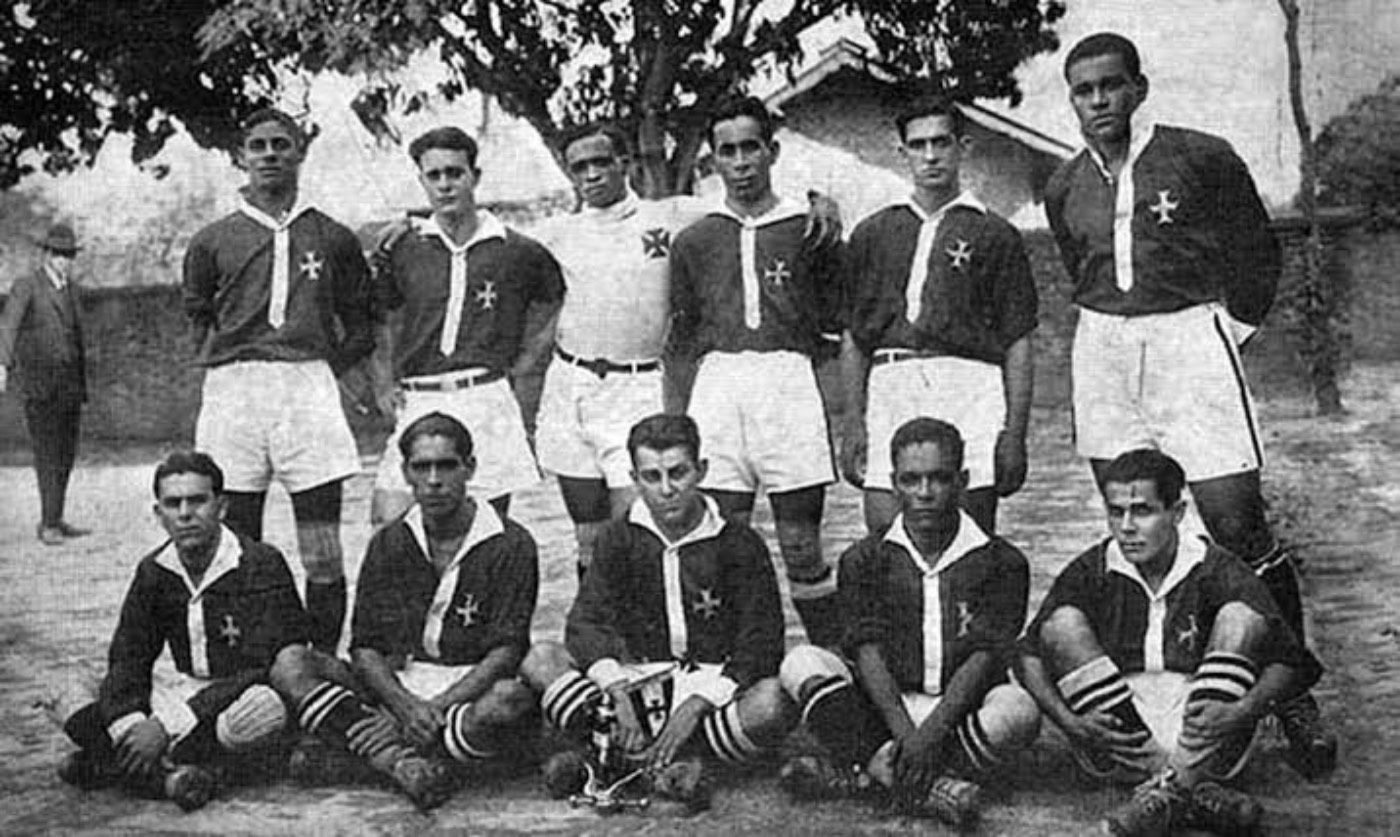
The masses and the multi-racial mosaic of Brazil did not receive an invitation from the elites to enter the game; they imposed their de facto presence in it, and the existence of their clubs was expressed by a permanent conflict that continues to this day. An enormous political and ideological campaign would be needed in order for the Brazilian footballing edifice to be presented as national and unified — and this would perhaps create Brazil’s first truly national experience, even if there are no reasons to celebrate it today.
To the preparation of this national transition and tradition also belongs the construction of Vasco da Gama’s stadium, São Januário, a U-shaped stadium, that is, two straight sections on either side of the touchlines of the playing field and only one end, which was at that moment the largest stadium in South America, with a capacity of 24,584 spectators.
As regards the national team, in 1922, when the Sudamericano was organized again in Brazil, after 1919, this time with the participation of Paraguay as well, the Seleção won its second international title, in fact beating the newly appearing team of the culturally closest country in a play-off match, by a score of 3-0, in order to secure that title. Although many years would have to pass before Brazil won the tournament again, none of all those lost editions took place within its borders. Thus, a dangerous myth could be created: that inside Brazil no one else could win an international football tournament.
The escalation towards the great battle
In 1924, with the momentum from the Paris Olympics, Uruguay organized the Sudamericano, where Argentina had more reasons than ever to beat the team that a few months earlier had won the respect and perhaps the sympathy of the entire footballing — and not only footballing — planet. The last match between the two teams before the Olympic Games, on 25 May, had ended in an emphatic 4-0 victory for Argentina, while shortly before the start of the Sudamericano, the two teams met another four times, with Argentina even winning once in Montevideo by a score of 2-3, on 31 August for the Copa Honor Uruguayo. In the last match between them before the start of the international competition, on 2 October at Barracas in Buenos Aires, Argentina beat Uruguay 2-1, with Cesáreo Onzari scoring from a direct corner kick, something that had been valid only since the summer of that same year. The symbolic significance of the victory against the Uruguayan Olympians, as well as the original way in which the winning goal was achieved, forever named in football phraseology the direct goal from a corner gol olímpico. However, the match entered history because of incidents of unprecedented violence, the throwing of stones at the Uruguayan footballers, particularly targeting Andrade, as well as the arrest of Scarone by the Argentine police. Despite the fact that the match never ended, the Argentines considered that the game had been won. However, in the opening match of the Sudamericano, their national team stumbled with a goalless draw against Paraguay; the decisive last match between the two great teams of the competition ended with the same score and Uruguay won yet another title, its 5th up to that point in the institution.
The home victory, in Buenos Aires, where the Sudamericano of the following season was organized, perhaps contained an anticlimax for the Argentines, since Uruguay decided not to participate in it. On its return to the competition, in 1926, when it was hosted on Chilean grounds, Uruguay won the title again, beating Argentina 2-0, while Argentina also drew 1-1 with the hosts. In 1927, however, Argentina finally managed to win the precious title in a competition with the participation of its great rival, which it beat on 20 November in Lima by a score of 3-2, with the final score shaped by an own goal by Adhemar Canavesi in the 85th minute. This victory of Argentina, however, was exactly what it needed in order to believe that despite Uruguay’s historical superiority in the Sudamericano, which did not come from an excess of talent, but from a more rational organization of the national team and a more pragmatic conception of the game, the albiceleste could take its great revenge on the world stage. The scene had already begun to be set.
In a country that would later offer a precious legacy that would determine the way football is played worldwide for many decades, the Netherlands, the Olympic Games of 1928 were being organized. In a stadium that reflected the evolution of the international Expressionist architectural style, designed by Jan Wils, one of the founding members of the De Stijl movement, together with Piet Mondrian, Theo van Doesburg and Gerrit Rietveld, the greatest football battle ever organized within the Olympic framework would take place.
The tournament was much more complete compared with that of 1924, with 17 teams declaring participation, while from South America, beyond Argentina and Uruguay, the national team of Chile also made the journey to Amsterdam. La Roja, however, did not even manage to enter the main draw, since in the qualifying match against Portugal it was defeated 4-2 and its Olympic adventure ended ingloriously.
The first round was held at the Olympic Stadium and the Oude Stadion, that is, the old stadium of Amsterdam, from 27 to 30 May. On Tuesday 29 May, Argentina was the first of the two countries of the Río de la Plata to enter the tournament. The opponent, or victim, of the raging Argentines in that opening match was the team of the United States, which, although it can boast that it scored twice against one of the top teams in the world, saw the final score, 11-2, become the most emphatic up to that point in an Olympic football match. The Argentines showed that they had arrived in Amsterdam to prove that the legend of 1924 had happened only in their absence and that the so-called La Nuestra was the top football school on the planet.
The following day, in the last match of the first round, Uruguay faced the host Netherlands, which also sought revenge because of the penalty by which it had been eliminated in the semi-final of 1924, a refereeing decision the Dutch were never able to digest — and unfortunately we do not know whether they were right. Under the direction of the man considered the best referee of the era, the Belgian Jean Langenus, and in the presence of 27,730 spectators, Uruguay did not struggle as much as four years earlier and with a 2-0 score took the great and objectively more difficult qualification for the next round.
The draw had been made in such a way that the two South American football superpowers could meet only in the final. Thus, from that point onwards, the intermediate rounds constituted a display of strength by the two, building their confidence, their legend, but also the prestige of the final that everyone was waiting for. Argentina, with Tarasconi as its hero, scoring 4 goals from the 1st to the 89th minute, demolished Belgium 6-3, while in the same quarter-final round Uruguay did not face strong resistance from Germany, which it beat 4-1, perhaps compensating the Dutch public after the elimination of the first round. In the semi-finals Argentina had a clearly easier task, facing the surprise of the tournament, the only representative of the African continent, Egypt, which it nevertheless crushed 6-0, while Uruguay had to face a great and rising world football power, Italy, which was already footballingly under the development sponsored by the fascist regime. Although the Italians took the lead in the 9th minute through Baloncieri, Cea, Campolo and Scarone had overturned the situation before the interval and in the second half Levratto merely shaped the final 3-2 in favour of the Celeste, which formalized the great rendezvous of 10 June.
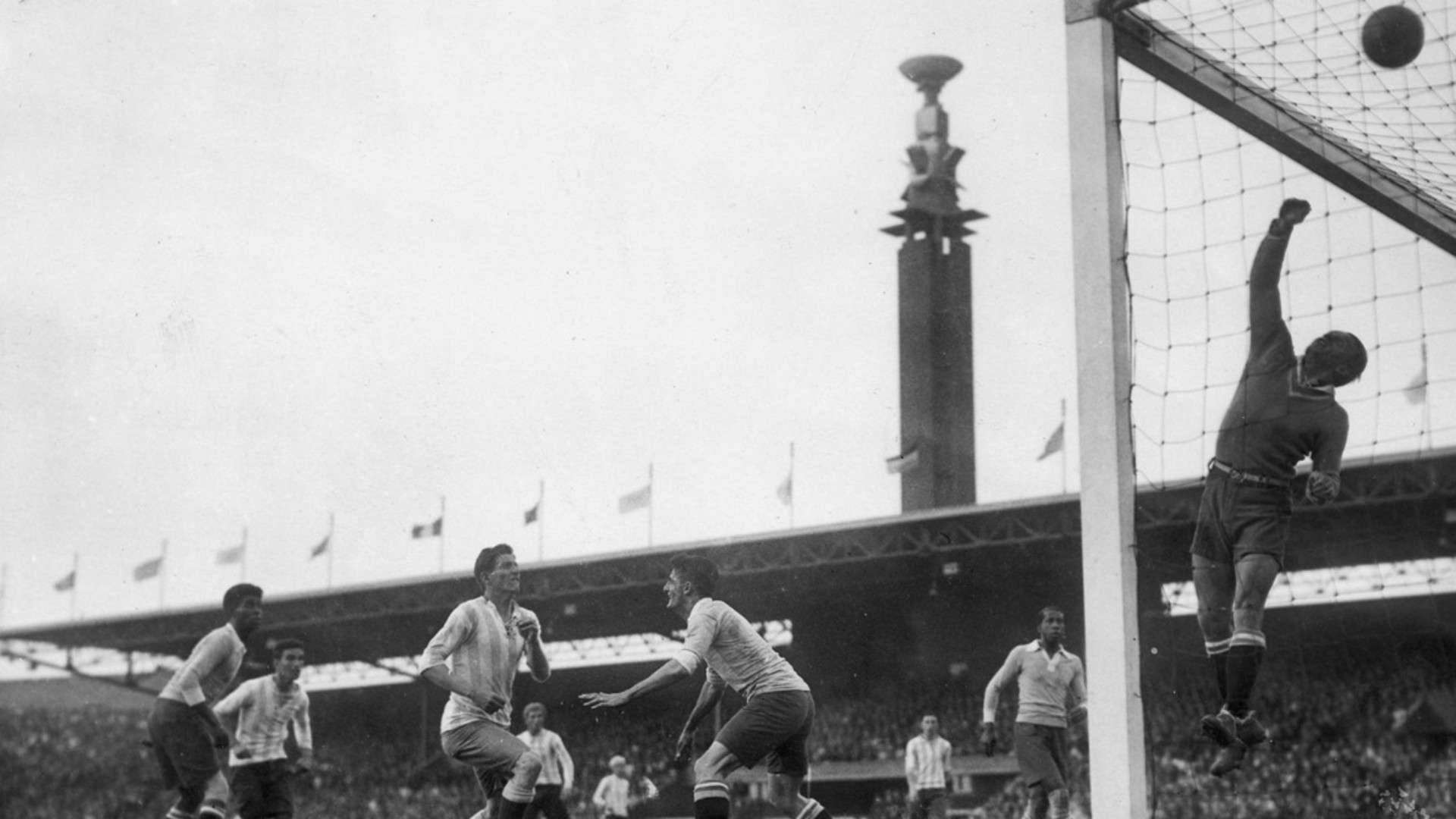
The great final was not simply a great football event; it was by an enormous distance from any other the greatest spectacle event that had ever taken place in Europe. A total of 250 thousand applications were sent for a ticket to the great encounter and obviously the Olympic Stadium was packed, with the official record reporting 28,253 spectators. Uruguay played in a light-blue kit and Argentina in light-blue and white stripes. The footballers of the two teams would form line-ups that defined the passage of football into a new quality; they were those who played in the greatest match of all time in the era before and after the beginning of a period in which football became what we know down to our days.
In Argentina, the passion for the historically significant victory can be described by the situation on the day of the match. The Argentines were desperate to learn in real — or almost real — time every piece of information. Newspaper correspondents sent wired telegrams from Amsterdam and loudspeakers outside the newspapers La Prensa and La Nación transmitted whatever became known about the development of the match.
In that final of 10 June, however, there was no winner. Petrone opened the scoring for Uruguay, while the Argentine centre-forward Manuel Ferreira equalized in the 50th minute. Since this result remained the same after extra time, the match had to be decided in a replay. Three days later, in the same stadium, which was again packed, the two teams lined up for the continuation of their great battle. Uruguay again opened the scoring, with a goal by Figueroa in the 17th minute, before Argentina’s emblematic centre half, Luis Monti, answered in the 28th minute. Ultimately, Uruguay’s golden scorer was once again Héctor Scarone, who in the 73rd minute gave victory to his team, sealing its global superiority in a period of crucial importance for football.
A historic decision – the passage into the new footballing world
A few days before the beginning of the Olympic football tournament, as traditionally happened, the FIFA congress was held in the city hosting the Games. The 17th congress of the International Confederation, held on 25 May 1928 in Amsterdam, was one of the most important, perhaps the most important, in its History. Football had already far exceeded the framework of popularity of any sport, and its political and cultural influence could no longer keep its administration either within the framework of national sports organizations or within the framework of the International Olympic Committee, which was attached to amateurism. Professionalism had already existed since the end of the 19th century in England, while during the 1920s Austria, Hungary, Italy and the United States proceeded to the professionalization of their national championships. Shadow professionalism in Argentina and Uruguay, as well as the schisms that had a corresponding ideological basis in Brazil, showed that it was a matter of time before this transition became official in South America too.
Moreover, football could now stand on its own at international level. The 10,000 spectators who remained outside the ground at the Paris Olympic Games and the 250,000 applications for a ticket for the final of the Amsterdam Games confirmed this. Football not only could and immediately needed to evolve in a way different from the other sports, but also needed its own separate competitions. The success of international competitions, after all, had already been shown by the Campeonato Sudamericano, which was held outside any aegis of multi-sport national administration, under the exclusive responsibility of CONMEBOL and the national football federations. In FIFA’s administration, Jules Rimet was the right man to lead this step. Thus, at the Amsterdam congress it was decided to begin the holding of the FIFA World Cup, outside the Olympic framework, without exclusions based on the amateur or professional identity of the players.
What needed to be defined, given this decision, was the country that would organize the first edition of this institution. Uruguay, having as an extremely strong weapon its world success at the Olympic Games of 1924, since those of 1928 had not yet begun, but also its successes in the Sudamericano, which clearly placed it in the position of pioneer of South American football, had every reason to claim that, on the basis of footballing performances, it was the most suitable country to welcome this institution. But it also had something even more important: the political will and interest for this World Cup to happen in the small country, which outside football was more unknown. Combining a narrative of celebration of 100 years of Uruguayan independence, which essentially referred to the end of the Paraguayan War and the Constitution adopted on 18 July 1830, with the ambitious plans for the construction of the facilities that would host the competition, through the securing of the necessary resources from local capital that desired this international projection, the Uruguayan federation, having also developed the necessary close relations with FIFA’s leadership, managed to receive the mandate to organize this original competition.
The most ambitious and emblematic plan for the newly established competition was the construction of a magnificent stadium, which could host the passion of football supporters, in contrast with the proven very small capacity, for the needs of the sport, of the Olympic Stadiums of Paris and Amsterdam. Thus, in 1929, in the area of what was then called Parque de los Aliados, dedicated to the victory of the Allies during the First World War, construction began on a stadium made entirely of concrete, which would reflect the modernist urban renewal of a city that a few years earlier the “father of architectural modernism” himself, Le Corbusier, had visited in order to supervise and admire. The designer of this stadium was the architect Juan Antonio Scasso, who later also served as president of Peñarol. The plan provided for the construction of four tiers and a capacity of 90,000 spectators. However, the consequences of the so-called stock market crash, that is, the crisis of production, of 1929, shrank the plans and the capacity to 69,000 spectators, something that still constituted a clear change of scale, given that Parque Central, which until then usually hosted Uruguay’s international matches, had a capacity of only 20,000. The most emblematic element of the architectural wonder, however, was the construction of a nine-storey tower, which reflected the nine stripes of Uruguay’s flag and still stands today on its north-eastern side.
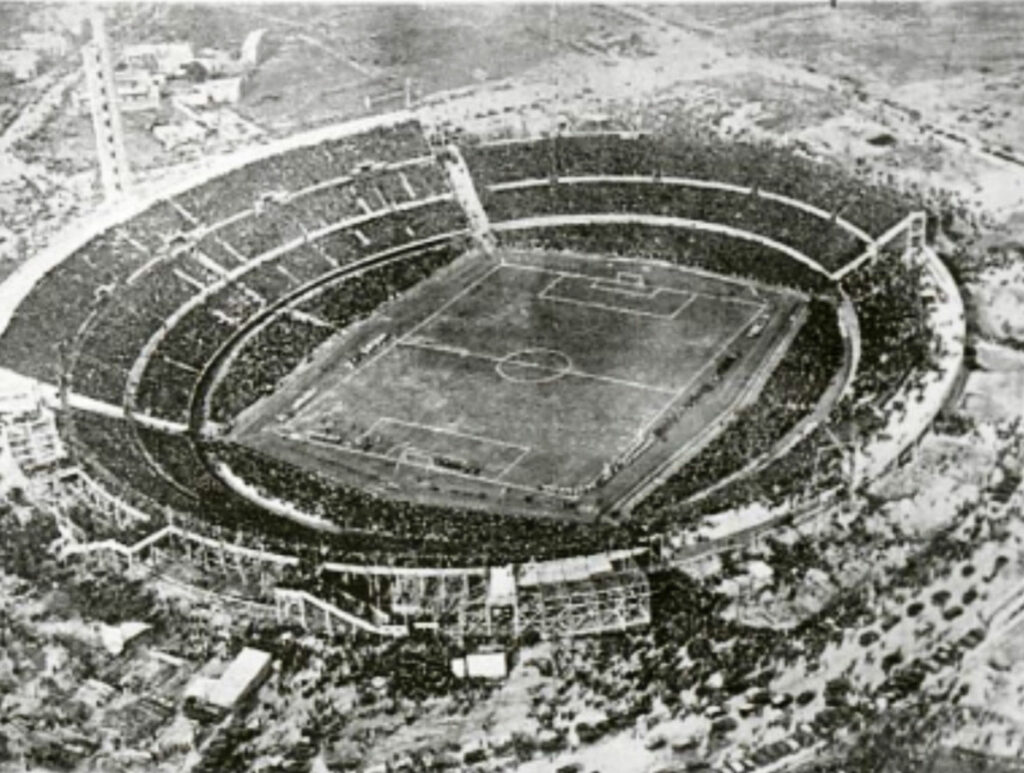
Beyond the difficulties created by the capitalist crisis, however, further obstacles to the construction were set by the weather, since the first half of 1930 was accompanied by very intense storms in the area, which obstructed the continuation of the works. As a result, the Centenario, which was scheduled to host all the matches of the first World Cup, finally opened its gates on 18 July, the day of the centenary of Uruguayan independence. Perhaps this date was the one that truly had to be taken into account as the final deadline, since the unknown framework within which the competition was beginning did not set strict criteria for its prestige.
The most difficult undertaking, however, was to gather the national teams that would give the new institution its real dynamic. Under the weight of the economic recession and of the new balances being created in Europe, which was steadily heading towards the second generalized destructive war of the 20th century, this was an extremely difficult task undertaken mainly by the inspirer of the competition, Jules Rimet. The largest participation existed, as was natural, from South America. It is characteristic of the immediate success of the competition that although the Sudamericano until then had been held with 3, 4, or 5 teams, 7 South American national teams declared participation in the competition: the host Uruguay, Argentina, Bolivia, Brazil, Chile, Paraguay and Peru. All the teams had played at least once in the Sudamericano, but never — until then — all together.
From Central and North America, Mexico and the United States declared participation, while from Asia the participation of Japan and Siam, later Thailand, was secured. From Africa the representative would be Egypt, which had managed to reach the semi-finals of the 1928 Olympic Games, but the great problem was the participation of the European teams, those that had consistently participated in the Olympic football tournaments. Beyond the issue of the level of the participants, the participation of the great footballing powers of metropolitan Europe would place the World Cup in a higher position in the hierarchy of football institutions, in relation to the Olympic Games, which, because they were outdated for the vision of Rimet and FIFA, had to be eclipsed.
The European teams, however, had no intention of making such a large investment for a competition that was an ocean away, was difficult to have an impact on local news, and concerned a new football network, outside those that had until then developed in each individual European region. The most striking example, of course, was the complete abstention of the teams of the Central European International Cup, the so-called Danubian School, which was held outside the framework of FIFA and was the most important international football institution for Austria, Czechoslovakia, Hungary and Italy. As for England, on the island no one even deigned to hear about an unprecedented football competition outside the country that gave birth to the sport.
Thus, Rimet, after managing to secure the participation of his homeland, France, convinced Belgium, as well as two Balkan countries that needed to enter a new football network, Yugoslavia and Romania, to take part in the competition.
This composition meant that a total of 16 teams would compete in the first World Cup, something that in itself did not seem a small matter at all, given that this competition was not taking place in Europe and that only 17 teams had taken part in the last, extremely successful Olympic Games before it. On this basis, 4 groups would be created, from which the first team would qualify for the semi-finals, which would be held as knockout matches. However, these plans would change, as the Asian teams withdrew their participation before the beginning of the competition.
An ocean liner, the Conte Verde, built near Glasgow in 1923, would transport the teams of Europe and that of Egypt, as well as all their compatriot referees and other officials, to the other side of the Atlantic, on a journey that would last about two weeks. The team of Egypt, however, ultimately did not manage to board the ocean liner in Marseille, delayed by a storm in the Eastern Mediterranean, reducing even further the number of participants in the first World Cup, with 13 teams finally present in Montevideo on the day of the group draw.
The situation on the Conte Verde, the ship that transported the European delegations and 12 years later would carry 17,000 Jewish refugees to the United States, looked like a camp. The footballers tried to maintain their physical condition, running on the deck, doing weights and going up and down the ship’s stairs. According to the Romanian forward Constantin Stanciu, the French footballers showed the greatest zeal, while Jules Rimet, also a passenger on the same route, was enthusiastic about his vision taking flesh and bones, while also feeling the disappointment that there were not more European teams living this unique experience. A devout Catholic, he saw football as an ideologically neutral ground, where without classes, without national divisions, only the full friendship of peoples would develop. The peoples were ultimately united in common traditions and culture thanks to football, but as regards the rest, this game of mad Englishmen became exactly the opposite: the most ideologized sport in the history of humanity, an expression of every material contradiction, foremost among which is class.
The draw that took place before the start of the competition had from the outset placed, as heads of the groups, the teams of Argentina, Brazil, the United States and Uruguay, which could meet only in the semi-finals. In the first group, together with Argentina, participated Chile, France and Mexico, while in the remaining groups, each composed of three teams, Brazil would face Yugoslavia and Bolivia, Uruguay would face Romania and Peru, and the United States would face Paraguay and Belgium.
The first match of the competition was played on 13 July, with a 3 p.m. local kick-off, and the opposing teams were France and Mexico. Lucien Laurent, footballer of Cercle Athlétique of Paris, who after the World Cup moved to Peugeot’s great factory team, Sochaux-Montbéliard, scored in the 19th minute of the match the first goal in the History of the World Cup, in front of 4,444 spectators who had bought a ticket at Estadio Pocitos. Argentina did not struggle in this group, since although it beat France 1-0, only two days after the tricolores’ opening match, it imposed itself with an emphatic 6-3 over Mexico and also beat Chile 3-1. The great protagonist of these matches was the Argentine centre-forward Guillermo Stabile, player of Huracán, who scored 5 goals in the group stage, in the two matches he played, after the injury of Nolo Ferreira of Estudiantes.
In the second group, things did not prove so easy for Brazil, which in its opening match fell victim to a surprise, losing 2-1 to Yugoslavia. The Yugoslavs crushed Bolivia 4-0 to secure qualification to the semi-finals, while Brazil, which repeated that score against its neighbour, objectively could not qualify for the semi-final stage.
In the third group, the dance was opened by the match between Romania and Peru, where the Balkan side emerged victorious by a score of 3-1. On 18 July, in the first match in the History of the Centenario, on the day of the national anniversary, Uruguay faced Peru in its maiden World Cup match. The 57,735 spectators who gathered to watch the feats of the world football superpower perhaps expected more than the “poor” 1-0, but the goal by Héctor Castro, who beyond being a deadly scorer was perhaps the most complete footballer of his era, gave promises of escalation in the continuation of the competition. In the crucial match for qualification against Romania, Uruguay won 4-0, in front of more than 70 thousand spectators, and naturally the ambitions for the great distinction once again found a material basis in its footballing performance.
In the fourth group, the United States won by the same score, 3-0, consecutively against Belgium and Paraguay, securing its own participation in the final phase of the four top teams. There the crossings were not predetermined and a second draw, held on 23 July, had to function on the basis of the most likely scenario and create the conditions for a final between the rivals of the Río de la Plata. As has happened many more times in World Cup draws, this was achieved and in the semi-finals Uruguay would face Yugoslavia, while Argentina would face the United States. The two expected finalists confirmed the predictions. For Argentina, Peucelle and Stabile each scored 2 goals, while for Uruguay Cea scored a hat-trick and Iriarte scored 2 goals. The only difference was that while the United States scored the consolation goal in the 89th minute, Yugoslavia opened the scoring in the 4th minute of the match. The scores of both matches ended 6-1.
On 30 July, at the newly built Centenario, the greatest battle would be held: the repetition of the Sudamericano finals, the repetition of the last final of the Olympic Games, the match between two teams representing the countries that took football from the British, evolved it, changed its language and style, ideologized it, structured their own internal conflicts around it, created the crowds that lived for every football victory, that identified with the clubs and the national teams, the narratives that accompanied every local or national mythology. All this in the first final of the new exclusively footballing and global competition. There was no doubt that this was the greatest football match of History up to that point, and it remains to this day one of the most mythical, but also historically decisive and critically referential, football games ever played.
Fifteen thousand Argentines set off from the inner port of the estuario towards Montevideo; many of them did not manage to arrive in time because of the fog, while others could not obtain the ticket that would put them inside the Centenario. Back in Buenos Aires the telegrams arrived at a rate shorter than one minute, while the development of the match was also broadcast by radio. Large factories, such as that of General Motors, are reported to have stopped the production line, while Parliament stopped its afternoon work. It is worth noting that while nowadays World Cup finals are always held on Sunday, that 30 July 1930 was a Wednesday. A Wednesday afternoon that in Argentina, however, seemed like Sunday.
In Montevideo, the Argentine delegation was under enormous psychological and emotional strain. The team’s delegation was visited by the legendary tango performer Carlos Gardel, who, having arrived in Argentina as an immigrant, son of French immigrants from Toulouse, claimed that he had been born in Tacuarembó in northern Uruguay. Although at some point he had diplomatically declared that his heart belonged to Argentina and his soul to Uruguay, he had no hesitation in going to the La Barra hotel in order to encourage his Argentine counterparts, now national heroes. Given, of course, the result of the final, Uruguayans still claim even today that Gardel was a source of bad luck for Argentina and therefore is in reality one of them.
At the moment when in Argentina the slogan shaking the atmosphere was “Argentina sí, Uruguay no! Patria o muerte!”, in Montevideo the centre half of the albiceleste, Luis Monti, was receiving threatening messages against his life, making the scene literally warlike, with the Argentine star preferring not to play in the greatest match and ultimately being persuaded otherwise by his teammates and the entire Argentine delegation. Similar threatening messages had also been received by the referee of the match, the Belgian Jean Langenus, who agreed to officiate the game only after receiving the relevant security guarantees and after a boat was waiting for him so that he could leave Montevideo immediately after the end of the football match.
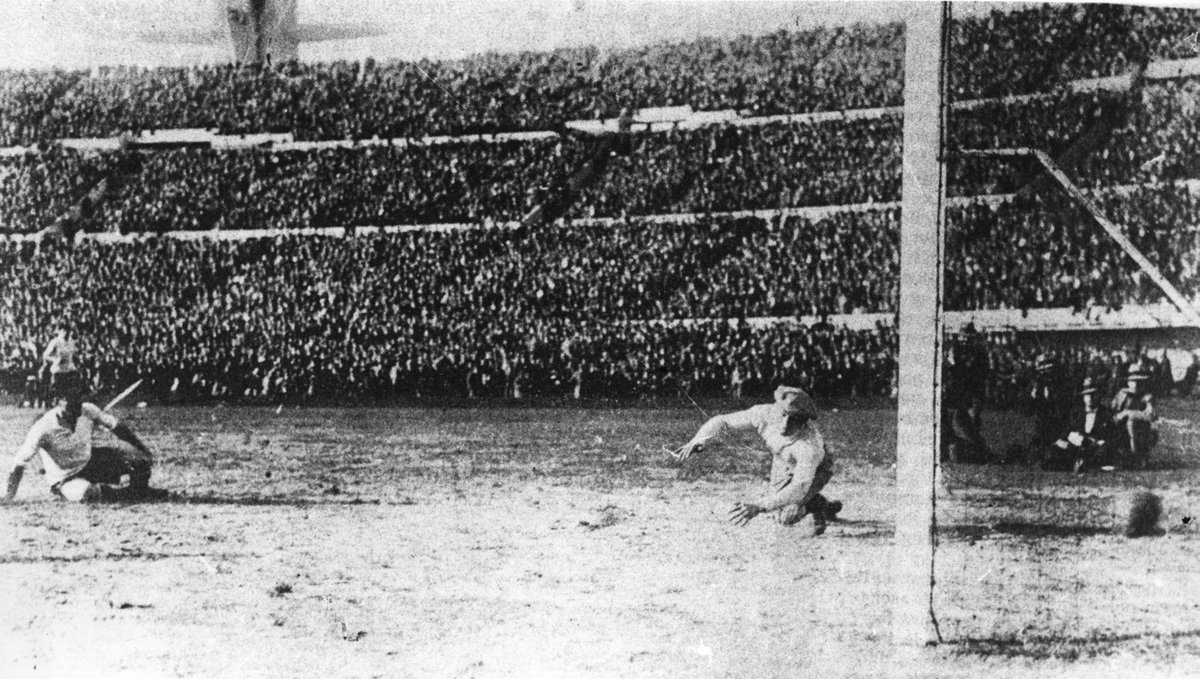
Although the official record of tickets says that 68,346 spectators watched the great and epic-dimensioned encounter, historical sources maintain that more than 80,000 people were in the stands of the Centenario that afternoon. Referee Langenus appeared wearing Bermuda shorts, a jacket and a tie, while Uruguay and Argentina wore their classic kits. The two teams could not even agree on which ball the final would be played with, with the result that it was agreed that in the first half a Scottish-made ball brought by the Argentine team would be used, and in the second half a heavier, English-made and English-origin ball brought by Uruguay. In a match that, because of its early and perhaps footballingly primitive conditions, was also characterized as the greatest neighbourhood match in football history, all these characteristics only add a mythical dimension to the historical encounter.
Although Pablo Dorado opened the scoring for the hosts in the 12th minute, all accounts converge on the fact that the Argentines presented a unique spectacle, allowing the imagination to create a historical reflection of those football matches where intense emotional charge and the stakes lead to performances that seem to touch an artistic degree of perfection. The Argentines first equalized through Peucelle, while Stabile gave them the lead, with his 8th goal in a tournament in which he emerged as top scorer, wearing the shirt of a national team that he wore only during those days in Montevideo, because of an injury to his teammate, a shirt he would never wear again after that final. And if Varallo’s moment was the one that could have locked the historic victory for Argentina, his injury contributed to the opposite. The team that played less spectacularly managed to score 3 goals, scored by Pedro Cea, Santos Iriarte and Héctor Castro, to seal an era of absolute footballing superiority.
Argentina, La Nuestra, had been defeated on the pitch, in the most important game in History up to that point. How had this happened? In Uruguay, it is not certain that they could, but it is certain that they did not want to, explain it footballingly. Historical analysis shows that Argentina, perceiving the superiority of its game, made sure to turn it into a national narrative. Institutionalized ideological organs such as Gráfico and Borocotó were interested in the maintenance of this myth, and what happened at the Centenario was precisely its material footballing expression. The most beautiful football was the one Argentina played, but the winner was — again — Uruguay. Gianni Brera, the Italian journalist, would later write that “between the two rioplatense national teams, the ants are the Uruguayans, the cicadas are the Argentines.” But in football few want to be the ants, and so in Uruguay, which through football was acquiring global reach, there was a necessity for the construction of a different myth.
This narrative said that the Uruguayans in reality win because they compete with greater fighting spirit. Indeed, a historically completely baseless construction aimed to explain this national characteristic too. In the area of Montevideo, before the era of European expeditions and colonialism, lived an indigenous tribe, the Charrúas, who naturally had to retreat as their vital space was occupied by European settlers. The Charrúas, however, continued to coexist in the wider area for centuries. The independence of Uruguay, however, was the event connected with their disappearance. Specifically, the President of the country, Fructuoso Rivera, who first assumed power in 1830, that is, 100 years before that first World Cup, organized their genocide, which remained known as the Campaña de Salsipuedes in 1831. The only 4 surviving Charrúas became the object of racial studies and were even sent to Paris in 1833, where they were exhibited to the public and there breathed their last. Today Uruguay recognizes this historical genocide, while a complex of these four last Charrúas stands as a statue in Montevideo.
Despite the historical crime, however, the mythology built around the football team claimed that Uruguay’s footballers carry this fighting spirit of those Charrúas; indeed, the Celeste’s way of playing was named garra charrúa, that is, the claw of the Charrúa. Perhaps in this way Uruguay achieved two things at the same time in its national narrative: to erase a criminal historical legacy by creating an unfounded national legend.
The truth is that Uruguay managed to win in those years, on the one hand, because it approached the game itself more pragmatically, even if it did not lack talent; it had organized the national team with physiotherapists and doctors, while it did not exclude Black and mixed-race footballers who had difficulty finding a place in Argentina’s national team, making use of all the different racial and cultural characteristics of its society. No Indian ever won any battle for the national team, only children of the barrios, regardless of colour, who were successfully incorporated into a culturally young society searching for its identity.
It was not only a celebration
The 1930 World Cup, which was held in South America, closed an entire era for the Latin American continent. The football of the American countries of the South Atlantic may have been at its peak and still had golden pages to write in the years that followed; however, the societies that had known prolonged economic growth, that had remained far from the vice of the First World War, that had constituted the outlet for millions of migrants from the poor European South, would receive the first great economic blow almost simultaneously with the greatest celebration organized for their main exportable cultural product, football.
The outbreak of the capitalist crisis in the United States, which was already the principal recipient of their products and had replaced the old European superpowers not only as a commercial partner but also as controller of their political development, would decisively affect the Latin American countries too. Economic crisis has political crisis as its immediate consequence, and in capitalism political crisis means two things: either the overturning of relations of power and the overthrow of the ruling class, or the harsher imposition of power and the collapse of bourgeois democratic freedoms. Sometimes both happen, since the people overturn the desperate attempt of the ruling class to hold on to power.
In the Argentina of 1930, however, only the abolition of democracy took place. The social unrest that existed under the pressure of the crisis, as well as the pressure from the ruling class for more concessions to local capital, whose position was worsening, led Yrigoyen to concentrate powers in the Presidency, so that he could control more effectively the response of political power. These moves, however, became the cause for the nationalists and a movement born inside the national army, as well as a party that propagandistically paraphrased the name of the Unión Cívica Radical into Unión Cívica Radical Antipersonalistas, claiming therefore that it was only against personalist power and not the ideology on the basis of which Yrigoyen had been elected, to attempt a successful coup on 6 September 1930. This coup, headed by the officer José Félix Uriburu, formed a military power whose aim was to copy fascist power as it had been organized in Italy, a country which in any case had very close cultural ties with Argentina. Uriburu and his far-right allies abolished the Constitution of 1853 for the first time and imposed the technocratic and fascist administration they envisioned. This dictatorship would inaugurate a long course of political power held by the military, with the alternation of dictatorial regimes and falsely named unfree democratic periods, with political authorities that usually maintained very close ties with the United States. This first period, although it was called la Década Infame, the infamous decade, is considered to have lasted for about 13 years and ended with the military coup of 1943; however, the first direct free elections would be held again in Argentina in 1946.
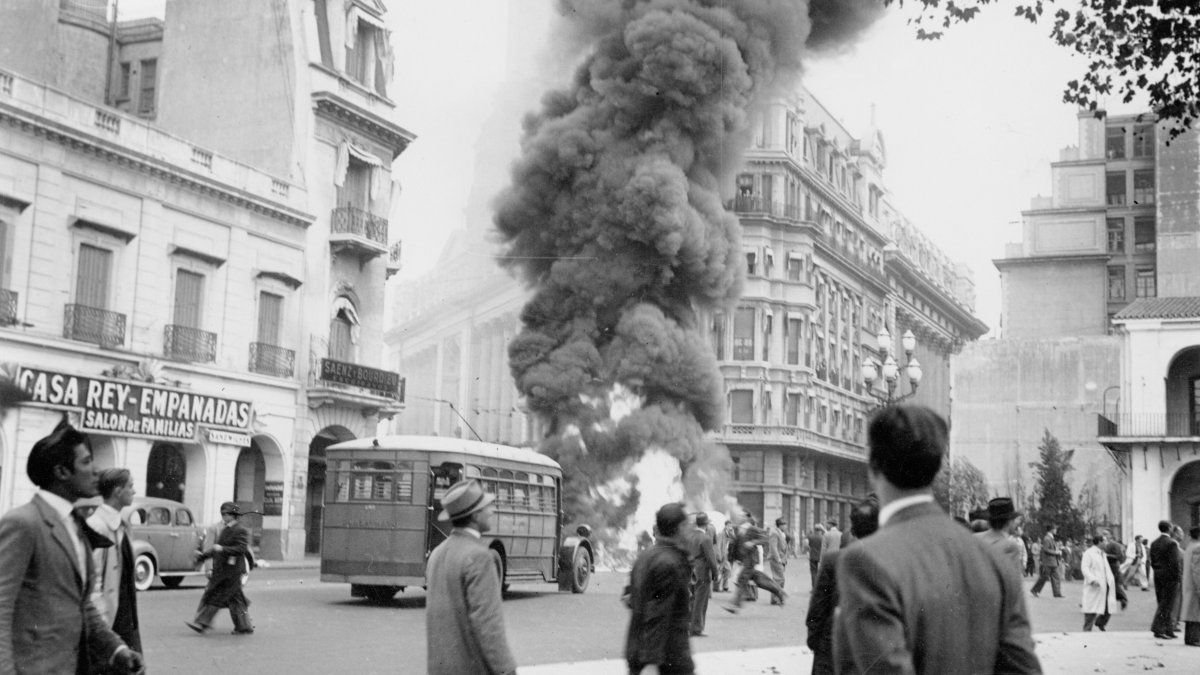
During these years, football, which functioned as national mythology, had no reason to stop its evolution, since it is timelessly an object of instrumentalization by every power. One of the first important developments, which it is not certain whether it was a choice of the new power or an almost natural evolution accelerated also through the organization of the World Cup, was the professionalization of the football championship from 1931. The beginning in this direction was made by a delegation of footballers who asked dictator Uriburu for freedom to negotiate contracts. He, referring the matter to the Mayor of Buenos Aires, José Guerrico, left the latter to decide that the solution to all issues would come with professionalism. However, what power essentially did was, instead of answering the demands of the footballers as workers, to bind football even more tightly to the interests of capital, since in this way it incorporated it into the broader technocratic capitalist reorganization it was attempting.
Football was tied even by blood relations to power, with General Agustín Pedro Justo, who succeeded Uriburu through the holding of unfree elections, otherwise expressing his sympathy for the working-class Boca, while later the son of President Ramón Castillo was President of the football federation. The ties of political power with the great popular clubs are perhaps also reflected in the results of these decades. Gimnasia La Plata won the championship of 1929, while the last championship before professionalism, that of 1930, was won by Boca Juniors. From that year onwards, for 36 years no team outside the Cinco Grandes won the championship. Football was changing, but the protagonists were the same, while political events throughout the world would also affect the perception of a country that turned towards introversion, diametrically opposed to its entire previous historical course.
Brazil’s nationalist era
If the Década Infame opened an era in which democracy would be the antonym of Argentine society, in 1930 a transformation of enormous ideological depth began for Brazil, which to a large extent built the myth of its national football. Brazil, having taken all its footballing steps later in time compared with Argentina and Uruguay, had, by the 1930 World Cup, managed to win 2 Campeonatos Sudamericanos, yet it had not found itself in an Olympic Games final, a competition in whose football tournament it had not even taken part, while naturally it was not part of a legendary final, as happened with the two neighbouring countries to the South.
At the end of the 1920s, in a climate of growth but also of social unrest, the President of Brazil was Washington Luís, who, although born in Rio de Janeiro, studied and began his career as a judge in São Paulo. The successful, for the interests of the bourgeoisie, handling of the uprisings in São Paulo, in the years when he was mayor of the city and then governor of the province, gave him the endorsement to be elected president in 1926. However, before the elections of 1930, with the effects of the crisis having considerably worsened the possibility of political control over the general ferment, Luís had lost the support of many of his allies, being forced to give the endorsement to his collaborator Júlio Prestes. Prestes, as candidate of the Partido Republicano Paulista, won overwhelmingly in those elections against a former minister of Luís, Colonel Getúlio Vargas. Colonels often do not lose elections, but organize movements, and three weeks after the electoral contest Vargas was the head of the coup that overthrew Prestes and took power, placing himself on 3 November in the position of President of the country. In this position he would remain as a coup-maker until 1934, when in the presidential elections conducted through representatives from the appointed national assembly he was officially and in an apparently constitutional way proclaimed President of Brazil. It took, again, only three years for him to follow the steps of his idol, a failed painter from Austria, and, driven by the danger of a communist uprising that began inside the army, to abolish every constitutional legality, outlaw the Communist Party and begin the period of his tyranny that remained in History as the Estado Novo.
Football, once again an object of instrumentalization, could not escape the “interest” of the power of the Estado Novo, which, also having the experience of the neighbouring countries, found an astonishingly popular accessory for the writing of a new nationalist tradition. The difference of the Brazilian narrative is that while the deeply ideological national approach of Argentina developed in an era when the aim was to disentangle football from the dominance of the English, the approach of the 1930s was much more closely connected with class exploitation and for this reason, instead of being limited to the quality of an extroverted society that had to find its common identity, it essentially aimed to present class contradictions and centuries-old racial exploitation as a neutral ground for the development of the particular Brazilian social phenomena, of which every Brazilian had reasons to be proud.
In this undertaking, a decisive role was played by the journalist Mário Filho, the son of a publisher who was born in Recife but moved to Rio de Janeiro and began his career as a sportswriter in 1926 at the newspaper A Manhã, published by his father. Within the developments of the era, it was not difficult for Filho to develop an excessive enthusiasm for football and to devote himself almost exclusively to it from 1928 onwards, when he began working at his father’s second newspaper, Crítica. During this period Filho began to generate, as Borocotó was doing in parallel in Argentina, the vocabulary of Brazilian football. Focusing his analysis on the evolution of Rio’s historical bourgeois teams, Flamengo and Fluminense, he was the inspirer of the famous word Fla-Flu, which signifies this pair of footballing rivals of the city. In 1931, after his father’s death, he founded Brazil’s first purely sports magazine, under the name O Mundo Sportivo; the same year he also began working at the newspaper O Globo, while from 1932 he also developed a particular writing interest in Brazilian cultural elements, such as samba, even inaugurating the competition of samba schools in Rio de Janeiro. His essential contribution to the construction of the national myth through football began in 1936, when he began working at the newspaper Jornal dos Sports.
Filho was the right man in the Estado Novo’s search for the theoretical and then practical constitution of the so-called Brasilidade, that is, the way the country would be culturally constituted upon nationalist principles. For football he did the work that was ideologically organized for the whole of Brazilian society by another intellectual of the regime, Gilberto Freyre, who had studied at Baylor and Columbia Universities. The dictator Vargas, for his part, following also the example of Mussolini, as well as of other dictators, made sure to tighten his relations, even if propagandistically, with the popular and especially working-class-origin teams. Vasco’s stadium, São Januário, became his den, since it hosted events of every kind, with the participation of intellectuals who contributed to the building of this new national identity and nationalist consciousness. Filho essentially undertook the opposite ideological path, that is, the transformation of clubs that were fortresses of the bourgeoisie into popular clubs, which transferred into their supporter base their already developed ideological background, thus contributing to the incorporation of the masses into the dominant ideology.
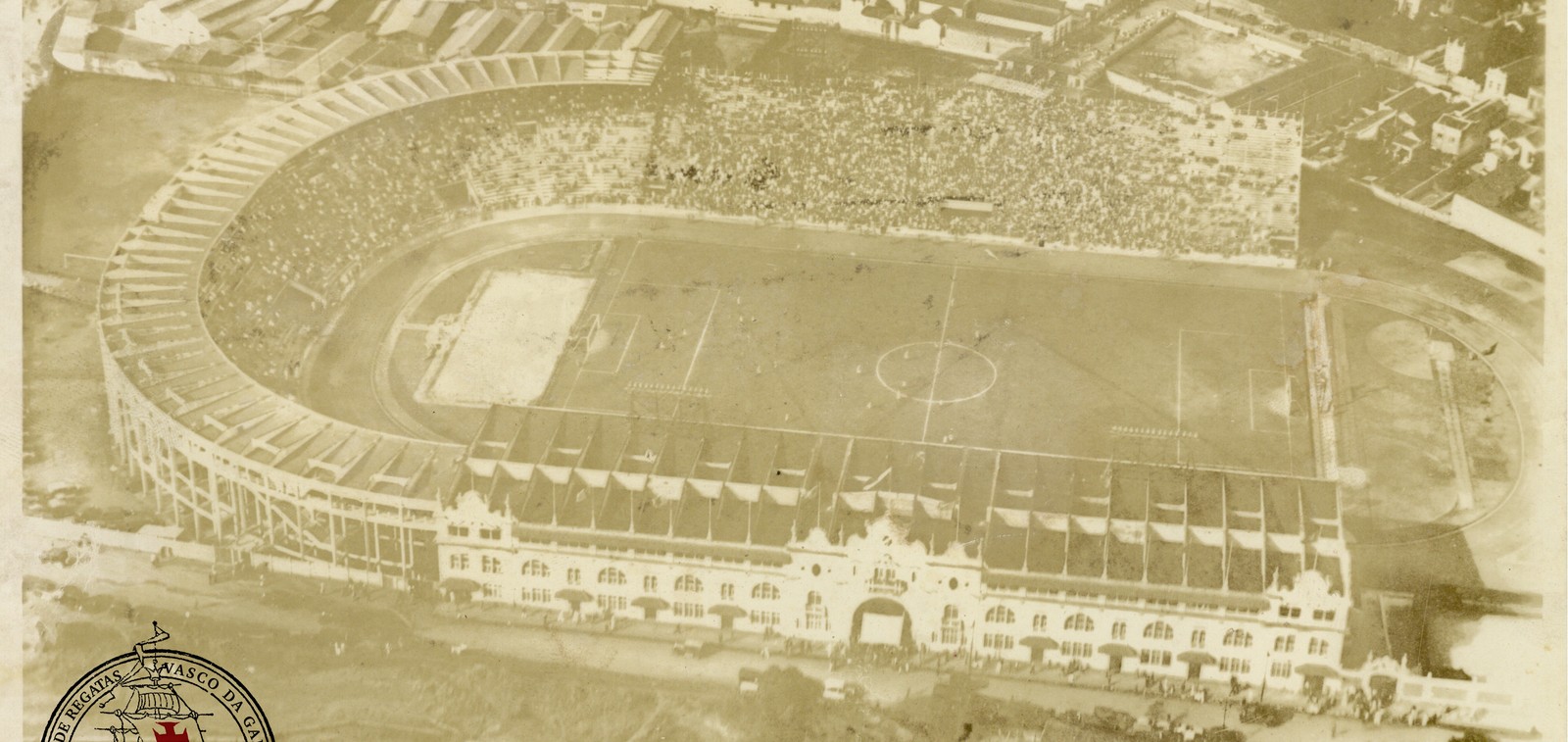
Filho’s professional move to the newspaper Jornal dos Sports was part of this activity. The publication was issued by José Bastos Padilha, publisher and president of Flamengo from 1936 to 1939. Filho was Padilha’s man who undertook to transform the elitist Flamengo into a club supported by the masses. He brought to the club the three top Black Brazilian footballers of the era, Fausto, Domingos da Guia, and the greatest Brazilian footballer before Pelé, Leônidas da Silva. When the supporters of Fluminense, whose nickname was pó de arroz, from rice powder, began calling those of Flamengo pó de carvão, that is, coal powder, the apparently popular character of the club had already been impressed upon collective consciousness. A few years later, a famous band, the charanga, played constantly during Flamengo’s matches, intensifying its popular characteristics even more.
The idol of that Flamengo team, Leônidas da Silva, also known as Leônidas, was the epitome of everything Vargas’s regime envisioned for football as its political tool. Born in 1913 in Rio de Janeiro, he was the first footballer to acquire the nickname “black diamond”, as happened in all the other cases because of the colour of his skin. He began his career for São Cristóvão and in 1933 transferred to the Uruguayan Peñarol, in an environment where the climate was much more welcoming for Black footballers. In 1934 he returned to Brazil, Rio and Vasco, before transferring to Botafogo and finally in 1936 to Flamengo. He is considered the inspirer of the volley shot, the so-called bicycle kick, which was much more difficult to execute with the balls of the era, while the planet first came to know him at the 1934 World Cup, where Brazil’s national team was eliminated in the first round by Spain.
Leônidas, however, was the necessary symbol for the building of a national mythology that erased centuries of racial exploitation, which argued that there are no colours, that all people regardless of race are parts of the same national whole — without of course recognizing that the class contradictions that existed in Brazilian society were the result of those centuries of exploitation and therefore the social background where this rhetoric developed was anything but neutral. The illusion of social mobility through Leônidas and other Black footballers, who improved their living conditions while being only exceptions to a very harsh rule of class slavery, constituted excellent material for the propaganda of the so-called mestiçagem, that is, a way of life without racial boundaries, a racially and class-neutral state, which meant nothing more than a state where the dominance of one class was treated as a natural correlation. Indeed, the embrace of so-called mulatismo, that is, of particular Afro-Brazilian elements within elements of culture such as football, music and dance, as well as the elevation of football as artistic expression and of Black culture, with its transformation into futebol arte, which was the corresponding Brazilian version of la nuestra and garra charrúa, created a narrative that generously gave the oppressed a share of participation in everything concerning the country’s intangible heritage, since the material one remained in very specific hands. Finally, the archetype of a resourceful person in life, who within the harsh character of the great cities manages to survive and overcome the difficulties, the poverty, the destitution generated by class exploitation, of the so-called malandro and his bohemian way of life, malandragem, was what was reflected in the faces of these footballers, poor children of the city, but in reality children of a lesser god, as Leônidas also was.
Flamengo, as an object of political instrumentalization, would also become the vehicle of Brazil’s footballing evolution, beginning a process that reshaped national football to such a degree that, much later, it could dominate on a global level. In 1937, Palinha would hire as Flamengo’s coach the Hungarian Dori (Izidor) Kürschner, the former great centre half of MTK, who had shone as an exceptionally intelligent footballer in the early 20th century. Kürschner also managed to play 5 times for Hungary’s national team, in the years of the early development of the football of the Danubian School, until 1911. He then worked as a coach in German teams, while from 1924 he moved to Switzerland, to head the technical staff first of Schwarz-Weiß Essen, and then of Grasshoppers and Young Boys, in the era of the absolute glory of Central Europe’s football network. Padilha and above all his close collaborator, Filho, knew the evolution of football worldwide and probably understood that the best way to detach from the British identity the sport carried in Brazil was contact with the ideas of another great European school, which would help in its modernization, mainly in comparison with the other South American countries, without however intensifying the British characteristics. Brazil, which was closing itself into political introversion, used football in an extroverted way, not only for internal consumption, but in order to make it also a mirror of the state and the ideology of the Estado Novo.
Kürschner understood the anachronism of the English style of football, which was expressed by the 2-3-5 system and was still played in Brazil and the other countries of South America, but the experiment for the modernization of the style at Flamengo failed, mainly because of the suspicious role of his translator, Flávio Costa, who essentially sabotaged Kürschner’s work. In 1938, although he was dismissed from the position of Flamengo’s coach, he remained in Brazil and continued his path as assistant coach of the national team, since the position of coach could not be given to a non-Brazilian. There he managed to persuade them to implement the WM, the system evolving in the football schools of the Danube, and the results were wonderful — both for the national team and for Vargas’s regime.
In the first round, Brazil faced Poland in Strasbourg, in a match whose regular time ended with the unreal — even for the standards of the era — 4-4, with Leônidas finally giving victory in extra time with two more goals, scoring 3 in total in the encounter and the final score being shaped at 6-5 in favour of the Seleção. In the quarter-finals, facing Czechoslovakia, finalist of the previous tournament, which had in its ranks the excellent scorer Nejedlý, the first match ended 1-1, while the replay was victorious for Brazil, with Leônidas scoring in both of these games. In the semi-finals, the Italy of Pozzo and Meazza, the reigning world champion, needed a penalty to shape the 2-0 in the 60th minute and Romeu’s goal in the 87th was not enough to avert elimination; however, in the small final Brazil prevailed 4-2, with two goals by Leônidas, over Sweden, in order to return with the bronze medal from a World Cup that was taking place on European soil, in which all the footballingly advanced countries of Central Europe participated, and with Leônidas being declared top scorer. Given that Brazil was, in fact, the only representative of South America in the competition, this success could be duly celebrated and contribute to the regime’s narrative. Kürschner may have had another failed spell at Botafogo and ultimately breathed his last in 1941 in Rio de Janeiro, as a result of cardiac arrest, but his contribution was crucial for the way the national team would evolve while chasing a historically great distinction.
The Danube on the Río de la Plata
Another representative of the Danubian School, however, would play his own role in the transformation of football south of Brazil, in the countries of the estuario. The story of Imre Hirschl, who remained in Latin America’s collective consciousness as Emérico, could be the plot of a novel, or the Oscar-winning screenplay of a film. Born in Apostag, Hungary, on 11 July 1900, the child of a Jewish family, he found himself within that generation of Hungarian Jews who constituted crucial figures in the evolution of footballing thought in continental Europe. The fact that he found himself among them, of course, does not mean that he himself was a bearer of this footballing modernity. That did not prevent him at all, however, from searching for this position somewhere else on the planet, where apparently there were opportunities for everyone.
Although there is a gap in his biography, which certainly has nothing to do with any footballing career before his arrival in Brazil, the first interesting incident is reported in São Paulo in September 1929, where Hirschl approached Béla Guttmann, a fellow Jew, but also a very well-known member of the Jewish football school of Vienna, who matured footballingly at Hakoah before becoming a coach carrying his new ideas — and a curse — to almost every corner of the known footballing world. In São Paulo, Guttmann was present as coach of Hakoah of New York, a team founded by the players of the original Hakoah of Vienna who wanted to remain after a tour in America. Hirschl asked his compatriot to take charge of massaging the team’s players and thus managed to invade one of the most legendary football networks of the era, essentially carrying this success of his as an identity in his later path.
When, in the Argentine leg of the tour, Hakoah of New York no longer had any need of Hirschl’s services and neither the necessary resources to pay his salary, the resourceful masseur was left without work. He then presented himself to the historic team of Gimnasia, where he took the position of coach, saying that he was part of that great Hungarian football school. With Gimnasia he did not start well, losing the first three matches and having won only three in the first round of the championship, but faith in the coach who acquired the nickname “El Mago” was unshakeable, since everyone was waiting for the results of the transfer of his own football culture. Hirschl was probably indeed a magician, because he transformed Gimnasia into a team called “El Expreso Platense” and from mediocre in the competition it became a title contender. This success opened the door for him to River Plate, with which he won the championships of 1936 and 1937. However, this was not his most important contribution.
Moving to River, he brought with him from Gimnasia Pepe Minella, a footballer who could implement his conception of the tactical evolution of the game. South American football until that period was still attached to the 2-3-5 and, almost simultaneously with Kürschner’s attempt to introduce the WM in Brazil, Hirschl could with Minella form at least the defensive M at River, which meant that the centre half dropped back, with the two full-backs opening for the first time towards the flanks and a defensive three being created, with the central player both a defensive factor and part of the creation that begins from deep on the pitch. In addition, he brought through new players, such as Adolfo Perdenara and José Manuel Moreno, whom he gave a place in the team at 16 and 18 respectively, so that they would develop into key members of the most legendary River team of all time.
Hirschl left River in 1938, in order to continue his career at other teams in Argentina, Brazil and Uruguay, and emerged as an intellectual of football, one of the few connoisseurs of South American football in such depth and breadth, since he worked in all three countries. Indeed, his spell at Peñarol at the end of the 1940s would perhaps be crucial for one of the most important footballing events in History.
Hirschl’s legacy, however, survived at River, which continued to develop ways of playing and tactical approaches under the spirit of the modernization of the game. The continuer of his work was the Italian Renato Cesarini, who, although born near Ancona, had grown up in Buenos Aires. However, for 6 years he had played in Italy, in the colours of Juventus, winning 5 consecutive championships and a Central European International Cup, playing for the Squadra Azzura. In the Italian football dialect, indeed, there is the so-called Zona Cesarini, which refers to the final critical minutes of the match, the period in which Cesarini had scored some of his most crucial goals.
Cesarini would build River within the framework of the tactical approach of Central Europe, adding an element that created the background for the development of almost the whole of modern football. From 1941 the team’s attacking line consisted of Juan Carlos Muñoz, Félix Loustau, Ángel Labruna and those promoted by Hirschl, José Manuel Moreno and Adolfo Pedernera. This astonishing five did not play in a line, but adopted the conception of the false 9, that is, the approach of the WM as it dominated in Europe and as it would be shaped after the war mainly in Hungary, with the well-known wondrous results. But, besides this, it also had a unique ability to change the positions of its players, in this space created for the team’s attack-minded players. This approach would be re-discovered decades later, in the Netherlands, more completely, to create the principles of the football that became known as totaalvoetbal or, in English, total football — the basis of the football played today. In our days, tactical approaches at the highest footballing level, also making use of the better athletic characteristics of footballers, seem to be returning to those first experimental forms of managing positions and covering space in attack.
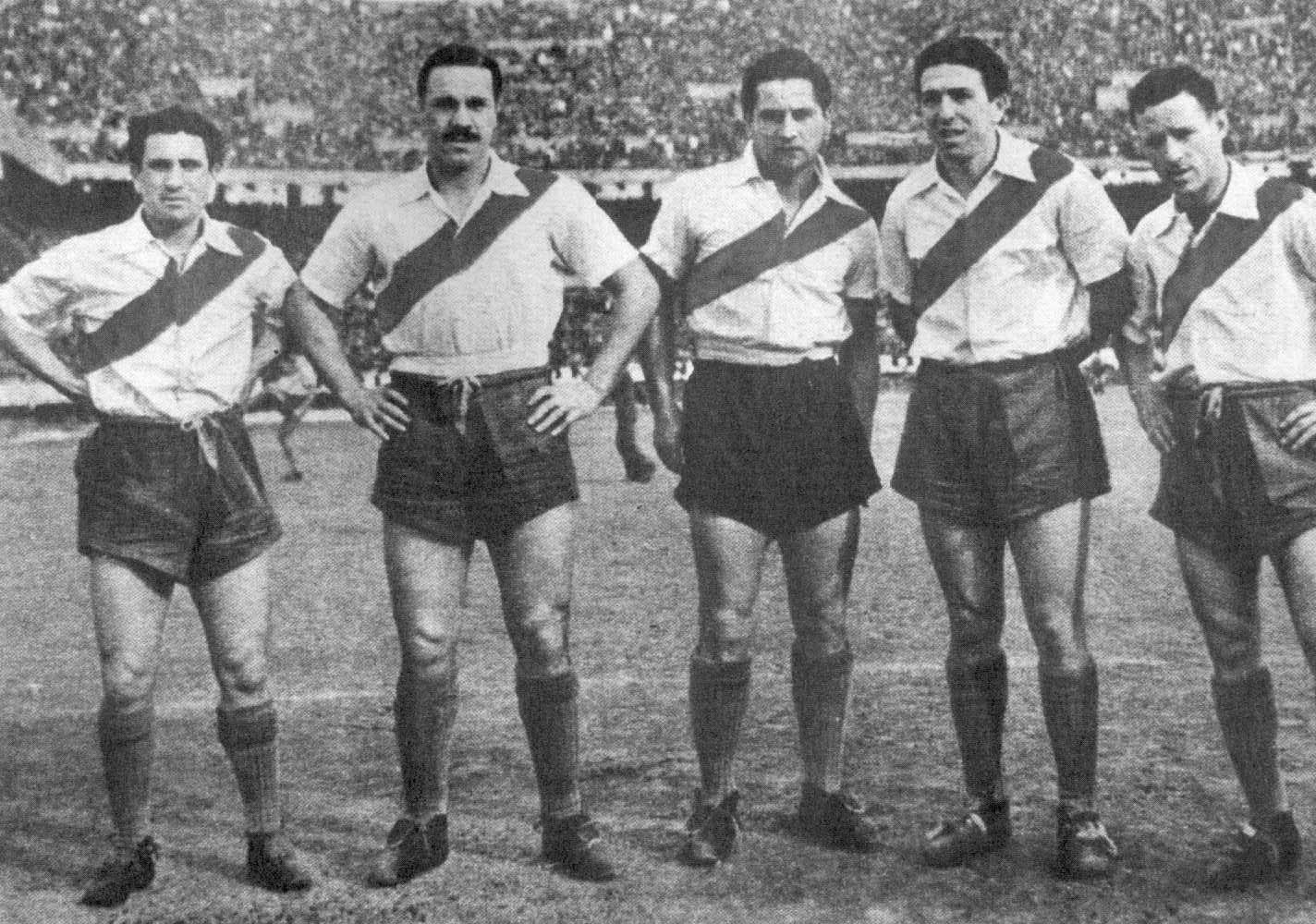
River’s five seemed to function like a machine and for this reason remained in history with the nickname La Máquina, which was given to it — who else? — by Borocotó, after River’s emphatic victory over Chacarita Juniors, 6-2, on 12 June 1942. From 1944 River’s technical leadership had been taken over by the scorer of the Montevideo World Cup final Carlos Peucelle, who continued Cesarini’s work. In 1946, when Pedernera left River to transfer to Atlanta of Buenos Aires, his place was taken by a promising 19-year-old forward, son of Italian immigrants and born in the neighbourhood of Barracas, named Alfredo di Stefano.
River’s achievements did not remain, however, at club level. The tactical evolution of Argentine football was faster than that of the surrounding countries, with the result that in the years between 1941 and 1947 it won 4 of the 5 Campeonatos Sudamericanos, losing only by a thread the 1942 tournament in Montevideo, after being defeated 1-0 in the last match by the host and winner of that tournament, Uruguay.
Argentina once again had reasons to believe that its football was the best in the world. The so-called La Nuestra was being developed by coaches born in Argentina who assimilated footballing thought as it evolved globally, and the results in South America, at international level, were the best in its History up to that point. The great goal was the organization of the 1942 World Cup on its soil. Having omitted to participate in the 1938 tournament, under the weight also of the political conflict that determined the results on European soil, it awaited a World Cup on the free and peaceful continent in order to unfold the characteristics of its evolved, beautiful, spectacular, resourceful and extremely effective football. However, the 1942 World Cup never took place, since Europe and the rest of the world in general had entered the destructive process of the Second World War, a war that cost a generation in every society that in one way or another participated in it, with the sacrifice of the Soviet Union naturally foremost.
The political developments within the borders, however, would never allow Argentina to secure this superiority. In 1943 the Década Infame ended with yet another military coup. The military men Arturo Rawson, Pedro Pablo Ramírez and Edelmiro Julián Farrell successively assumed the position of Head of State, without elections being held. From 1944, however, until 10 October 1945, Farrell had appointed as vice-president of his Government an army officer who had studied in Turin, studied military tactics in Italy, and developed certain particular political positions that favoured the choice of social-democratic policies instead of the neoliberal or fascist conception. Colonel Juan Domingo Perón, after Argentina’s declaration of war against the Axis powers in March 1945 (!), was removed from the position of vice-president, as someone associated with fascist Italy, and took over the Ministry of Labour, establishing for the first time a system of universal social security in Argentina, institutionalizing the role of trade unions in collective bargaining and introducing a series of benefits for union members. His gradual distancing from the political line of the leadership led to his resignation and finally to his arrest and imprisonment on 17 October 1945. But by then it was already too late for his enemies within the political system. Perón, with his populist rhetoric as vehicle, his policy of granting small concessions to the working class, the support of the trade unions and the dazzling presence of his future wife, Eva Duarte, which gave his presence the necessary aura of a star, was already a popular hero in Argentina. The woman known in History as Evita organized a great rally for his liberation. Five days later the couple would marry, completing a popular political fairy tale.
On 24 February 1946, Perón needed 189 electoral votes to be proclaimed President of Argentina. In the end he won 304, gathering 53.71% of the popular verdict against José Tamborini, the candidate of an alliance of parties with the participation of the Unión Cívica. His story would mark Argentina for decades; his political approach, Peronism, would become an autonomously defined political ideology, with specific applications in specific conditions, and overall would be the counterweight to the authoritarian military dictatorial regimes, leaving its ideological imprint down to our days on Argentina’s political formations.
As regards football, however, under Perón Argentina would be transformed from a country that wants to radiate abroad into a country that wants to radiate its image in its own mirror. This would lead to an isolation that was also based on other causes, such as the break with FIFA, which never gave the country the right to organize the long-desired World Cup. Instead, the World Confederation made sure to keep this footballing Pandora’s box for another country.
The national myth – The national tragedy
The country that was given the opportunity to build this national myth was Brazil. After the end of the Second World War, FIFA had one great priority: for the tradition that had begun to continue at all costs, for the World Cup to continue. For the organization of the 1942 World Cup, two countries had officially expressed interest, the Brazil of Vargas and Nazi Germany, while Argentina was also ready to submit its candidacy. Although the decade that followed changed the setting, in brief, even within the country of the Amazon, with British political pressures forcing Vargas to side with the Allies, forcing him to legalize the Communist Party, as a condition of the Soviet Union, and finally to be overthrown by another military coup, which marked the beginning of the end of the Estado Novo, in 1945. Nevertheless, in the elections that took place on 2 December 1945, the right-wing political formation of the Social Democratic Party, born out of the Estado Novo, with the military man Eurico Gaspar Dutra as candidate, took power. Dutra, in the new Cold War situation, made sure immediately to rupture relations with the Soviet Union, creating close relations of dependence with the United States, and within the same framework he once again outlawed the Communist Party.
As regards football, it continued to be a tool of political exploitation. Filho wrote that it had to remain a priority of the new political leadership, because “schools and hospitals are good, but the most important thing is the national legacy”. Given that for the World Cup that would be held 12 years after the previous one, Nazi Germany, or the German state that emerged, was not in a position to claim it, while Argentina lacked arguments, since it had boycotted the 1938 tournament, Brazil finally took on the responsibility it so ardently desired. The World Cup was a first-class opportunity to create a series of national monuments that reflected the Brazil of the era and of course had to be linked with a great victory that would complete the narrative.
The first great modernist stadium built in Brazil was the Estádio do Pacaembu, in São Paulo. Its construction works began in 1936 and were completed at the end of 1940. Pacaembu was the epitome of the architectural style of the Estado Novo and resembles a faithful transfer of the technique of fascist Italy. From its opening it was the central stadium of the country, hosting the great matches of the national team, and it also became the home of the popular and people-born Corinthians. The inscription at its entrance has the same typeface one encounters on Italian buildings of the era, while its oval shape, the concrete from which it is entirely built, as well as the columns that stand around its perimeter, are clear references to the kind of Brazilian modernism that represented brasilidade.
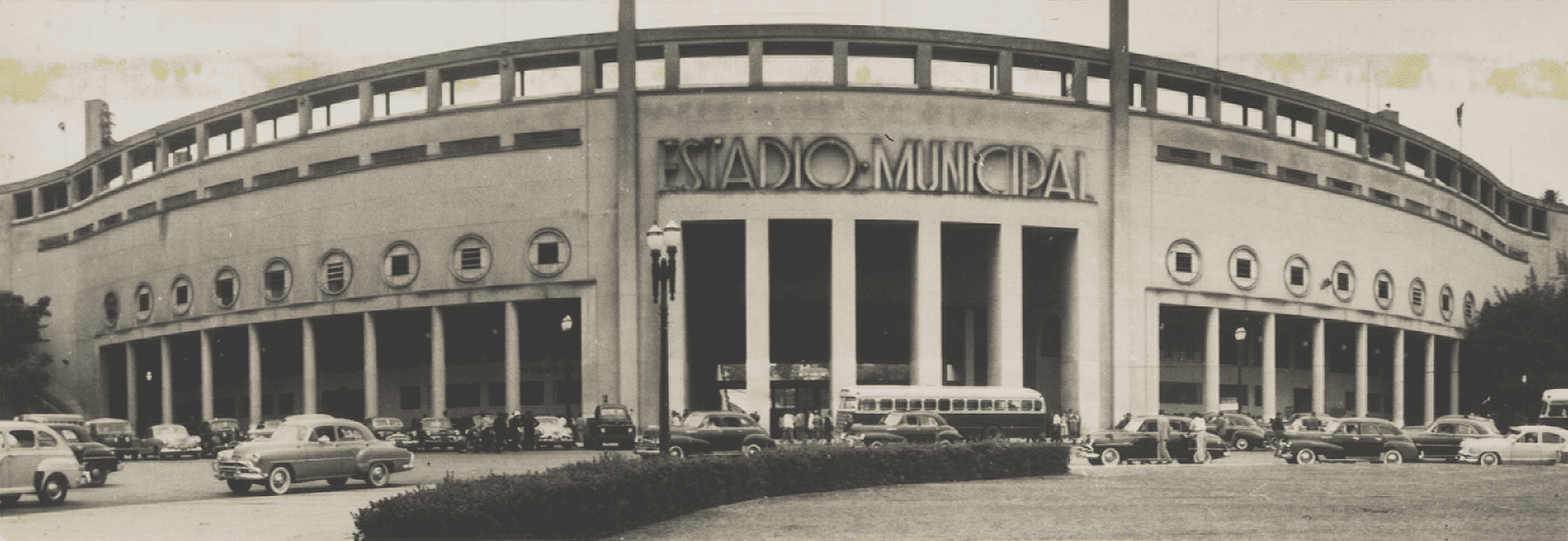
Pacaembu was by far the largest stadium of the Campeonato Sudamericano that was organized in Brazil, with the participation of 8 teams, in 1949. 27 years after the success of 1922, the tournament returned to Brazil and the organizers wanted to show that no one else could beat them in their home. They had reasons to believe it, since the national team, under the instructions of Flavio Costa, the translator who sabotaged Kürschner’s work, had instilled into its approach the modern elements of the Central European game, following the line of footballing excellence as this was expressed globally.
The opening match at São Januário, Vasco’s home, was emphatic, with the organizers beating Ecuador 9-1 on 3 April, while a week later, in the enormous Pacaembu, Bolivia suffered a crushing defeat by the Seleção with a score of 10-1. The victories continued, with more usual scores, 2-1 against Chile, 5-0 against Colombia, 7-1 against Peru, 5-1 against Uruguay, but the team that put a brake on Brazil’s perception that there was no opponent on its level was Paraguay, in the last match of 8 May. Tesourinha opened the score in the 33rd minute, but Avalos and Benítez turned the score around in the second half and the celebration being prepared at São Januário never took place. The two teams were level on points, since Paraguay had lost 2-1 to Uruguay, and the title would be decided in a play-off match. On 11 May, Brazil was merciless. In front of 55,000 spectators who flooded São Januário, it crushed Paraguay 7-0 to seal the belief that one year later the great celebration everyone was waiting for would happen.
Argentina, faithful to the doctrine of isolationism and the proud admiration of its national idol, and also maintaining a stance of disapproval at the fact that Brazil had been given the right to organize the World Cup, did not participate in that Sudamericano, while it would not participate the following year in the World Cup either. And if the Argentines took the position of spectator in this historical development for South American and world football as a whole, the Brazilians, as central heroes of the tragedy, were building with excessive pride the scenery in which the greatest footballing drama in History would unfold.
On the banks of the Maracanã river, which crosses the city of Rio de Janeiro and gave its name to an area too, the construction site for the Brazilian footballing Parthenon was being prepared. The great supporter of the project was, who else, Mário Filho, after whom the stadium was named about 20 years later, after his death. In the same line was his brother, the writer Nelson Rodriguez. The construction of the stadium, which resembled Pacaembu but with all its dimensions extremely larger, reflected the same modernist elements and began in 1948, with the aim that the great footballing temple, which would hold more than 200,000 spectators, would be ready for the long-awaited World Cup.
The World Cup would begin on 24 June 1950 and, unlike Centenario, Maracanã was ready before the start. On 13 June the inauguration took place with the match between two representative teams of Rio de Janeiro and São Paulo, which the hosts won 3-1. Everything was ready for the great tournament in which initially 16 teams were scheduled to participate, divided into 4 groups, with the first of each group qualifying for the final phase, where from the matches of the unified group that would be formed the world champion would be proclaimed. It was, that is, the first and only World Cup in History that did not have one match as the final of the tournament.
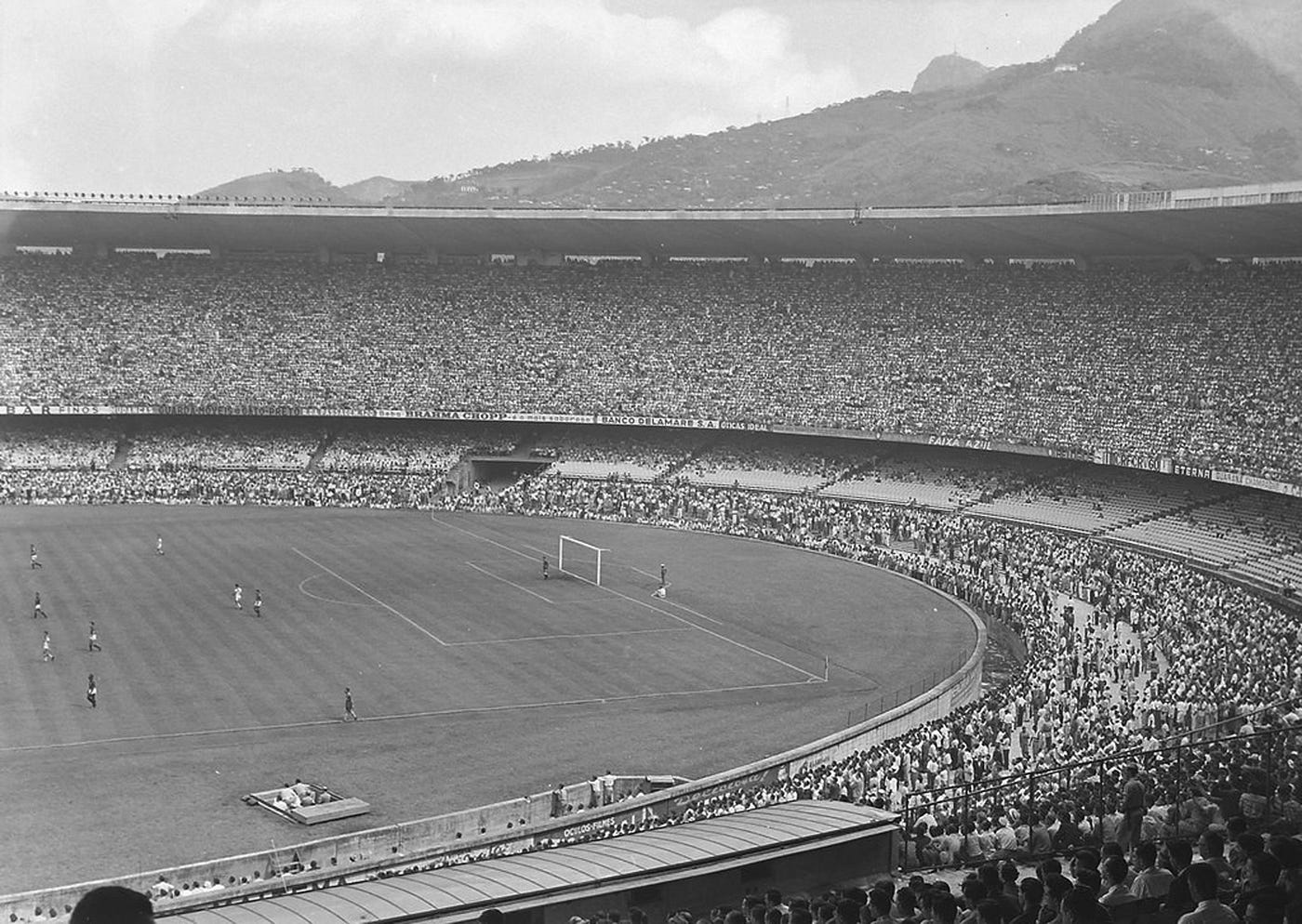
However, the first team to withdraw from the tournament was Scotland, which had declared that it would participate only as winner of the Home Championship. Having lost the tournament to England — and as England was participating in it for the first time — it withdrew its participation. For financial reasons Turkey also withdrew, with FIFA inviting three of the eliminated teams, France, Portugal and Ireland, to replace Turkey and Scotland. In the end, only France accepted the invitation and the World Cup would be held with 15 teams. However, after the group draw, India also withdrew, due to increased cost, while France also withdrew its initial agreement to participate, also for financial reasons.
This meant that the second World Cup organized in South America was once again held with the presence of 13 teams, while, given that the group draw had been made before the withdrawal of the last two, the groups displayed imbalance, with two groups of four teams, one of three and one with only two teams.
In the first group Brazil opened the tournament emphatically against Mexico, in a match for which 80,000 tickets were cut at Maracanã and the score ended 4-0. In the second match, however, the Seleção failed to beat Switzerland, which had in fact been defeated by Yugoslavia in the opening match. The furious Brazilians, confusing the names of the countries that resemble each other in the Portuguese language, attacked the Embassy of Sweden with stones. Thus, the last match, against the Yugoslavs, was life and death. 142,429 people gathered at Maracanã to help their national team avoid humiliating elimination and its footballers rewarded them, as Ademir and Zizinho scored the golden goals that gave Brazil the ticket to the next phase.
In the second group, England was the team that suffered the great disaster. The English, who believed that no other team in the world could beat them in an official match, had a terrible realization when they lost first to the United States and then to Spain, to be eliminated from the rest of the competition. Spain, with three victories, took qualification. In the third group Sweden managed to beat title-holder Italy and draw with Paraguay, a result sufficient to give it qualification, while from the fourth group, of two teams, Uruguay qualified by beating Bolivia 8-0.
The final phase was dithyrambic for Brazil, which crushed Sweden 7-1, its opponent in the 1938 Third-Place Match, and Spain 6-1, which had come from an unexpected victory against the English. By contrast, Uruguay failed to beat the Spanish, with their encounter ending in a 2-2 draw, while it beat Sweden with great difficulty, 3-2, overturning the score thanks to two goals scored by Miguez in the 77th and 85th minutes.
On 16 July 1950, the last match of the tournament would be played, between Brazil and Uruguay. The Seleção needed even the single point of the draw to be proclaimed World Champion and everyone was waiting for the coronation. More than 200,000 people, despite the 173,850 tickets that were officially cut, filled the newly built stadium of Rio. The Uruguayans, contrary to every notion of the fighting spirit of garra charrúa, had as their aim simply not to be humiliated, according to testimonies of the very footballers who played in that crucial match. Even the Montevideo newspaper El País hosted a column that foretold defeat, saying that Uruguay’s players lacked training and were fat and heavy.
The moment had come for an entire mythology to find its crowning in a great victory. The press was already celebrating the title, with the São Paulo newspaper Gazeta Esportiva and Rio’s O Mundo publishing front pages that prematurely announced victory. A carnival parade was organized in Rio de Janeiro and politicians visited the footballers, delivering fiery speeches within the framework of the broader mythological narrative that accompanied the event.
Only a few football connoisseurs saw things differently. Among them the São Paulo FC official, Paulo Machado de Carvalho, who was trying to convince the federal coach Flávio Costa to remove the politicians who might distract the footballers, and Imre Hirschl, who as coach of Peñarol had constant communication with Uruguay’s captain, Obdulio Varela, and said that Brazil could not go very far. These voices, however, were lost within the general climate that had already proclaimed the winner. 22 gold medals with the names of the Brazilian footballers had already been made and before the game the Mayor of Rio, Ângelo Mendes de Moraes, presented them to the Seleção players saying: “You, players, who in less than a few hours will be hailed as champions by millions of compatriots! You, who have no rival in the entire hemisphere! You, who will outstrip every other competitor! You, whom I already salute as victors!”. Meanwhile, the victory song “Brasil Os Vencedores”, that is, Brazil the Winners, was composed in order to be played, paradoxically, after the end of the final.
The match, however, was not as easy as the Brazilians expected. The Uruguayans defended stoutly, having closed themselves in their penalty area, with every clearance, however, finding some Seleção player and ending in a new Brazilian attack. Chances were missed, but the goal did not come, the goal that would mean the beginning of the celebration. The first half ended with a goalless draw, yet its nature did not correspond to the score. Just two minutes after the start of the second half, the São Paulo forward Friaça managed with a low shot to open the score — Maracanã was in flames and it seemed that the floodgates of goals would open too, those whose flow some magical power had blocked in the first half. The same was felt by Uruguay’s captain, Obdulio Varela, who complained intensely to the match referee, the Englishman George Reader, in order to break the rhythm the Brazilians could acquire.
But the setting of the first half was repeated, with Uruguay slowly finding the strength to counterattack. The Celeste gradually took control of the game and in the 66th minute Juan Alberto Schiaffino equalized. Silence covered Maracanã, not intense, but there was already doubt, even if the draw was a score that gave the title to Brazil. The 270,000 tragic heroes had begun to perceive the possibilities of the material world, which could conceal a dreadful conclusion to their dream. The interpretation of this staging would be undertaken by Alcides Ghiggia, winger of Peñarol, who in the 79th minute made a movement from the flank, showed that he was preparing to cross, sent goalkeeper Moacir Barbosa to the centre of the goal and finally shot into his near corner. Silence in Maracanã, that silence that sounds more deafening than any noise. In the 11 minutes that remained nothing changed; the Brazilians perhaps did not have the reserves to return from hell. In a pandemonium after Reader’s final whistle, the scenes were chaotic. There was no proper award ceremony; instead, in the chaos, Jules Rimet saw Obdulio Varela somewhere and handed him the Cup that bore his name. It is inaccurate whether there were two suicides reported by various sources. The tragedy, however, had been completed, an entire mythology collapsing inside the temple it built to glorify its greatness, but which became synonymous with its destruction. The Maracanaço has remained in History as the greatest footballing drama, a corresponding Waterloo, or a Hiroshima, as Nelson Rodriguez himself called it, for Brazil.
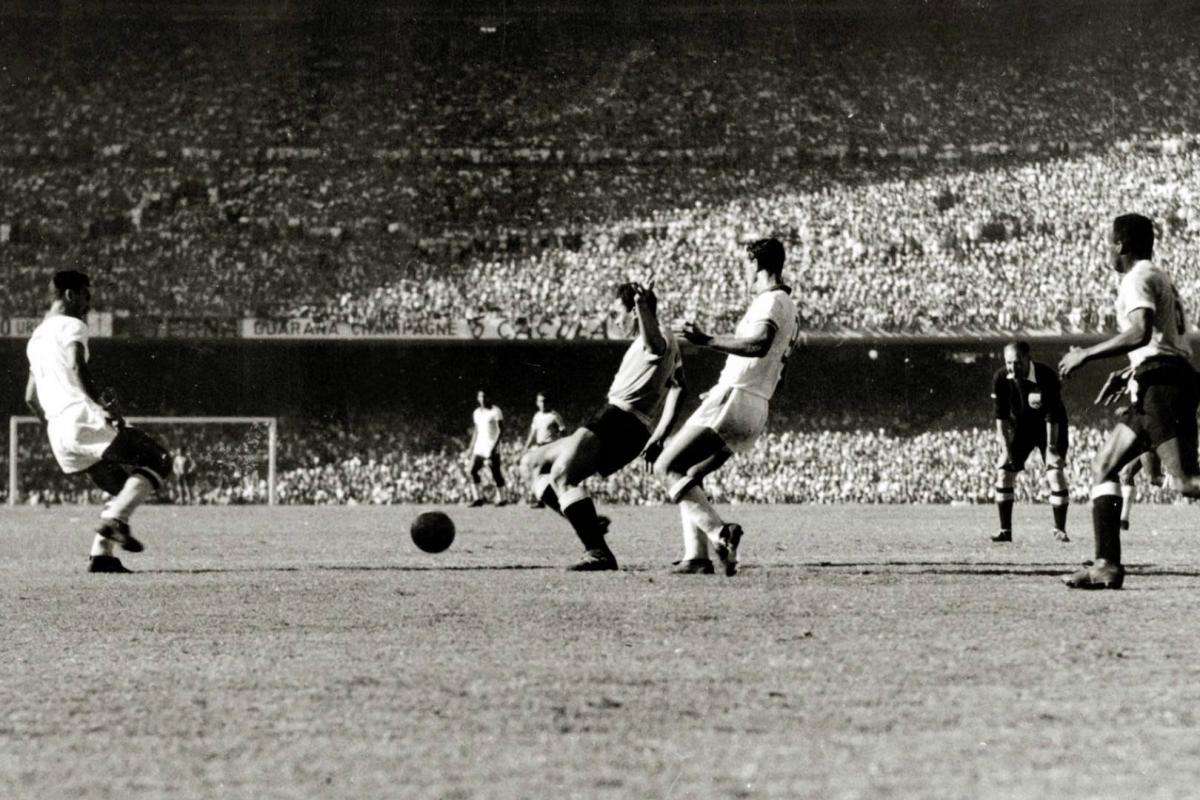
The anger of the Brazilians was concentrated on the scapegoat, the otherwise excellent Brazilian goalkeeper Moacir Barbosa, who played for Vasco da Gama and continued his career until 1962. He was, however, the face of the national tragedy; perhaps his Black skin could reveal the emptiness of mestiçagem, of brasilidade, of the nationally glorified malandro, so that he himself said that a woman, meeting him in the street, pointed him out to her child saying “this man made all of Brazil unhappy”. Barbosa, who lived until 2000, later stated that “the greatest prison sentence that exists in the country, life imprisonment, is 20 years; however, my own sentence never ended”.
In 1950 at Maracanã, Brazil’s dream was not the only thing extinguished. The winners, themselves part of a tragedy, could hardly realize that this was the swan song of a national team that contributed decisively to the modernization of World Football, to the degree that FIFA itself today allows it to remember this era, of the two Olympics and the two World Cups, by placing 4 stars on its shirt. As for Argentina, the myth of La Nuestra would find its own historical end when the albiceleste too would decide to come out again onto the global stage to measure the superiority of its own footballing conception. The only historical winner, in the end, was Brazil, which left behind the myths of another era and built a footballing structure based on real organization that begins in the favelas and reaches the greatest stadiums in the world — and the results would not be long in coming, even if few believed it that afternoon of 16 July 1950, among them a ten-year-old boy who worked as a waiter serving tea in São Paulo, Edson Arantes do Nascimento, who would remain in History as Pelé.
La nuestra, garra charrúa, futebol arte
The course of football in South America, up to 1950, has enormous importance because it shows all the characteristics of the sport’s global expansion. The way the British penetrated the formation of the new states, the constitution of the nations that would carry the national footballing approach and the distinct style of their football school, the transfer of the sport by the English, its appropriation by the locals, the development of regional football networks, the ideologicalization of footballing events and accompanying phenomena, the appearance of the identity of club supporters, the social reach of the clubs, the results of the exchange of footballing know-how with other football cultures, the passage into a new quality through professionalism, the strengthening of FIFA as a global institution that exceeds sporting limits.
The ground for all the above to happen was extremely fertile in the countries that had cultural kinship with the Europe that gave birth to the sport, had reasons to escape the British framework as regards the development of phenomena that took root in bourgeois social life, where there was a relatively great freedom in the development of the national narrative, which gave ample space to the mythology that always needs to accompany football, while they were located at a geographical point that, from the moment of the landing of the European conquerors, was “condemned” to communicate with the rest of the world. The football that began as an activity of maniacs became a reason for existence for the masses, was instrumentalized by political powers, managed to reflect people’s lives, while even intellectuals bent over it to explain it, to interpret it and even to distort it, serving the interests of the elites.
This football, which was born and evolved in its own unique and deeply ideologically charged way in the countries of South America, still moves people all over the planet today with its particular characteristics, people who seek in the beloved sport the reflection of society, who admire the dribble, the dexterity, the need for a different aesthetic approach to a competitive game, one that can give birth to heroes like those of fairy tales. The fairy tale of adults is football and some of its best heroes were children who resembled the pibe, the charrúa, the malandro.
To all of them, football owes its sweetest and most romantic side — because whatever the elites did, in the barrios and the favelas no one was able to stop the people from playing football.
