
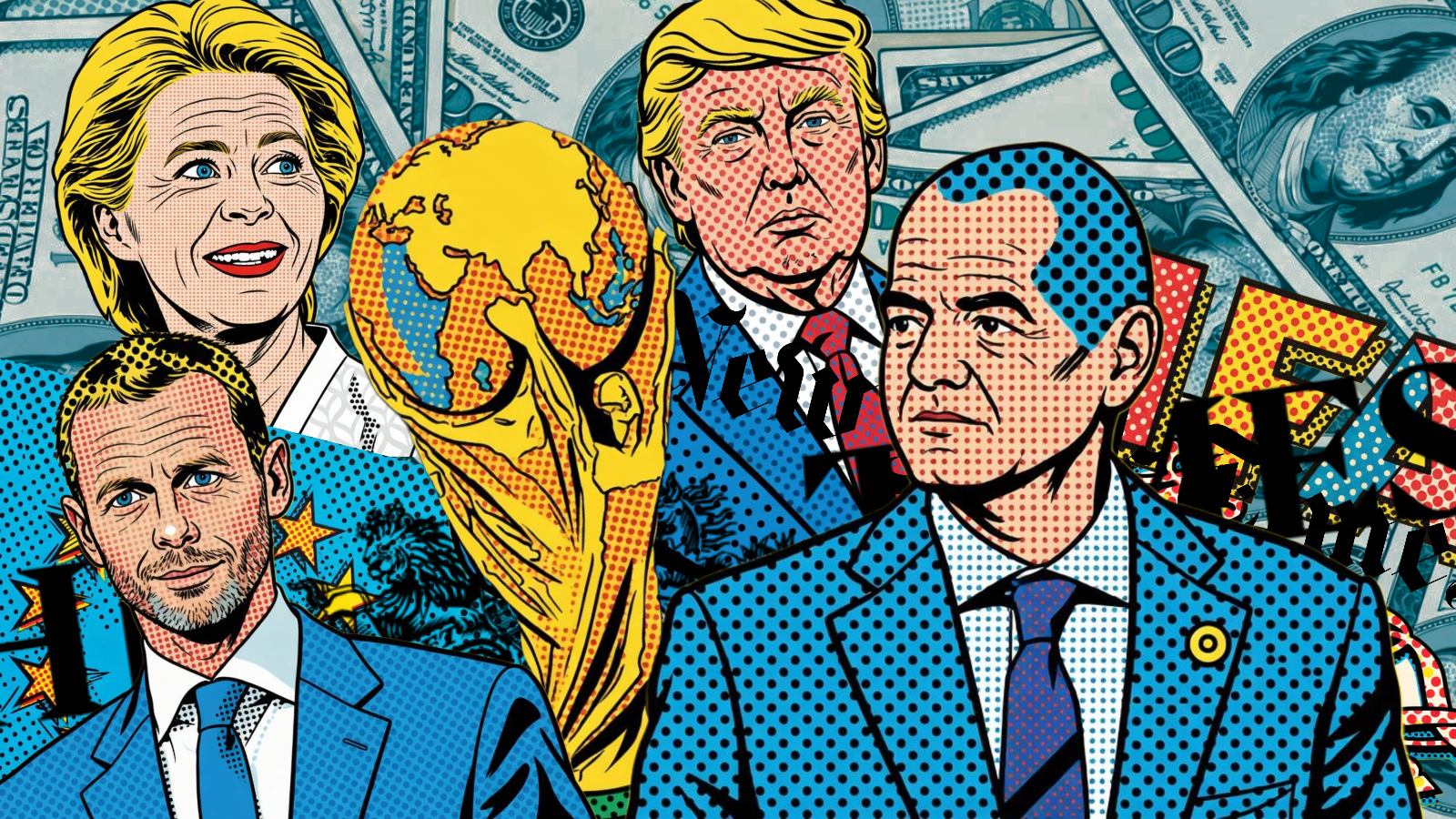
The phrase “rerum novarum” could be translated from the Latin as “on new things” and, given the state into which world football has descended, it is perhaps the most fitting title for an attempt to analyse it. It is not, however, an original title where football is concerned. The document known as “Rerum Novarum” was the papal encyclical of Pope Leo XIII, through which the Catholic Church sought to shape the life of the working class within a framework that would incorporate it into capitalist power. It would be wholly unrelated to football were this ideology not also the worldview of a French lawyer, Jules Rimet, who, imbued with these ideas, took over the FIFA presidency and worked to create the World Cup. In this sense, FIFA, the World Cup, all the major football confederations and the major football competitions were never romantic, innocent expressions of a multinational football gathering. They were always instruments aligned with the political needs of their age and attuned to the political outlooks and interests of those who conceived them. Seen in this light, and without any illusions about a change in the character of the sport and its competitions, it is necessary a) to place current events in their true historical context; b) within that same context, to explain the actions and stance of each actor, as well as the nature of the conflicts between them; and c) to propose the position that should be taken by all those who are in practice excluded from this discussion: the supporters, the fans—in a word, the peoples who have always loved football and still do.
Because all this requires a relatively extensive analysis, while the conclusions usually drawn from reading a text are sometimes hasty, we must, before they are even reached, foreshadow the answer to the central question: is the flotation of FIFA’s competitions a positive development for the football we want? The answer is “NO”. With that made clear, there is value in going beyond the surface and examining the issue more deeply, because only then can there be any hope of a football different from the one we have today, at club, local, regional, national, international and global level.
Developments
One powerful tool commonly available to those in power—the ruling class at every level—is the preparation of changes through a seemingly complex system of innovations that runs counter to the interests of the masses, while anyone wishing to oppose it tries to find the right slogans with which to rally those masses. The problem with slogans, however, is that while they have the power to build mass support for a position, or opposition to one, they often take the place of analysis: the true ideological depth required to confront an action by those in power. This weakens the argument and ultimately helps make the innovation imposed from above look carefully planned, while any reaction to those plans appears to be a spontaneous, spasmodic movement rooted in ignorance.
Because we genuinely care about football, we cannot fall into that trap. We need to know the full case made by the dominant power for the changes it wants to introduce—in this instance, FIFA—but we must also be able to place those changes in their proper historical context. Moreover, we must analyse in the same way the positions of other bodies and actors that appear to support our interests, but are in fact merely using the rhetoric described above because, at this particular moment, the changes happen not to serve their own interests. Put simply, we need to know who our friends are, who our enemies are—and why.
And if there is one thing that the way public debate is conducted today does not allow us to discern—through telegraphic statements of a few dozen words and articles of no more than a few hundred, as powerful outlets seek not to deepen the discussion but to amplify their voice by reproducing their slogans—it is the actual facts. Even the simplest piece of information, available at our fingertips and concerning events that took place a few months ago, or even weeks or days ago, seems to disappear into the depths of historical oblivion whenever a conflict of this kind erupts. Here, however, we need to set out those facts.
In April 2026, at the FIFA Congress held in Vancouver, Gianni Infantino spoke of the need to “unleash” FIFA’s commercial power. Without providing further information about these plans, FIFA presents that reference as the starting point of its new drive to commercially exploit, and therefore commercially diversify, the global game. The same position, in the same general terms, was presented again in New York on 18 July, one day before the World Cup final. Yet once again, the way this was done appears consistent with the way all so-called public consultations are conducted today: representatives and officials gather in one place, the person in the position of power presents a plan, and no discussion follows through any institutionalised process—only a show. We now talk about congresses, but what we are really referring to are joint presentations, theatrical re-enactments of dialogue that contain only the outcomes of consultations held in unknown places, with lobbying having replaced institutional dialogue at every level.
This is a point worth dwelling on in order to assess the stance of those actors currently opposing FIFA’s plan. Has UEFA, or any other confederation, ever objected to the way decisions are taken at the so-called “FIFA Congresses”? Does UEFA operate any differently, or the other continental confederations, the national associations and every organisation that administers football? When was the last time we witnessed a genuine clash—in the form of a dialogue—between two different lines and visions for the future of football in a country, on a continent or across the entire world? All discussions take place without even allowing the rest of us to be spectators, in places we know nothing about and which are, of course, never announced. In this sense, the entire football edifice across the world currently operates like a vast multinational whose board of directors and every one of its bodies meet outside any publicly instituted process in order to decide their strategy, treating the sport’s billions of supporters as customers with a passion for its product.
The unfortunate thing is that, for anyone who follows football even superficially, this observation is no shocking revelation. Yet we sometimes appear to gloss over this nature of football officialdom in our discussions: the fact that it is widely accepted does not diminish its contribution to developments. In this particular case, indeed, and contrary to what many of us may imagine—or wish to imagine—to be the positions of each opposing side, this truth lies at the heart of the conflict.
The moment the supposed bombshell landed, shaking the foundations of the global football edifice, came with the publication of an article by the Times of London setting out in greater detail the FIFA plan that had previously been described only in broad terms. The article was published at midday on Tuesday, 28 July 2026: exactly ten days after the meeting in New York held around the World Cup final, and less than ten days after the conclusion of the 23rd edition of the global tournament. According to the Times article, the plan included:
- the creation of a corporate structure that would control FIFA’s competitions, namely the men’s and women’s World Cups, as well as the Club World Cup
- the flotation and market offering of an overall 20%–30% stake, which private investors would be able to buy
- the participation of the national associations as shareholders in this structure
- an overall equity valuation of $20 billion
- the involvement of Joshua Kushner’s firm Thrive, which appeared to be one of the prospective investors
- the involvement of J.P. Morgan as financial adviser to the venture
Later that same day, the sports news outlet The Athletic, which belongs to the New York Times group, published an analysis by Matt Slater describing the sale of a stake of up to 21% in the corporate structure, named FFE (FIFA Forward Enterprise), as well as a series of changes to the format of FIFA’s competitions. These included more matches, larger or more frequent tournaments, more expensive tickets and hospitality packages, tournaments staged in markets that generate higher commercial returns, and greater exploitation of data, content and sponsorship rights by the shareholders in the new structure.
That same day, FIFA confirmed all the information above in an official statement, thus closing the discussion over any doubts about the validity of the reports and opening the much larger debate about the future of football’s major competitions and, by extension, the future of football itself at global level.
One reasonable question that arises, even if it does not appear crucial at this particular moment, is whether the two outlets—the Times of London and the New York Times—published this information in coordination with FIFA or contrary to its timetable. The answer, which obviously cannot be given, is highly significant, because knowing it could explain another aspect of the political conflict that is also being expressed through football. On the one hand, the New York Times is an organ of the liberal wing of United States politics—that is, the Democratic Party—which domestically represents interests different from those of President Trump and his extended family, including Joshua Kushner, as well as his political allies, among whom Infantino is currently numbered. On the other, the Times of London is the traditional newspaper of the British bourgeoisie, which, at this juncture marked by a series of conflicts within the so-called Western North Atlantic bloc, represents interests different from those served by the present US administration. If these reports were intended to disrupt FIFA’s timetable and therefore its communications strategy, the outcome suggests that, to some degree, they achieved their aim. On the other hand, it cannot be ruled out that FIFA itself wanted structural changes of this kind to be “leaked” by news outlets and then confirmed, as indeed happened, rather than unveiled in a sudden announcement of its own. The appropriate outlets in such a case would obviously be those that are not fully aligned with the political and economic interests with which Infantino has openly allied himself.
The reports and FIFA’s confirmation were followed by statements from other bodies, the most important of them from UEFA. Commenting on the Times of London report, UEFA said it had been wholly unaware of the plan and expressed its opposition to it. In particular, UEFA’s statement said: “None of us are the owners of football. It is not FIFA’s to sell.” (“None of us are the owners of football. It is not FIFA’s to sell.”) Yet the significance of these developments far beyond the narrow football context is evident from the fact that the United Kingdom’s prime minister, Andy Burnham, himself made comments along the same lines. In the Judiciary Committee of the US House of Representatives, Democrats were sharply critical of Infantino’s relationship with the Trump administration and of Joshua Kushner’s involvement in all the manoeuvres that had been revealed, perhaps also indicating, to some extent, the political line advanced by The Athletic’s New York Times article in relation to the question posed earlier.
The following day, 29 July, FIFA took another step towards implementing the plan. In a letter sent to the 211 national associations, it invited them to respond by a deadline of 19 September as to whether or not they accepted the plan. According to the FIFA letter, which came into the possession of the Times of London and the Reuters news agency, approval requires a positive response from more than 50% of the national associations; the overall development package could exceed $10 billion; if the plan is approved, the already scheduled, much smaller $2.7 billion increase in FFE’s share capital will proceed; and a one-off sum of $20 million was available to every association that chose to participate in the new shareholding structure.
A number of national associations, such as England’s Football Association and the Fédération Française de Football, as well as confederations such as the AFC (Asia) and CONCACAF (Central and North America), announced through statements and press releases that they had previously known absolutely nothing about the plan. CONMEBOL issued no corresponding statement. At political level, however, the European Commissioner for Sport, Malta’s Glenn Micallef, said on social media that football “is not baseball”, launching an attack on the apparent “commercialisation” of the World Cup.
In a second statement, UEFA said that it had learned of the letter’s existence from the national associations, adding that this told us everything we needed to know about the aims of FIFA’s plan. It expressed its belief, based on discussions with the parties involved, that there was significant and growing opposition to the structure, before attacking FIFA’s leadership and accusing it of using the sport to enrich its officials and their friends. The deposed former FIFA president Sepp Blatter took the same line, telling Reuters that football does not belong to individuals but to the people.
On the evening of 29 July, Infantino said in a recorded message that the plan presented was not an obligation but a proposal and an opportunity, describing the events of those days as the starting point of a democratic consultation process. The fact that he was able to use the leaks in this way, effectively speaking out against the backroom consultations concerning world football, shows that the entire process did not necessarily unfold against the wishes and planning of FIFA and Infantino himself. UEFA delivered its own resounding response to that message less than 24 hours later, declaring that it had unanimously decided that none of its members would participate in FIFA competitions until the process relating to the plan was withdrawn in its entirety.
What FIFA’s plan represents
However self-evident the need to intensify the sport’s commercialisation may appear in order to serve its political instrumentalisation, it is equally necessary to examine the particular way this is happening today, under present historical conditions and amid international imperialist rivalries. It is widely accepted that, from its foundation—with the codification that took place at London’s Freemasons’ Tavern in 1863—football served as a political tool in the hands of whoever needed to direct and incorporate the working class. The fact that this was the game loved by the masses, initially in the Britain of the Industrial Revolution and then throughout the world, was the reason it was instrumentalised, not the other way round. In other words, the growth of football into a mass social phenomenon was not historically the result of its instrumentalisation. Sometimes, however, it needs to be made to look as though the opposite is true!
If there is one country—even one belonging to Western capitalism—where football never occupied the centre of social life, never gave expression to society and never created collective identities, it is the United States. The stereotypically portrayed Yankees, the white, English-speaking population of the country that would become the locomotive of capitalism and Western imperialism in the mid-20th century, had organised their lives around sports in a completely different way, treating them as a pleasant break from the rhythms of industrialised life rather than as an element of identity and a personal passion. But the United States is not inhabited only by those stereotypical Yankees. In a country made up of a racial and ethnic mosaic, with distinct traditions and cultural outlooks passed down from generation to generation, football always had an audience in the United States. What had no audience was US football itself. Immigrants were connected to teams in their countries of origin: in New York there were Napoli supporters, in Texas Club América supporters and, much more recently, in a number of cities young Gen Z fans wear the shirts of Manchester City, Liverpool, Real Madrid, Barcelona and other European clubs. Thus, not only could the love of football in the United States not be instrumentalised directly by the local ruling power; it also was, and remains, a vehicle for cultural penetration by other countries.
Despite the ever-increasing investment of enormous amounts of capital in football in the United States, the attraction of stars—above all the greatest footballer of all time, Lionel Messi—the highly methodical organisation of Major League Soccer’s top division, the construction of infrastructure and the outreach to millions of the country’s residents and citizens who already loved football, the centre of football fans’ interest remained beyond the great superpower’s borders. In this way, although the sport is a highly successful commercial product in the US market, it has been unable to become a political instrument in the way it has in Europe and South America.
To move to the centre of social life in the United States, it must overtake the traditional American sports—gridiron football, baseball, ice hockey and basketball—both as an economic force and as a social phenomenon. Yet doing so requires a financial effort many times greater even than the considerable economic scale of North America’s traditional sports. Finding that money requires a structural change in football and in its very economy, one incompatible with the way the game operates, at least in Europe.
On the Old Continent, football is not only a sport but also an arena for business activity that attracts exposure far beyond its economic scale. For example, the supermarket chain “TESCO”, relatively unknown outside Great Britain, reported revenues of £72.8 billion in February 2026, with annual net income of £1.7 billion. At the same time, Manchester City’s total revenue in the previous season was £694 million, with a net loss of £9.9 million. It is clear that, quite apart from their profits and losses, the scale of the two businesses differs by two orders of magnitude: the supermarket is 100 times larger than a football club with a global profile. To use another comparison, a superstore belonging to the supermarket chain could be said to have annual turnover on the same order of magnitude as a medium-sized Premier League club. Yet many more of us surely know the name of Brentford’s chairman and manager than the person in charge of the TESCO Superstore on Syon Lane in west London. And anyone wondering why the manager of a superstore is not paid as much as Brentford’s manager will have taken the first step towards understanding the concept of surplus value.
In Europe, football can give anyone involved in it far greater exposure at a far lower financial scale. That is why there are many cases of owners taking charge of teams that are not a source of profit for them, but a permanent financial drain that secures their political and social profile. This happens precisely because they do not need to bring football to centre stage in order to instrumentalise it: football is already a cultural element of these societies, and supporters are already connected to it, creating a corresponding personal identity through their bond with a club.
In the United States, this entire edifice must be created if the ruling political power there wants to instrumentalise football through its cultural characteristics in the same way as happens in Europe and South America. Yet the amounts of money that must be found to drive this process are far greater, and the prospect of losses on such a scale is prohibitive for potential investors: because of the size of the economy; because of the clash that will take place in the market, given that the aim is to displace other sports industries; and because capital is required to develop, in an inorganic way, a culture of bonds with clubs that are not traditional elements of society. For US investors, then, football must also become a profitable area of business in order to ensure the sustainability of what is ultimately a political enterprise.
Capital channelled into the football market cannot deliver the immediate return on investment required for this much larger financial structure to function if it is invested in domestic football activity in the United States. The political power seeking to instrumentalise the sport, and the economic interests looking to make the corresponding investment, must therefore find a powerful ally to set this process in motion in a larger, already developed market. It is hard to imagine that anyone believes there could be an institution better suited to that purpose than FIFA itself or, where football competitions are concerned, any event with a greater global profile than the World Cup. This is why US politics and US capital have won FIFA over, as reflected in the close relationship between President Trump and President Infantino that is constantly paraded in public; and this is why FIFA’s structure, which includes specific US companies and financial institutions, has put the World Cup in its commercial sights.
In this sense, this development can only be described as negative, because it instrumentalises the sport still further, on a path that is highly likely to affect even its aesthetic character—if not immediately, then certainly over time. But it must be equally clear that this is not the first time world football has seen a development in this direction. Beyond the Catholic Church’s Rerum Novarum and the development of football between the wars, which served the Catholic Church’s political agenda, the connection between private business interests and the World Cup itself emerged clearly in 1974, when Havelange granted exclusive sponsorship privileges to Adidas and Coca-Cola in order to replenish FIFA’s coffers, which he himself had first emptied for his political campaign. For more than half a century, these two multinationals have made fortunes from the defining event of the popular sport, and their presence there has today become almost a natural extension of its image.
Why, then, has the plan for football devised by Infantino, FIFA and, in effect, the United States met with an angry reaction from other confederations, chiefly UEFA, as well as from the European Union’s political institutions?
What the conflict represents
To understand why UEFA and the European political institutions reacted so strongly to the plan for a partial flotation of the World Cup, we must look beyond the slogans. The football confederation that has contributed more than any other in recent decades to the commercialisation of the sport and the application of free-market rules in every sphere of it—with the transformation of the European Cup into the Champions League and the legal precedent arising from Bosman’s dispute with RCF Liège as pivotal decisions, the latter liberalising transfers and helping drain football talent from every corner of the earth—is clearly not the one concerned about the so-called “poor man’s game stolen by the rich”.
UEFA’s problem, and that of the European interests it represents, is essentially written into its latest statement, and its opposition rests on two distinct parts. The first concerns the analysis of the United States’ need to turn football into a profitable business, since this is the only way it can be instrumentalised in its domestic market. UEFA’s statement reads verbatim: “The moment external investors acquire ownership interests in FIFA competitions, football changes forever. Commercial return becomes a permanent obligation. Investor expectations become a daily pressure. From that moment onwards, every decision on the international calendar, every decision on competition formats and every decision shaping the future of football is no longer driven by what best serves the game, but by what best serves shareholders.”
It is a little paradoxical for this to be written by a confederation that, together with the national associations and domestic leagues, has in recent decades created a calendar exceeding 80 matches for the major clubs, while smaller regional clubs seeking a place in these glittering competitions—which generate profits of around 5 billion a year—begin their competitive commitments in early July and complete them in late May. This passage contains UEFA’s truth, but it has nothing to do with the performance and health of footballers or with any aversion to commercial profit, which is already astronomical for all the companies that sponsor its competitions.
What Europe cannot withstand at this moment is football’s transformation into a profitable enterprise. Why? Because it does not have the capital to compete with the rest of the world, and especially the United States. Unprofitable football, an industry of fairly limited scale compared with other sectors, can sustain business losses in exchange for political gain. But expensive football—on a larger scale, involving larger sums of money and greater risk in the investment of much larger amounts of capital—is something Europe cannot keep up with. This means that UEFA and European football, which as a result of the way they have been managed in recent decades are not merely at the centre of the global game but close to becoming the sole representatives of its elite, with Argentina’s national team the only exception, risk suddenly encountering competition with which they certainly cannot keep pace. Imagine the talents of France, Spain, Italy, Germany and England leaving to play for US clubs, or their academies, before turning 18. What European football has effectively done to the game on other continents now risks being done to it by the United States if such a development takes place.
Beyond this, the loss of football as a central cultural asset would deprive Europe of yet another characteristic that assists it in international diplomacy. The fact that European football is a magnet for business interests, which in this way acquire a positive global profile, serves as soft power for EU policy in a world of fierce rivalries in which the European Union can no longer put forward its industry, its technological innovation, its capital or even its military strength. This, then, would be an overall weakening of Europe whose consequences concern not only football but also the Union’s political position in the world. This is why the European institutions have reacted with such fury and why, for some time, through the development of corresponding institutional frameworks in the European Parliament too, they have sought to safeguard this function of football before losing this precious asset as well. This is why there is fury at every FIFA decision concerning global football competitions, even those apparently of minor importance, such as expanding the World Cup from 48 to 64 teams, which does not add any matches for any participant. It is also why, after Spain’s victory in the recent World Cup final, the Commission felt the need to describe the trophy won by the European team as “Made in Europe”, as if anyone had ever doubted the birthplace of football and of the trophy itself.
UEFA’s words about the good of football are heard only when the confederation is losing the upper hand in the global balance of forces. No one cared about the good of world football when Brazilian, Argentine, Ivorian, Senegalese and other players arrived in Europe as teenagers to join its football system. In the eyes of the European institutions, no element of the poor man’s game is endangered when those players—and very nearly Messi himself—turn out for national teams far from their countries of birth. Football colonialism is fine for the European institutions as long as they have the upper hand in it; when the balance of forces changes, that is when they remember “the poor man’s game”.
The key point in this conflict between FIFA and UEFA, however, is that it is not a clash between commercialised football and pure football, but between the United States—and indeed its present administration—and the European Union. UEFA has one major lever of pressure: world football is unthinkable without its participation. Developments over the past 30 years have brought about this situation. Indeed, had Argentina not reached the semi-finals of the last World Cup, the final four would have looked like those of an entirely European competition, with three of the four teams also having been semi-finalists at EURO 2024. Cristiano Ronaldo’s final remarks after Portugal’s elimination from the recent World Cup and the end of his career with his national team were also along these lines.
In its ideological arsenal, Europe uses many arguments against shareholding and individual ownership in football precisely because it has found other ways to use the game as a political instrument. These could not work without the space for major economic interests to operate and for large amounts of capital to be invested in the various football projects concerning the fortunes of national teams, but above all those of the major clubs. What happened in the recent election for the Real Madrid presidency was nothing other than a major war between different business interests, in a process which, although providing for the universal participation of members, each casting one vote, was a very long way from any meaningful notion of the right to participate and contest the club’s leadership. At the same time as Germany boasts that no private individual can own more than 50% of the shares in a football club—with exceptions made possible by legal loopholes—the otherwise democratic Stuttgart, with its 100,000 members, was able to present itself as a powerful capitalist and move to snatch from privately owned PAOK the football jewel of an entire country, Giannis Konstantelias. Pressure on the owner of Thessaloniki’s football public limited company from supporters who own no shares in it prevented that development, showing that it is not always formal participation that determines the balance of forces, but material reality.
UEFA and its associations are interested only in preserving what they have already secured. That means a small group of clubs will win European competitions in perpetuity; several of the major national leagues will essentially be one-horse races (see France and Germany); while other illustrious championships, such as Spain’s La Liga, will have gone more than 20 years without seeing a champion from outside a trio of clubs that dominate at every level—political, organisational, administrative and competitive. The football UEFA has created over the past 30 years is not the football of the poor, and it is certainly not what UEFA is defending.
Why it matters to us
Given, then, that this conflict concerns the interests of different capitalist classes, major economic interests and their political representatives, why does it matter to football lovers? How can it matter to them?
For one thing, these developments matter to us because, in loving football itself, we know that such a structural change to its leading competitions, as well as placing their organisation in the hands of interests that operate in a manner different from what can now be considered the European tradition, will also change the game’s aesthetic character and its identity. In other words, they risk destroying and erasing the game we love. The implementation of changes such as the mandatory stoppages for the so-called “hydration breaks” at the last World Cup, for the sake of advertising, has already had a huge impact on the way a football match is organised and unfolds.
At the same time, there can be no illusions about football. The football that has now become the property of a small group of Western European countries cannot be the game we envision, and we cannot applaud the inequality that exists in the sport, even within Europe. That does not mean that an even more aggressive incursion by business is the solution—quite the opposite. It will create the same problems in the sport on a much greater scale and with far greater intensity, even if whoever dominates it changes sides and shores.
The third solution lies not in football’s past, but in its future. After all, an analysis of the sport’s history from its birth to its global spread and the modern age shows that it was never, ever disconnected from the interests of classes seeking to secure a larger share of political power. Nor was it ever detached from the economy and, given that the economy throughout the world at present is capitalist, football everywhere at present is capitalist too. In this sense, the solution lies neither in opposition to professional sport—which history has shown to be a condition for the working class’s participation in high-performance sport—nor in dismantling the superstructure that, among other things, generates relationships, identities, cultural bonds and genuine popular culture.
What we need is a different foundation on which to build football: in other words, a struggle for a different economy. The actions of the sport’s rulers themselves demonstrate the extent to which this is a necessary condition for its development. The political war—the alignment of economic interests with the strategy of the ruling class in each country—is expressed directly as a blueprint for the development of the sport worldwide, while the particular conflicts between them are expressed as football conflicts. The peoples who love football must understand that they can be neither shareholders nor ostensible supporters of this football development through supposedly democratic structures in which the same economic interests ultimately call the shots. We need a different kind of football power, and it is now blindingly obvious that this is connected to a different kind of political power. Until then, we will be left only with slogans and a few faded sepia photographs that we will call romantic, even if they depict eras in which football served as a symbol even for ideologies that led to the deaths of millions of people.
Our answer to the attack on football cannot be to retreat into defence. It requires a corresponding, organised counterattack. Football romanticism is no longer enough for us—we need our own authentic football modernism. Here, at any rate, that is what we are working for!
